PART 2: “YOU MEAN… SHE NEVER TOLD YOU?”
He had spent the entire drive imagining his new life.
A son and a daughter.
A beautiful woman who had supposedly given him everything his wife never could.
And nearly half the wealth he believed he had accumulated over twelve years of marriage.
He had no idea that, by the time he reached his parents’ front door, his bank accounts were already being reviewed by investigators, his company had begun securing its financial records, and the woman he had underestimated for twelve years had finally stopped protecting him.
His mother, Victoria, opened the door.
She looked unusually pale.
“Arthur, you’re early.”
“Big day, Mom.” He stepped inside and placed the champagne on the kitchen counter. “I thought we could celebrate.”
“Celebrate what?”
“My children.”
Victoria stared at him.
For a moment, something almost like fear crossed her face.
Then she whispered, “What children?”
Arthur laughed.
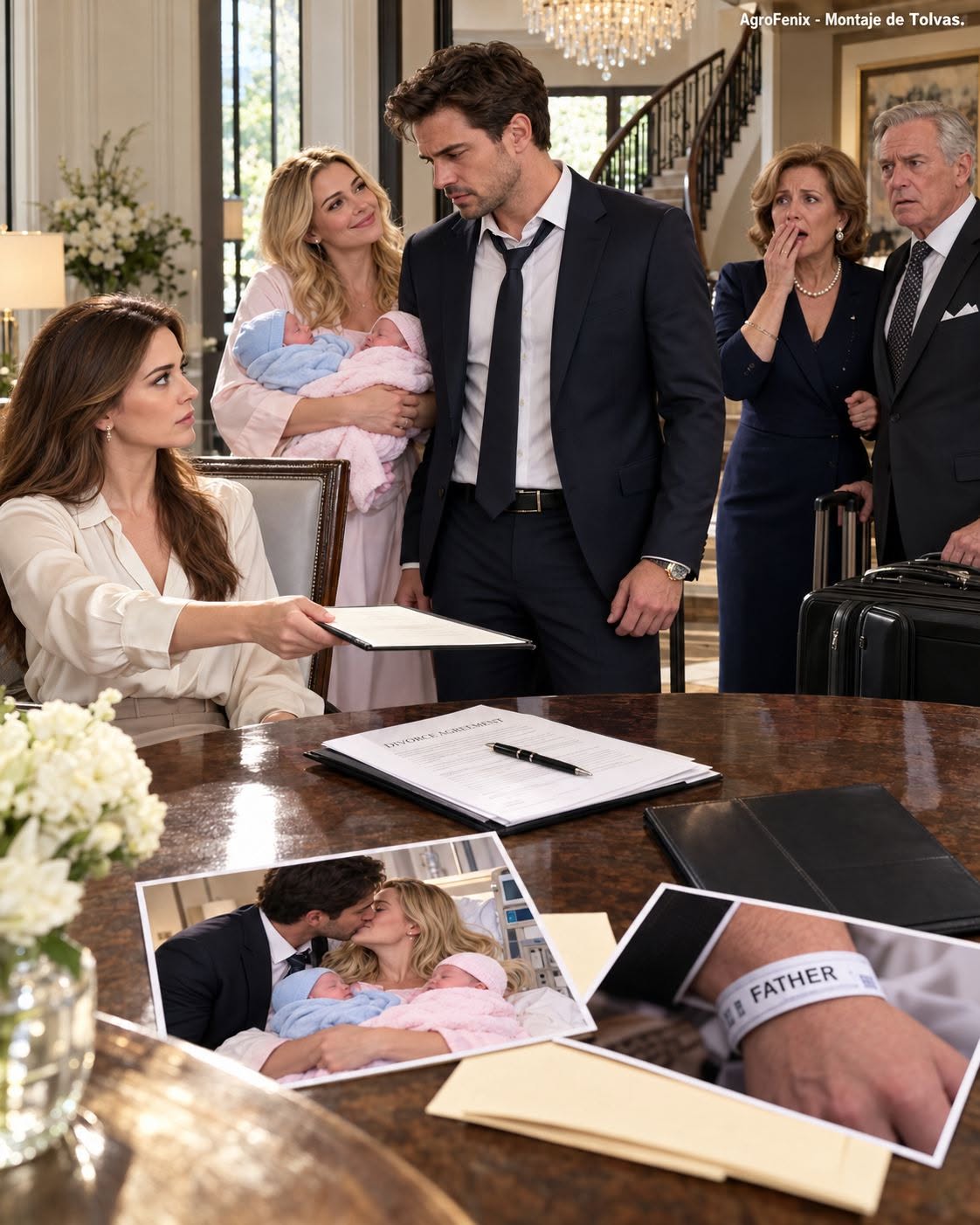
“Come on, Mom. Don’t tell me you haven’t seen the pictures. Brooke gave birth to twins yesterday. A boy and a girl.”
Victoria slowly lowered herself into a chair.
“Arthur, sit down.”
“Why?”
“Please.”
Something in her voice made him stop smiling.
He pulled out the chair opposite her.
Victoria folded her hands on the table, staring at her son as though she were seeing a stranger.
“Did you tell your wife?”
Arthur frowned.
“My wife?”
“Your wife, Arthur. The woman you have been married to for twelve years.”
“Oh, that.” He shrugged. “We signed the divorce papers last night. She took it surprisingly well.”
Victoria’s lips parted.
“You divorced her?”
“Technically, the paperwork is being filed today. But yes, it’s over. I gave her the opportunity to walk away without a fight, and she accepted.”
He leaned back in his chair.
“Honestly, Mom, it was a relief. I want a real family. I want children. I want someone who can give me the future I’ve always wanted.”
Victoria suddenly slammed her palm against the table.
“Stop talking!”
Arthur stared at her.
He had rarely heard his mother raise her voice.
“What is wrong with you?”
She stood, walked to the cabinet beside the refrigerator, and returned with an old envelope.
The paper had yellowed around the edges. His name was written across the front in his father’s handwriting.
Arthur recognized it immediately.
His father had died six years earlier.
“What’s that?”
“Something your father asked me to give you when the time was right.”
Arthur reached for it, but Victoria held it back.
“First, answer me honestly. Did you ever have a fertility examination when you were nineteen?”
His expression changed.
“Why are you asking me that?”
“Because I need to hear you say it.”
He swallowed.
“Yes. After the accident, I went to a specialist. He said there was a problem.”
“A problem?”
Arthur looked away.
“He said I probably couldn’t have children naturally. That was twenty years ago. Doctors get things wrong.”
Victoria closed her eyes.
“No, Arthur. They didn’t.”
He stared at her.
“What are you talking about?”
She placed the envelope on the table and pushed it toward him.
Inside were copies of his original medical records, followed by a letter from his father.
Arthur read the first page.
Then the second.
His hands began to shake.
The diagnosis was clear. Multiple examinations had confirmed that he suffered from a condition preventing sperm production. The specialists had documented no realistic prospect of natural conception.
He looked up, his face drained of color.
“This doesn’t prove anything. Medical science has advanced.”
Victoria nodded slowly.
“Perhaps. But did you ever return to a specialist? Did you ever undergo treatment? Did you ever have another examination confirming that the diagnosis had changed?”
Arthur said nothing.
“Because your father paid for a second opinion,” she continued. “And a third. Every doctor gave him the same answer.”
Arthur pushed the papers away.
“Brooke told me the babies were mine.”
Victoria’s eyes filled with tears.
“And you believed her.”
“She’s my best friend’s—”
He stopped.
The irony hit him so suddenly that he couldn’t finish the sentence.
Brooke had been his wife’s closest friend for years. He had always trusted her. He had told himself their affair was a mistake that had somehow turned into destiny.
He had even convinced himself that the twins were proof that his marriage had been the problem all along.
Now, for the first time, another possibility entered his mind.
“What are you saying?” he whispered.
Victoria gripped the edge of the table.
“I’m saying that before you destroy your marriage, your reputation, and your entire life for those children, you should have asked yourself one simple question.”
Arthur stared at her.
Victoria’s voice broke.
“You mean… she never told you?”
The room went silent.
Arthur’s face twisted.
“Told me what?”
Victoria slowly pulled another document from the envelope.
A letter.
It was addressed to her, dated seven months earlier, and signed by Brooke.
Arthur snatched it from her hands.
He read the first line.
Then the second.
By the third, his breathing had become ragged.
Mrs. Whitmore, I know what the doctors told you about Arthur. I also know you have kept his condition a secret from him for years. But please understand that I never intended for things to go this far.
He stopped reading.
His eyes darted toward the bottom of the page.
There, in Brooke’s own handwriting, were the words that made his stomach turn.
Arthur believes the twins are his. I have not corrected him because I need him to leave his wife before the truth becomes impossible to hide.
Arthur dropped the letter.
“No.”
Victoria said nothing.
“No, this is a lie.”
“Arthur—”
“She’s the mother of my children!”
His mother flinched.
“Then why does she sound as though she’s afraid of you discovering something?”
Arthur stood so quickly that his chair scraped backward across the floor.
He grabbed his phone and called Brooke.
She answered on the fourth ring.
“Baby? Is everything okay?”
“I’m at my mother’s house.”
A pause.
“All right. Why?”
“My mother says you wrote her a letter.”
Silence.
Arthur’s fingers тιԍнтened around the phone.
“Brooke, answer me.”
“What letter?”
“The letter in which you said I wasn’t the father of the twins.”
He heard her inhale sharply.
Then came a sound he would never forget.
Brooke began to cry.
“Oh, Arthur…”
His knees weakened.
“Tell me it’s not true.”
She said nothing.
“Tell me!”
Finally, she whispered, “I didn’t know how to tell you.”
Arthur closed his eyes.
For twelve years, he had watched his wife carry the unbearable grief of two miscarriages. He had held her through the nights when she couldn’t sleep, listened to her blame herself, and secretly resented her for something neither of them had understood.
Yet here he was, having destroyed their marriage over a story he had never bothered to verify.
“Whose children are they?” he asked.
Brooke sobbed.
“I can’t do this over the phone.”
“Whose children are they?”
“Arthur, please.”
“GIVE ME A NAME!”
She hung up.
Arthur stared at the screen.
Then he slowly turned toward his mother.
For the first time in his adult life, he looked genuinely frightened.
“Mom, what do I do?”
Victoria’s expression hardened.
“You should have thought about that before you threw away the woman who stood beside you for twelve years.”
He looked at the letter again.
And for the first time, he understood that the question his mother had asked was not the beginning of his nightmare.
It was merely the first crack in a lie much larger than he could imagine.
Because Brooke hadn’t just concealed the truth about the twins.
She had been hiding something else.
Something involving his company.
And his wife.
At 9:03 that morning, my attorney called.
“Claire, the court has received our emergency application. The judge has authorized preservation measures covering the records and ᴀssets identified in our filing. The financial investigation is moving forward.”
I stood beside the floor-to-ceiling windows of my office, watching the city awaken beneath a gray October sky.
“Good.”
“There’s something else. Arthur’s attorney called. Apparently, he has discovered a discrepancy involving the twins’ parentage.”
I closed my eyes briefly.
“Already?”
“Do you know something I don’t?”
“I know that Victoria sent me the medical report three weeks ago. I also know she wouldn’t have sent it unless she suspected something was wrong.”
My attorney paused.
“Why didn’t you confront Arthur when you received it?”
I looked at the framed pH๏τograph on my desk.
Arthur and I, standing outside the house we had bought during our fifth year of marriage. We were younger then, smiling as if the future belonged to us.
“Because the medical report wasn’t proof of infidelity or fraud,” I said. “It was a warning that the story he was telling me might not be true.”
“And the financial records?”
“Those were proof of something else entirely.”
For six months, I had quietly investigated irregularities in my own company.
I had noticed invoices for services that had never been delivered, unexplained payments to a consulting firm, and expenses that didn’t match our contracts.
Arthur had dismissed my questions.
“You’re seeing problems where there aren’t any, Claire.”
When I asked to review the accounts, he would smile and kiss my forehead.
“Leave the numbers to me. You have enough on your plate.”
I had trusted him.
Then I had checked the records myself.
The consulting company was registered to a relative of Brooke’s. Its business address led to a private mailbox. Its invoices described strategic services that no employee could remember receiving.
Nearly eight hundred thousand dollars had disappeared.
And the money had helped pay for Brooke’s apartment, her medical care, and the elaborate nursery she had shown off in pH๏τographs.
The twins might have been part of their affair.
But the financial trail suggested that their relationship had also become a business arrangement.
“Claire?” my attorney said.
“I’m here.”
“There’s one more thing you need to know. Arthur is claiming that the divorce agreement you both signed enтιтles him to half your business.”
I almost laughed.
“Of course he is.”
“He says you prepared the agreement yourself.”
“I prepared a preliminary settlement proposal. He signed it without independent review. But that document doesn’t override the ownership agreements, the company’s financial structure, or any claims arising from fraud. We’ll let the court determine what is enforceable.”
“Understood.”
“Please make sure every action we take is documented. I don’t want revenge. I want the truth established, the company protected, and the people responsible held accountable.”
When the call ended, I sat down.
For the first time in weeks, I allowed myself to cry.
Not because Arthur had chosen Brooke.
Not because he had called me incapable of being a mother.
But because I had spent twelve years believing that love meant giving someone the benefit of the doubt, even when that person repeatedly made me doubt myself.
I had mistaken patience for loyalty.
I had mistaken silence for peace.
And I had mistaken the man I married for the man he had become.
I wiped my eyes, opened my laptop, and returned to work.
There was still a great deal to do.
And I was no longer doing it for Arthur.
At noon, Brooke arrived at Arthur’s parents’ house.
She wore oversized sunglᴀsses and a cream-colored coat. Her hair was perfectly styled, but her face looked exhausted.
Arthur was waiting in the living room.
The moment she entered, he held up the letter.
“Explain this.”
Brooke glanced at Victoria, then back at him.
“Can we please talk privately?”
“No.”
“Arthur—”
“You lied to me about the children. You watched me celebrate becoming a father while knowing I might not be their biological father. You let me destroy my marriage over it.”
Her lips trembled.
“I loved you.”
“You loved me enough to steal money from my company?”
Brooke froze.
Arthur noticed.
“What?”
“Nothing.”
“Don’t you dare tell me nothing.”
She slowly removed her sunglᴀsses.
“Your wife has been filling your head with lies.”
“My wife is filing financial fraud claims against me. She didn’t need to fill my head with anything. The records are there.”
Brooke looked toward Victoria.
“You promised me you would never tell him.”
Victoria rose from her chair.
“I promised to protect my son from humiliation. I never promised to help you deceive him.”
Brooke’s face reddened.
“You have no idea what happened between us!”
“Then tell us,” Arthur said. “Right now.”
For a long moment, Brooke stared at him.
Then she sat down and began to speak.
She admitted that she had known about Arthur’s fertility diagnosis before the affair began. She had learned of it through an old conversation with Victoria, who had once mentioned the condition while discussing Arthur’s painful experience as a teenager.
Brooke had never forgotten it.
She also admitted that she had been seeing another man.
A man she refused to name.
According to her, the relationship had ended before the twins were conceived. She claimed she had never been certain which man was their biological father, and when Arthur learned about the pregnancy, she had allowed him to believe the children were his.
“You knew I couldn’t have children,” Arthur whispered.
“I knew what the doctors had said.”
“And you let me believe I had somehow beaten the odds.”
“I thought it would bring us together.”
“By lying?”
“I thought if you believed the children were yours, you would finally leave Claire.”
Arthur stared at her in disbelief.
“So the twins were your way of forcing me to choose?”
Brooke started crying again.
“I was afraid you’d never leave her.”
“And the money?”
She looked down.
“I needed help.”
“Eight hundred thousand dollars?”
“I didn’t take all of it!”
The room fell silent.
Arthur took a step toward her.
“What did you just say?”
Brooke covered her mouth.
But it was too late.
“You said you didn’t take all of it,” Arthur repeated. “So you admit you took some.”
“I didn’t mean—”
“Where did the rest go?”
Brooke shook her head.
Arthur looked at his mother.
Victoria was staring at Brooke with an expression of utter disgust.
Then Arthur turned back to the woman he had risked everything for.
“You told me Claire was controlling the company. You said she was hiding money. You said she was preparing to abandon me.”
“I was trying to protect myself!”
“From what?”
Brooke didn’t answer.
Arthur reached for her handbag, but she pulled it away.
“Don’t touch my things!”
“What are you hiding?”
“Nothing!”
He stared at her for several seconds.
Then he said quietly, “Get out.”
Brooke looked stunned.
“Arthur, please. We have children together.”
“I don’t even know whether they’re mine!”
“You can’t do this to me!”
He laughed bitterly.
“Do what? Ask you to tell the truth? I should have done that before I signed away my marriage.”
Brooke grabbed her handbag and stormed toward the door.
Before leaving, she turned around.
“You think Claire is going to take you back? You think she cares about you? She has been waiting for this. She wants to ruin you.”
Arthur said nothing.
Brooke’s eyes narrowed.
“She knew about the money. She knew about the medical report. And she still let you sign those papers.”
The door slammed behind her.
Arthur stood motionless.
Then he looked at his mother.
“Did Claire know?”
Victoria took a long breath.
“She knew enough to stop trusting you.”
That answer hurt more than anything Brooke had said.
Because deep down, Arthur knew his wife had never wanted to destroy him.
She had simply stopped saving him from the consequences of his own decisions.
Two days later, I received an unexpected visitor.
Arthur stood outside my office, looking as though he hadn’t slept.
His expensive suit was wrinkled. His tie hung loosely around his neck. The confidence that had once made him seem untouchable had disappeared.
My ᴀssistant called to ask whether I wanted him removed.
I looked through the glᴀss wall.
“Give us ten minutes,” I said.
Arthur entered slowly.
“Claire.”
“Arthur.”
He looked around the office, at the pH๏τographs, the awards, and the shelves of business reports.
For years, he had described this room as the place where I handled administrative details while he made the important decisions.
Now, standing inside it, he seemed to understand how little he had ever known about my work.
“Can we talk?”
“You have ten minutes.”
He sat down.
“I was wrong.”
I folded my hands on the desk.
“About what?”
He looked at me helplessly.
“Everything.”
“That’s a broad admission.”
“I believed Brooke. I believed the children were mine. I thought you were the reason we couldn’t have a family. I said things I can never take back.”
His voice cracked.
“I was cruel to you, Claire. I know that.”
I didn’t respond.
He leaned forward.
“Please tell me there’s a way to fix this.”
I studied his face.
For twelve years, I had imagined what I would say if Arthur ever genuinely acknowledged the pain he had caused me.
I had rehearsed conversations in the shower, in the car, and in the middle of sleepless nights.
But now that he was sitting in front of me, I felt no desire to deliver a speech.
I only felt tired.
“Why are you here, Arthur?”
He blinked.
“What?”
“Are you here because you understand what you did to me? Or because Brooke lied to you, your money is being investigated, and the future you imagined has collapsed?”
He looked away.
“That’s not fair.”
“Neither was telling me that another woman had given you the family I never could.”
He flinched.
“I didn’t mean it.”
“You said it because you wanted it to hurt.”
He lowered his head.
For a moment, I almost felt sorry for him.
Then I remembered the nights I had cried alone after another pregnancy loss. I remembered Brooke sitting beside me, holding my hand while secretly building a life with my husband. I remembered Arthur signing the divorce papers with a smile because he believed he had won.
My sympathy faded.
“Claire, I loved you.”
“Perhaps you did. But love isn’t a word you get to use to erase what you did.”
“I can make things right.”
“No, Arthur. You can take responsibility. Those are different things.”
He reached across the desk.
I moved my hand away.
His expression crumpled.
“Is there someone else?”
I stared at him.
“Why would that matter?”
“Because if there is, I need to know.”
“After everything you’ve done, you still think this is about another man?”
He said nothing.
I opened a folder and placed a document in front of him.
“This is a summary of the financial transactions identified so far. Your attorney will receive the complete records through the appropriate legal process.”
He looked at the pages.
His face turned pale.
“Claire, I can explain these.”
“Then explain them to the investigators.”
“I was running the company!”
“You were entrusted with managing its operations. You were not authorized to divert company funds into a shell business.”
“I never meant for it to get this far.”
“That doesn’t change what happened.”
He stared at me for a long time.
Then he whispered, “What do you want from me?”
“The truth.”
“And if I give it to you?”
“Then the truth will speak for itself.”
I stood, signaling that our meeting was over.
Arthur remained seated.
“Claire, please. Twelve years can’t just mean nothing.”
I paused beside the door.
“You’re right. Twelve years meant a great deal to me. That’s why I tried so hard to save our marriage.”
I looked back at him.
“But you mistook my willingness to forgive you for permission to keep hurting me.”
He began to cry.
I had seen Arthur angry, arrogant, charming, and cold.
I had never seen him cry like that.
For one brief moment, the woman I had been twelve years earlier wanted to comfort him.
Instead, I opened the door.
“Your ten minutes are over.”
He left without another word.
And when the door closed behind him, I discovered something I had never expected.
I didn’t feel victorious.
I felt free.
The truth about the twins emerged three weeks later.
A court-authorized DNA test established that Arthur was not their biological father.
The results did not identify their biological father publicly, and I had no intention of turning two innocent babies into weapons in an adult conflict.
They had done nothing wrong.
They deserved to be loved, protected, and raised without being burdened by the choices of the people who brought them into the world.
Arthur, however, had to face the consequences of his own decisions.
The financial investigation also uncovered evidence that Brooke’s consulting company had been used to receive money diverted from my business. The records showed that Arthur had approved numerous payments without proper authorization, while Brooke had helped create invoices for services that could not be substantiated.
Both were required to respond to the allegations through the appropriate legal process.
Arthur’s attorney argued that the money had been spent on expenses related to their relationship and that Arthur had expected to repay it.
My attorney presented the contracts, bank records, and internal communications.
The court made no decision based on promises or tears.
It examined the evidence.
As for our divorce, the preliminary papers Arthur had signed did not magically settle every issue. The final division of marital property, responsibility for disputed funds, and any damages would have to be resolved under the applicable law.
I was prepared for that process to take time.
For the first time in years, I was no longer in a hurry to make someone else’s life easier.
Months pᴀssed.
The company continued operating under new financial controls. Independent auditors reviewed the accounts, employees were interviewed, and the questionable transactions were traced as far as the available records allowed.
I rebuilt the management team.
I hired people who understood that leadership was not about taking credit for someone else’s work. It was about accountability, transparency, and trust.
And slowly, my life began to feel like my own again.
Then, one rainy afternoon, Victoria called.
“Claire, may I see you?”
I hesitated.
“Why?”
“Because I owe you an apology.”
We met at a small café near the river.
Victoria arrived carrying a handbag and a familiar envelope.
She looked older than I remembered.
For several minutes, neither of us spoke.
Finally, she placed the envelope on the table.
“Arthur’s father wrote this shortly before he died. He asked me to give it to Arthur when he was ready to hear the truth about himself.”
“Why did you send me his medical report instead?”
“Because I was afraid he would never listen to me. I thought you might be the only person who could protect yourself before everything collapsed.”
She lowered her eyes.
“I should have spoken to you sooner. I knew Arthur was making reckless decisions. I suspected he was hiding something. But I kept telling myself that a mother should protect her son.”
I watched her quietly.
“And in doing so, you helped him avoid responsibility.”
Tears gathered in her eyes.
“Yes.”
She took a shaky breath.
“I cannot undo what he did to you. But I want you to know that I never believed you were the reason he couldn’t become a father. I saw how you suffered after your miscarriages. I saw how hard you tried. And I hated myself for not telling you what I knew.”
For a moment, the café seemed to disappear around us.
Two miscarriages.
Two surgeries.
Years of appointments and silent grief.
All those times I had wondered whether my body had failed me.
All those times Arthur had looked at me with disappointment I couldn’t explain.
I had spent so long carrying guilt that had never belonged entirely to me.
I reached for the envelope.
Inside was a short letter from Arthur’s father.
Claire, if you are reading this, I hope it means the people in this family have finally stopped confusing silence with peace.
Arthur has always been afraid of being seen as weak. I worry that one day he will hurt someone who loves him simply to avoid admitting that he needs help.
You have been patient with him in ways I don’t think he understands.
Please remember something I wish I had taught my son sooner: you are not responsible for making another person honest.
I read the final line twice.
Then I folded the letter and returned it to the envelope.
Victoria reached across the table but stopped before touching my hand.
“Can you ever forgive me?”
I considered the question.
“I don’t know,” I answered honestly. “But I don’t hate you.”
She began to cry.
I let her cry without trying to make the moment easier.
Sometimes compᴀssion meant offering comfort.
Sometimes it meant allowing another person to feel the weight of what they had done.
When we parted, Victoria hugged me.
I returned the embrace, then walked away.
I did not promise to come back.
I did not need to.
Nearly a year after Arthur signed those divorce papers, I received one final message from him.
It arrived on a quiet Sunday morning.
Claire, I know I have no right to ask anything of you. I wanted you to know that I have accepted responsibility for my part in what happened. I am working with my attorneys to resolve the financial claims. I also understand that the twins are innocent, regardless of who their father is.
I spent years believing that success meant being admired. I thought having children would prove that my life was complete. I thought being the man in charge meant I could decide which truths other people deserved to know.
I was wrong.
I don’t expect you to forgive me. I only hope that one day you can remember something good about the years we shared without remembering only the way they ended.
I read the message once.
Then I put my phone down.
There had been good years.
There had been laughter, holidays, quiet evenings, and dreams we had once shared sincerely.
I didn’t need to erase those memories to acknowledge the truth about our marriage.
Nor did I need to reopen the door simply because Arthur had finally begun to understand what he had destroyed.
I typed a brief reply.
I hope you learn to become someone you can respect. I wish you peace, but our marriage is over. Please communicate with me through our attorneys regarding any remaining legal matters.
Then I sent it.
I didn’t block his number.
I didn’t wait for his response.
I simply returned to my morning.
Outside, sunlight spilled across the garden of the house I had chosen for myself after the divorce. The flowers were beginning to bloom, and a light breeze moved through the open windows.
For the first time in years, the silence around me felt gentle.
It no longer meant that I was swallowing my pain to protect someone else.
It meant I was finally listening to myself.
I had once believed that the worst thing a woman could lose was the family she had spent years trying to build.
Now I understood that sometimes the greater loss was the person she became while trying to keep that family together.
Arthur had believed my quiet acceptance of the divorce meant he had won.
He had mistaken my refusal to fight with him for an inability to fight for myself.
He was wrong.
I had fought for the company I built.
I had fought for the truth.
I had fought to reclaim the years I had spent blaming myself for things that were never mine to carry alone.
But the most important battle had happened somewhere no court could measure.
It was the battle to stop believing that I needed to be chosen in order to be worthy of love.
I never learned every detail of what happened between Arthur and Brooke after the investigation began. Their lives were no longer mine to manage.
And I never needed to know whether Arthur eventually found peace.
That was his responsibility.
Mine was to build a life in which peace no longer depended on his choices.
On the anniversary of the day I signed the divorce papers, I returned to the desk where I had once spread out the pH๏τographs of my husband’s betrayal.
The desk was empty now.
I opened the bottom drawer, placed the old medical report inside a sealed envelope, and tucked Arthur’s father’s letter beside it.
Then I closed the drawer.
Not because I wanted to forget.
Because I no longer needed to carry the evidence everywhere I went.
I walked to the window and looked out at the morning sky.
For twelve years, I had tried to prove that I was a good wife.
I had tried to be patient enough, forgiving enough, successful enough, and strong enough to make our marriage survive.
But marriage was never supposed to be a trial in which one person had to prove their worth while the other was free to break every promise.
I had finally learned that love without honesty was not the future I wanted.
And silence, when chosen freely, could be more powerful than a thousand arguments.
Arthur had signed the divorce papers believing he was leaving behind a woman who had failed him.
In truth, he had released a woman who had spent far too long believing she had failed herself.
And when I finally closed that chapter of my life, I didn’t need revenge, an apology, or even the final word.
I had something far more valuable.
I had the truth. I had my freedom. And for the first time in twelve years, I had myself.
THE END.