PART 2 — THE WINTER THAT CHANGED EVERYTHING
Martha lifted one of the finished blankets from the table and held it out to him.
“Put your hands on it.”
He hesitated.
“Mrs. Ellery, I don’t need to—”
“Put your hands on it, Doctor.”
Something in her voice made him obey.
He pressed his palms against the thick gray cloth. The surface was rough, and the faint smell of sheep clung to it. He rubbed the fibers between his fingers, examining the тιԍнт weave.
“It’s unusually dense,” he admitted.
“Wrap it around yourself.”
He looked at her as though she’d suggested he dance in the street.
Then, reluctantly, he draped the blanket over his shoulders.
Martha opened the back door.
A sharp wind swept through the cabin.
Dr. Bell shivered.
“Now imagine you’re sleeping in an unheated room with a child who has a fever,” Martha said. “Imagine the fire has gone out and there’s no coal left. Would you care whether the blanket smelled like roses?”
The doctor pulled the cloth closer around himself.
For several seconds, he said nothing.
Then he removed it.
“It’s a useful experiment,” he conceded. “But you can’t build an entire business around a few blankets.”
“I’m not building a business.”
“Then what are you doing?”
Martha folded the blanket carefully.
“Preparing.”
The doctor shook his head.
“People have been predicting a terrible winter for years. The railroads are operating normally. The supply merchants have stocked their warehouses. There’s no reason to frighten people.”
“I’m not frightening anyone.”
“You’re spending your savings on wool nobody wants.”
Martha looked at him.
“Then nobody will mind if I keep it.”
He left without buying a blanket.
But as Dr. Bell rode back toward town, he kept thinking about the warmth of that cloth against his hands.
He simply wasn’t ready to admit it.
By the middle of November, Martha had woven eleven blankets.
She had also made thick woolen wraps, heavy socks, lined mittens, and padded coverings for small children.
The work was exhausting.
Her fingers stiffened in the cold mornings. Her back ached from hours at the loom. At night, she sometimes woke with cramps in her hands and had to sit beside the stove until she could move them again.
Lena helped whenever she could.
Tilly became responsible for counting finished pieces and stacking them in the dry storage room.
Even little Andrew seemed to understand the seriousness of the work. He slept beneath a small wool covering while his mother carded fleece beside the fire.
But the town continued to laugh.
Cornelius Blackwood made sure of that.
One Saturday, he stood outside his store and displayed a shipment of elegant imported coats.
“Now this,” he announced to a group of customers, “is proper winter clothing. Fine wool, professionally cleaned and finished. Not whatever Mrs. Ellery is making in her kitchen.”
A rancher named Samuel Price examined one of the coats.
“How much?”
Blackwood named the price.
Samuel whistled.
“That’s more than I paid for my last horse.”
“Quality costs money.”
“What if you can’t afford it?”
Blackwood shrugged.
“Then you should have planned better.”
A few customers laughed.
Samuel didn’t.
He had five children, two horses, and a roof that leaked whenever the snow melted.
He turned away from the coats.
That afternoon, he rode out to Martha’s cabin.
He stood awkwardly on the porch, twisting his hat in his hands.
“Mrs. Ellery?”
Martha opened the door.
“Samuel. Come in.”
He glanced at the stacks of woolen goods.
“I heard you’ve made blankets.”
“I have.”
“How much?”
Martha told him the price.
Samuel stared at her.
“That cheap?”
“I’m not selling them to become rich.”
“Then why sell them at all?”
“Because people need them.”
He swallowed.
“I’ve got five children. My youngest is three. If the weather turns bad, we may have trouble keeping the bedrooms warm.”
Martha studied him.
“Can you pay today?”
“Half.”
“Then pay half.”
“I don’t want charity.”
“Good. I don’t want you to think you’re receiving it.”
She selected two blankets and a pair of small woolen wraps.
Samuel examined the weave.
“Could I have another blanket next week?”
“If the wool holds out.”
He paid her, thanked her, and left.
Martha watched him ride away.
Then she turned back to the loom.
There was still too much work to do.
The first warning arrived on November 19.
A freight driver came into Tamarack Flat with his coat frozen stiff around the shoulders. He had traveled from the north, where the wind had blown snow across the road so heavily that his team had nearly become lost.
He stopped at the mercantile and asked for H๏τ coffee.
“Roads are turning ugly,” he told Eli Harper. “Worst wind I’ve seen in years.”
Blackwood overheard him.
“It’s November. Roads get ugly in November.”
The driver shook his head.
“Not like this.”
“How far north?”
“Forty miles beyond the last station. Drifts already higher than the wagon wheels.”
Blackwood waved dismissively.
“Then stay off the roads.”
The driver looked at him.
“I’d advise everyone else to do the same.”
That evening, the temperature fell so quickly that the water in Martha’s bucket developed a thin skin of ice before midnight.
She stepped outside and looked toward the western horizon.
The sky had turned a strange, bruised purple.
The wind moved across the prairie in long, low waves.
Martha stood very still.
She remembered her grandmother’s words.
When the air goes quiet before a storm, listen.
She went inside and closed the door.
“Lena,” she called. “Bring the extra kindling in. All of it.”
Lena looked up from the spinning wheel.
“Tonight?”
“Tonight.”
“What about tomorrow?”
Martha glanced toward the window.
“I wouldn’t count on tomorrow looking like today.”
The blizzard arrived before dawn.
It began with a distant roar, as though a thousand wagons were rolling across the prairie at once.
Then the wind struck the cabin.
The shutters rattled.
Snow slammed against the windows.
Tilly woke crying, and Andrew began screaming in his basket.
Martha hurried to the stove while Lena wrapped the children in blankets.
“Keep them away from the windows,” Martha called.
Another gust hit the cabin so hard that a framed pH๏τograph fell from the wall.
Lena stared at it.
“Good Lord.”
“Leave it!”
Martha fed another log into the stove.
The wind howled for hours.
By noon, the road to town had disappeared beneath drifting snow. By evening, the fence posts were nearly buried. The sky and ground had become one endless sheet of white.
No one could travel safely.
No one could deliver coal.
No one could bring food from the neighboring settlements.
And across Tamarack Flat, people began discovering how quickly a comfortable life could turn dangerous.
The Blackwood store had plenty of fine coats, but the freight wagon carrying his coal shipment was stranded miles away.
The mercantile had flour, beans, and canned peaches, but its rear door was buried beneath snow.
Families who had expected to buy supplies the next morning found themselves trapped in houses with dwindling woodpiles.
The doctor spent the first night visiting two families whose children were already coughing badly.
By the second morning, he couldn’t leave his own home without help.
The blizzard continued.
On the third day, the wind was so fierce that even opening a door became dangerous.
Martha kept her cabin warm by feeding the stove in careful intervals. She had stored dry wood beside the kitchen wall and stacked extra kindling beneath the workbench.
Her blankets covered the beds.
The children wore woolen wraps over their ordinary clothes.
Lena watched Martha work.
“You knew this was coming.”
Martha shook her head.
“No. I feared it might.”
“Then how did you know what to prepare?”
Martha paused, her hands resting on the loom.
“Because my grandmother taught me that a person doesn’t wait until the roof collapses to learn where the leaks are.”
She resumed weaving.
“Besides, I’ve lived through enough winters to know that the weather doesn’t care whether a town is ready.”
Outside, the storm roared.
Inside, the loom kept moving.
On the fourth morning, someone knocked on Martha’s door.
Three desperate blows.
Martha opened it only after securing a rope around her waist and fastening the other end to the heavy table.
Cornelius Blackwood stood on the porch.
His expensive coat was covered in ice. His face was gray with exhaustion, and his lips trembled as he tried to speak.
Behind him stood a young mother carrying a small boy wrapped in a thin shawl.
“Mrs. Ellery,” Blackwood gasped. “Please.”
Martha looked past him.
“How many?”
He swallowed.
“More than I can count.”
“What happened?”
“The houses near the creek are freezing. Several families have run out of wood. The children are getting sick.”
Martha’s expression changed.
“Where’s Dr. Bell?”
“Trying to help. He can’t get to everyone.”
The little boy in the mother’s arms began to cough.
Martha stepped aside.
“Bring him in.”
Blackwood stared at her.
“You’ll help us?”
“There’s a child standing in a blizzard. What do you think?”
The mother hurried inside.
Martha wrapped the boy in a thick wool blanket and guided her toward the stove.
Then she turned to Blackwood.
“Take off your wet coat.”
He obeyed.
For a moment, neither spoke.
Then Blackwood looked around the cabin.
The blankets stacked beside the wall.
The woolen wraps.
The thick socks drying near the stove.
The heavy cloth covering the window gaps.
He stared at the supplies he had mocked only weeks earlier.
“Good God,” he whispered.
Martha picked up another blanket.
“Don’t thank me yet. We need to find out how many people are in danger.”
Blackwood’s face crumpled.
“I laughed at you.”
“Yes.”
“I told everyone you were wasting your savings.”
“Yes.”
He looked down at the blanket in his hands.
“Why are you helping me?”
Martha met his eyes.
“Because cold doesn’t care who laughed.”
Then she handed him a stack of woolen wraps.
“Now stop talking and start carrying.”
For the first time in his life, Cornelius Blackwood did exactly as Martha Ellery told him.
By the end of the fourth day, Martha’s cabin had become a refuge.
People arrived in small groups whenever the wind weakened enough to allow travel. Some came on foot, tied together with ropes. Others were led by neighbors who knew the paths between the buried houses.
Martha and Lena worked without stopping.
They wrapped children in wool.
They heated water.
They divided food into small portions and made sure the elderly received warm drinks.
Tilly organized the blankets by size, her little face serious with responsibility.
“Small ones here,” she announced. “Big ones there. And nobody takes two until everyone has one.”
A rancher protested.
“My wife needs an extra blanket.”
Tilly looked up at him.
“So does the little boy over there.”
The man stared at her.
Then he lowered his voice.
“You’re right.”
He took one blanket and carried it to his wife.
Martha watched the girl for a moment, pride warming her tired heart.
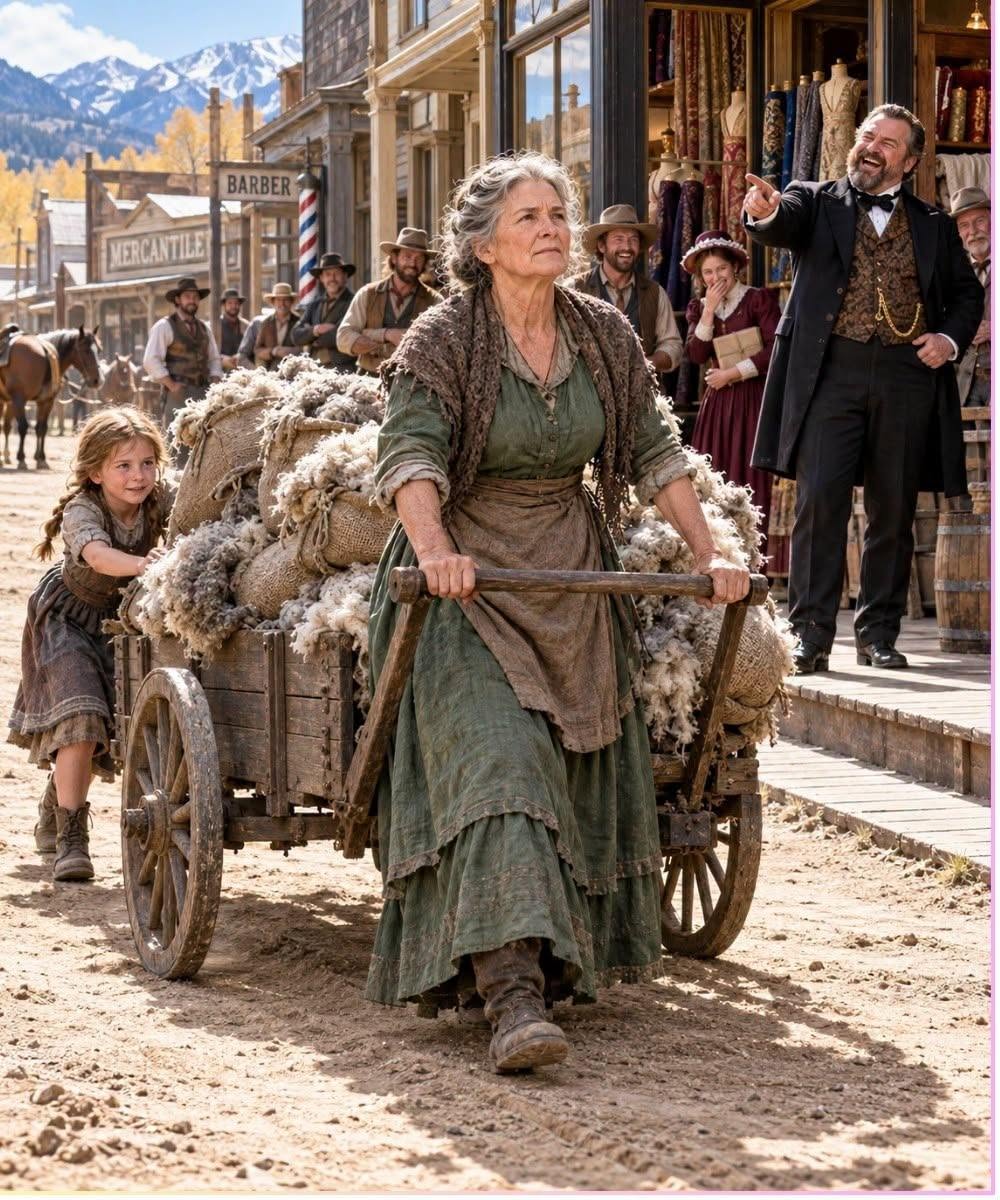
The town had laughed at a child pushing a cart of filthy wool.
Now that same child was helping keep its people alive.
But the worst was yet to come.
On the fifth day, Dr. Bell arrived with a boy whose breathing had become dangerously shallow.
The child was wrapped in a thin quilt, his face flushed and his hands icy.
“His name is Thomas,” the doctor said. “He’s eight. His family lost their wood supply when the shed collapsed.”
Martha hurried forward.
“Put him near the stove.”
Dr. Bell did so, then looked at the blankets stacked nearby.
“We need more of these.”
“How many?”
“Every one you have.”
Martha glanced toward the storage room.
“I have twelve finished blankets left.”
“Then we’ll need all twelve.”
She nodded.
“Lena, bring them out.”
As the women worked, Dr. Bell knelt beside Thomas and listened to his breathing.
Martha wrapped the boy carefully, leaving his face uncovered and making sure the blanket wasn’t so тιԍнт that it restricted his movement.
She brought warm water and asked the doctor what else he needed.
For the next hour, they worked together.
Slowly, Thomas’s breathing became less strained.
Dr. Bell sat back on his heels.
He looked at the thick wool covering the child.
Then at Martha.
“I was wrong,” he said quietly.
Martha adjusted the blanket around Thomas’s shoulders.
“About what?”
“The wool. The blankets. All of it.”
She didn’t answer.
He swallowed.
“I told people you were wasting your savings. I said the material was useless.”
Martha looked at him.
“And now?”
He glanced at Thomas.
“Now I’m grateful you didn’t listen to me.”
Martha nodded once.
“Then remember that the next time someone does something you don’t understand.”
The doctor lowered his head.
“I will.”
Outside, the blizzard continued to rage.
Inside, the old loom stood silent for the first time in weeks.
There was no more wool left to weave.
Every finished blanket had been given away.
Every wrap had found a child, an elderly neighbor, or someone who had spent too long in the cold.
Martha had spent nearly every dollar she owned on those thirty-one sacks.
She had worked until her hands hurt and her back refused to straighten.
And now, when the people of Tamarack Flat needed her most, her supplies were nearly gone.
Lena found her standing beside the empty shelves.
“What’s wrong?”
Martha looked at the bare boards.
“Nothing.”
“You’ve given everything away.”
“People needed it.”
“But what about you?”
Martha glanced at the small blanket covering her own bed.
“I’ll manage.”
Lena shook her head.
“No, Martha. You always say that. You manage when your hands ache. You manage when you haven’t slept. You manage when everyone laughs at you.”
She took Martha’s hands in hers.
“Who manages you?”
Martha stared at her.
For a long moment, she couldn’t speak.
Then she smiled sadly.
“My grandmother used to say that a person who knows how to mend cloth will never run out of work.”
Lena waited.
Martha squeezed her hands.
“I suppose I forgot that people need mending, too.”
Lena embraced her.
And for the first time since the storm began, Martha allowed herself to cry.
On the sixth morning, the wind finally weakened.
The snow remained deep, and the roads were still dangerous, but the sky had begun to clear.
People emerged from their homes to ᴀssess the damage.
Fences had vanished.
Sheds had collapsed.
Several roofs had been torn apart by the wind.
But the worst news came from the northern road.
A freight wagon had overturned near the creek. Its driver and two pᴀssengers had survived, but their supplies were scattered across the snow.
The town’s coal delivery was missing.
Without it, the next week would be almost as difficult as the last.
Cornelius Blackwood stood outside his store, staring at the wreckage of his business plans.
His imported coats had sold well before the storm, but most of the families who had bought them still lacked enough fuel to keep their houses warm.
He had plenty of expensive merchandise.
He had very little that could help people immediately.
Across the street, Martha’s cabin door opened.
She stepped onto the porch wearing her faded green dress and an old shawl.
She looked exhausted.
Her hair had come loose from its pins, and her hands were wrapped in strips of clean cloth.
But she stood straight.
People began gathering in front of her house.
Samuel Price arrived with his five children.
The minister came with a list of elderly residents who needed ᴀssistance.
Dr. Bell carried medical supplies.
And behind them, slowly and awkwardly, came Cornelius Blackwood.
He removed his hat.
“Mrs. Ellery.”
Martha looked at him.
“Yes?”
He glanced at the people gathered around the porch.
Then he lowered his head.
“I owe you an apology.”
The crowd fell silent.
Blackwood swallowed.
“I mocked you in front of this town. I called your wool garbage. I told people you were foolish to spend your savings on it.”
He looked at the snow-covered street.
“And when the storm came, I discovered that my store was full of things people couldn’t use to keep their children warm.”
Martha waited.
“I was wrong,” he said. “Not just about the wool. About you.”
For a moment, nobody moved.
Then Blackwood reached into his coat and pulled out a thick envelope.
“I’d like to pay for the wool you gave away. Every blanket. Every wrap. Every pair of socks.”
Martha looked at the envelope but didn’t take it.
“Why?”
“Because the people who received them shouldn’t have to pay for my mistakes.”
She studied him.
“That sounds reasonable.”
He let out a breath.
“Will you accept it?”
“Not for the blankets.”
His shoulders slumped.
“Then what?”
Martha pointed toward the mercantile.
“Open your storehouse. Count every sack of flour, every bean, every candle, every piece of dry clothing you have that can be spared. Then help distribute them to the families who need them most.”
Blackwood stared at her.
“You want me to give away my stock?”
“I want you to decide what kind of man you intend to be now that you know what the town needs.”
The crowd watched him.
For several seconds, Blackwood looked as though he might argue.
Then he placed his hat against his chest.
“All right.”
Martha nodded.
“Good. Start with the families near the creek. Their houses took the worst of the wind.”
Blackwood turned toward the mercantile.
This time, nobody laughed.
By the following week, Tamarack Flat had begun to recover.
Neighbors repaired roofs together.
Ranchers shared firewood.
The church opened its hall to families whose homes were still unsafe.
Dr. Bell organized a list of residents who needed medical attention, and Eli Harper arranged deliveries for those who couldn’t travel.
Blackwood donated supplies and paid for repairs to the mercantile’s damaged storage building.
He never again called Martha’s wool useless.
But the greatest change came in the way people treated Martha herself.
The minister visited her cabin and asked whether she would teach the women of the town how to prepare and weave the wool.
Samuel brought her a load of dry wood.
The young mother who had arrived with the sick boy returned with a basket of fresh eggs.
And Tilly Sorenson, who had pushed the handcart through the laughter, became the unofficial supervisor of the town’s new winter preparation group.
She took her duties very seriously.
“First, we count what we have,” she told a gathering of women in the church hall. “Then we decide who needs it. And nobody gets to laugh at anyone for preparing early.”
Several women smiled.
Martha stood at the back of the room, listening.
When Tilly finished, she looked toward her.
“Was that right, Martha?”
Martha nodded.
“Very right.”
Tilly beamed.
Then she asked the question Martha had been expecting.
“Do you think winter will be bad again next year?”
Martha looked through the window at the pale sunlight resting on the snow.
“I don’t know, child.”
“Then why prepare?”
Martha knelt beside her.
“Because preparing isn’t about knowing exactly what will happen. It’s about caring enough to be ready when something does.”
Tilly considered this.
Then she nodded solemnly.
“I think I understand.”
Martha smiled.
“Good. Now go make sure they haven’t forgotten to count the candles.”
The girl hurried away.
Martha watched her for a moment, then returned to her cabin.
The thirty-one sacks of filthy wool had cost her nearly everything she owned.
She had never recovered the full value of her labor. She had never become wealthy from the blankets.
But she had gained something far more lasting.
A town that understood the difference between appearances and usefulness.
Neighbors who knew that generosity was not weakness.
And the knowledge that, when the world turned cold, she had helped people survive.
That evening, Martha sat beside the stove with Lena and Tilly.
Outside, snow drifted softly across the prairie.
Inside, the cabin smelled of bread and warm wool.
Tilly rested her head against Martha’s shoulder.
“Do you think people will laugh at us again?”
Martha stroked the girl’s hair.
“Probably.”
Tilly frowned.
“Why?”
“Because people sometimes laugh at what they don’t understand.”
“Then what should we do?”
Martha smiled.
“Keep doing what matters.”
The fire crackled.
For the first time in weeks, nobody was rushing to finish another blanket. Nobody was counting supplies or worrying about the next knock at the door.
They simply sat together, warm and safe.
And Martha thought of her grandmother, who had taught her that the natural oil in wool was not dirt to be stripped away but protection to be preserved.
Some things looked imperfect because they had been made for survival rather than display.
Some people were dismissed because their worth could not be measured by money, appearance, or status.
And sometimes, the people who laughed loudest in the sunshine were the first to discover how much they needed the very thing they had mocked.
Martha closed her eyes and listened to the wind moving gently beyond the walls.
Winter had not made her rich.
It had revealed what she had been rich in all along.
THE END.