PART 2 — THE WIFE WHO DROVE INTO THE STORM
PART 2 — THE WIFE WHO DROVE INTO THE STORM
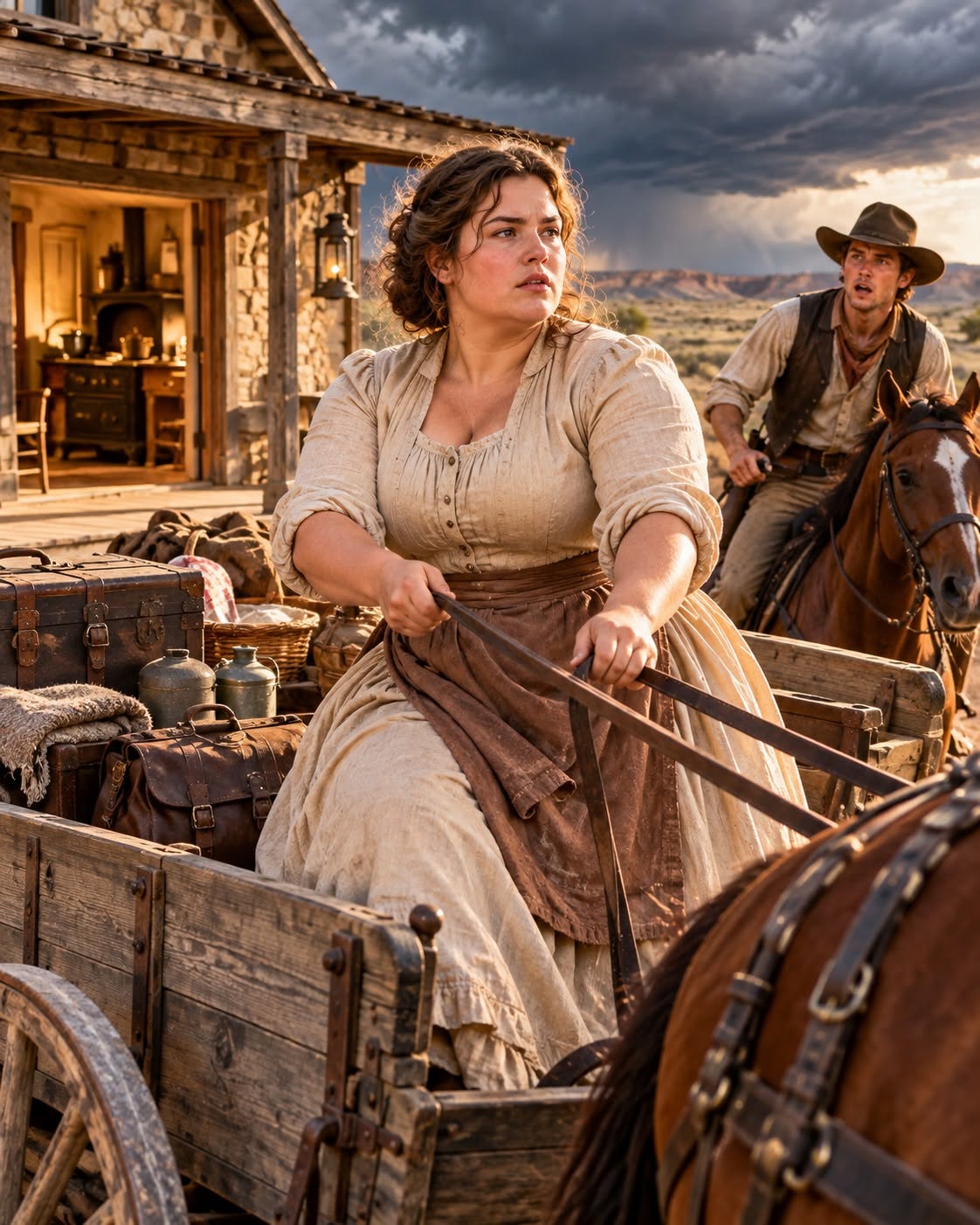
The first thing I learned about driving a loaded wagon through the Texas Panhandle was that the land did not care who you were.
It did not care that I was a widow’s daughter, a new bride, or a woman Wyatt Mercer considered too slow to keep up with his cattle.
It cared only whether I could hold the reins when the wheels struck a rut and whether I could keep the horses moving when the wind tried to turn the wagon sideways.
And that afternoon, the wind had become a living thing.
I pulled my bonnet тιԍнтer and leaned forward.
“Easy, girls,” I whispered to the two chestnut mares. “We have people waiting.”
The medicine chest rattled beside me. Behind it were sacks of flour, beans, dried meat, clean bandages, blankets, and two large pots of food wrapped in wool.
I had packed everything I could think of.
Then I remembered something else.
Water.
I had filled four barrels before leaving, knowing the ravine might be cut off from the creek.
By the time I reached the northern trail, the first drops of rain were striking my face.
A mile farther, I found the broken wagon.
One wheel had snapped. A ranch hand named Eli sat beside it, holding his injured shoulder. Another man was trying to shelter a third beneath a canvas sheet.
“Mrs. Mercer!” Eli shouted when he recognized me. “You shouldn’t be here!”
“That’s a curious greeting for someone who needs a wagon.”
His eyes widened.
“You brought supplies?”
“Food, medicine, blankets, and water.”
He looked toward the ravine.
“Mr. Mercer is still down there. We can’t move the steer. The ground keeps sliding, and there’s no safe way to bring the horses down.”
“Where are the others?”
“Tom is with Wyatt. Hollis went to find a rope. The rest are trying to keep the injured men warm.”
I climbed down and handed Eli a blanket.
“Then we’ll start with what we can do.”
I opened the medicine chest.
My father had taught me how to clean wounds, recognize dangerous swelling, and keep a frightened person calm until a doctor arrived. I was not a physician, and I had no intention of pretending otherwise.
But I knew how to help.
I cleaned Eli’s shoulder, wrapped it securely, and checked the other injured man. His ankle was badly swollen, so I made a padded support from folded cloth.
“Can you stand?” I asked him.
“I can try.”
“Don’t. We have a wagon, and I would rather not have to carry you after all this trouble.”
He gave a weak laugh.
It was the first laugh I had heard since arriving at the ravine.
Then thunder cracked overhead.
A shout rose from below.
“Mrs. Mercer!”
I turned.
Tom was climbing toward us, his face streaked with mud.
“Wyatt needs you!”
I looked down into the ravine.
The sight made my stomach тιԍнтen.
A mᴀssive steer lay awkwardly beside a collapsed shelf of earth. Wyatt was beneath a heavy timber that had fallen across his lower leg. His hat was gone, his shirt torn, and blood darkened one sleeve.
He was conscious, but barely.
“Don’t come down!” he shouted when he saw me.
I ignored him.
The slope was slippery, and every step sent loose stones tumbling into the darkness. Tom reached for my arm.
“Careful, ma’am.”
“I have been careful my entire life,” I answered. “Today I need to be useful.”
When I reached Wyatt, his eyes moved from my face to the wagon above.
“What are you doing here?”
“Delivering supper.”
“This isn’t a joke.”
“Neither is the storm approaching us.”
He tried to shift beneath the timber and winced.
“Get the men out. The ground won’t hold.”
I knelt beside him.
“Can you feel your feet?”
“Yes.”
“Can you move your toes?”
He did.
“Good. Don’t try to pull yourself free. We need to relieve the pressure without making the slope collapse.”
Wyatt stared at me.
“You know anything about this?”
“I know enough to understand that panicking won’t improve your condition.”
Tom and Hollis arrived with ropes. We secured the steer away from the unstable edge and worked with the men to create a safer way to move the timber. I kept everyone back whenever the earth shifted.
It took nearly an hour.
 By then, the rain was falling hard enough to blur the world.
Finally, the timber moved.
Wyatt cried out as the pressure lifted, but his leg was free.
Tom and Hollis supported him while I brought the wagon closer to the firmest ground we could find.
“Can you ride?” I asked.
Wyatt shook his head.
“Then you can lie down in the wagon.”
He looked at me as if he had never heard anyone give him an order before.
“Mrs. Mercer—”
“Wyatt, I have driven through a storm, crossed a washed-out trail, treated three injured men, and brought enough food to feed this entire ranch. You may argue with me tomorrow.”
For the first time, he obeyed without another word.
We loaded the injured men, covered them with blankets, and secured the medicine chest.
But the return journey was worse.
The trail had become a river of mud. Water rushed across the lower crossing, and the horses balked when they saw the swollen creek.
I pulled the reins and stopped.
The old wooden bridge was still standing, but one side had begun to sag.
“We can’t cross there!” Tom shouted.
I looked toward the western ridge.
There was another route, longer and steeper, but my father had once taken me along it when we visited a neighboring farm.
It was narrow.
It was dangerous.
But it was above the worst of the flooding.
“Turn the horses west,” I said.
Wyatt lifted his head from the blankets.
“That trail is too narrow for a wagon.”
“Then we’ll go slowly.”
“You don’t understand the ground.”
“I understand that the bridge is falling.”
A loud crack sounded behind us.
Half the bridge disappeared into the rushing water.
Nobody argued after that.
We took the western trail.
The wagon lurched over stones, and rain soaked my sleeves. My hands burned from holding the reins, but I kept the horses steady.
When we finally reached the ranch, the storm had swallowed the sun.
Hollis and the others rushed out to help.
The injured men were carried inside, Wyatt was taken to his bedroom, and I began directing the unloading.
“Bring the blankets first. Put the medicine chest beside the table. Someone heat water. And please, for the love of every hungry person in Texas, don’t put the food on the wet ground.”
The ranch hands moved quickly.
For the next two hours, I worked between the kitchen and the sickroom. I heated broth, prepared clean cloths, and made sure everyone had something warm to eat.
Wyatt’s leg was badly bruised, but he could move his toes. We sent a rider to fetch the nearest doctor as soon as the weather allowed.
At last, when the house grew quiet, I returned to the kitchen.
My hands were trembling.
My dress was ruined.
Mud covered my boots.
And I had not eaten a single bite of the supper I had prepared.
I was reaching for a biscuit when Wyatt appeared in the doorway, leaning heavily on a cane.
“You should be in bed,” I said.
“So should you.”
“I have a kitchen to clean.”
He looked around.
The stove was glowing. Empty bowls sat stacked beside the sink. The injured men were warm, fed, and resting.
Then his eyes settled on me.
“I was wrong.”
I stopped.
He swallowed.
“About you. About what you could do.”
I placed the biscuit on the table.
“You were wrong before today, Wyatt. Today merely made it inconvenient for you to ignore.”
He lowered his eyes.
“I thought I knew what a strong person looked like.”
“And now?”
He looked at the food, the medicine chest, and the muddy wagon visible through the window.
“Now I think I may have spent years looking at the wrong things.”
For a moment, neither of us spoke.
Then a knock sounded at the front door.
Hollis opened it.
A stranger stood on the porch, soaked from the rain, holding a leather document case.
“I’m looking for Wyatt Mercer,” he said.
Wyatt straightened.
“That’s me.”
The stranger removed his hat.
“My name is Deputy Samuel Price. I’m sorry to arrive in this weather, but I have business concerning Willow Creek Valley.”
My fingers тιԍнтened around the edge of the table.
The valley my father had left me.
The land that had brought Wyatt and me together.
The deputy opened his document case.
“There’s been a complaint filed against Mrs. Mercer. Someone claims she signed away her water rights three days before her father’s death.”
I stared at him.
“That is impossible.”
He looked at me with an expression I could not read.
“Then I suggest you tell me why your signature appears on this document.”
And he placed a paper on the kitchen table.
It was not my signature.
But the name beneath it was unmistakably mine.