PART 2: THE WIDOW TOOK THE PARALYZED MOUNTAIN MAN HOME, BUT THE SECRET BENEATH HIS BROKEN BODY TERRIFIED THE TOWN
THE WIDOW TOOK THE PARALYZED MOUNTAIN MAN HOME, BUT THE SECRET BENEATH HIS BROKEN BODY TERRIFIED THE TOWN
“Get me in the wagon.”
Cora Miller held Judd’s gaze for a moment.
Then she nodded.
She did not ask whether he was certain. She did not promise that everything would be fine. She simply stepped into the stall, pushed the filthy hay away, and began preparing a place for him.
The stable boy watched with his mouth hanging open.
“You really mean to take him?”
“I said I needed help,” Cora answered.
“But he can’t walk!”
“Then he won’t be doing much walking.”
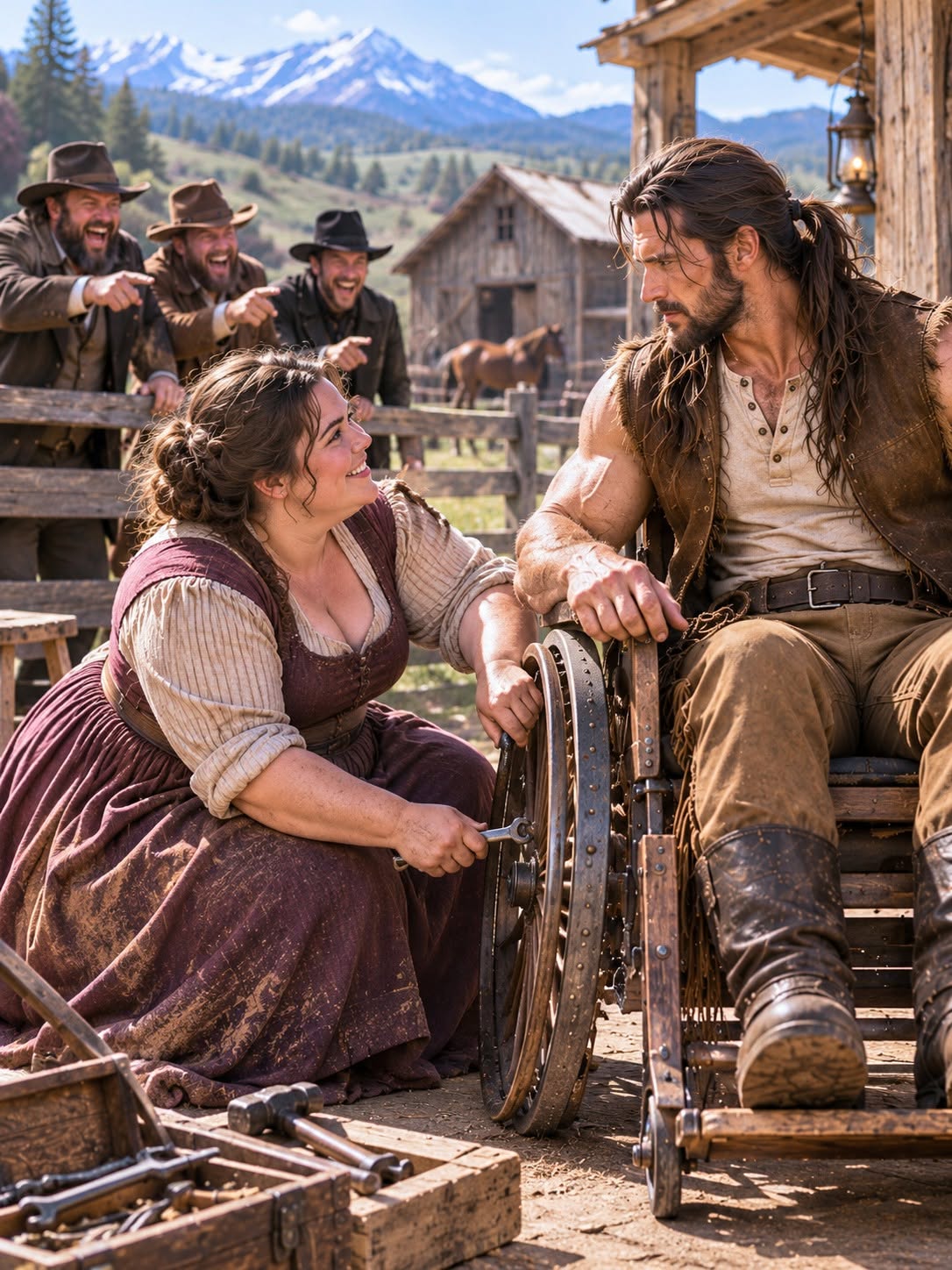
A few men outside burst into laughter.
Jedidiah Rust leaned against the doorway, enjoying every second.
“Careful, widow. That one will eat more than he earns. You’ll be feeding a corpse before winter.”
Cora finally turned toward him.
“Then I suppose you’ll have to find something else to laugh about.”
The laughter faltered.
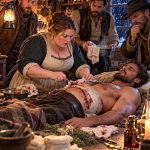
With Billy’s help, she lifted Judd onto a blanket and dragged him carefully toward the wagon. He was so heavy that her arms trembled, and twice she nearly lost her grip. Judd never cried out, even when pain тιԍнтened his face.
When they finally settled him onto the wagon bed, he looked at her.
“You don’t know what you’re taking home.”
“No,” Cora replied, climbing onto the driver’s seat. “But I know what I’m leaving behind.”
The wagon rolled out of Rosehaven beneath the mocking eyes of the townspeople.
For the first several miles, neither spoke.
Judd lay beneath a blanket, staring at the sky. Cora kept her hands firm on the reins, steering around the rocks and ruts that cut across the prairie.
At last, he spoke.
“Why?”
She glanced down.
“Why what?”
“Why take me?”
Cora considered the question.
“Because you asked me to.”
“That ain’t enough.”
“It was enough for me.”
He turned his face away.
By the time they reached the Miller homestead, the sun was sinking behind the western hills.
The place was hardly a ranch anymore. The barn leaned to one side. Half the fencing had collapsed. The house needed a new roof, and the well bucket had a crack that made drawing water a miserable chore.
But it was hers.
Or at least, it was what remained of the life she and Thomas had built.
Cora had prepared a bed near the kitchen stove. She had washed the sheets twice and placed a basin of warm water beside it.
Judd stared at the clean bed as if it were something he had no right to touch.
“I’ll sleep on the floor,” he muttered.
“You’ll sleep where I put you.”
“I ain’t a child.”
“And I’m not asking you to be one.”
She and Billy had helped carry him from the wagon. Now Cora adjusted the pillows behind his shoulders and brought him a bowl of broth.
He looked at the food.
“I can’t pay you.”
“I know.”
“I can’t mend your fences. Can’t ride. Can’t lift a sack of grain.”
“Then eat the broth before it gets cold.”
His jaw тιԍнтened.
For the first time, Cora saw something more painful than anger in his eyes.
Shame.
That night, she woke twice to find him struggling to shift his weight. He refused to call for help. By morning, the blanket was tangled around his legs and sweat covered his forehead.
Cora said nothing about it.
She cleaned him, changed the bedding, and brought fresh water.
When he tried to apologize, she interrupted him.
“Your body is hurt, Judd. That doesn’t make you less of a man.”
He stared at her.
Nobody had spoken to him that way since the accident.
The days that followed were difficult.
Judd was stubborn, proud, and sometimes so angry that Cora feared he might break the bed beneath him. He hated needing help with ordinary things. He hated the way his legs refused to answer him. Most of all, he hated the thought that the men in Rosehaven might have been right.
He was useless.
But Cora refused to let him believe it.
She gave him small jobs.
He began by sorting nails and repairing the broken hinges on the kitchen cabinet. Then he sharpened her tools, studied the ranch accounts, and helped her plan which sections of fence needed rebuilding first.
His hands were enormous, but astonishingly precise.
One afternoon, Cora found him studying a map of the property.
“What’s that?” she asked.
“Your eastern pasture.”
“What’s wrong with it?”
“Nothing, if you enjoy watching cattle starve.”
He pointed to a narrow creek running along the northern boundary.
“Your fence cuts off the water from the lower field. Move it twenty yards west and you could graze twice as many head.”
Cora leaned over the map.
“Thomas never noticed that.”
“Thomas wasn’t a mountain man.”
 There was no arrogance in his voice. Only observation.
Over the next week, Judd began directing the ranch work from the porch. He could not walk, but he could see things Cora had missed for years.
He understood weather patterns, animal behavior, soil, and water. He could tell from the color of the grᴀss where underground moisture lay. He could recognize a sick animal by the way it held its head.
Cora started making money again.
And then the doctor came.
Dr. Samuel Whitcomb had treated Judd in town and declared his spine hopelessly damaged. When he saw the mountain man sitting upright at Cora’s kitchen table, he looked almost offended.
“You’re still alive.”
Judd gave him a cold look.
“Disappointed?”
The doctor ignored him and examined his back.
After several minutes, he grew quiet.
“There’s something I didn’t see clearly before,” he said.
Cora stood beside the table.
“What?”
“The swelling has gone down. His injury may not be a complete break. There could be pressure around the spinal cord rather than a total severing.”
Judd’s expression did not change.
“Can I walk?”
The doctor hesitated.
“I can’t promise that. But I would not call your condition hopeless.”
For the first time, hope entered the room—and it frightened Judd more than despair.
Because hope could be lost.
Dr. Whitcomb recommended a brace, careful movement, and months of exercises. He warned them that recovery would be slow and painful.
Cora listened to every word.
Judd listened too.
That evening, she found him staring at his legs.
“I don’t want you wasting your life on me,” he said.
Cora placed a wooden chair beside his bed.
“Then don’t waste mine by giving up.”
The first exercises were humiliating.
Judd could barely move his feet. His muscles trembled. Sometimes the pain became so fierce that he bit down on a strip of leather to keep from shouting.
Cora stayed beside him.
When he failed, she helped him try again.
When he cursed, she let him.
When he wanted to quit, she reminded him that he had once survived a mountain falling on him.
“You’re asking too much,” he snapped one afternoon.
“Perhaps.”
“You don’t understand what it feels like.”
“No,” she said quietly. “I don’t.”
Then she placed his hand in hers.
“But I know what it feels like to watch the world decide your life is over.”
He looked at her.
“My husband died four months ago. The bank wants this ranch. Rust wants the land. Half the town thinks I’m too weak to keep it. They have already buried me in their minds.”
She took a breath.
“But I’m still here.”
Judd looked down at their joined hands.
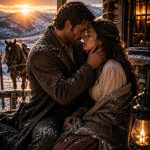
“So am I,” he whispered.
Three weeks later, a stranger arrived at the ranch.
He rode a black horse and wore a silver badge beneath his coat.
He introduced himself as Deputy Marshal Harlan.
“I’ve been looking for Judd Mercer.”
Judd’s face went pale.
“What do you want?”
The marshal glanced at Cora before answering.
“There’s a reason the men who brought you down from the mountains were so eager to leave you in that stable.”
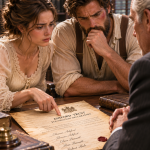
He reached into his coat and produced a folded sheet of paper.
“Five years ago, you surveyed the northern ridge for the territorial government. You found something there. Something Jedidiah Rust has spent a fortune trying to hide.”
Judd stared at the paper.
Then he looked at Cora.
And for the first time since she had brought him home, fear—not pain, not shame, but genuine fear—crossed his face.
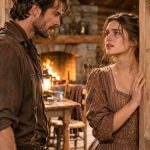
“Mrs. Miller,” he said, his voice barely audible, “you need to understand something.”
Outside, a horse whinnied.
A second rider appeared beyond the fence.
Then a third.
Judd gripped the edge of the table.
“They didn’t leave me to die because I was crippled.”
He looked toward the approaching riders.
“They left me to die because I knew where the bodies were buried.”