PART 2 — THE TOWN THAT CAME KNOCKING
PART 2 — THE TOWN THAT CAME KNOCKING
The first knock came just after sunrise.
Bess Hadley was inside her smokehouse, checking the last row of venison, when she heard someone pounding on her cabin door.
She wiped her hands on her apron and stepped outside.
Reverend Michael stood on the porch, his coat covered in snow.
Behind him waited three townsmen, their expressions unusually serious.
“Bess,” the reverend began, “we need to talk.”
She glanced at the men.
“About what?”
“The supply train.”
“I heard.”
“The bridge is gone. The road is buried. We have no way of knowing when another shipment will reach Prospect Creek.”
Bess nodded.
“That’s unfortunate.”
One of the men shifted impatiently.
“Unfortunate? Girl, half the town is going to run out of food!”
Bess looked at him calmly.
“Then half the town should have prepared.”
The man flushed.
Reverend Michael raised a hand.
“Please. We didn’t come to argue. We came to ask whether you have anything you could spare.”
Bess looked beyond them toward the town.
She could see smoke rising from the chimneys below, though several were already thinner than usual.
“How much food does the town have?”
The reverend hesitated.
“Perhaps enough for two weeks. Some families have less.”
“And how many people?”
“Nearly two hundred.”
Bess considered the answer.
“Then two weeks won’t be enough.”
The men exchanged uncomfortable looks.
Finally, Reverend Michael said, “Mr. Abernathy believes you may have preserved meat.”
Bess almost laughed.
Of course he did.
Abernathy had spent the summer mocking her work. Now he wanted to know exactly how much she had stored.
“How does Mr. Abernathy know what I have?”
“He has heard rumors.”
“Then he should stop listening to rumors and start counting his own supplies.”
The reverend lowered his eyes.
“Bess, I know people have been unkind. But children are hungry already.”
That changed her expression.
She thought of the little Gable children, who had once brought her wildflowers. She remembered Mary Gable’s kindness and the way the woman had tried to persuade her to leave the mountain.
“Come back tomorrow,” Bess said. “Bring me a list of the families with children, elderly people, and anyone who cannot work.”
The reverend looked relieved.
“You’ll help us?”
“I’ll consider what I can do.”
But when he returned to town, he carried a very different message.
Bess Hadley had food.
And she was willing to share.
By noon, the news had reached every corner of Prospect Creek.
By evening, people were arguing outside Abernathy’s store.
Some wanted to send a wagon to Bess’s property.
Others demanded that the town council take control of her supplies.
Abernathy listened without speaking.
He stood behind his counter, counting coins while the men debated.
Finally, he closed his ledger.
“There’s no need to panic,” he said. “Bess is a young woman. She cannot possibly have enough food to support the entire valley.”
Silas Croft, still recovering from his journey through the mountains, shook his head.
“You haven’t seen her smokehouse.”
Abernathy’s eyes narrowed.
“How much does she have?”
“Enough to make a difference.”
“How much?”
Silas hesitated.
“I saw rows of meat hanging from the rafters. Barrels stacked against the walls. More than I’ve seen in any single household.”
 A strange silence followed.
Abernathy looked toward the window.
“Then perhaps it’s time we paid Miss Hadley another visit.”
The next morning, Bess woke to the sound of several horses outside.
She opened her door and found Abernathy standing with Reverend Michael, two councilmen, and a group of townspeople.
“Good morning,” she said.
Abernathy removed his hat.
“Miss Hadley. We have come to discuss a community arrangement.”
“What kind?”
He smiled.
“Your father owed me money. You know that. I have been patient, but circumstances have changed.”
Bess folded her arms.
“My father’s debts have nothing to do with my food.”
“Everything has something to do with something, young lady.”
He held up a paper.
“Your father’s unpaid account can be settled if you agree to transfer a portion of your preserved goods to the town.”
Bess looked at the document.
Then she looked at the two councilmen.
“Did the town council approve this?”
One of them cleared his throat.
“We haven’t formally voted.”
“Then why are you here?”
Abernathy’s smile disappeared.
“Don’t make this difficult.”
Bess stepped back and opened the door wider.
“Would you like to see the smokehouse?”
The men exchanged glances.
They followed her around the cabin.
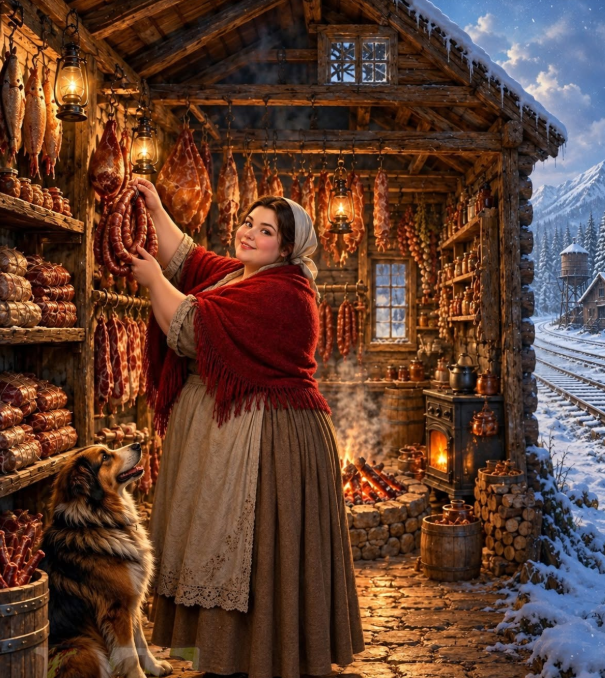
When Bess opened the heavy wooden door, the smell of smoked venison, alderwood, and salt drifted into the cold morning air.
Inside, rows of preserved meat filled the shelves.
Barrels of dried vegetables stood against the back wall. Bundles of herbs hung from the rafters. Several sealed containers of pemmican rested beneath the workbench.
Abernathy stared.
For a moment, he forgot to speak.
Bess watched him carefully.
“This is my father’s property. Every pound was hunted, prepared, and preserved by me.”
Abernathy stepped closer to the shelves.
“Good heavens. You could feed half the town.”
“Not if I waste it.”
He turned toward her.
“You must understand that this is no longer a private matter. People are starving.”
“Then let’s make a fair agreement.”
“What sort of agreement?”
“I will sell food at a reasonable price. Families who cannot pay immediately can work for their share when the weather allows. Children and elderly people will not go hungry.”
One of the councilmen nodded.
“That sounds reasonable.”
Abernathy immediately interrupted.
“Absolutely not. We cannot allow one young woman to decide who eats and who doesn’t.”
Bess looked at him.
“Then perhaps you should have prepared something yourself.”
The words struck harder than she intended.
The group went silent.
Abernathy stepped toward her.
“Be careful, Miss Hadley. You are sitting on a fortune, and fortunes attract trouble.”
Bess didn’t move.
“Are you threatening me?”
He smiled again.
“I’m advising you.”
Then he walked away.
That afternoon, Bess began distributing food.
She made a list of families and carefully measured portions. Each household received enough to prepare meals for several days.
She charged only what she needed to replace supplies after the thaw.
For families without money, she accepted promises of labor.
Mary Gable was the first to arrive.
She brought her three children and a small basket of potatoes.
“Bess, I don’t have enough money to pay you.”
“You don’t need to pay me today.”
Mary looked at the shelves.
“How can I ever repay you?”
“Help me keep the children fed. That’s enough.”
Mary began crying.
Then she stepped forward and hugged Bess.
For the first time in months, Bess allowed herself to be held.
But the weather continued worsening.
Snow buried the lower road.
The creek froze along its banks.
The temperature dropped so sharply that several families stopped traveling between homes.
Bess began receiving visitors at all hours.
A father with two hungry boys.
An elderly widow whose firewood had run out.
A miner whose wife was sick.
She helped everyone she reasonably could.
But she also knew her supplies were not endless.
Four hundred pounds of meat sounded like a fortune until nearly two hundred people began depending on it.
So she called a meeting.
She asked the strongest men in town to help gather firewood, repair roofs, and clear the path between houses.
She asked the women who could sew to make warmer clothing from old blankets and spare fabric.
She asked the storekeepers to open their remaining supplies and make honest records of what was available.
And she asked Reverend Michael to organize a daily list of families who needed ᴀssistance.
For a few days, it worked.
Prospect Creek began to function like a community instead of a collection of frightened households.
Then came the night of November 6.
The wind howled through the valley.
Snow struck the windows so hard that Bess could barely see the barn.
She had just secured the smokehouse door when she heard a strange sound outside.
A horse.
Then another.
She grabbed her lantern and stepped onto the porch.
Three riders were approaching.
At their head was Abernathy.
He dismounted and walked toward her.
“Miss Hadley,” he called over the wind. “We need to settle this tonight.”
Bess тιԍнтened her grip on the lantern.
“What do you want?”
“Your entire stock of preserved meat.”
She stared at him.
“No.”
Abernathy’s expression hardened.
“The town council has decided the food must be placed under my supervision.”
“Show me the signed order.”
He pulled a folded document from his coat.
Bess unfolded it.
The paper bore two councilmen’s signatures.
But the document did not authorize the seizure of private property.
It merely recommended that food distribution be coordinated through the general store.
Bess looked up.
“This does not give you ownership of my supplies.”
Abernathy stepped closer.
“Don’t be foolish. You cannot feed the town alone.”
“I never claimed I could.”
“Then hand over the food.”
“No.”
The silence between them grew.
Finally, Abernathy leaned closer and spoke quietly.
“Your father understood how business worked. He knew when to surrender something he couldn’t protect.”
Bess felt the words like a slap.
“My father never surrendered this land.”
“Your father is ᴅᴇᴀᴅ.”
Bess looked directly into his eyes.
“And I’m not.”
Abernathy’s face darkened.
He turned to his men.
“Come back tomorrow. We will discuss this with the council.”
Then he mounted his horse and disappeared into the snow.
Bess remained on the porch long after they were gone.
She knew Abernathy would not stop.
And she knew there was another reason he wanted control of the smokehouse.
Her father had told her something about the northern timberland shortly before he died.
Something she had not yet fully understood.
She went inside and opened his old hunting chest.
Beneath his maps and weather notes lay a leather journal.
She had read it many times, but never from beginning to end.
This time, she turned to the final pages.
There, in her father’s uneven handwriting, was a sentence she had never noticed before.
If Abernathy comes asking for the northern timber, remember this: the timber is not the treasure. The spring beneath it is.
Bess read the sentence again.
Then she found a small hand-drawn map.
It showed a narrow trail beyond the smokehouse, leading toward a rocky ridge.
Beside the trail, her father had written:
Winter spring. Never let the storekeeper own the water.
Bess stared at the page.
The smokehouse was important.
The preserved food was important.
But her father had been preparing her for something far bigger.
And now Abernathy knew it existed.