PART 2: THE SON HE NEVER KNEW — THE CASE THAT DESTROYED HIS PERFECT REPUTATION
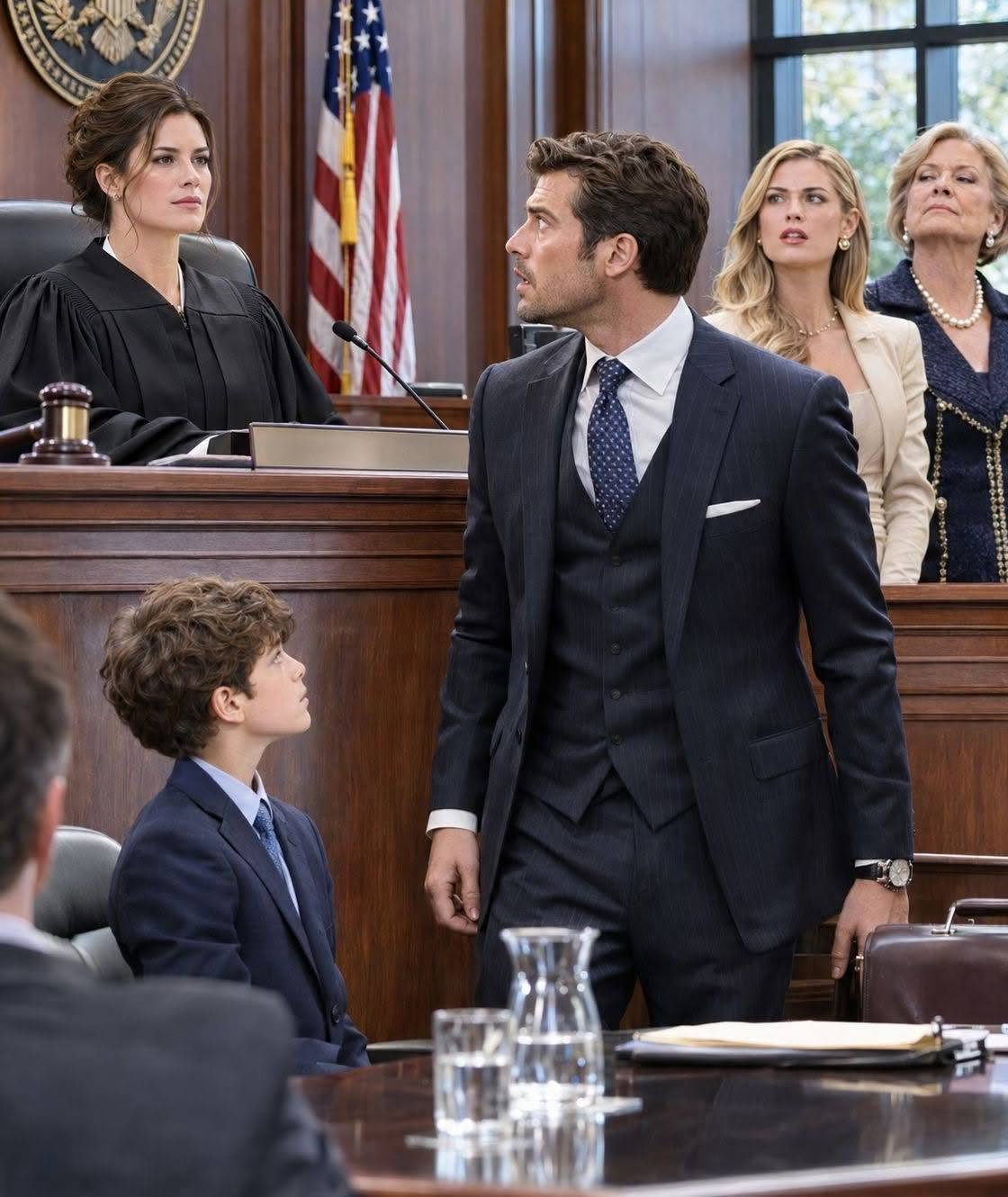
For nearly ten years, he had built his reputation on confidence, influence, and the ability to intimidate opposing attorneys.
But that morning, he couldn’t seem to find a single word.
“Your Honor,” he finally managed.
I looked down at the case file.
“Good morning, Mr. Carter. Please proceed.”
He swallowed.
“Yes, Your Honor.”
I noticed his eyes lingering on my face.
He was searching for something familiar, perhaps trying to reconcile the woman he had once dismissed with the judge now sitting above him.
But I gave him nothing.
“Before we begin,” I said, “would you please identify yourself and confirm your representation of the defendant?”
Daniel straightened his jacket.
“Daniel Carter, representing Carter Financial Group’s former chief executive officer, Richard Lawson.”
I glanced at the defendant.
Richard Lawson was facing multiple allegations involving corporate fraud, fraudulent financial reporting, and the unlawful transfer of millions of dollars from investor accounts.
It was an unusually complicated case.
And Daniel had been hired to defend him after two previous attorneys withdrew.
“Very well,” I replied. “Let’s proceed.”
Daniel began his opening statement.
He spoke beautifully.
He described his client as a respected businessman who had been unfairly targeted by investigators. He questioned the reliability of the prosecution’s financial analysis and suggested that the alleged transactions were ordinary business operations misunderstood by inexperienced investigators.
Then he made a mistake.
A very serious one.
“Your Honor, the prosecution’s entire case rests on a fundamentally flawed interpretation of financial records. I intend to demonstrate that the investigators lacked the necessary expertise to understand the transactions.”
I looked at him.
“Mr. Carter, are you suggesting that the financial records themselves are inaccurate, or that your interpretation differs from that of the prosecution?”
Daniel hesitated.
“My interpretation is supported by independent financial consultants.”
“Then I suggest you present their findings rather than speculate about the prosecution’s qualifications.”
A few people in the courtroom shifted in their seats.
Daniel nodded.
“Of course, Your Honor.”
He continued.
But I noticed something else.
His client, Richard Lawson, was becoming increasingly nervous.
Every time Daniel mentioned the financial records, Lawson looked toward the defense table as if he feared something might be revealed.
I made a note.
This case was going to be more complicated than Daniel understood.
During the afternoon session, the prosecution called its first major witness.
A financial investigator named Michael Harris took the stand.
He explained how millions of dollars had been transferred through a network of shell companies.
According to his investigation, the money had eventually reached accounts controlled by Lawson and several senior executives.
Daniel stood for cross-examination.
“Mr. Harris, you claim these transactions were fraudulent?”
“Yes.”
“But you cannot personally testify that Mr. Lawson authorized every transfer, can you?”
“I can testify that his credentials were used to approve several of them.”
“Credentials that other employees could access?”
“Yes, theoretically.”
Daniel smiled.
“So you’re admitting that someone else could have conducted these transactions?”
“Someone else could have accessed the system. However, the approval records and communications establish a different picture.”
“What communications?”
The prosecutor approached the bench.
“Your Honor, we request permission to introduce Exhibit 47.”
I reviewed the submission.
“Granted.”
The courtroom monitor displayed an email exchange between Lawson and his chief financial officer.
The subject line read:
FINAL TRANSFER — DO NOT DISCLOSE TO INVESTORS.
Daniel’s expression тιԍнтened.
His client leaned toward him and whispered something urgently.
Daniel shook his head.
Then the prosecutor displayed another document.
A signed authorization.
It appeared to contain the signature of a senior employee who had previously denied approving the transfers.
The investigator explained that the signature was believed to have been digitally reproduced.
Daniel immediately objected.
“Your Honor, the defense challenges the authenticity of this document.”
“Objection noted. The prosecution will establish the foundation for its admission.”
I looked toward the witness.
“Mr. Harris, does your investigation include forensic examination of the original electronic records?”
“Yes, Your Honor.”
“And are those findings available?”
“Yes.”
“Proceed.”
Daniel slowly sat down.
For the first time that day, his confidence seemed to be slipping.
During a short recess, Daniel approached the bench after receiving permission to address a procedural question through the proper court channel.
“Your Honor, may I request a brief conference regarding a potential conflict of interest?”
I looked at him.
“Please explain.”
He lowered his voice.
“Given our previous personal relationship, I believe the court should consider whether my client’s right to an impartial proceeding could be affected.”
I studied him carefully.
“Mr. Carter, this matter has been ᴀssigned according to the court’s established procedures. Do you have any specific evidence of judicial bias?”
He hesitated.
“No, Your Honor.”
“Then any formal motion must be submitted in writing, supported by the relevant facts and applicable law.”
He nodded.
But before he walked away, he whispered:
“Emily, we need to talk.”
I looked directly at him.
“You may address me as Your Honor in this courtroom, Mr. Carter.”
His face reddened.
“Yes, Your Honor.”
He returned to his table.
I knew he wouldn’t let the matter rest.
But I also knew that my personal history with Daniel could never influence the case.
If a genuine conflict arose, the appropriate legal procedures would have to be followed.
My responsibility was to the law, not to the past.
At 5:30 p.m., I returned to my chambers.
My ᴀssistant, Rebecca, had placed a message on my desk.
“Judge Carter, there’s a young man waiting outside. He says he’s your son.”
I smiled.
“Noah?”
“Yes. He said he finished his university interview early and wanted to surprise you.”
I checked the time.
“Please send him in.”
A moment later, my eighteen-year-old son entered carrying a backpack.
“Mom!”
I stood and hugged him.
“How was your interview?”
“Good, I think. But I have something important to tell you.”
He pulled a document from his backpack.
It was a scholarship notification from a prestigious university.
I hugged him again.
“I am so proud of you.”
He laughed.
“Mom, you’re going to make me cry.”
Then his expression changed.
“By the way, I saw something strange downstairs.”
“What?”
“A man was standing near the elevators. He kept looking at me.”
My heart skipped.
“What did he look like?”
“Expensive suit. Dark hair. Maybe in his forties.”
Daniel.
I tried to keep my expression neutral.
“Did he speak to you?”
“No. But he looked at me like he recognized me.”
I gently adjusted Noah’s collar.
“Don’t worry about it, sweetheart.”
But Noah wasn’t finished.
“Mom, can I ask you something?”
“Of course.”
“Have you ever thought about telling me who my father was?”
I froze.
For years, I had prepared myself for that question.
Noah had occasionally asked about his father when he was younger, but I had always told him that his parents had separated before he was born.
I had never lied about his existence.
I had simply avoided giving him a name.
Now I knew I couldn’t avoid it forever.
“There’s something I need to tell you,” I said.
But before I could continue, Rebecca knocked.
“Your Honor, I’m sorry to interrupt. Mr. Carter is requesting an urgent meeting.”
I looked toward the door.
“Tell him all communications regarding the case must follow court procedure.”
Rebecca nodded.
Then she hesitated.
“He also left something for you.”
She placed a sealed envelope on my desk.
My name was written across it.
Emily.
I recognized Daniel’s handwriting immediately.
I didn’t open it.
Instead, I put it aside.
“Thank you, Rebecca.”
Noah looked at me.
“Was that the man downstairs?”
I nodded slowly.
“Yes.”
“Who is he?”
I took a deep breath.
“Your father.”
Noah stared at me.
For several seconds, the room was completely silent.
Then he asked:
“The lawyer?”
I nodded.
“Daniel Carter is your biological father.”
Noah sat down.
“Why didn’t you tell me?”
I lowered myself into the chair beside him.
“Because I was afraid. When your father and I separated, I was pregnant and alone. I had seen how he treated me, and I didn’t want you growing up feeling unwanted.”
Noah looked down at his hands.
“Does he know?”
“He found out today.”
Noah slowly shook his head.
“Ten years?”
“Yes.”
He looked toward the courtroom doors.
“So the man who spent the entire day standing in front of you is my father?”
I nodded.
Noah was quiet for a long time.
Then he asked the question I had feared most.
“Did he know I existed and choose not to come?”
“No, sweetheart. He didn’t know.”
I reached for his hand.
“I made that decision. It was my responsibility, and one day I’ll explain everything. But you were never unwanted.”
Noah squeezed my fingers.
“I know, Mom.”
Then he looked at the envelope.
“Are you going to read that?”
I shook my head.
“Not tonight.”
The following morning, Daniel returned to court.
This time, he looked different.
He was quieter.
His opening confidence had been replaced by something resembling exhaustion.
The trial continued.
The prosecution introduced additional electronic records, banking documents, and testimony from a former company accountant.
Then came the revelation that changed everything.
The accountant identified a series of payments made to an offshore consulting company.
According to the prosecution, those payments were part of a scheme to conceal investor funds.
Daniel stood.
“Your Honor, the defense requests permission to question the witness about the ownership of that consulting company.”
“Proceed.”
The accountant explained that the company had been registered through several intermediaries.
Then the prosecutor displayed its final ownership records.
Daniel stared at the screen.
His client’s name appeared in the documents.
But there was another name.
Vanessa Blake.
Daniel’s former girlfriend.
The woman whose father had helped launch his legal career.
The woman he had left me for.
Daniel slowly turned toward his client.
“Mr. Lawson, you told me Vanessa Blake had no involvement in this company.”
Lawson didn’t answer.
The prosecutor continued.
“Your Honor, the government has also obtained correspondence indicating that Ms. Blake arranged several of the transactions under investigation.”
Daniel’s face turned pale.
He had spent years defending powerful businessmen.
Now the evidence suggested that someone connected to his own past had been involved in the very financial scheme he had promised to expose.
He requested a recess.
I granted the request.
The case was becoming increasingly complex, and the court would not rush any decision.
During the recess, Daniel approached me through the permitted courthouse procedures.
“Emily, I need to speak with you.”
I remained seated.
“Mr. Carter, if this concerns your client’s case, submit the appropriate request.”
“It doesn’t.”
“Then it isn’t something we should discuss here.”
He lowered his voice.
“I know about Noah.”
I looked at him.
“What about him?”
“He’s my son.”
I said nothing.
Daniel’s eyes filled.
“I saw his face yesterday. I couldn’t stop thinking about it.”
I looked down at the documents in front of me.
“Daniel, you are in the middle of a serious trial. We cannot discuss personal matters while you’re appearing before this court.”
“I understand.”
“Then please leave.”
He stood there for another moment.
Finally, he turned away.
But as he reached the door, he stopped.
“Emily, I never knew.”
I looked up.
“Neither did I know how much my life would change after you left.”
He lowered his head.
Then he walked out.
That evening, Noah and I sat at the kitchen table.
I had prepared his favorite dinner.
He was unusually quiet.
Finally, he spoke.
“Mom, I want to meet him.”
I put down my fork.
“Are you sure?”
“I don’t know what I expect. I just want to see him without the courtroom, without his expensive suit, and without everyone watching.”
I nodded.
“We can arrange that.”
Noah looked at me.
“But I don’t want him buying things for me or pretending he was there.”
“I wouldn’t allow that.”
He smiled faintly.
“Good.”
Then my phone rang.
It was Rebecca.
“Your Honor, I’m sorry to call so late. There’s been an unexpected development in the Carter Financial case.”
I straightened.
“What happened?”
“The prosecution has submitted a supplemental disclosure. It contains evidence that may require further hearings.”
“What kind of evidence?”
Rebecca paused.
“An internal memorandum signed by Daniel Carter’s client. It appears that Mr. Lawson attempted to transfer responsibility for the financial transactions to another individual.”
“Who?”
Rebecca took a breath.
“Vanessa Blake.”
I closed my eyes.
This case had just become more personal than I had ever imagined.
But I would not let it become personal in the courtroom.
“Thank you, Rebecca. Make sure the document is properly filed and served on all parties.”
“Understood, Your Honor.”
I ended the call.
Noah looked at me.
“Is something wrong?”
I looked at my son.
“There’s another chapter to this story, sweetheart.”
Three days later, the courtroom was packed.
Daniel stood beside his client.
The prosecutor approached the bench.
“Your Honor, the government requests permission to introduce newly authenticated correspondence relevant to the defendant’s knowledge and intent.”
I reviewed the filing.
The request was properly supported.
“Granted, subject to the applicable evidentiary rules.”
The first email appeared on the courtroom monitor.
It was between Richard Lawson and Vanessa Blake.
The second was a message from Vanessa to an unidentified recipient.
The third contained a reference that made Daniel suddenly grip the edge of the defense table.
The subject line read:
THE CARTER FAMILY — DO NOT ALLOW THE OLD FILES TO SURFACE.
Daniel looked toward the prosecutor.
“What old files?”
The prosecutor requested permission to approach the bench.
After reviewing the supporting materials, I authorized the next procedural step.
A financial archive had been recovered from a former company server.
It contained evidence that the alleged scheme had begun years earlier.
And one of the names appearing in the archive was Margaret Carter.
Daniel’s mother.
He stared at the screen.
“No.”
His voice was barely audible.
The prosecutor continued.
“Your Honor, we believe these records demonstrate that several individuals coordinated the concealment of financial transactions over an extended period. We request additional time to establish the relevance of the documents and identify the individuals involved.”
Daniel looked completely shaken.
For years, he had believed his mother had simply wanted the best for him.
Now he was discovering that the people who had helped build his career might have been involved in something far darker.
I looked at the documents.
Then I looked at Daniel.
“Mr. Carter, I understand this development may be unexpected. However, you are counsel for the defendant. Any personal concerns must be addressed separately from the proceedings.”
He nodded slowly.
“Yes, Your Honor.”
The hearing was adjourned.
As everyone began leaving, Daniel remained standing.
He looked toward me.
Then he asked quietly:
“Emily, how much more is there?”
I gathered my papers.
“That depends on what the evidence establishes.”
He closed his eyes.
And for the first time in ten years, the man who had once told me I would never amount to anything seemed to understand that success and integrity were not the same thing.
But the greatest surprise was still waiting.
Because the next morning, Noah received a letter.
It wasn’t from Daniel.
It was from Margaret Carter.
And the first sentence read:
Your mother has never told you the real reason your father left her ten years ago.
I stared at the letter.
Then I turned to Noah.
“Don’t open that until I explain something.”
He looked at me.
“Mom, what aren’t you telling me?”
I had spent ten years protecting my son from the past.
Now the past had finally found our front door.
And this time, I would have to tell him everything.