PART 2: THE FIRE BEHIND THE WALL WAS HIDING SOMETHING FAR MORE TERRIFYING
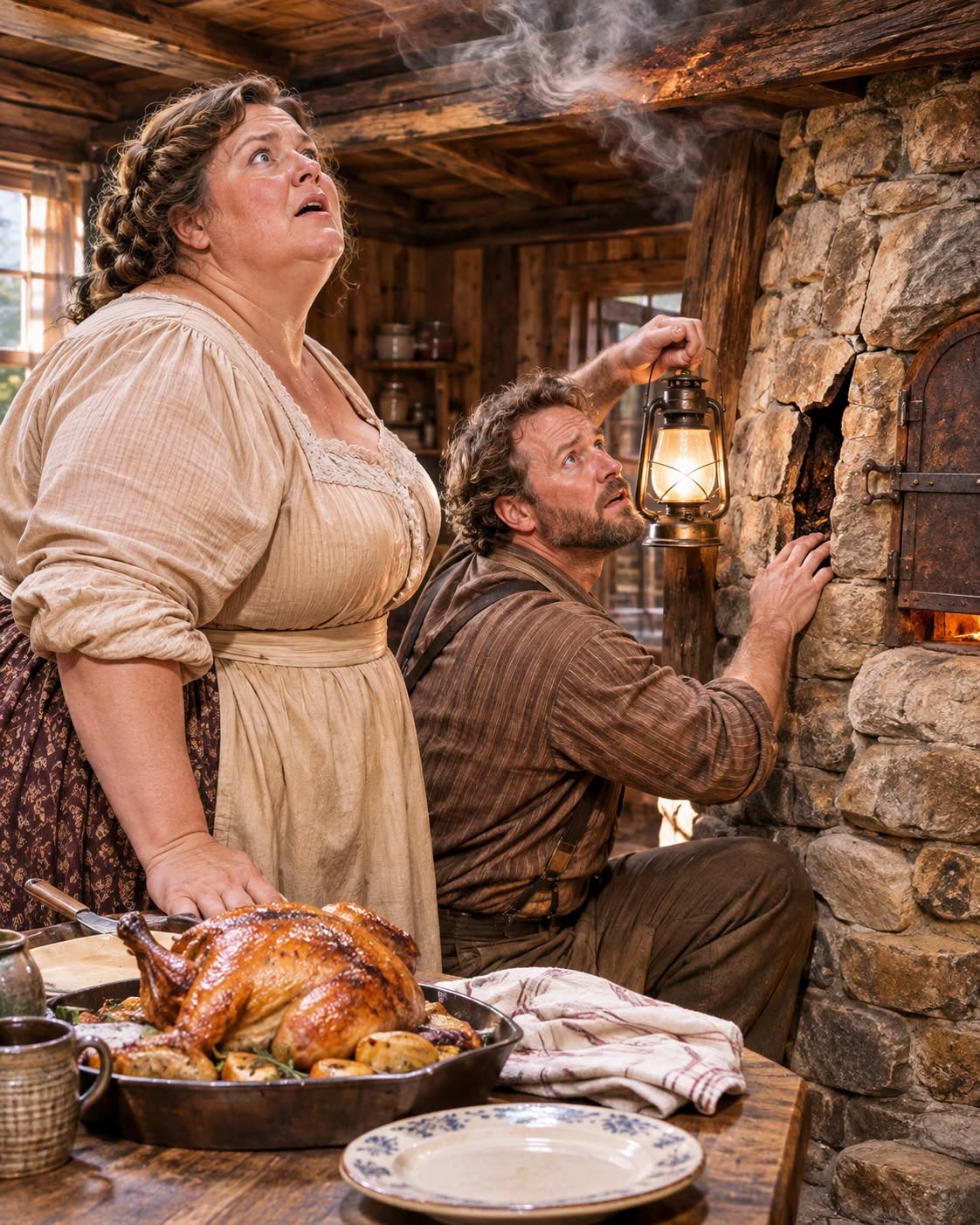
PART 2: THE FIRE BEHIND THE WALL WAS HIDING SOMETHING FAR MORE TERRIFYING
Thomas grabbed the iron poker and struck the burning wood beneath the oven, scattering a shower of sparks.
“Get away from the wall, Martha!”
She barely had time to turn before a loud crack echoed through the cabin.
A thin stream of smoke poured from the ceiling. Then another appeared near the wooden beam above the oven.
Thomas lifted the lantern, his face suddenly pale.
“The fire has traveled behind the stones.”
Martha stared at him.
“How far?”
He didn’t answer.
He didn’t know.
For a moment, neither of them moved. The warm, comforting cabin that had sheltered them through countless autumn nights had suddenly become a trap.
Thomas grabbed a bucket of water.
“Take the chicken outside. Get the blankets, too.”
Martha looked toward the table. Their supper remained untouched, the golden chicken sitting in the middle like an absurd reminder of what had brought them to this moment.
“Thomas, there’s something else.”
“What?”
“Listen.”
They both went silent.
Behind the wall came a faint scratching sound.
Three slow scratches.
Then silence.
Thomas raised the lantern closer to the blackened opening.
“Probably mice,” he muttered.
But Martha had lived long enough to know the difference between ordinary sounds and something that didn’t belong.
“That isn’t a mouse.”
Thomas took the iron poker and carefully removed another piece of loose clay.
A small section of stone shifted.
Behind it was a narrow cavity, much larger than either of them had expected.
And inside that cavity, something metallic reflected the lantern light.
Thomas reached forward, but Martha caught his wrist.
“Don’t.”
He looked at her.
“What?”
“There’s smoke coming from there. If the wood is burning behind those stones, opening it could make everything worse.”
For once, Thomas listened without arguing.
They rushed outside and collected buckets from the rain barrel. Thomas poured water over the smoking section of the wall while Martha dragged their bedding away from the cabin.
The smoke thickened.
Then came another sound.
A deep groan from somewhere inside the stonework.
Thomas stepped backward.
“That beam is giving way.”
A moment later, a burning piece of wood dropped from the ceiling and struck the floor.
Martha screamed.
Thomas stamped it out with his boot.
They worked desperately for nearly twenty minutes before the smoke began to thin. The fire hadn’t reached the main roof, but the wooden supports behind the oven were badly charred.
When the immediate danger had pᴀssed, Thomas examined the exposed cavity.
He found something that made his breathing stop.
It was a small iron box.
Not a cooking tool. Not a piece of old machinery.
A locked iron box, wrapped in what remained of a piece of dark leather.
“Thomas?”
He carefully pulled it from the opening.
The box was surprisingly heavy.
Its surface was covered in rust, but a small symbol remained visible on the lid.
A circle.
Three intersecting lines.
And beneath them, a name scratched into the iron.
EDWARD WHITMORE.
Martha stepped closer.
“Do you know that name?”
Thomas didn’t answer immediately.
He had seen it before.
Not in a book, but on an old wanted poster that had hung outside the settlement’s trading post nearly twelve years earlier.
Edward Whitmore had been a respected land surveyor who disappeared after accusing several wealthy men of stealing government land.
The official story claimed he had abandoned the territory.
But Thomas remembered something else.
A rumor.
People had whispered that Whitmore had discovered a hidden cache of documents proving that several prominent settlers had murdered families to seize their properties.
Then, one winter, he vanished.
Martha examined the box.
“Why would something belonging to him be inside our wall?”
Thomas turned it over.
On the bottom was a second inscription, almost hidden beneath the rust.
 IF THE WALL OPENS, THE TRUTH MUST COME OUT.
Martha felt a chill move through her.
“Who built this cabin?”
“An old man named Samuel Grady. He sold it to us before leaving for the northern territory.”
“Did he know about this?”
Thomas shook his head.
“I never asked.”
Martha looked toward the damaged oven.
“Then perhaps we should have.”
Thomas tried the lock, but it wouldn’t move.
He searched the box for a key and found nothing.
Then Martha noticed something.
“Look at the leather.”
A tiny piece of paper had been folded inside the wrapping. It was brittle, yellow, and nearly destroyed.
Thomas unfolded it carefully.
There were only two sentences.
THE FIRE WILL REVEAL WHAT THE STONE HAS KEPT.
TRUST NO MAN WHO COMES ASKING ABOUT THE OVEN.
They stared at the words.
Outside, the wind began to rise.
Then three knocks sounded against the cabin door.
Both turned.
It was nearly midnight.
Nobody in the settlement should have been traveling in that weather.
Thomas took his rifle and approached the door.
“Who’s there?”
A man’s voice answered.
“Samuel Grady.”
Thomas froze.
Martha looked at him in disbelief.
The former owner of their cabin had been gone for almost seven years.
Thomas opened the door only a few inches.
An elderly man stood outside, soaked from the rain, his gray beard trembling in the wind.
His eyes moved past Thomas and landed on the damaged oven.
Then they shifted to the iron box.
For several seconds, he said nothing.
Finally, he whispered:
“Good Lord. You opened it.”
Thomas тιԍнтened his grip on the rifle.
“You know what’s inside?”
Samuel stepped forward.
“Listen carefully. You have no idea what you’ve just uncovered.”
Martha stood behind Thomas.
“Then tell us.”
The old man’s expression changed.
He looked terrified.
“Because the man who killed Edward Whitmore is still alive.”
A sudden gust slammed the door against Thomas’s shoulder.
Samuel grabbed his arm.
“And he knows exactly where this cabin is.”
But before Thomas could ask another question, a gunsH๏τ exploded from the darkness outside.
Samuel collapsed onto the wooden floor.
And in his final breath, he whispered a name.
“Your… neighbor.”