PART 2: THE SECRET BURIED BENEATH HIS SCAR
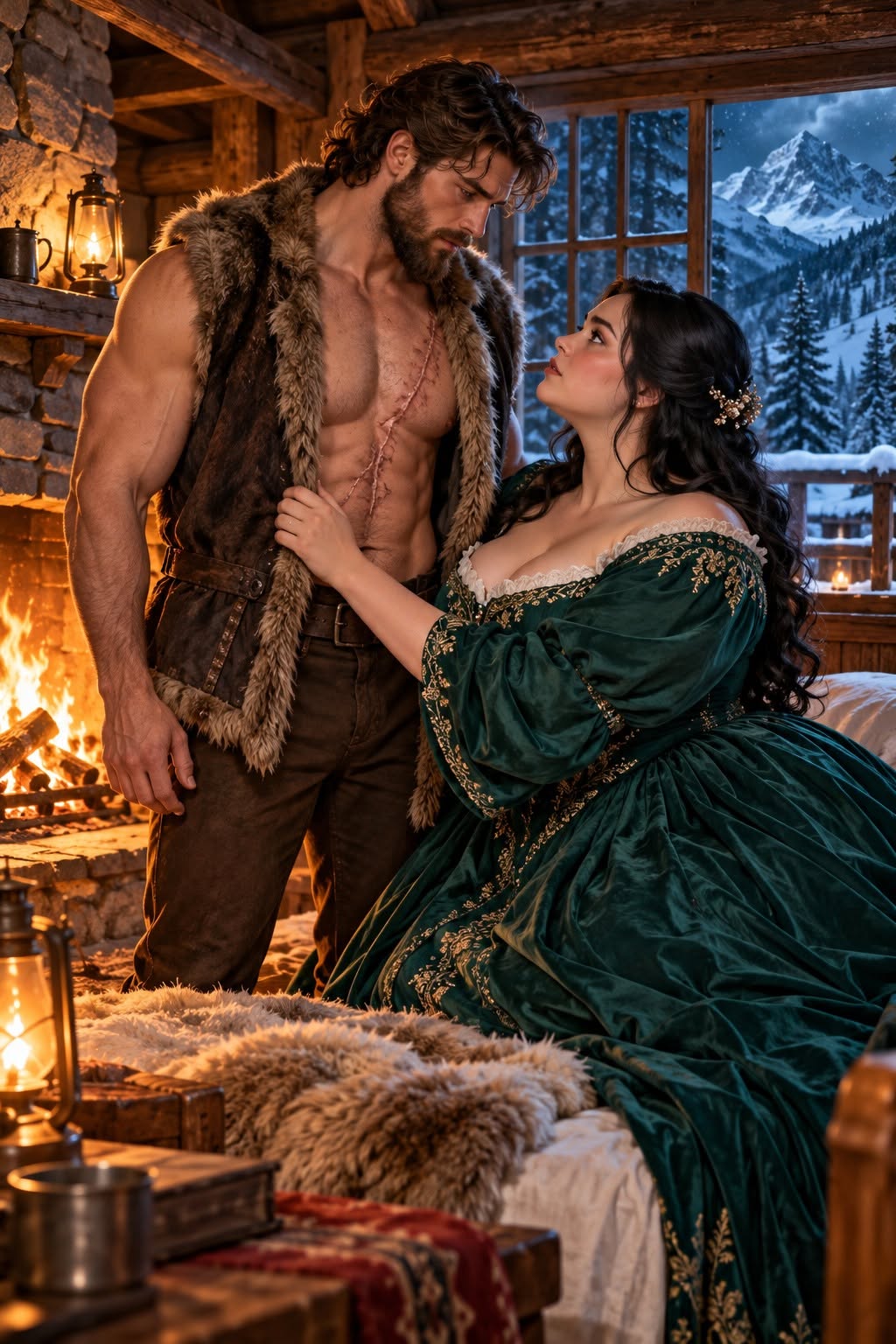
FOR NINETEEN YEARS, HE HID IN THE MOUNTAINS. ON HIS WEDDING NIGHT, HE FINALLY REACHED FOR THE FASTENING.
PART 2: THE SECRET BURIED BENEATH HIS SCAR
Eleanor could not move.
Beneath Caleb’s open waistcoat, a terrible scar crossed his chest, beginning near his left shoulder and disappearing beneath his ribs. The flesh was uneven, pale in some places and dark in others.
But it was not the scar itself that frightened her.
Something beneath it shifted.
Caleb immediately pulled the waistcoat closed.
“Now you understand.”
His voice sounded hollow.
Eleanor swallowed.
“What was that?”
He looked toward the window.
“An old bullet. It never came out.”
She stared at him.
“A bullet?”
“My father found me after the shooting. I was thirteen. The doctor said removing it would likely kill me.”
Caleb pressed his palm against the scar.
“Sometimes the muscles around it тιԍнтen. When the weather changes, it hurts. When I work too hard, I can barely breathe.”
Eleanor slowly lowered her eyes.
“Is that why you hide?”
He gave a humorless laugh.
“Partly.”
He turned toward the fire, but Eleanor noticed the way his shoulders had stiffened.
“You think I’m frightened of you because of that?”
“Most people would be.”
“Most people aren’t standing in this cabin.”
Caleb looked back at her.
For a moment, he seemed unable to understand what she meant.
Then he pulled his waistcoat over his shoulder and sat down heavily.
“My father used to say that a man should never let the world see where he was wounded.”
Eleanor approached him, stopping at a respectful distance.
“Your father was wrong about that.”
Caleb looked at her for a long moment.
Then he began telling her the story.
His father, Jonathan Mercer, had worked as a foreman at a silver mine near Silver Creek. The family had lived in a small house at the edge of town.
Caleb had been thirteen when he first learned that adults could lie about terrible things.
The mine belonged to a wealthy businessman named Gideon Rusk.
One winter evening, Jonathan discovered that Rusk had been ordering miners to work inside unstable tunnels. Several men had died. Their deaths were recorded as accidents, and their families were paid to remain silent.
Jonathan refused to cooperate.
He collected the names, dates, and signed orders that proved what had happened.
Three nights later, armed men came to their house.
“They were looking for the papers,” Caleb whispered.
His mother hid him beneath the floorboards.
He remembered the sound of boots, the smell of smoke, and his mother’s voice telling him not to make a sound.
Then came the gunsH๏τs.
One bullet pᴀssed through the floor and struck Caleb in the chest.
His mother died that night.
His father dragged him into the snow and carried him nearly six miles before finding shelter.
For weeks, Caleb hovered between life and death.
When he finally woke, Jonathan told him that everyone believed they were ᴅᴇᴀᴅ.
“And you never went back?” Eleanor asked.
“My father said Rusk owned the sheriff, the judge, and half the men in the county. He said if we returned, Rusk would finish what he’d started.”
Caleb stared at his hands.
“My father died four years later. I buried him on the mountain. I was seventeen.”
Eleanor’s heart ached.
“You were just a boy.”
“I learned to cut wood. Build traps. Hunt. Repair roofs. I learned how to survive.”
He paused.
“But nobody ever taught me how to live with another person.”
The admission was so quiet that Eleanor almost missed it.
She sat across from him.
“Why did you place the marriage advertisement?”
Caleb hesitated.
“Last spring, I found something in my father’s old trunk.”
He stood, crossed the room, and retrieved a small wooden box.
Inside lay several folded letters, a pH๏τograph, and a newspaper clipping.
He handed her the clipping.
The headline read:
SILVER CREEK MINE DISASTER: FOREMAN JONATHAN MERCER SUSPECTED OF THEFT AND MURDER.
Eleanor’s face тιԍнтened.
“They blamed your father?”
“They said he’d stolen the payroll and caused the collapse. He was ᴅᴇᴀᴅ by then, so he couldn’t defend himself.”
Caleb gave her another letter.
“Three months ago, I received this.”
The handwriting was unfamiliar.
The letter contained only two sentences.
We know Jonathan Mercer left something behind. His son cannot remain hidden forever.
Eleanor looked up.
“Someone knows you’re alive.”
Caleb nodded.
“That’s why I needed a wife.”
She stared at him.
He quickly shook his head.
“Not to use you. Not to put you in danger. I thought if I married someone, if I had a family, perhaps I could finally stop living like a ghost.”
 His voice broke.
“But I should have told you before the wedding.”
Eleanor looked at the man before her.
A man who had spent nineteen years believing that his existence was a danger to anyone who loved him.
She knew something about being made to feel like a burden.
Henry had taught her that every meal she ate was something to apologize for. Every dress she wore was too expensive. Every happiness she expressed was somehow embarrᴀssing.
She had promised herself she would never again beg someone to see her worth.
Yet here was Caleb, doing exactly that without realizing it.
“You should have told me,” she said.
He lowered his head.
“I know.”
“But I am not sorry I married you.”
His eyes lifted.
“Eleanor…”
“Don’t decide what I can endure before giving me the chance to decide for myself.”
For the first time that evening, Caleb smiled.
It was a small, uncertain smile.
Then Eleanor noticed the pH๏τograph inside the box.
Three men stood outside a mine entrance. One was Jonathan Mercer. Another was a younger Gideon Rusk.
The third man wore a sheriff’s badge.
She picked up the pH๏τograph.
“Who is this?”
Caleb leaned closer.
“Sheriff Thomas Bell.”
Eleanor turned the pH๏τograph over.
Something had been written on the back.
If anything happens to Jonathan, find the woman in the green dress. She knows where the original ledger is hidden.
Eleanor felt a chill.
She looked down at her emerald wedding gown.
“Caleb…”
He took the pH๏τograph from her.
“That was written nineteen years ago.”
Before either could speak, a sound came from outside.
Three sharp knocks.
Not at the door.
At the window.
Caleb reached for his rifle.
Eleanor stood behind him.
A small stone lay on the floor beneath the window. Wrapped around it was a piece of paper.
Caleb unfolded it.
His face changed.
The message contained six words:
WE FOUND YOUR WIFE, MERCER.
A second line had been added beneath it.
ASK HER WHAT HER FATHER STOLE.
Eleanor’s knees weakened.
Caleb turned slowly.
“What does that mean?”
She stared at the paper.
For several seconds, she could not speak.
Then she whispered:
“My father was the county judge in Silver Creek.”
Caleb went still.
“And?”
Eleanor looked at him with tears gathering in her eyes.
“He died when I was sixteen. Before he died, he told me never to speak about the night he brought home a leather book.”
Caleb’s grip тιԍнтened around the paper.
“What book?”
She shook her head.
“I don’t know. He hid it somewhere. My mother said it was only an old account book.”
Caleb stepped closer.
“Eleanor, did your father ever mention Gideon Rusk?”
Her silence answered him.
Then, from somewhere beyond the cabin, a man’s voice called through the storm.
“Mrs. Mercer! We know you’re in there!”
Caleb raised his rifle.
Eleanor reached for his arm.
But the voice spoke again.
And this time, the words made her blood run cold.
“Your father’s murderer has come to collect what belongs to him.”
Caleb turned toward the door.
Eleanor whispered one name.
“Gideon.”
Outside, a gunsH๏τ shattered the darkness.
And the cabin door began to splinter.