PART 2 – THE SECRET BEHIND THE BETRAYAL
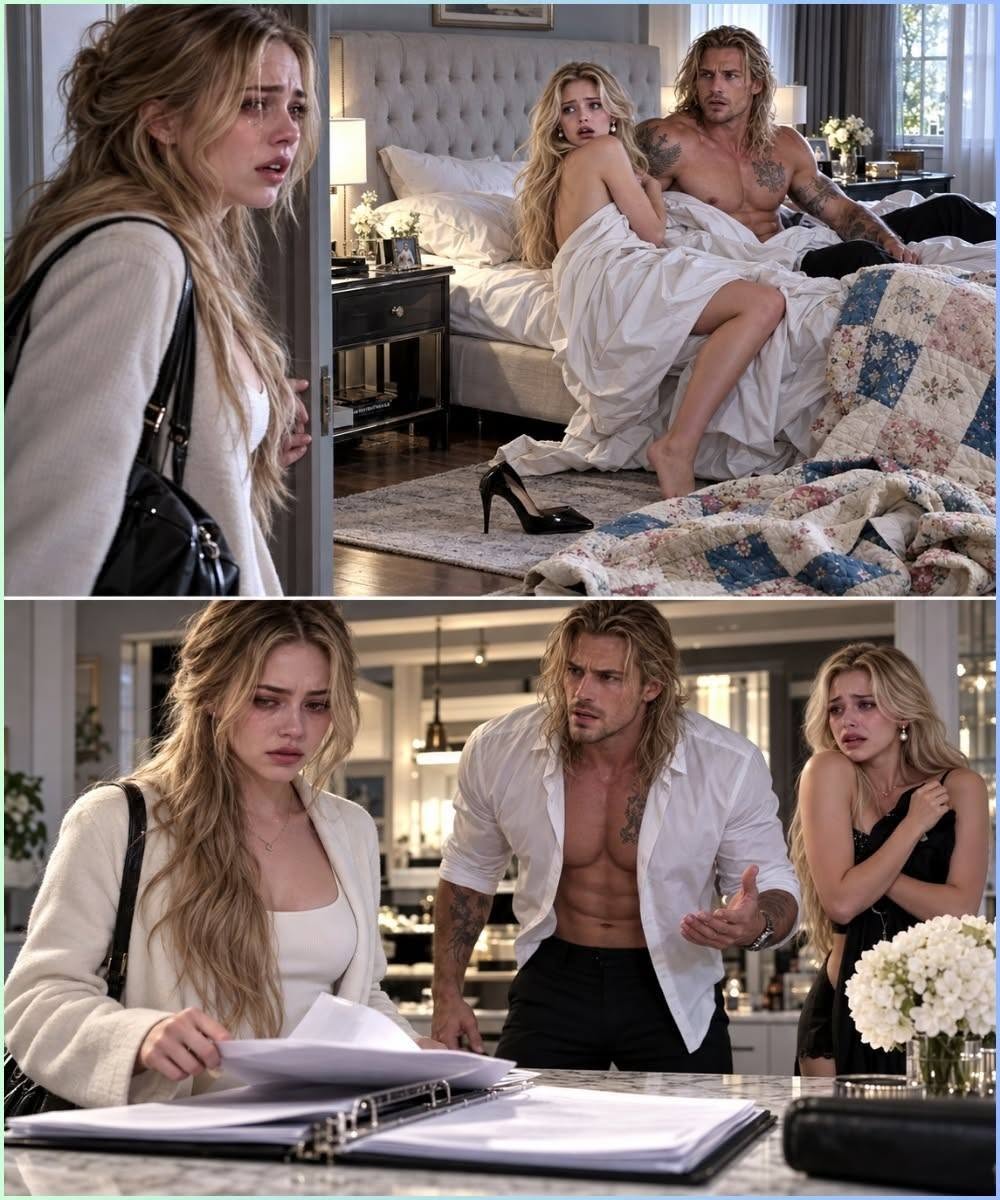
Sloane stared at me.
“What?”
“Did you accidentally fall into my bedroom? Did you accidentally take off your clothes? Did you accidentally climb into my fiancé’s bed?”
“Wren, please. You’re making this worse.”
I closed the wedding binder.
“No, Sloane. You made it worse. I’m just refusing to pretend it isn’t happening.”
Bennett stepped between us.
“Stop attacking her. This is between you and me.”
I looked at him.
“That’s interesting. Because I distinctly remember finding both of you in my bed.”
He had no answer.
Then Sloane said something that changed the entire conversation.
“Bennett was going to tell you.”
I slowly turned toward her.
“When?”
She wiped her cheeks.
“After the wedding.”
For a moment, I couldn’t understand what she’d said.
“After the wedding?”
Bennett looked at the floor.
Sloane continued, her voice trembling.
“He was going to end things with me. He said he wanted to marry you. He said what happened between us was complicated.”
I stared at her.
“Complicated?”
She nodded.
“We didn’t plan for it to happen.”
I looked at Bennett.
“How long?”
He rubbed his forehead.
“Wren, it started last summer.”
Last summer.
I mentally counted.
Eight months.
Eight months of family dinners.
Eight months of wedding planning.
Eight months of Bennett kissing my forehead before bed and telling me how lucky he was.
Eight months of Sloane texting me heart emojis and asking whether I needed help with the flowers.
Eight months of both of them knowing exactly what they were doing.
“Did you sleep with her in this house before today?”
Bennett didn’t answer.
I nodded.
“Right.”
I turned toward the staircase.
“Get out.”
“Wren—”
“Get out of my house.”
He looked offended.
“This is our house.”
I almost admired the audacity.
The house had belonged to my grandmother. She left it to me before she died, and I had spent four years renovating it. Bennett had moved in eighteen months earlier, but he had never been on the deed.
He knew that.
Apparently, he had forgotten.
“No,” I said. “This is my grandmother’s house. You live here because I invited you. That invitation is over.”
His expression changed.
“You can’t throw me out like this.”
“I just did.”
Sloane picked up her purse.
“Wren, can we please talk privately?”
I looked at her.
“We’ve been talking privately for years. Apparently, you had plenty of conversations I wasn’t invited to.”
She lowered her head.
Then Bennett made his biggest mistake.
He said, “You need to think about what this will do to your mother.”
I stopped.
Slowly, I turned around.
“What does my mother have to do with this?”
He glanced at Sloane.
It was brief.
But I saw it.
And so did she.
Something pᴀssed between them.
Fear.
I looked at my stepsister.
“What did you tell him?”
She shook her head.
“Nothing.”
“Then why did he bring up Mom?”
Bennett sighed.
“Your mother has been under a lot of stress. The wedding is important to her. We shouldn’t make this public until we’ve figured out how to handle everything.”
I stared at him.
“You’re worried about publicity?”
“I’m trying to protect everyone.”
“No. You’re trying to protect yourself.”
He stepped closer.
“Wren, listen. Your mother and I have had conversations about the future. She knows how much this wedding means.”
I felt something cold move through my chest.
“What conversations?”
Neither answered.
Then Sloane whispered:
“Maybe you should ask your mother.”
I picked up my phone.
I called her.
She answered on the fourth ring.
“Sweetheart? Is everything okay? I was just looking at the seating chart.”
I closed my eyes.
“Mom, did you know Bennett was having an affair with Sloane?”
Silence.
Not confusion.
Not disbelief.
Silence.
The kind that arrives when someone has been waiting for a question they hoped would never be asked.
“Mom?”
Her voice became very small.
“Wren, please don’t do anything until we talk.”
My fingers тιԍнтened around the phone.
“You knew?”
“I was going to explain.”
“When?”
“After the wedding.”
I looked at Bennett.
He had gone completely still.
I felt the room move around me.
My mother knew.
My own mother knew.
And apparently, everyone had decided that the best way to handle my wedding was to let me walk down the aisle first.
“Why?” I whispered.
“Because I didn’t want to lose you.”
I laughed once.
A small, empty sound.
“You should have thought about that before helping them lie to me.”
“Wren, listen. There are things you don’t understand.”
“Then explain them.”
My mother began crying.
“Your grandmother’s house. The inheritance. The money. Bennett was trying to help us.”
I looked at the wedding binder.
Then at the man who had slept with my stepsister.
“What money?”
My mother stopped speaking.
And that was when I knew the affair wasn’t the whole story.
PART 3 – THE WEDDING WAS NEVER JUST ABOUT LOVE
My mother arrived forty minutes later.
Her name was Elaine Calder.
She was sixty-one, elegant, carefully dressed, and usually capable of making any uncomfortable conversation sound like a misunderstanding.
That afternoon, she looked ten years older.
She entered the kitchen and immediately glanced at Bennett.
Then Sloane.
Then me.
“Where is everyone?”
“There’s nobody else coming, Mom.”
She set her handbag on the counter.
“Wren, please. Let’s sit down.”
I remained standing.
“Tell me about the money.”
She closed her eyes.
For several seconds, she didn’t speak.
Then she admitted that Bennett had been helping her with financial matters for nearly a year.
My mother had accumulated significant debt after a failed investment in a small commercial property.
She had borrowed money from several sources and fallen behind on payments.
She was terrified I would find out.
Bennett had offered to help.
At first, he reviewed her accounts and contacted creditors.
Then he started discussing the possibility of using the property I had inherited from my grandmother as collateral for a loan.
My grandmother’s farmhouse.
The house I lived in.
The house where Bennett and Sloane had been sleeping together.
I stared at my mother.
“You wanted to borrow against my house?”
“Only temporarily.”
“Without asking me?”
“Bennett said it would be easier once you were married.”
I looked at him.
He didn’t deny it.
“Easier how?”
My mother answered.
“He said you would eventually combine your finances. He thought the bank would approve a larger loan if you were married.”
I felt sick.
“So the wedding was a financial strategy?”
“No!” Bennett interrupted. “I loved you.”
“Then why were you discussing my inheritance with my mother behind my back?”
He looked frustrated.
“Because I was trying to solve a problem.”
“Whose problem?”
Nobody answered.
I looked at Sloane.
She was sitting on the edge of a chair, twisting her engagement-party bracelet around her wrist.
“Did you know about the loan?”
She nodded.
“How much?”
“Wren…”
“How much?”
“Three hundred and twenty thousand dollars.”
The number landed like a physical blow.
I looked at my mother.
“Three hundred and twenty thousand?”
She began crying again.
“I didn’t know how to fix things.”
I turned to Bennett.
“And you thought sleeping with my stepsister would help?”
He slammed his hand against the counter.
“Enough! I’m tired of being treated like the villain here. I’ve spent months trying to keep this family together.”
I looked at him.
“You’ve spent eight months sleeping with Sloane.”
“That’s not fair.”
I almost smiled.
“Fair?”
He lowered his voice.
“Wren, I made mistakes. But you have to understand that I was under pressure, too.”
“From whom?”
He hesitated.
Then Sloane spoke.
“From me.”
Everyone turned toward her.
She was crying, but her voice was steady now.
“I told Bennett I was pregnant.”
The room went silent.
I looked at her.
“What?”
She nodded.
“Two months ago.”
My mother covered her mouth.
Bennett immediately stood.
“Sloane, don’t.”
But she continued.
“I told him I couldn’t keep pretending everything was fine. I said he had to make a choice.”
I stared at Bennett.
“Is she pregnant?”
He looked at me.
“I don’t know.”
Sloane wiped her face.
“I took a test. It was positive.”
My mother sank into the nearest chair.
For a few seconds, I couldn’t think.
Then I asked the only question that mattered.
“Were you planning to marry me while she was carrying your child?”
Bennett’s silence was enough.
Sloane whispered, “He said he would take responsibility.”
I looked at her.
“And what was I supposed to do? Raise your child?”
“No!”
“Pay your bills? Sign the loan? Smile in the wedding pH๏τographs?”
She began sobbing.
I turned toward Bennett.
“You were going to marry me, use my inheritance to solve your financial problems, and keep your pregnant mistress hidden.”
He shook his head.
“That’s not what happened.”
“Then tell me what happened.”
He had no answer.
For the first time, I understood something.
Bennett wasn’t frightened because he had lost the woman he loved.
He was frightened because the arrangement he had carefully constructed was falling apart.
I picked up my phone.
“I’m calling my attorney.”
My mother stood.
“Wren, please. We can work this out as a family.”
I looked at her.
“You stopped being a family when you decided my consent was optional.”
She flinched.
I called my attorney, Margaret Ellis.
She had handled the transfer of my grandmother’s estate and knew exactly how the property was тιтled.
I explained what had happened.
She listened without interrupting.
Then she asked me to check whether Bennett had access to any of my financial documents.
I looked toward the home office.
My laptop was there.
So was the folder containing my grandmother’s property records.
Margaret told me not to sign anything, not to transfer money, and not to allow anyone to remove documents.
Then she said something that made my heart race.
“Wren, I need you to look inside the blue folder your grandmother left with the original deed.”
I went upstairs.
The bedroom was still in disarray.
The quilt remained on the floor.
I picked it up and folded it carefully over the chair.
Then I opened the home office cabinet.
The blue folder was exactly where I had left it.
Inside were the deed, tax documents, and a sealed envelope with my name written in my grandmother’s handwriting.
I had never opened it.
The envelope had been marked:
For Wren, when she is ready to understand why this house matters.
My hands trembled as I broke the seal.
Inside was a letter.
My grandmother had written that she had established a separate trust to protect the property from future debts, marriages, and financial claims.
The house was not merely inherited property.
It was held in a protected family trust, with me as its sole beneficiary.
Bennett could never use it as collateral without my explicit legal authorization.
And my mother had no authority over it whatsoever.
At the bottom was a second document.
A letter from the attorney who had helped establish the trust.
It mentioned an earlier attempt by someone to obtain information about the property.
The request had come through a financial adviser.
I read the name.
Bennett Shaw.
My stomach dropped.
He hadn’t merely been discussing a possible loan.
He had already tried to investigate the legal structure of my inheritance.
I took pH๏τographs of every page and sent them to Margaret.
Then I walked downstairs.
Bennett was standing near the kitchen island.
“Where have you been?”
I placed the letter in front of him.
“Reading.”
He looked at it.
His face changed.
“Where did you get that?”
“My grandmother.”
He picked it up.
His hands began shaking.
“You don’t understand what this means.”
I looked directly at him.
“I understand perfectly.”
My mother stood behind him.
“Wren, please don’t turn this into something worse.”
I turned toward her.
“Mom, did you know he had already contacted the trust attorney?”
She looked at Bennett.
That was her answer.
I felt the last remaining piece of my childhood disappear.
Then Margaret called back.
Her voice was serious.
“Wren, I’ve reviewed the documents. There’s something else you need to know.”
“What?”
“The attorney who received Bennett’s inquiry kept a record of the communication. He also preserved an email in which Bennett discussed your upcoming marriage and the possibility of obtaining your signature afterward.”
I closed my eyes.
“Can you send it to me?”
“I already have.”
A notification appeared on my phone.
I opened the email.
There were three lines that made everything unmistakably clear.
Once we’re married, the financial situation becomes easier to manage.
Elaine believes Wren will agree when she understands the family needs.
The paperwork can be handled afterward.
I looked at Bennett.
“You never intended to ask me.”
He said nothing.
“You intended to put a ring on my finger first and make it difficult for me to say no afterward.”
He finally looked up.
“Wren, I can explain.”
I shook my head.
“No. You’ve explained enough.”
Then I walked to the front door and opened it.
“Get out.”
This time, nobody argued.
Bennett collected his overnight bag.
Sloane followed him.
My mother remained in the kitchen.
“Wren, where am I supposed to go?”
I looked at the woman who had raised me.
“You can go home.”
“This is my home, too.”
“No, Mom. This is Grandma’s house. She left it to me because she trusted me to protect it.”
Elaine began crying.
I didn’t move.
Finally, she picked up her handbag and walked outside.
I closed the door.
Then I stood in the hallway for a long time.
The house was quiet.
The wedding binder remained on the kitchen island.
The quilt was folded over the chair.
And for the first time in seven years, I wasn’t waiting for Bennett to come home.
PART 4 – THE SIX DAYS THAT CHANGED EVERYTHING
The next six days were not dramatic.
They were exhausting.
I canceled the pH๏τographer, the florist, the transportation, and the H๏τel reservations.
I contacted the guests personally.
Some were kind.
Some were confused.
A few asked whether Bennett and I might reconsider.
I didn’t explain everything.
I simply said the wedding was canceled because of circumstances that made marriage impossible.
Margaret handled the financial matters.
She sent formal notices confirming that Bennett had no ownership interest in the property and no authority to use it as security.
The trust documents were reviewed.
The bank confirmed that no loan had been approved or secured against my grandmother’s house.
That was the first relief I had felt in days.
Then came the messages.
Bennett sent seventeen in one evening.
The first apologized.
The second blamed stress.
The third said Sloane had manipulated him.
The fourth said he had never stopped loving me.
The fifth said I was destroying his life.
I stopped reading after that.
Sloane sent a longer message.
She said she had always felt inferior to me.
She said my mother had treated us differently.
She said she had spent years feeling like a visitor in a family that already belonged to me.
I read the message twice.
Then I deleted it.
I could understand insecurity.
I could understand resentment.
But I could not understand how someone could turn those feelings into a reason to climb into her sister’s bed.
On the sixth day, I went to the vineyard.
Cᴀss met me outside the reception hall.
She looked genuinely sorry.
“I wish things had turned out differently.”
“So do I.”
She handed me an envelope.
Inside was a partial refund for several services that hadn’t yet been provided.
I thanked her.
Then I walked through the empty reception space.
The chairs were stacked.
The flowers hadn’t been ordered.
The dance floor was bare.
I had imagined that room filled with people.
I had imagined Bennett waiting at the end of the aisle.
I had imagined my grandmother’s quilt draped over a chair near the front, where everyone could see it.
Instead, there was nothing.
And strangely, I felt peaceful.
I didn’t need a wedding to prove I had loved someone.
I didn’t need to marry a man simply because I had spent seven years believing he was the right one.
I could grieve the future I had imagined without sacrificing the future I still had.
That evening, my mother called.
I almost let it go to voicemail.
But I answered.
“Wren?”
“Yes.”
“I know you don’t want to hear from me.”
“That’s true.”
She took a shaky breath.
“I was wrong.”
I didn’t respond.
“I was scared about the debt. I thought Bennett could help. Then I discovered what was happening between him and Sloane, and I convinced myself it would stop.”
“Why didn’t you tell me?”
“Because I was afraid you’d leave.”
I looked at the quilt folded at the end of my bed.
“You were so afraid of losing me that you helped everyone lie to me.”
She began crying.
“I know.”
“Do you?”
“Yes.”
I didn’t forgive her that night.
But I listened.
And sometimes, listening is the first step toward deciding whether a relationship can ever be repaired.
PART 5 – THE WEDDING THAT NEVER HAPPENED
Three months later, I received an unexpected invitation.
It was from my cousin, Hannah.
She was hosting a small family dinner at the farmhouse.
I almost declined.
Then I remembered that my grandmother had loved that house because it was always full of people.
So I went.
My mother was there.
She looked different.
Quieter.
She apologized again, this time without asking me to forgive her.
She told me she had begun working with a financial counselor and was making a repayment plan.
I wished her well.
We didn’t hug.
Not yet.
Sloane wasn’t there.
I later learned that she had moved to another state.
She and Bennett had separated before the baby was born.
The pregnancy had been confirmed, but the relationship had collapsed under the weight of everything that happened.
I didn’t ask for details.
I didn’t need them.
Bennett eventually sent one final letter.
He wrote that he regretted losing me and that he had made decisions he could never take back.
He said he hoped I would remember the good years.
I folded the letter and put it in a drawer.
Not because I wanted to preserve it.
Because I no longer needed to carry it around.
A year after the canceled wedding, I invited a few close friends to the farmhouse.
There was no ceremony.
No expensive flowers.
No rented ballroom.
Just food, laughter, and people who had shown me what loyalty looked like when it actually mattered.
My grandmother’s quilt was spread across the old wooden table.
One of my friends asked where I had bought it.
I smiled.
“My grandmother made it.”
She touched the fabric.
“It’s beautiful.”
I looked down at the uneven sтιтches and the faded pieces of old dresses.
“Yes,” I said. “It is.”
Then I remembered what my grandmother used to tell me.
You could tell what kind of people lived in a house by the way they treated the things no one else would notice.
For a long time, I thought she was talking about furniture.
Now I understood she had been talking about people.
And I had finally learned the difference between someone who wanted a place in my life and someone who deserved one.
I never married Bennett Shaw.
I never signed the loan.
And I never again confused seven years of history with a lifetime obligation.
Because the worst thing Bennett and Sloane took from me wasn’t the wedding.
It was the future I had imagined.
And the best thing I did for myself was refuse to spend the rest of my life pretending that future still existed.
THE END.