PART 2 — THE PRICE OF SILENCE
PART 2 — THE PRICE OF SILENCE
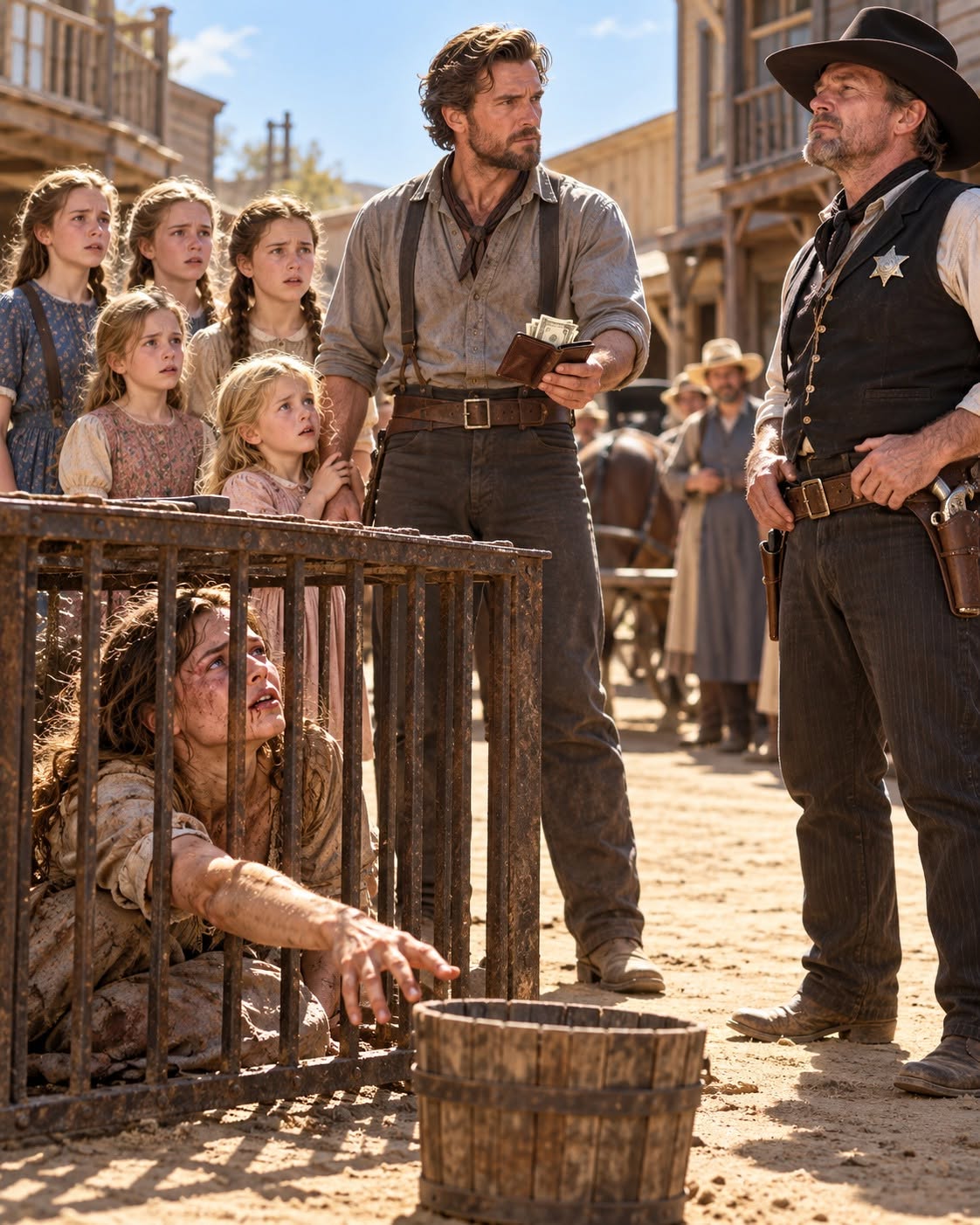
Sheriff Dolan stared at Samuel McCord’s wallet.
The bills inside were enough to make the sheriff’s eyes flicker with interest. But his smile returned almost immediately.
“You think money buys everything, McCord?”
“No,” Samuel replied. “But it might buy you the chance to do the right thing before you make this worse.”
Dolan stepped closer.
“You’re interfering with lawful business.”
Samuel looked at the cage.
“Then tell me what law allows you to leave a woman without water for five days.”
A murmur rippled through the crowd.
Dolan’s face reddened.
“She’s a vagrant. She’s been punished.”
“Punished for what?” Samuel asked. “For asking for work?”
The sheriff glanced toward the barber shop, where Mr. Henley stood with his arms folded.
“Keep your nose out of this.”
Samuel did not move.
His youngest daughter, six-year-old Rosie, stepped out from behind him. She held a small tin cup in both hands.
“Papa,” she whispered, “can I give her water?”
Samuel looked at the cup.
Then he looked at Hannah.
Her eyes were barely open. Her lips had cracked, and her hands rested weakly against the bars.
“Yes, sweetheart,” he said.
Rosie hurried forward.
Dolan blocked her path.
“Stay back, little girl.”
 Rosie stopped. She looked up at the sheriff, then at the cage.
“But she’s thirsty.”
The words were so simple that the crowd seemed to forget how to breathe.
Dolan glanced around. He had expected fear, perhaps a few murmurs. He had not expected a child to question him in front of the entire town.
“Move along,” he snapped.
Samuel stepped between him and Rosie.
“No.”
The sheriff’s hand moved toward his belt.
Samuel’s voice remained calm.
“You can arrest me if you wish. But you’ll have to explain to the county judge why a six-year-old girl was forbidden to give water to a woman who has committed no violent crime.”
Dolan hesitated.
The crowd had changed.
A few men who had laughed at Hannah’s suffering now looked uncomfortable. A woman standing beside the bakery reached for her own water bottle. Someone near the mercantile whispered, “This has gone too far.”
Then Mr. Henley spoke.
“Unlock the cage, Dolan.”
The sheriff turned on him.
“You too?”
“I heard her ask for work,” the old barber said. “I heard Mrs. Pritchard refuse her. I watched you drag her into that cage. I’ve said nothing for four days, and I’m ashamed of it.”
Another voice joined him.
“So am I.”
Then another.
The sheriff’s confidence began to crumble.
He looked at Samuel.
“Fine. You want her out? Pay the fee.”
Samuel’s expression hardened.
“There is no fee.”
Dolan gave a mocking laugh.
“Then she stays.”
Samuel turned toward the crowd.
“Does anyone here know the territorial law on vagrancy?”
A man in a dark coat stepped forward from the edge of the square.
“I do.”
It was Judge Elias Warren, who had arrived in Dusk Creek that morning to inspect the county records. He had been standing near the H๏τel, watching the gathering.
Dolan stiffened.
“Judge.”
Warren walked toward the cage.
“Vagrancy does not authorize public torture, Sheriff. Nor does it permit you to deny a prisoner water.”
“She was a nuisance,” Dolan muttered.
“Then you should have issued a lawful citation. You did not have the authority to imprison her in this manner.”
The judge looked toward the blacksmith.
“Mr. Turner, do you have the key?”
The blacksmith nodded slowly.
“I do.”
Dolan’s face turned dark.
“That key belongs to the sheriff’s office.”
“And I made the lock,” Turner replied. “You gave me the order to build it.”
He stepped forward.
The key turned.
The cage door creaked open.
For a moment, Hannah did not move.
She seemed unable to believe that the door was truly open.
Then her knees buckled.
Samuel caught her before she fell.
“Easy,” he said. “You’re safe now.”
Hannah’s head rested against his shoulder. She tried to speak, but no sound came.
Rosie rushed forward with the tin cup.
“Here, ma’am.”
Samuel helped Hannah drink slowly.
The water touched her lips, and she closed her eyes.
A few people in the crowd turned away.
Not because they were disgusted by Hannah.
Because they were ashamed of themselves.
Samuel carried Hannah to the doctor’s office.
His five daughters followed, Rosie holding тιԍнтly to his hand.
Dr. Bell examined Hannah and ordered her to rest. He gave her cool water, a little broth, and clean bandages for the places where the iron had rubbed against her skin.
“She needs time,” he said. “And quiet.”
Samuel nodded.
“Can she stay at my home?”
The doctor looked at him.
“You have five children.”
“I know.”
“You’re a widower. Your house is already crowded.”
Samuel glanced toward the little girls waiting in the hallway.
Then he looked at Hannah, who lay exhausted on the examination bed.
“I know that too.”
The doctor said nothing more.
When Hannah woke several hours later, the sun had begun to set. She found herself in a clean room with a quilt over her legs and a glᴀss of water on the bedside table.
Samuel sat near the window, repairing a small wooden toy.
“You’re awake,” he said.
Hannah tried to sit up.
“Please don’t,” he added. “The doctor says you need rest.”
She looked around the room.
“Where am I?”
“My home. My daughters insisted you should have the quietest room.”
Hannah’s eyes filled.
“I don’t know how to thank you.”
“You don’t have to.”
She looked down at her hands.
“People watched me for five days.”
Samuel set the toy aside.
“I know.”
“Some of them laughed.”
“I know.”
“Why didn’t anyone help?”
Samuel did not answer immediately.
He had asked himself the same question since the moment Rosie had spoken.
“Sometimes,” he said quietly, “people convince themselves that cruelty is someone else’s responsibility. They wait for a braver person to step forward.”
Hannah swallowed.
“And today?”
“Today my daughter asked a question I should have asked sooner.”
A silence settled between them.
Then Hannah whispered, “I was afraid I would die in that cage.”
Samuel’s expression changed.
“You won’t be going back.”
The next morning, Dusk Creek woke to a town meeting.
Judge Warren had ordered Sheriff Dolan to surrender his records. The county would investigate the unlawful imprisonment, and Mrs. Pritchard was summoned to explain why she had falsely accused Hannah of begging.
But the most surprising testimony came from a young stable boy.
He admitted that Dolan had been paid by a group of merchants to “make an example” of anyone they considered undesirable.
Hannah had been chosen because she was alone.
Because she was poor.
Because she had no family in town to defend her.
And because the merchants believed nobody would care.
When the judge asked Hannah whether she wished to press charges, she sat quietly for a long moment.
She could have demanded punishment.
She could have named every person who had laughed.
Instead, she said:
“I want the cage removed from Main Street.”
The judge looked at her.
“Anything else?”
“Yes.”
Hannah’s voice grew stronger.
“I want the town to establish a place where women without work can ask for help without being treated like criminals. A place where they can earn a meal, find shelter, and be heard.”
The room fell silent.
Samuel watched her with quiet respect.
She had been humiliated in front of the entire town.
And now she was asking them to make sure no one else endured the same cruelty.
Judge Warren nodded.
“That is a reasonable request.”
The cage was dismantled before the end of the week.
The iron bars were taken to the blacksmith’s shop, where they were melted down and used to make hinges, tools, and a new gate for the town’s public garden.
Sheriff Dolan was suspended pending investigation.
Mrs. Pritchard never apologized publicly, but she stopped turning away women who asked for work.
And Hannah?
She stayed at Samuel McCord’s home while she recovered.
At first, she insisted she would leave as soon as she could stand without dizziness.
But Rosie had other plans.
The little girl brought Hannah drawings, asked her to read stories, and insisted she sit beside her at supper.
The older daughters began asking Hannah for help with sewing, cooking, and arithmetic.
Samuel found himself listening for Hannah’s voice in the kitchen each morning.
And Hannah, who had believed she had nowhere left to go, began to feel something she had not felt in years.
Belonging.
Yet one evening, as Samuel returned from town, he found Hannah standing on the porch with a folded letter in her hand.
Her face had gone pale.
“Samuel,” she said, “I need to tell you something.”
He stopped.
“What is it?”
Hannah looked toward the road leading out of Dusk Creek.
“The man who arranged for me to be locked in that cage wasn’t Sheriff Dolan.”
Samuel’s expression darkened.
“Who was it?”
She held out the letter.
At the bottom was a name Samuel recognized.
A name connected to the land he had spent years trying to protect.
And when he read it, he realized Hannah’s arrival in Dusk Creek had not been an accident.
To be continued in Part 3…