PART 2: THE POWER THEY NEVER KNEW HE HAD
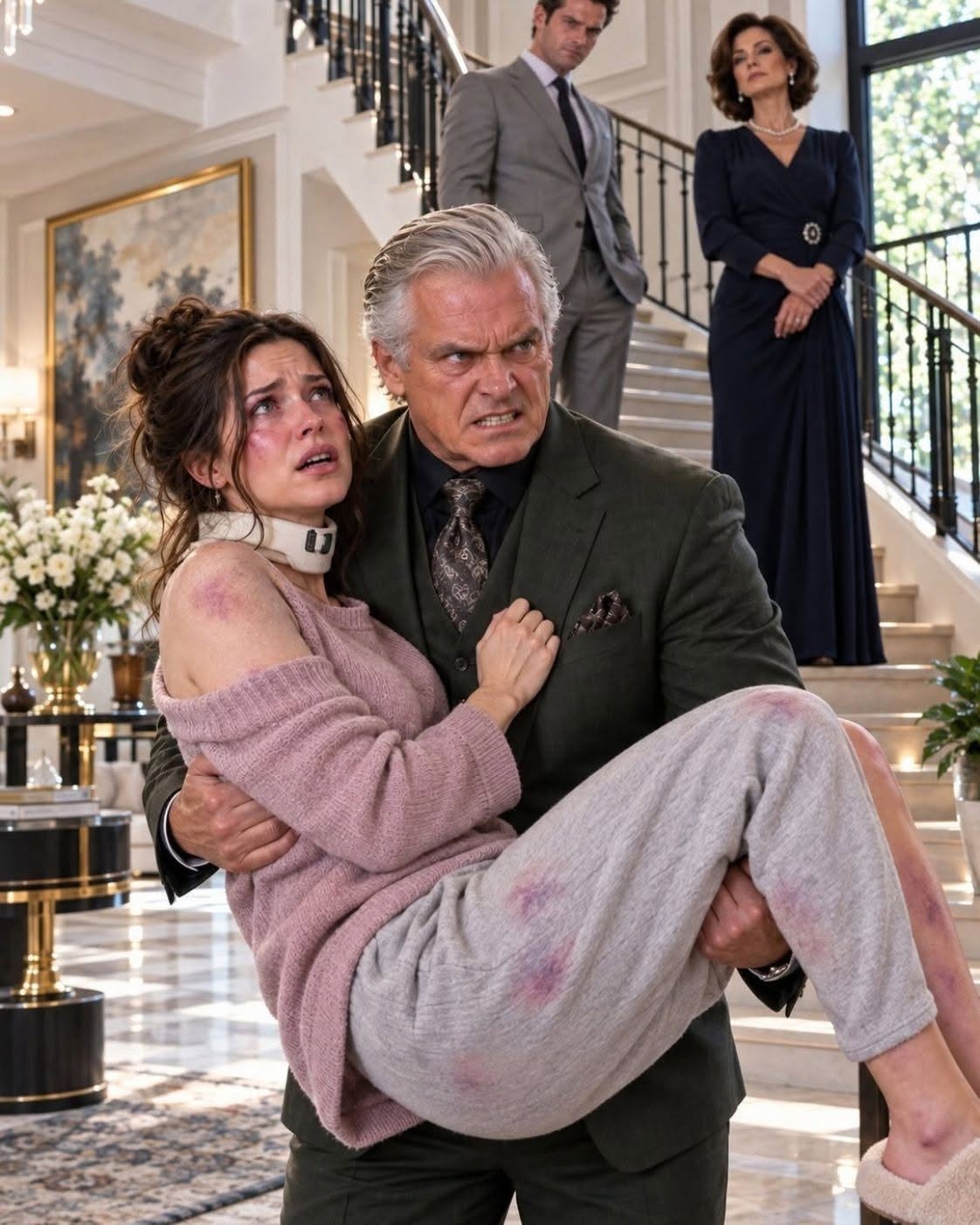
The first call my father made was not to the police.
It was to the hospital’s head of security.
The second was to a woman named Evelyn Brooks, a former federal prosecutor who had worked alongside him for nearly twenty years.
The third was to someone Gabriel Fletcher refused to identify.
I would later learn that the third call changed everything.
But at that moment, all I could think about was my daughter.
“Mr. Fletcher,” I whispered, struggling to sit up despite the sharp pain in my ribs, “they have my little girl. My mother-in-law said she was taking her somewhere safe. What if they don’t bring her back?”
Gabriel pulled a chair beside my bed.
“Rachel, listen to me carefully. Your daughter is not a bargaining chip, and your injuries do not make you an unfit mother. We will address the custody motion, but first, we need to establish exactly what happened in that house.”
I shook my head, tears burning my eyes.
“You don’t understand. The Callahans know judges. My husband’s uncle is a state senator. They donate to political campaigns. They can make people believe anything they want.”
Gabriel’s expression hardened.
“Then we will make sure the truth is supported by evidence, not opinions.”
He opened his briefcase and placed a small notebook on the table.
“Tell me everything you remember. Start with the argument.”
So I did.
I told him about the argument over my husband’s secret bank accounts. I told him how Daniel had demanded that I sign documents transferring control of a trust established for our daughter. When I refused, he grabbed my arm.
I remembered the cold expression on his face.
I remembered my mother-in-law standing near the doorway, watching without attempting to stop him.
And I remembered the moment Daniel shoved me.
I had fallen backward, my body striking the stairs one after another before I landed at the bottom.
For several seconds, I couldn’t breathe.
Daniel stood above me.
Instead of calling an ambulance, he looked at his mother and said, “She did this to herself.”
Then he walked away.
My mother-in-law, Margaret Callahan, approached me only long enough to whisper something I would never forget.
“You should have signed the papers.”
Gabriel wrote everything down.
When I finished, he closed his notebook.
“Did you know there was a security camera overlooking the staircase?”
I stared at him.
“What?”
“Your husband’s family installed a surveillance system throughout the house, including the entrance hall.”
My heart began to pound.
“They told me the cameras were only outside.”
Gabriel exchanged a glance with someone standing near the door.
A uniformed officer stepped into the room.
“Mrs. Callahan,” he said, “we’ve received information that may be relevant to your case.”
He paused.
“The camera system recorded the incident.”
For the first time, I saw something resembling concern cross Gabriel’s face.
“Has anyone accessed the footage?”
The officer nodded.
“Someone attempted to delete the recording less than an hour after the ambulance left. However, the system’s backup server retained a copy.”
Gabriel slowly rose from his chair.
“Secure it. Obtain the proper warrants and preserve every available record. No one touches that footage without a documented chain of custody.”
Then he turned toward me.
“Rachel, your husband may have just made the biggest mistake of his life.”
But the footage was only the beginning.
That evening, my father finally arrived.
He wasn’t wearing the expensive suit I had imagined after hearing Gabriel’s description of his former career. He wore his usual brown jacket, an old wristwatch, and the same worried expression he had worn whenever I came home crying as a child.
The moment I saw him, I broke down.
“Dad, I’m sorry.”
He stopped beside my bed.
“For what, sweetheart?”
“For believing I could handle everything myself. For not telling you what Daniel was really like. For letting them treat me this way.”
My father gently took my hand.
“Rachel, you don’t apologize for someone else’s cruelty.”
His voice trembled slightly.
“You hear me? Not today. Not tomorrow. Not ever.”
I clutched his hand and cried until I had nothing left.
When I finally looked up, I noticed that his eyes had changed.
The warmth was still there, but beneath it was something I had never truly understood before.
Determination.
“Where is my granddaughter?” he asked.
“At the Callahan estate. Margaret said she was taking care of her.”
Dad nodded once.
“Then we’ll bring her home.”
“Dad, they won’t let you near her.”
He looked at me for a long moment.
“Rachel, do you remember what I told you when you were little and someone at school tried to frighten you?”
I wiped my tears.
“You said that people who need to make others afraid are usually afraid of something themselves.”
A faint smile crossed his face.
“Exactly.”
He kissed my forehead, then stepped into the corridor with Gabriel.
I couldn’t hear their entire conversation, but I heard my father say one sentence clearly.
“Find out who helped them prepare that custody filing, and make certain every relevant record is preserved.”
Gabriel answered, “Already underway.”
By the following morning, the Callahan family had begun to panic.
Daniel had expected me to remain silent. Margaret had expected my father to arrive, argue with her, and leave defeated.
Instead, their attorney received a formal preservation notice concerning the surveillance footage, communications, and financial records relevant to the case.
The hospital documented my injuries. Investigators began interviewing witnesses. My attorney filed an emergency request for protective measures and an appropriate custody hearing.
Then another discovery emerged.
The documents Daniel had demanded that I sign were connected to a financial arrangement I had never authorized.
And the trust established for our daughter was not the only account involved.
Gabriel found transactions that appeared to connect Daniel’s private business interests to a network of companies ᴀssociated with his family.
Some records required further verification. Others raised questions that could not be dismissed with a phone call to a friendly politician.
My father did not publicly accuse anyone.
He didn’t threaten the Callahans.
He simply made certain that the appropriate authorities received the evidence through the proper channels.
At 10:17 a.m., my phone rang.
It was Daniel.
Gabriel had warned me not to discuss the case with him, so I answered only long enough to hear his voice.
“Rachel, what have you done?”
I closed my eyes.
For months, I had imagined what I would say if he ever realized he had gone too far.
Now that the moment had arrived, my voice was surprisingly steady.
“I told the truth.”
“You’ve turned my family against me!”
I almost laughed.
“Your family was there when you pushed me down the stairs, Daniel.”
Silence.
Then he lowered his voice.
“You need to understand something. My mother can make this very difficult for you. If you cooperate, we might still be able to work something out with the custody arrangement.”
There it was.
Even now, he believed my daughter was something he could use to control me.
“No,” I said. “You don’t get to hurt me and then negotiate over our child as if she’s property.”
I ended the call.
My hands were shaking, but I didn’t regret a single word.
Two days later, Daniel’s family arrived at the courthouse believing they still controlled the outcome.
They wore expensive clothes, carried polished folders, and greeted people as if they owned the building.
Margaret even smiled when she saw me.
“Rachel,” she said sweetly, “I hope you’ve had time to reconsider your atтιтude. This doesn’t have to become embarrᴀssing for everyone.”
I looked at her.
“You called me worthless while I was lying on the floor with broken ribs.”
Her smile disappeared.
Before she could respond, the courtroom doors opened.
My father entered beside Gabriel Fletcher and a woman carrying a thick case file.
Margaret’s expression changed immediately.
She recognized the attorney.
Evelyn Brooks had once led a major federal prosecution involving financial misconduct and public corruption. Her reputation was built on meticulous preparation and an unwillingness to abandon difficult cases simply because powerful people were involved.
Daniel leaned toward his mother.
“What is she doing here?”
Margaret didn’t answer.
Then the judge entered, and everyone rose.
The hearing began with the Callahans’ attorney describing me as emotionally unstable, financially dependent, and incapable of providing a secure home for my daughter.
He spoke about my injuries as though they were evidence of my weakness.
He spoke about Daniel’s resources as though money automatically made him a better parent.
For several minutes, I sat in silence, gripping the edge of my chair.
Then Evelyn stood.
“Your Honor, the peтιтioner has presented a narrative. We would like the opportunity to present evidence.”
The judge nodded.
Evelyn submitted the hospital records, the relevant witness statements, and a motion requesting that the court review the authenticated surveillance footage under appropriate procedures.
When the video began playing, the courtroom became completely silent.
There was Daniel.
There was me.
There was Margaret standing nearby.
The recording showed the argument, Daniel’s shove, and my fall down the staircase.
It showed him looking at me before walking away.
And it showed Margaret reaching for her phone instead of helping me.
No amount of money could change what appeared on that screen.
Daniel’s attorney stood abruptly.
“Your Honor, we object to any interpretation of this recording before its authenticity and context have been fully established.”
The judge ordered the relevant evidentiary questions addressed and directed that the footage be preserved for further proceedings.
Then Evelyn presented a second issue: evidence that the family had attempted to characterize my injuries as proof that I was incapable of caring for my child.
The judge’s expression grew increasingly serious.
“This court will not confuse a parent’s victimization with parental unfitness,” she said. “The child’s safety and best interests must remain the central concern.”
Margaret looked toward Daniel.
For the first time, neither of them appeared confident.
But the most devastating moment came when Evelyn asked the court to consider the circumstances surrounding the disputed financial documents.
Daniel’s face turned pale.
Because he understood something that his family had failed to understand from the beginning.
I was no longer alone.
And my father had no intention of allowing intimidation to subsтιтute for evidence.
The hearing ended without a final custody determination, but the court issued temporary protective measures and scheduled further proceedings. My daughter would not simply be handed over to the Callahans on the strength of their accusations.
Outside the courtroom, Margaret rushed toward my father.
“You’ve destroyed our family!” she shouted.
Dad stopped walking.
“No, Margaret. Your family made its choices. I’m simply making sure those choices are examined.”
“You think you’re untouchable because you used to work for the government?”
He regarded her calmly.
“No. I know exactly how easily people can mistake influence for immunity.”
Then he walked away.
I followed him down the courthouse steps, one careful step at a time.
For the first time in years, I felt that the future might belong to me again.
But when Gabriel called us back to his office that afternoon, I realized the custody battle was only one part of the story.
He placed a new folder on the table.
“We’ve uncovered something else,” he said.
“What is it?” I asked.
He opened the folder.
“Your husband wasn’t simply trying to obtain control over your daughter’s trust. There are indications that he was attempting to move ᴀssets before certain financial records could be examined.”
I stared at the documents.
“Are you saying he planned all of this?”
“I’m saying we need to establish what he knew, what he intended, and who else may have been involved.”
Dad studied the pages in silence.
Then he looked at Gabriel.
“Proceed carefully. Every allegation must be supported.”
Gabriel nodded.
Outside the window, the afternoon sun was beginning to fade.
Daniel had believed that pushing me down those stairs would make me easier to control.
Margaret had believed that humiliating me would make me disappear.
Neither understood that the moment I survived that fall, their carefully constructed story had begun to collapse.
And the next revelation would expose just how far they had gone to keep their secrets hidden.
PART 3: THE FINAL TRUTH — THE DAY THE CALLAHANS LOST EVERYTHING
Three weeks later, I returned to the courthouse.
My ribs were healing, although every deep breath still reminded me of the night my husband had pushed me down the stairs.
But the bruises were fading.
And something else had changed.
I no longer lowered my eyes when someone mentioned Daniel’s name.
My daughter was staying in a safe environment under arrangements established through the ongoing family court proceedings. I spoke with her every day, telling her stories about the little things we would do together when we were reunited.
I never told her that her father was a monster.
She was too young to understand the complicated truth, and she deserved the freedom to grow up without being burdened by the hatred of adults.
Instead, I told her that Mommy loved her.
That was the one truth no court, no lawyer, and no amount of money could take away from me.
Meanwhile, the investigation into Daniel’s financial affairs had expanded.
Authorities were examining transactions involving several companies linked to the Callahan family. Investigators were also reviewing whether any records had been improperly altered or destroyed.
No one had yet announced criminal charges related to those financial questions, and my father repeatedly reminded everyone that suspicion was not proof.
“Never confuse what you believe with what you can establish,” he told me one evening. “That’s how innocent people get hurt, and guilty people escape.”
I finally understood why he had spent his career the way he had.
He wasn’t powerful because he could frighten people.
He was powerful because he understood the difference between revenge and justice.
Then, one morning, Daniel made a mistake that changed the course of the custody case.
He sent me a message.
It was short.
Tell your father to stop digging, and I’ll make sure you see your daughter again.
I read it three times.
For a moment, the old fear returned.
Then I forwarded the message to Gabriel.
His response came within minutes.
Do not reply. Preserve the original message. We will handle this through the proper legal channels.
I did exactly that.
The message was added to the evidence being reviewed by my legal team. Whether it would carry legal significance depended on the surrounding circumstances and the court’s ᴀssessment.
But one thing was clear.
Daniel was still trying to use our daughter to pressure me.
And this time, I refused to play his game.
At the next hearing, the judge reviewed the updated evidence and heard testimony concerning the disputed custody allegations.
Daniel’s attorney argued that the message had been taken out of context.
Evelyn responded by presenting the timeline of communications and explaining why the court should consider it alongside the other evidence.
The judge listened carefully.
Then she addressed Daniel directly.
“Mr. Callahan, your financial resources and family connections are not the issue before this court. Your conduct, your daughter’s welfare, and the credibility of the evidence are.”
Daniel shifted in his seat.
For the first time, he had no clever response.
After hearing the evidence, the court maintained protective measures and established a clear framework for the next stages of the custody proceedings. The judge made it unmistakably clear that no parent could use threats or financial pressure to determine the outcome.
It was not the end of the case.
But it was the end of Daniel’s belief that he could dictate the result.
Outside the courtroom, his mother approached me one final time.
“You must be very proud of yourself,” Margaret said bitterly. “You’ve brought strangers into our private family affairs. You’ve humiliated my son. You’ve turned everyone against us.”
I looked at the woman who had stood over me while I lay injured at the bottom of her staircase.
For months, I had imagined this confrontation.
I had imagined shouting at her, telling her how much I hated her, making her feel even a fraction of the fear she had caused me.
But standing there, I discovered that I didn’t need any of those things.
“You’re right about one thing,” I told her. “I brought other people into this.”
She lifted her chin.
“Exactly.”
“Because I needed help. Because I was hurt. Because you and Daniel wanted everyone to believe I deserved what happened to me.”
Her expression тιԍнтened.
“I will never apologize for telling the truth.”
I turned away before she could answer.
That afternoon, my father took me to a small café near his house.
It was the same kind of place where we had celebrated birthdays when I was young. Nothing about it was impressive. The tables were scratched, the coffee was ordinary, and the woman behind the counter still remembered my father’s usual order.
For the first time in weeks, I felt as though I could breathe.
“Dad,” I asked, “why didn’t you ever tell me who you were?”
He looked down at his coffee.
“I told you what I did for a living.”
“You told me about reports and paperwork.”
He smiled faintly.
“I did review reports. I did paperwork. A great deal of it.”
“Dad.”
He sighed.
“Rachel, I spent decades watching people use their positions to make others feel small. Some were wealthy. Some were elected officials. Some were simply people who had never been told no.”
He paused.
“I didn’t want you growing up thinking that the world was divided into powerful people and helpless people. I wanted you to understand that your worth had nothing to do with your connections.”
I stared at him.
“So you kept your career quiet?”
“I retired. I wanted a peaceful life. I wanted to be your father, not the man people remembered from a courtroom.”
He reached across the table and squeezed my hand.
“But when you called me from that hospital, you weren’t asking for a former prosecutor. You were asking for your dad.”
Tears filled my eyes.
“I was so scared.”
“I know.”
“What if you hadn’t been there?”
He shook his head.
“Then we would have found another way. You are not powerless just because you don’t have a famous name behind you.”
Those words stayed with me.
Because somewhere along the way, I had begun to believe Daniel’s version of the world.
I had believed that his money made him right.
That his family’s connections made them untouchable.
That my dependence on him meant I had no choice.
I had been wrong.
The following months brought more difficult revelations.
Investigators continued examining the financial records. The family court proceeded with the custody case. Lawyers challenged evidence, questioned witnesses, and argued over the facts.
Some allegations were substantiated by documents. Others required further investigation. My father refused to speculate publicly, and Gabriel made sure that every legal step followed the appropriate procedures.
Eventually, Daniel faced separate legal scrutiny over his treatment of me, while the financial investigation proceeded on its own track.
The cases did not resolve overnight.
Justice rarely arrives in a single dramatic moment, no matter how satisfying it might look in a story.
There were delays.
There were difficult hearings.
There were nights when I wondered whether I had the strength to keep going.
But every time I felt myself slipping back into fear, I remembered what my father had said.
You don’t apologize for someone else’s cruelty.
And I kept moving forward.
Months later, the court reached a new custody arrangement based on the evidence presented and my daughter’s best interests. The outcome included safeguards designed to protect her while the adults continued to address the unresolved issues through the legal system.
I was finally able to build a stable life for my little girl without living under Daniel’s roof or answering to Margaret’s demands.
The financial investigation also produced further legal proceedings, though not every suspicion became a proven offense, and I learned to let the authorities determine what the evidence established.
The Callahan family could still afford expensive lawyers.
They could still make phone calls.
They could still tell their version of the story.
But they could no longer decide that their version was the only one anyone was allowed to hear.
One year after the night I fell down those stairs, I stood in my new home watching my daughter play in the living room.
She was laughing at something on television, her little feet kicking happily against the sofa.
The sound filled the house.
I had spent so long imagining the life Daniel might take away from me that I had almost forgotten what it meant to simply live.
My father arrived carrying a small birthday cake.
He placed it on the kitchen counter and looked around.
“You’ve done well, sweetheart.”
I smiled.
“We’ve done well.”
He shook his head.
“No. You did the hardest part. You found the courage to stand up again.”
I looked at him, remembering the frightened woman in the hospital bed who had believed she had nothing left.
“I couldn’t have done it without you.”
He pulled me into a gentle hug.
“You never had to do it alone.”
That evening, after my daughter had fallen asleep, I sat beside the window and thought about everything that had happened.
I thought about the staircase.
The hospital.
The custody motion filed while I was still struggling to breathe.
And the woman who had called my father to collect his “worthless daughter.”
For a long time, I believed that the most satisfying ending would be watching the Callahans lose their money, their reputation, and their influence.
But I finally understood something more important.
Their downfall was never the real victory.
The real victory was that I no longer needed their approval.
I no longer feared their threats.
And I no longer measured my worth by how much power someone else possessed.
My father had spent his career confronting people who believed they were above the rules.
But he had given me something more valuable than his reputation or his connections.
He had reminded me that I deserved to be protected, that my voice mattered, and that asking for help was not a weakness.
As for Daniel, he would have to live with the consequences of his own choices.
I would not spend the rest of my life waiting to see whether he regretted what he had done.
I had a daughter to raise.
A home to protect.
And a future that finally belonged to me.
The last time I saw Margaret, she stood across the courthouse lobby, surrounded by lawyers and speaking in a low, furious voice.
For a moment, our eyes met.
She looked at me as though she still couldn’t understand how the woman she had called worthless had survived her family’s attempt to destroy her.
I didn’t smile.
I didn’t threaten her.
I simply took my daughter’s hand and walked toward the exit.
My father was waiting outside.
The sun was shining, and my little girl was telling him a story about something she had learned that morning.
He listened as though she were the most important person in the world.
Because to him, she was.
I slipped my hand into his arm.
“Dad?”
“Yes, sweetheart?”
“Thank you for coming to get me.”
He stopped walking.
Then he looked at me with the same gentle expression he had worn when I was a child.
“I didn’t come to get you, Rachel.”
He glanced at my daughter, then back at me.
“I came to help you remember that you could leave.”
And for the first time in a very long time, I understood the difference.
I hadn’t been rescued because my father was powerful.
I had been given the chance to reclaim a life that had always been mine.
The Callahans thought money could silence the truth. They thought influence could erase consequences. And they thought a woman they had broken would never find the courage to fight back.
They were wrong.
Because the most dangerous thing they ever did wasn’t pushing me down those stairs.
It was believing that, after I fell, I would never stand up again.
And they would never understand how wrong they were.
THE END.