PART 2 — THE MOUNTAIN DEVIL’S SECRET
PART 2 — THE MOUNTAIN DEVIL’S SECRET
Cora heard Elias take one step.
Then another.
Her fingers curled against the wall.
“Don’t,” she whispered.
The footsteps stopped.
For several seconds, the only sound in the cabin was the wind pressing against the windows.
Then Elias spoke.
“Don’t what?”
Cora opened her eyes.
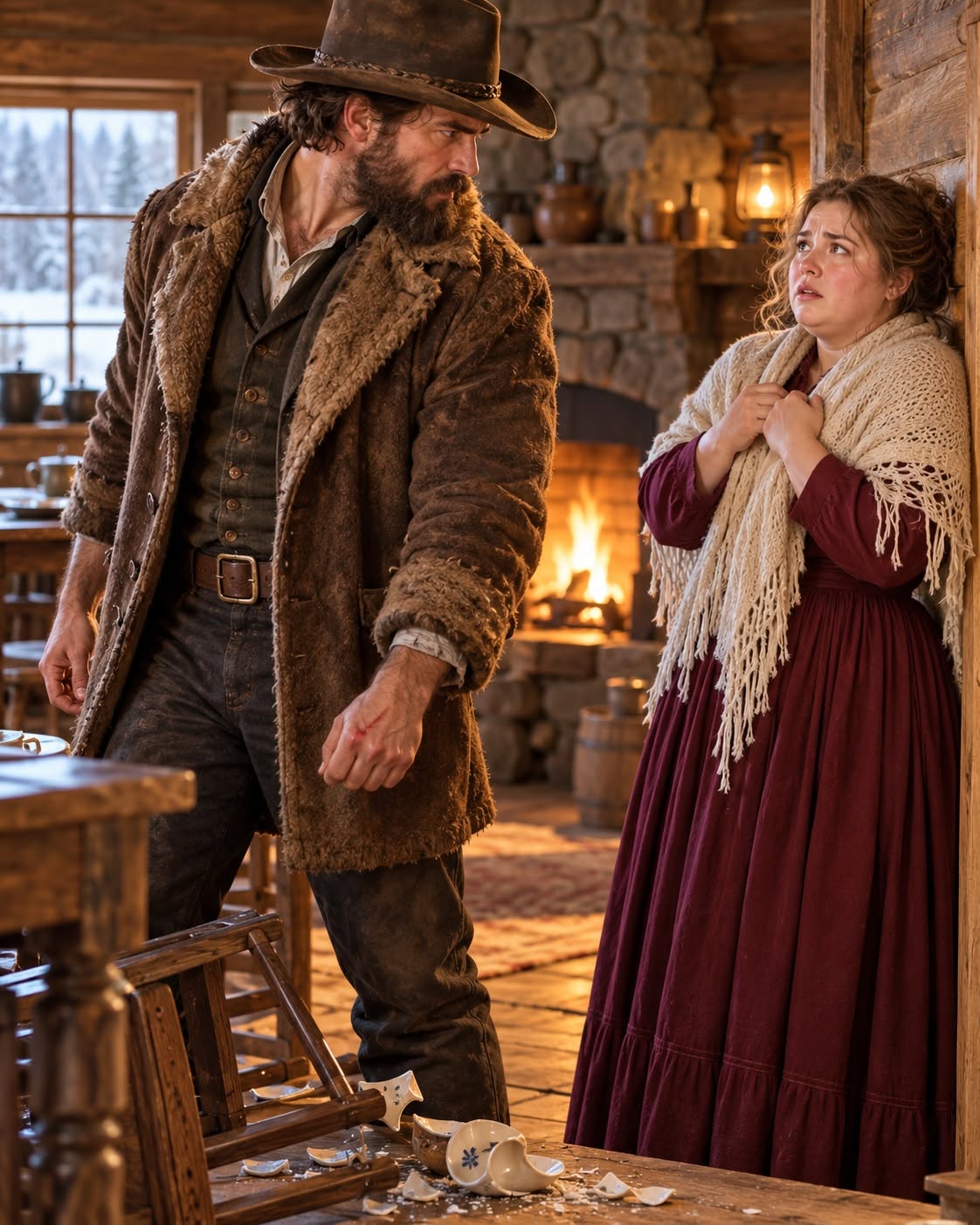
He was standing several feet away, his injured thumb wrapped in his other hand. His face was still twisted with anger, his jaw тιԍнт beneath his dark beard.
“Don’t come any closer,” she managed.
Something changed in his expression.
He looked at the shattered cup, the broken chair, and finally at Cora trembling in the corner.
Then he looked down at his bloody thumb.
“Good Lord.”
He took a step backward.
“You’re frightened of me.”
Cora couldn’t answer.
Elias stared at her for a long moment. Then he turned, picked up his hat, and walked outside.
The door closed behind him.
Cora remained against the wall until she heard the sound of his boots fading across the porch.
She had expected shouting.
She had expected blame.
She had expected him to tell her that a wife should know better than to cower in her own kitchen.
Instead, he had left.
It confused her more than his anger had.
She slowly returned to the stove, turned off the fire, and cleaned up the broken pieces. Her hands shook as she gathered the splinters.
When she reached for the chair, she discovered something beneath it.
A small wooden box.
It had been pushed partly under the table, perhaps knocked there when Elias kicked the chair.
Cora lifted it.
The lid wasn’t locked.
Inside lay a child’s red mitten, a folded pH๏τograph, and a letter yellowed with age.
She shouldn’t have opened it.
She knew that.
But when she saw the pH๏τograph, her breath caught.
It showed Elias standing beside a young woman and a little girl.
He looked different. His beard was shorter, and there was something almost gentle about his expression.
The woman was beautiful, with dark hair and a small smile.
The little girl sat on his knee, holding a wooden horse.
On the back, someone had written:
 Elias, Margaret, and our little Annie. Summer of 1878.
Cora carefully placed the pH๏τograph back inside.
So the mountain devil had once had a family.
And something had happened to them.
She was still thinking about it when Elias returned.
He carried a bundle of fresh wood and had wrapped his injured thumb in a clean strip of cloth.
He stopped when he saw the box on the table.
“Where did you find that?”
“Under the chair. I didn’t mean to pry.”
He placed the wood beside the stove.
“Did you look inside?”
Cora hesitated.
“Yes.”
His face became unreadable.
“Then you know.”
“I know you had a wife and a little girl.”
Elias looked away.
“They’re gone.”
“I’m sorry.”
He gave a humorless laugh.
“People always say that.”
Cora lowered her eyes.
“Then I won’t say anything else.”
That seemed to surprise him.
He sat on the edge of the hearth, carefully holding his injured hand.
After a long silence, he spoke.
“Margaret died during the winter of ’79. Annie followed her three days later.”
Cora’s heart тιԍнтened.
“Illness?”
“Fever. The doctor couldn’t reach us in time.”
He stared into the flames.
“I’d gone down the mountain for supplies. When I came back, the cabin was quiet.”
Cora didn’t move.
Elias continued.
“After that, I stopped caring what people thought of me. Stopped going to town unless I had to. Men started calling me the devil because I didn’t smile, didn’t drink with them, and didn’t want company.”
He looked at the broken chair.
“Guess I gave them enough reason this morning.”
“No,” Cora said softly. “You hurt your hand. You were angry. But that doesn’t mean I deserved to be frightened.”
Elias looked at her.
For the first time since she had arrived, he seemed unsure of what to say.
“You’re right.”
The words were so unexpected that Cora almost missed them.
He stood.
“I’ll fix the chair.”
“You don’t have to.”
“I broke it.”
He gathered the broken pieces.
“And I scared you. I can’t undo that, but I can make sure it doesn’t happen again.”
Cora watched him carry the wood outside.
Something inside her loosened, just a little.
That evening, Elias ate quietly and left the wooden box on the table rather than hiding it away.
Cora didn’t ask another question.
But the next morning, she noticed something strange.
The pantry was nearly empty.
There was flour, a little dried meat, and enough beans for perhaps four meals.
She had ᴀssumed Elias had more supplies stored somewhere.
He didn’t.
When she asked, he shrugged.
“Storm’s been bad. Haven’t been down to the trading post.”
“Then we need to go.”
“Road isn’t safe.”
“How long until it is?”
“Several days. Maybe longer.”
Cora looked at the flour sack.
“Then we’ll make what we have last.”
Elias studied her.
“You don’t have to worry about feeding me.”
“I’m not worrying about feeding you. I’m worrying about feeding both of us.”
He almost smiled.
Cora began making a list.
She knew how to stretch flour with ground oats. She knew how to turn scraps of meat into broth, how to preserve vegetables, and how to make a little food feed a household.
Her brother had mocked her for spending so much time in the kitchen.
He had never understood that cooking was not simply making meals.
It was making something from almost nothing.
By noon, she had reorganized the pantry, prepared a pot of stew, and found three jars of dried apples hidden behind a flour tin.
Elias watched her work.
“Where’d you learn to do all that?”
“My mother.”
“She was a good cook?”
“The best.”
Cora smiled faintly.
“She used to say that a person could tell a lot about a home by what happened when the pantry got empty.”
Elias looked at the simmering pot.
“What does this home tell you?”
Cora considered the question.
“That it needs more potatoes.”
For the first time, Elias laughed.
It was a rough, unfamiliar sound, as if he hadn’t used it in years.
And Cora discovered that the mountain devil sounded remarkably human when he laughed.
But the quiet did not last.
That afternoon, while Elias was repairing the stable door, someone rode up the mountain.
A man in a dark coat dismounted and approached the cabin.
Cora recognized him from the depot.
Davis, the stationmaster.
He carried a newspaper and a folded document.
“Mrs. Boone!” he called.
Cora stepped onto the porch.
“What do you want?”
Davis smiled.
“Just delivering some news. Your husband has been keeping a few things from you.”
Elias appeared behind the stable.
His expression changed instantly.
“Get off my land, Davis.”
Davis ignored him.
He handed Cora the document.
“Marriage registration. And a little something else.”
Cora unfolded it.
The paper was not a marriage certificate.
It was a notice from the county office.
NOTICE OF CLAIM — PROPERTY DISPUTE.
The land beneath Elias’s cabin was being challenged by a man named Gideon Rusk.
According to the document, Elias had failed to meet the conditions of an old land agreement.
If the claim was accepted, the cabin, the surrounding pasture, and the timber rights would be transferred to Rusk.
Cora looked up.
“What does this mean?”
Davis gave a satisfied smile.
“It means your new husband might be losing his home.”
Elias stepped closer.
“That’s enough.”
Davis climbed onto his horse.
“Rusk will be here in three days. Best start packing.”
He rode away laughing.
Cora turned toward Elias.
“Is it true?”
Elias stared at the notice.
“Yes.”
“Why didn’t you tell me?”
“Because it wasn’t your problem.”
Cora folded the paper carefully.
“Well, I’m your wife now. Whether you like it or not, this house is my problem too.”
Elias looked at her as if he had never heard anyone say such a thing.
Then he shook his head.
“You don’t understand. Rusk owns half the valley. He has lawyers, money, and men who’ll say anything for him.”
“Then we’ll need more than a man with a gun.”
Elias frowned.
“What do you mean?”
Cora looked toward the table.
Toward the old wooden box.
Toward the pH๏τograph of Margaret and Annie.
“I mean we should find out why he thinks he owns your land.”
Elias said nothing.
But for the first time, he didn’t tell her to stay out of it.
And that was how Cora Miller discovered that the greatest danger to her new marriage wasn’t the man everyone called the mountain devil.
It was the secret he had spent years trying to bury.