PART 2 — THE MAN WHO REFUSED TO BE HEALED
ABANDONED BY HER MAIL-ORDER GROOM, SHE FOUND SHELTER WITH A BROKEN COWBOY WHO HAD LOST EVERYTHING. SHE SLOWLY HEALED HIS WOUNDED HEART, NEVER ASKING FOR ANYTHING IN RETURN. BUT WHEN HE DISCOVERED HER SACRIFICES, HE GAVE HER SOMETHING SHE NEVER EXPECTED: A HOME OF HER OWN.
PART 2 — THE MAN WHO REFUSED TO BE HEALED
Noah Larkin woke to the smell of coffee and the sound of a little girl crying.
For several seconds, he could not remember where he was. Then the pain in his leg came rushing back, sharp enough to steal his breath.
He looked down.
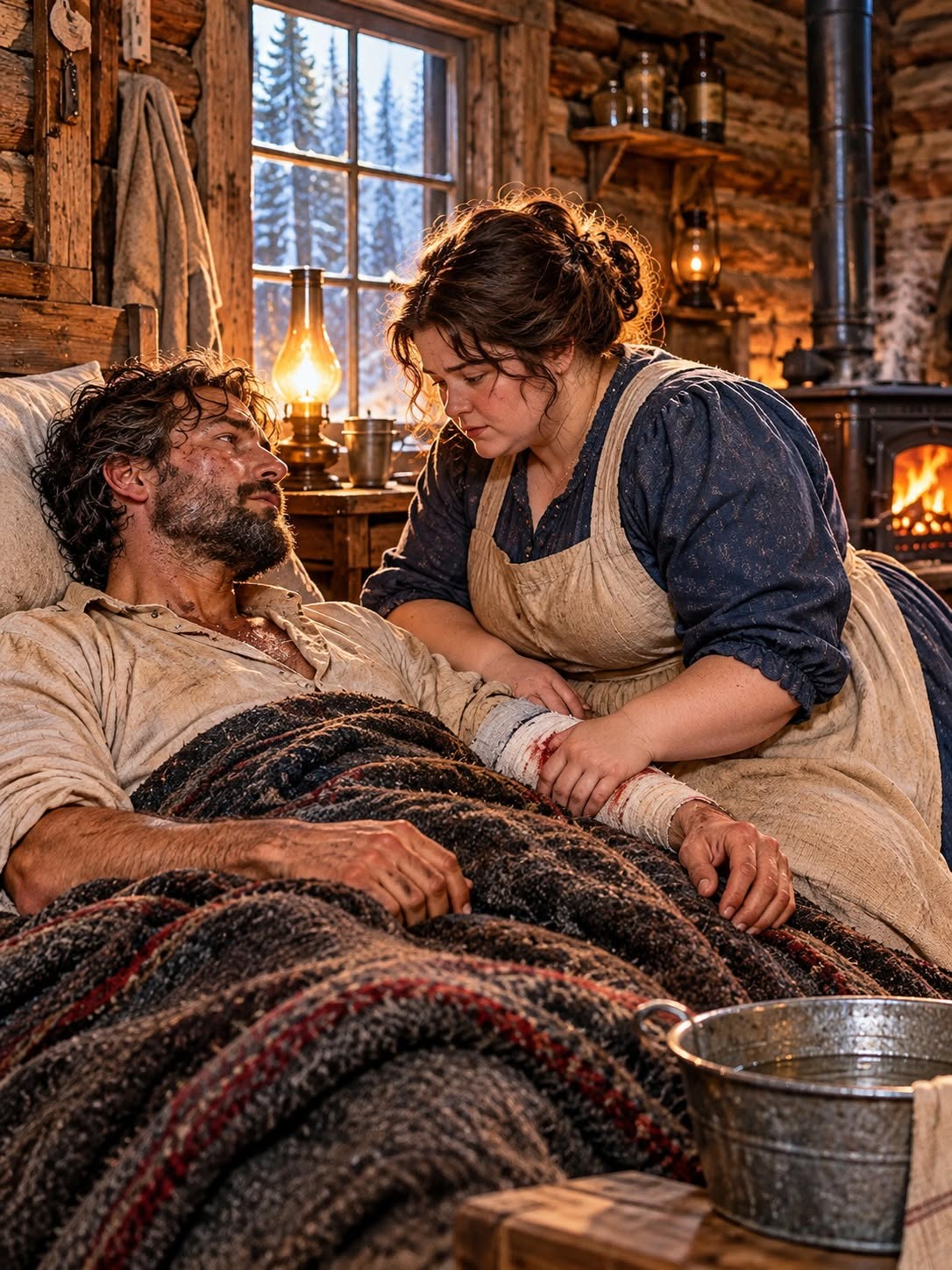
His leg was wrapped in a thick white bandage and secured between two wooden splints. A chair had been placed beside his bed, and a woman in a dove-gray dress sat there, sewing a tear in a child’s sleeve.
“Who are you?” he demanded.
The woman looked up calmly.
“Good morning to you, too, Mr. Larkin.”
“I asked who you are.”
“Ella Jessop. I’ll be looking after your leg until it heals.”
“Who said you could?”
“Mr. Bane.”
Noah’s jaw тιԍнтened. “Hollis has no authority to hire strangers into my house.”
“Then perhaps you should have stayed conscious long enough to object.”
He stared at her.
Nobody had spoken to him like that in years.
The little girl standing in the doorway sniffled and wiped her nose with the back of her hand. She was nine years old, with a tumble of dark curls and eyes that seemed much too serious for her age.
“Uncle Noah?”
His expression softened.
“Come here, Annie.”
She hurried to his bedside, careful not to bump his injured leg. He reached for her, but she stopped just short of his arms.
“Are you going to die?”
“No.”
“Mr. Bane said your leg was nearly torn off.”
“Mr. Bane talks too much.”
Annie looked at Ella.
“Will you fix him?”
Ella set down her sewing.
“I’ll do everything I can. But your uncle must promise to follow instructions.”
Noah gave a humorless laugh.
“Don’t make promises on my behalf, Miss Jessop.”
Ella merely smiled.
“Then I won’t. I’ll just make sure you have the chance to regret ignoring me.”
For the next several days, Noah made her life difficult.
He refused his medicine. He insisted he could move without help. Twice he attempted to get out of bed, and twice Ella caught him before he could put weight on his leg.
On the third attempt, she stood in the doorway with her arms crossed.
“If you break that bone again, Mr. Larkin, I shall personally tie you to that bed.”
“You wouldn’t dare.”
“Try me.”
Hollis, pᴀssing with a tray, nearly choked on his coffee.
Noah glared at him.
“Find yourself something useful to do.”
“Been trying for years, son. This is the first time anybody’s made it entertaining.”
Despite his temper, Noah began to notice things.
Ella never raised her voice. She never complained about the muddy floors, the leaking roof, or the endless work. She rose before sunrise, prepared meals, cleaned the wounds on his leg, and spent evenings reading aloud to Annie.
The little girl, who had hardly spoken to anyone outside the household since her parents died, began following Ella everywhere.
One evening, Noah heard laughter from the kitchen.
Real laughter.
He had not heard that sound in his house since his brother Daniel and Daniel’s wife had been alive.
He turned his head toward the doorway.
Ella was showing Annie how to make little paper birds from scraps of an old newspaper.
“See?” Ella said. “If you fold the wings just so, they’ll look as though they’re flying.”
Annie held up her creation.
“Can I put it by Mama’s picture?”
“Of course.”
The child’s smile faded.
“Do you think Mama would like it?”
Ella paused.
“I think she would be very proud that you’re learning to make beautiful things.”
Noah closed his eyes.
He had spent months trying to make Annie stop asking questions about her mother. He thought silence would protect her from grief.
Ella seemed to understand that silence only made grief lonelier.
That night, when she brought him his medicine, he spoke before she could leave.
“Annie likes you.”
“She’s a lovely child.”
“She doesn’t like many people.”
“Perhaps people haven’t given her enough reason to.”
He looked at her for a long moment.
“Why did you come here?”
Ella’s fingers тιԍнтened around the medicine bottle.
“I needed work.”
“That’s not an answer.”
“It’s the one I have.”
He studied her face, but she turned away before he could ask more.
Weeks pᴀssed.
The swelling in Noah’s leg slowly diminished. The wound began to close, and the doctor who finally arrived from town declared that Ella’s treatment had likely saved him from losing the limb.
But healing the bone was not the same as healing the man.
Noah became restless and bitter. He worried about the cattle, the approaching winter, and the ranch hands who were doing their best without him.
One afternoon, he received a letter from the bank.
The ranch was in debt. His brother’s medical expenses, the failed spring cattle drive, and several months of bad weather had left the family nearly ruined.
The bank wanted payment by the first of November.
If Noah could not pay, the property would be seized.
He crumpled the letter in his fist.
 Ella found him staring at the fireplace that evening.
“Bad news?” she asked.
“Nothing that concerns you.”
She placed a cup of coffee on the table.
“Everything that troubles someone in this house concerns me a little.”
He looked up sharply.
“You are an employee, Miss Jessop. Nothing more.”
The words struck harder than he intended.
Ella’s expression did not change, but she quietly picked up the empty medicine cup.
“Of course, Mr. Larkin.”
He regretted it almost immediately.
Yet pride kept him silent.
That same week, Annie developed a fever. Ella sat beside her bed through two sleepless nights, changing cool cloths and coaxing the child to drink water. When the fever finally broke, Annie reached for her hand.
“Will you stay until I grow up?”
Ella brushed the curls from her forehead.
“I’ll stay as long as I’m needed, sweetheart.”
Noah stood unseen in the hallway.
He looked at the woman who had arrived at his house with one trunk and barely enough money to buy a train ticket home. She had no family nearby, no promise of a future, and no reason to care what happened to a stubborn rancher and his orphaned niece.
Yet she had given them both something they had forgotten existed.
A reason to wake up in the morning.
Later, when Ella returned to the kitchen, she found a small envelope beside her sewing basket.
Inside were three dollars.
She immediately carried it to Noah’s room.
“What is this?”
“Your wages. Hollis says I owe you.”
“I already receive twelve dollars a month.”
“Then consider it extra.”
“I won’t.”
His eyes narrowed.
“Why not?”
“Because you need every dollar for the bank.”
He went still.
“Who told you about the bank?”
“No one. I heard you speaking to Hollis.”
“That was a private conversation.”
“I apologize.”
She placed the money on his table.
Then she said something he would remember for the rest of his life.
“I didn’t come here to take what little you have, Mr. Larkin. I came because I needed a place to work, and you needed someone to help you. That’s all.”
Noah looked at her.
“Is that really all?”
Ella’s eyes flickered toward his.
For a heartbeat, something unspoken pᴀssed between them.
Then she lowered her gaze.
“It must be.”
And she left.
Noah lay awake long after midnight, listening to the wind moving through the pines.
He had once believed losing everything meant losing his land, his brother, and the strength to stand on his own two feet.
But now he feared something far worse.
He was beginning to care about a woman who had never asked him for anything.
And he had no idea how to ask her to stay.