PART 2: THE FOUR BOYS WHO CHANGED CHRISTMAS
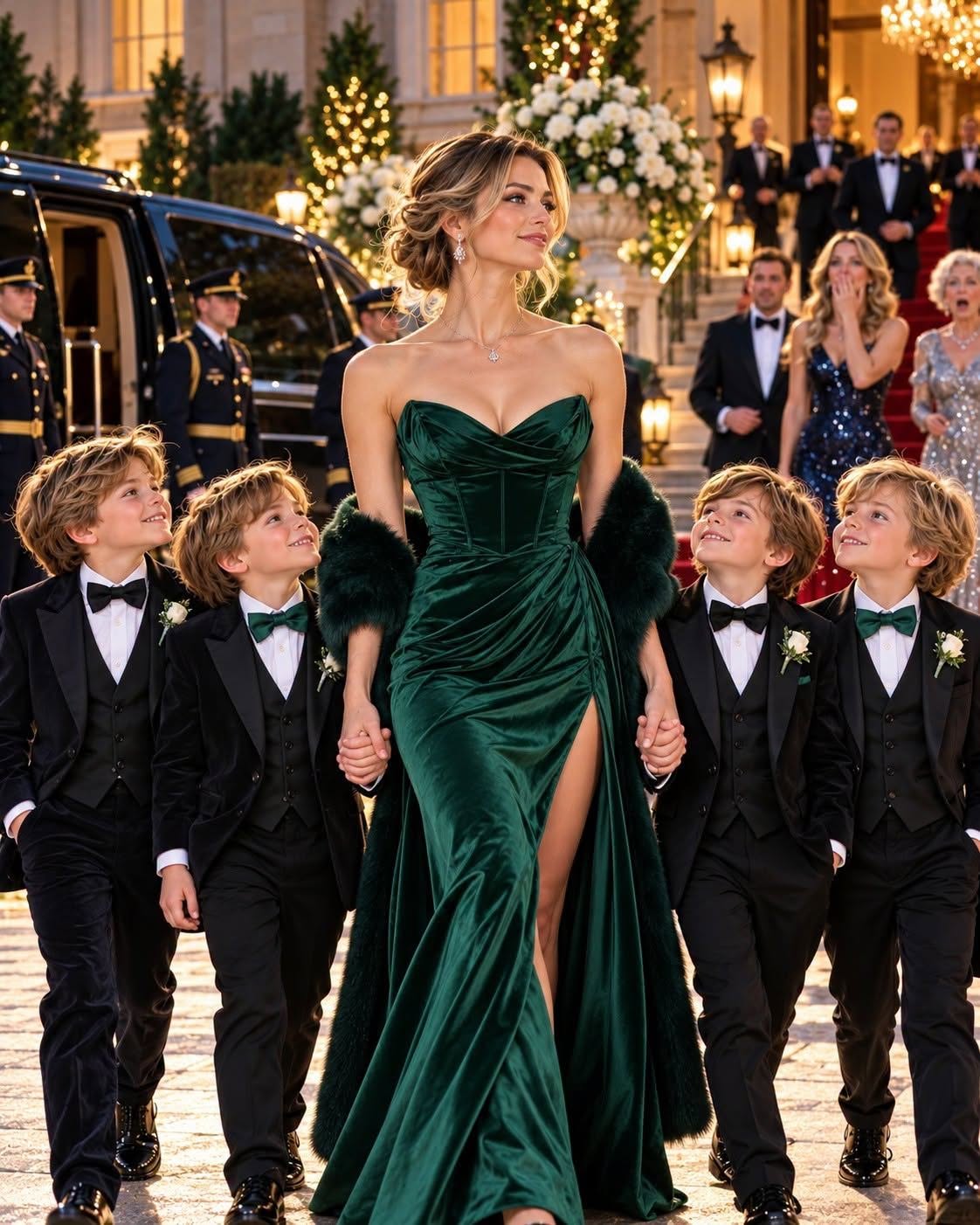
I told myself it was about my sons.
They deserved to meet their father if they wanted to. They deserved to look at the man whose eyes they had inherited and decide for themselves what kind of person he was.
But late at night, when the house was quiet and four identical sets of pajamas lay scattered across the hallway, I sometimes wondered what Tristan would do when he saw them.
Would he recognize himself in their faces?
Would he deny what was standing right in front of him?
Or would he finally understand what his disbelief had cost him?
I pushed those questions aside.
I wasn’t going to Sun Valley to beg Tristan Holloway for anything.
I wasn’t going to demand child support, an apology, or a place in the Holloway family.
I was going because four little boys had asked to meet their family.
And I would make sure they never regretted asking.
On Christmas Eve, I stood in front of the mirror, fastening a pair of simple pearl earrings.
I wore a navy-blue dress beneath a tailored winter coat. My hair was pinned neatly at the back of my head, and I carried a small leather bag containing the boys’ documents, emergency contacts, and a letter from my attorney confirming that I had made no legal demands as part of this visit.
I had no intention of turning Christmas dinner into a courtroom.
Behind me, Liam tugged at his tie.
“Mom, do I have to wear this?”
“Yes.”
“Why?”
“Because we’re visiting people who believe a tie is a personality trait.”
Caleb burst out laughing.
Asher nearly fell off the bench trying to join him.
Mason simply adjusted his own tie and examined his reflection.
“We should be polite,” he reminded his brothers. “Even if they aren’t.”
I turned to look at him.
“Where did you learn that?”
“You.”
For a moment, I couldn’t speak.
Then I crouched in front of all four boys.
“Listen to me. You don’t have to impress anyone tonight. You don’t have to make anyone love you. You don’t have to prove that you’re good enough to belong in that house.”
I looked at each of their faces.
“You already belong wherever you are loved. Understand?”
Four heads nodded.
“And if anyone says anything that makes you uncomfortable, you tell me. We leave. No arguments.”
“Even if there’s dessert?” Caleb asked.
“Even if there’s dessert.”
He sighed dramatically.
“This family is already becoming difficult.”
I kissed his forehead.
Then we left for Sun Valley.
I had no idea that before the evening was over, one of Tristan’s most carefully protected secrets would be exposed, too.
And this time, I wouldn’t be the only person in the room who had to answer for the past.
The Holloway estate looked exactly as I remembered it.
A long, winding driveway cut through the snow-covered grounds. White lights wrapped around enormous pine trees, and the mansion’s windows glowed gold against the darkening Idaho sky.
Tristan’s family had always treated Christmas as a performance.
Every ornament had to be perfect. Every guest had to be important. Every pH๏τograph had to tell the world that the Holloways were a family without flaws.
I remembered attending those dinners during my marriage.
I remembered sitting beside Tristan while his father discussed military promotions and his mother praised the wives of his colleagues.
I remembered being asked, repeatedly, when we intended to start a family.
And I remembered the shame that followed me home after Tristan told me he didn’t believe I was pregnant.
Now I was returning with four sons.
Four beautiful, living answers to a question that had haunted me for eight years.
We were still several miles from the estate when my phone rang.
It was Daniel Reeves, the coordinator of the regional trauma-readiness program I directed.
“Grace, the weather has worsened near Sun Valley,” he said. “The aviation team has been monitoring the conditions. Are you still planning to arrive by road?”
I glanced at the snow falling across the windshield.
“I was. Why?”
“One of our partner units has a scheduled training transfer nearby. The pilot says the route is still manageable, but ground travel may become difficult. If you want to avoid the worst of the traffic, I can ask whether they can arrange an authorized transfer to the landing field near the estate.”
I hesitated.
The boys were listening.
“Would that be safe and appropriate?”
“Only if the crew approves the conditions and the transfer is within the unit’s authorization. No promises until they confirm.”
I thanked him and ended the call.
Twenty minutes later, everything was approved.
The pilot had a suitable landing area near the estate, the weather remained within operating limits, and the authorized transfer fit the team’s schedule.
The boys could barely contain themselves.
“Mom,” Liam whispered as we approached the aircraft, “are we really going in a helicopter?”
“Yes.”
“Is it a military helicopter?”
“It’s operated by a military partner unit.”
Caleb’s eyes widened.
“Does Dad know?”
I looked at him.
“No, sweetheart. He doesn’t.”
Asher grinned.
“That’s going to be a surprise.”
I didn’t answer.
Because suddenly, I realized it would be.
The flight was brief, and the snow-covered estate soon appeared beneath us.
Through the window, I could see guests gathering near the mansion. Cars lined the circular drive. Men in dark suits stood beneath the portico while women in elegant coats greeted one another.
And there, near the entrance, stood Tristan Holloway.
He wore a perfectly tailored charcoal suit. His hair was neatly trimmed, his posture straight, his expression confident.
Beside him stood Sabrina, his beautiful fiancée, wearing a cream-colored dress and a diamond necklace that glittered beneath the outdoor lights.
Tristan was laughing at something his father had said.
He looked like a man who had finally arranged his world exactly as he wanted it.
Then he heard the helicopter.
His smile faltered.
He turned toward the field.
Everyone else did the same.
The aircraft descended over the snow-covered ground, its rotor wash sending powder swirling across the lawn. Conversations stopped. Several guests stepped back beneath the portico.
Tristan’s father frowned.
“What on earth is that?”
Sabrina тιԍнтened her grip on Tristan’s arm.
“Is that part of the entertainment?”
Tristan didn’t answer.
He was staring at the aircraft.
The helicopter settled onto the landing area.
The rotor blades slowed.
The side door opened.
I stepped down first.
For a moment, Tristan appeared merely confused.
Then four boys emerged behind me.
Mason.
Caleb.
Asher.
Liam.
Four eight-year-old boys with dark hair, strong brows, and the same unmistakable gray-blue eyes that stared back at me every morning.
The same eyes Tristan had seen in his own reflection since childhood.
I watched him recognize them.
It happened slowly.
His gaze moved from Mason to Caleb, then to Asher and Liam.
His mouth opened.
Nothing came out.
The wineglᴀss in his hand slipped between his fingers and struck the stone beneath him.
It shattered.
Red wine spread across the white snow.
Tristan didn’t even look down.
His face had gone completely pale.
“No,” he whispered.
Sabrina turned toward him.
“Tristan?”
He didn’t seem to hear her.
He took one unsteady step forward.
Then another.
“Grace,” he said, his voice barely audible. “What is this?”
I rested one hand on Mason’s shoulder.
“These are my sons.”
Tristan stared at the boys.
“Your sons?”
I held his gaze.
“Our sons, Tristan.”
The words struck him harder than any accusation could have.
Behind him, his mother emerged from the doorway, followed by his father and several relatives.
His mother’s eyes widened.
“Oh, my God.”
She looked at the boys.
Then at me.
Then back at the boys.
“Grace,” she whispered, “you were telling the truth?”
I didn’t answer immediately.
For eight years, I had imagined what it might feel like to hear someone in the Holloway family finally ask that question.
I had imagined anger.
I had imagined vindication.
I had imagined a hundred things.
I had never imagined how little satisfaction it would bring.
“Yes,” I said quietly. “I was.”
Tristan shook his head as though the movement might somehow change what he was seeing.
“Four?”
“Four.”
“But you told me—”
“I told you I was pregnant. You accused me of lying.”
His father turned sharply toward him.
“Tristan, is that true?”
Tristan looked as though he had forgotten how to breathe.
“I didn’t know.”
I felt something cold settle inside me.
“No,” I said. “You chose not to know.”
Silence spread across the courtyard.
Then Mason stepped forward.
He had been quiet throughout the entire journey, but now he looked directly at Tristan.
“Are you our dad?”
Tristan’s face crumpled.
For the first time since I had known him, the confident major seemed entirely lost.
He crouched slightly, as if trying to bring himself to the boys’ eye level.
“Yes,” he whispered. “I’m your dad.”
Mason studied him.
“Why didn’t you come see us?”
Tristan opened his mouth.
Closed it.
Looked at me.
I couldn’t rescue him from that question.
Not anymore.
“I thought…” He swallowed hard. “I thought your mother wasn’t telling me the truth.”
Caleb frowned.
“Mom tells us the truth.”
“I know,” Tristan said quickly. “I know she does.”
“Then why didn’t you believe her?”
Tristan looked down.
And for once, he had no answer that could make him look good.
Inside, the Christmas dinner had come to a standstill.
Tristan’s mother insisted that we come into the house. She ordered H๏τ chocolate for the boys, asked the staff to prepare four extra place settings, and repeatedly pressed a hand against her chest as though she were trying to steady herself.
Sabrina, meanwhile, had gone very quiet.
She watched Tristan as he sat across from the boys, studying their faces with a kind of desperate concentration.
He asked Mason about school.
He asked Caleb what sports he liked.
He asked Asher whether he enjoyed science.
He asked Liam if he liked flying.
The questions came too quickly, tumbling over one another.
The boys answered politely, but they didn’t rush toward him. They didn’t call him Dad with the easy affection he seemed to be longing for.
They had never met him before.
To them, he was a stranger who happened to share their eyes.
Finally, Tristan looked at me.
“Can I speak with you privately?”
I glanced at the boys.
“After dinner.”
“Grace, please.”
“After dinner, Tristan.”
Something in my tone made him stop.
For once, he respected the boundary.
Dinner began with a tension so thick that even the Holloways’ usual small talk couldn’t break through it.
Tristan’s mother sat beside me.
“I don’t understand,” she whispered. “Why didn’t you tell us?”
I put down my fork.
“I tried to tell your son.”
“But you could have contacted us.”
“Would you have believed me?”
She looked wounded.
I continued before she could answer.
“Your family knew I was pregnant. You knew Tristan refused to believe me. Nobody asked whether I was all right. Nobody asked whether the baby was healthy. And after the divorce, nobody contacted me to find out what happened.”
Her eyes filled with tears.
“We thought you had moved on.”
“I did move on.”
I looked toward my sons.
“I had to.”
Across the table, Tristan’s father cleared his throat.
“These boys are Holloways. We have a responsibility to them.”
I met his eyes.
“They are people, not an inheritance.”
The older man stiffened.
“I didn’t mean—”
“I know what you meant. But my sons aren’t here to repair your family’s reputation or give anyone a second chance at looking like a perfect family.”
I turned toward Tristan.
“They’re here because they wanted to meet you.”
That was the truth.
Nothing more.
Nothing less.
After dinner, while the boys examined the enormous Christmas tree with Tristan’s younger cousins, Tristan found me standing beside the glᴀss doors overlooking the snow-covered garden.
He closed the door behind us.
For several seconds, he said nothing.
Then he whispered, “Why didn’t you tell me about the quadruplets after the divorce?”
I stared at him.
“I did.”
“No, I mean afterward. When you found out there were four. When they were born.”
“I sent your attorney the medical confirmation. Your lawyer acknowledged receiving it.”
Tristan’s eyes widened.
“I never saw that.”
“Then perhaps you should ask your attorney what happened to it.”
He dragged a hand over his face.
“I would have come.”
I felt the old pain rise inside me, but it no longer had the power to pull me under.
“Would you?”
“Yes.”
“Would you have believed me if I had called again? Would you have answered if I had sent another message? Would you have stopped long enough to look at the evidence you refused to see?”
He said nothing.
I stepped closer.
“Tristan, I was frightened. I was carrying four babies. I had a high-risk pregnancy, medical appointments, financial worries, and a future I had never imagined. I needed the man I had married to believe me.”
My voice trembled, but I didn’t look away.
“You made me feel as though telling you I was pregnant was something shameful. As though I had committed an offense by asking you to be a father.”
His eyes filled.
“I was wrong.”
“Yes.”
“I was so wrong.”
“Yes.”
He seemed startled by the simplicity of my answer.
Perhaps he had expected me to shout.
Perhaps he had expected tears.
Perhaps he had expected the woman he remembered—the one who kept trying to explain herself until he grew tired of listening.
That woman was gone.
“I don’t know how to make this right,” he whispered.
“You can’t make the last eight years happen again.”
“I know.”
“Do you?”
I looked through the glᴀss at our sons.
Caleb was showing his grandfather a complicated trick with a Christmas ornament. Asher was laughing at something Liam had whispered. Mason stood nearby, watching everything with the quiet caution that had always made him seem older than his brothers.
“They learned to ride bicycles without you. They lost their first teeth without you. They had fevers, nightmares, school performances, birthday parties, and a thousand ordinary moments that made them who they are.”
I turned back to Tristan.
“You missed all of it.”
He lowered his head.
“And I can’t give those years back to you just because you finally understand what you lost.”
A long silence followed.
Then Tristan asked, “Is there any chance they might forgive me?”
“That’s not my decision.”
“Can you help me?”
“I can tell you this: don’t ask them to comfort you because you feel guilty. Don’t tell them how much you’ve suffered. Don’t make them responsible for your emotions.”
I paused.
“If you want to know them, start by listening to them. And understand that they don’t owe you a relationship simply because you’re their father.”
He nodded slowly.
“I understand.”
“No,” I said gently. “You understand the words. You’ll have to prove you understand the meaning.”
For the first time that evening, he didn’t argue.
We returned to the dining room just as Sabrina stood near the fireplace, speaking quietly with Tristan’s mother.
When she saw him, she straightened.
“Tristan, we need to talk.”
He looked at her, then at me.
“Of course.”
I started to move away, but Sabrina spoke before I could leave.
“Grace, would you mind staying?”
Her voice was controlled, though her hands were trembling slightly.
“I think there are things everyone needs to understand.”
Tristan frowned.
“Sabrina, not now.”
“Especially now.”
She looked at the four boys, then back at Tristan.
“Did you ever tell me the truth about your divorce?”
Tristan went rigid.
“What does that mean?”
“It means you told me your ex-wife couldn’t accept that the marriage was over. You told me she had made accusations about a pregnancy because she was desperate to keep you.”
His mother covered her mouth.
Sabrina’s voice broke.
“You told me you had never been given any reason to believe you were a father.”
Tristan stared at the floor.
“I believed that at the time.”
“You believed what you wanted to believe.”
He looked up sharply.
Sabrina removed the engagement ring from her finger.
The room fell silent.
“I agreed to marry you because I thought you were an honest man who had been hurt by a difficult marriage. I thought you had learned from your mistakes.”
She placed the ring on the mantel.
“But tonight, I watched four little boys ask their father why he had never come to see them.”
She swallowed.
“And I realized that I don’t know the man I agreed to marry.”
Tristan took a step toward her.
“Sabrina, please. I never intended for this to happen.”
“That is exactly the problem, Tristan. You never intended to find out what happened. You never intended to question your own version of events. And you never intended to consider that Grace might have been telling the truth.”
He looked stricken.
Sabrina glanced at me.
“I am sorry for the things I believed about you.”
I gave a small nod.
“Thank you.”
She turned back to Tristan.
“I need time. I don’t know if I can marry someone who treats his own mistakes as if they are somebody else’s fault.”
Then she walked out of the room.
Tristan didn’t follow her.
He simply stood beside the fireplace, staring at the ring she had left behind.
For the first time that night, I felt no urge to gloat.
There was no victory in watching another woman discover the painful truth about a man she loved.
There was only the hope that she would make her decision with open eyes.
Later that evening, Tristan’s father asked to speak with me.
We sat in a small library while the boys played in the adjoining room under the watchful eyes of several relatives.
“I owe you an apology,” he said.
I waited.
“When you and Tristan divorced, I believed his account of what happened. I thought you were both angry and that the truth had been lost in the conflict.”
He looked at his hands.
“I should have contacted you. I should have asked questions. Instead, I allowed myself to accept the explanation that was easiest for my son.”
“Why are you telling me this now?”
“Because I want to know my grandchildren.”
I studied him carefully.
“That may be possible. But not because you want to feel better about what happened.”
He nodded.
“I understand.”
“And you don’t get to make promises on their behalf. If they want to know you, we’ll take it slowly. If they don’t, you’ll have to respect that.”
“Of course.”
He paused, then asked, “Will you let Tristan see them again?”
I looked toward the adjoining room.
Mason was helping Liam ᴀssemble a wooden puzzle. Caleb and Asher were arguing over the rules of a board game, while their grandfather’s younger sister tried unsuccessfully to keep them from changing the instructions.
“They can decide whether they want another visit,” I said. “And Tristan can decide whether he’s willing to do the work that being their father requires.”
The older man nodded.
For the first time, he seemed to understand that the decision wasn’t his to make.
It was nearly ten o’clock when Tristan walked us to the entrance.
The snow had stopped falling.
Our driver was waiting near the circular driveway, and the boys were bundled into their coats.
Tristan stood in front of them, his hands hanging awkwardly at his sides.
“I know tonight was a lot,” he said. “I know I’m a stranger to you.”
Caleb nodded.
“A little.”
Asher elbowed him.
“You’re supposed to say it nicer.”
“What? He is a stranger.”
Tristan gave a brief, broken laugh.
“No. He’s right.”
He crouched in front of them.
“I can’t change the fact that I wasn’t there when you were little. I can’t promise that I’ll suddenly know how to be the father you deserve.”
He looked at each boy.
“But if you want me to, I’d like to start getting to know you.”
Mason considered him for a long moment.
“Are you going to disappear again?”
Tristan’s expression changed.
“No.”
Mason didn’t look convinced.
“You said you didn’t know we existed. But Mom said she told you.”
Tristan swallowed.
“Your mother did tell me. I didn’t believe her. That was my mistake, not hers.”
Mason nodded once.
“Okay.”
It wasn’t forgiveness.
It wasn’t acceptance.
It was simply the first honest answer Tristan had ever given him.
And for that evening, it was enough.
Liam stepped forward.
“Can I ask you something?”
“Anything.”
“Do you really know how to fly helicopters?”
Tristan blinked.
“Some military aircraft, yes. I’m not a helicopter pilot, though.”
Liam’s face fell.
“Oh.”
Then Tristan smiled faintly.
“But I can introduce you to someone who is, if your mother agrees.”
All four boys turned toward me.
I raised an eyebrow.
“We’ll discuss it.”
Caleb sighed.
“Mom says that when she means maybe.”
“I heard that.”
The boys burst into laughter.
And Tristan, standing in the cold beneath the golden lights of his family home, watched them as though their laughter were the most extraordinary sound he had ever heard.
Before we left, he approached me one last time.
“Grace, I know I have no right to ask you for anything.”
“That’s true.”
He accepted the answer.
“But I want you to know that I’m sorry. Not just for tonight. For the way I treated you when we were married. For making you prove something you should never have had to prove. For believing the version of events that protected my pride.”
I watched him carefully.
“I don’t expect you to forgive me,” he continued. “I just needed to say it.”
For eight years, I had imagined hearing those words.
I had thought they might release me from the hurt.
But the truth was simpler.
I had already begun releasing myself long before Tristan learned how to apologize.
“Thank you for saying it,” I replied. “But an apology doesn’t erase what happened.”
“I know.”
“And it doesn’t mean we’re going back to what we were.”
His eyes lowered.
“I know that, too.”
I opened the car door.
Then I paused.
“Tristan?”
He looked up.
“If you want to be in their lives, don’t make promises tonight that you can’t keep tomorrow.”
He nodded, his expression solemn.
“I won’t.”
I got into the car.
The boys waved through the windows as we pulled away from the estate.
Tristan stood beneath the entrance lights until the car disappeared beyond the trees.
I didn’t look back again.
In the weeks that followed, Tristan did something I had never expected.
He didn’t send expensive gifts.
He didn’t ask his parents to pressure me.
He didn’t demand immediate access to the boys or insist that his position in the military enтιтled him to their respect.
Instead, he wrote them letters.
Four separate letters.
One for Mason, one for Caleb, one for Asher, and one for Liam.
He told them a little about himself. He asked about their favorite subjects, their hobbies, and what they wanted to be when they grew up.
Most importantly, he didn’t ask them to call him Dad.
He signed each letter simply:
Tristan.
The boys read the letters at the kitchen table.
Caleb wanted to know whether Tristan could teach him chess.
Asher wondered whether his father liked science fiction.
Liam asked if the military had any planes that could fly faster than a racing car.
Mason said very little.
But he kept his letter in the drawer beside his bed.
A month later, the boys agreed to a video call.
Tristan was nervous.
I could tell from the way he kept adjusting his collar and checking the camera angle.
The conversation was awkward at first.
Then Caleb began explaining a complicated game, Asher interrupted to correct him, and Liam demanded to know whether Tristan had ever seen a real fighter jet.
Mason listened quietly.
When the call ended, the boys argued about what they wanted to tell him next time.
I stood in the doorway, watching them.
My heart was full.
Not because everything had been repaired.
It hadn’t.
But because my sons were being given the opportunity to make their own choices, free from the bitterness that had once consumed me.
And because Tristan, for the first time in his life, seemed to understand that love wasn’t something he could demand.
It was something he had to earn.
Eight months after Christmas, I received another message from him.
This time, the subject line read:
Thank You for Telling Me the Truth
His message was short.
Grace,
I know I can never recover the years I missed. I also know that being their father will require more than showing up when I feel guilty.
I’m working on being someone they can trust, even if that takes years.
Thank you for protecting them without teaching them to hate me.
And thank you for building a life that showed them what love is supposed to look like.
Tristan.
I read it twice.
Then I closed the laptop.
Outside, the boys were playing in the backyard. Caleb was trying to teach Liam how to throw a baseball, Asher was narrating the entire event like a sports commentator, and Mason was pretending he wasn’t laughing.
I stepped onto the porch.
“Mom!” Liam called. “Watch this!”
He threw the ball.
It went directly into a flowerpot.
All four boys collapsed into laughter.
I laughed, too.
And in that moment, I understood something I had spent years trying to explain to myself.
The greatest thing that had happened to me wasn’t that Tristan finally discovered he had four sons.
It wasn’t that his fiancée had questioned him, or that his family had learned the truth, or that the man who once dismissed my words had finally apologized.
It was that I had stopped measuring my worth by whether he believed me.
I had raised four boys who knew they were loved.
I had built a career that mattered.
I had created a home where truth didn’t have to fight for a place at the table.
And I had learned that forgiveness, if it ever came, would be my choice—not a debt I owed someone who had hurt me.
That Christmas, Tristan Holloway expected his former wife to arrive alone, hoping to make her feel small beside the life he had built.
Instead, four little boys stepped onto the snow and showed him the truth he had spent eight years refusing to see.
But the real surprise wasn’t that they existed.
It was that their mother had learned to live beautifully without needing him to believe a single word.
And that was the one thing Tristan could never take away from her.