PART 2 — THE COOK WHO KNEW WHAT THE DOCTOR HAD MISSED
PART 2 — THE COOK WHO KNEW WHAT THE DOCTOR HAD MISSED
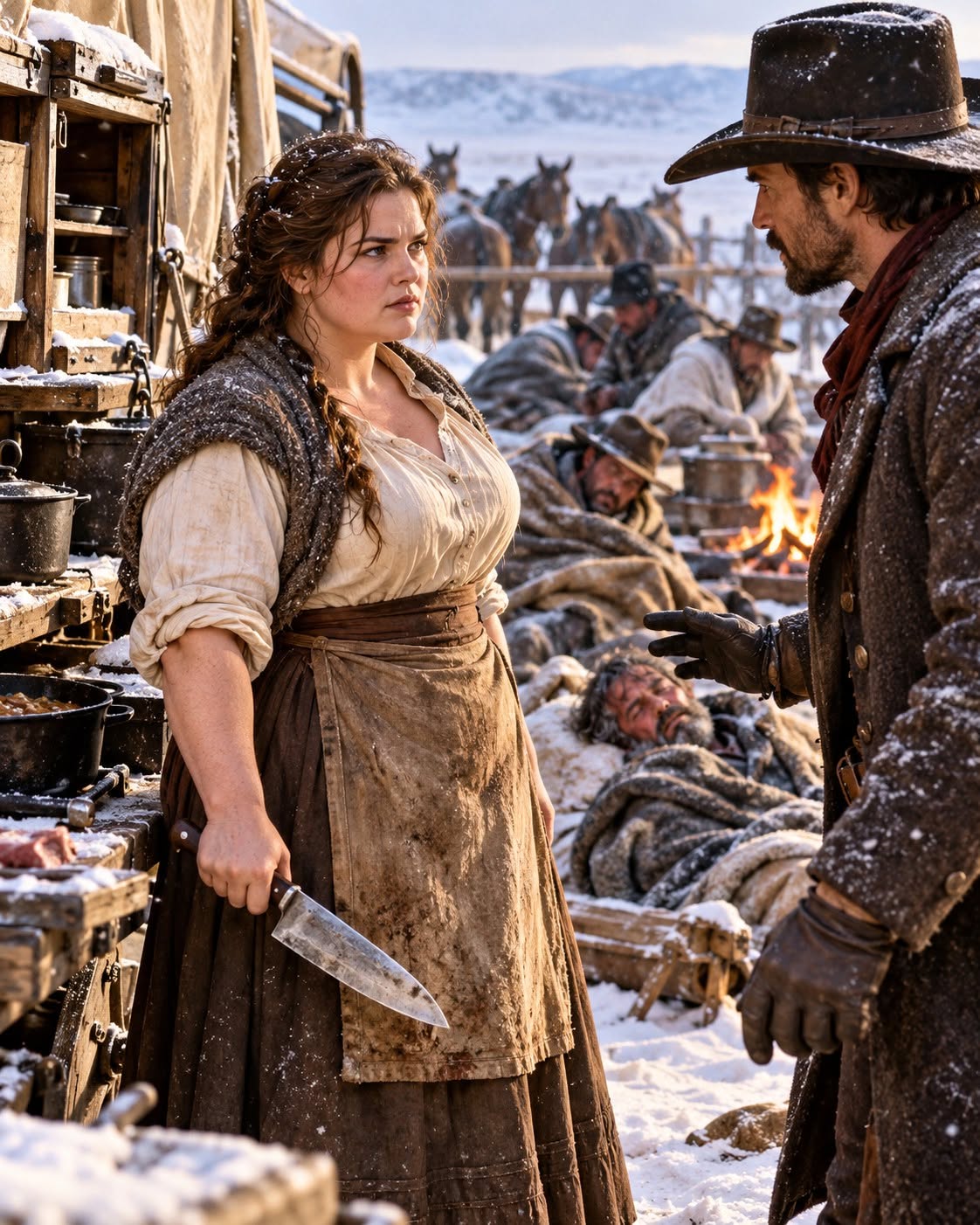
“Move, Wilmer.”
Katrina Foster had never spoken to the trail boss in that tone before.
The wind howled against the chuck wagon, rattling its wooden sides. Beyond the campfire, forty cowboys lay beneath blankets, their faces pale, their breathing uneven. Some shivered uncontrollably. Others were too exhausted to speak.
Wilmer stared at the butcher knife in Katrina’s hand.
“Put that down.”
“I’m not planning to cut anybody.”
“Then explain what you’re doing.”
Katrina pointed toward the medical chest.
“Because that man has been treating every sick cowboy like he’s got the same problem.”
Dr. Samuel Price looked up sharply.
He was a thin, gray-haired physician who had traveled with cattle drives for nearly twenty years. He had seen broken bones, infected wounds, fever, and accidents that would make a grown man faint.
He didn’t appreciate being challenged by a cook.
“Miss Foster, unless you’ve studied medicine, I suggest you return to your kitchen.”
Katrina didn’t move.
“My father was a butcher, Doctor. I spent years helping him prepare meat, preserve food, and care for injured animals. I’ve also spent enough winters watching people get sick to recognize when something isn’t right.”
“And what exactly isn’t right?”
She pointed toward the western side of the camp.
“Those men were sleeping in wet clothes. Their blankets are soaked. Half of them have been drinking creek water without boiling it. And you’ve got men coughing beside the food preparation area.”
The doctor frowned.
“Cold weather causes coughing.”
“Cold weather doesn’t explain everything.”
Katrina walked toward the nearest bedroll.
A young cowboy named Peter Lawson was lying there, barely conscious. His lips were dry, and his breathing sounded strained.
She touched his forehead.
“Has he been drinking?”
“Almost nothing,” the doctor answered.
“Then why is his water cup empty?”
The doctor looked down.
Katrina turned toward Wilmer.
“I need every clean blanket we have. I need the sick men separated from the healthy ones. And I need someone to bring me every pot, kettle, and bucket that can hold boiling water.”
Jeb Rollins, who had been standing near the horses, gave a weak laugh.
“Since when does a cook give orders to a hundred cowboys?”
Katrina turned.
“Since a hundred cowboys became too sick to feed themselves.”
Nobody laughed.
Wilmer studied her face.
Then he nodded.
“Do what she says.”
The camp erupted into movement.
Two cowboys began gathering blankets. Another cleared space inside the largest supply tent. Amos Bell, the youngest rider, ran toward the creek with empty buckets.
Katrina returned to the chuck wagon.
She had recognized something else.
Several of the sick men had complained about stomach cramps before the breathing problems became severe. Others had been drinking from a shallow stretch of creek near the cattle crossing.
 The water had looked clear.
But clear water wasn’t necessarily clean water.
She remembered her father’s words from years earlier.
Never trust what you cannot see, girl. A thing can look perfectly harmless and still make a family sick.
She asked the doctor whether he had noticed any pattern.
He hesitated.
Then he opened his notebook.
“Some developed fever first. Others complained of stomach trouble. A few had severe coughing.”
“Did they all drink from the same place?”
The doctor went silent.
Katrina looked at Wilmer.
“Where did we water the herd two days ago?”
“The lower creek.”
“Where the cattle crossed?”
“Yes.”
“Then I want that water source closed until we know it’s safe.”
The doctor looked irritated.
But he finally agreed.
Katrina began preparing fresh broth.
She used what remained of the salted beef, onions, dried vegetables, and the last of her preserved herbs. She made sure the sick men received small amounts of warm liquid rather than being forced to eat heavy meals.
She also instructed the cowboys to keep the tent ventilated without exposing the sick men to the freezing wind.
Dr. Price examined each patient again.
By midnight, he had reached an uncomfortable conclusion.
Katrina was right about the camp’s sanitation.
And there was another problem.
The sick men weren’t all suffering from the same illness.
Some had cold-related respiratory symptoms. Others had signs of gastrointestinal illness, likely worsened by contaminated water. A few had become dangerously weak from dehydration and exposure.
There was no single remedy.
There was no miracle bottle in his medical chest.
There was only careful work, clean water, warmth, and time.
For the first time, the doctor began asking Katrina questions instead of dismissing her answers.
“Have you ever worked in a hospital?”
“No.”
“Then where did you learn all this?”
Katrina stirred the broth.
“My mother died when I was fourteen. My father had a butcher shop, and there was nobody else to keep the household running. I learned how to preserve food, recognize spoiled meat, clean wounds, and care for people who couldn’t care for themselves.”
She paused.
“I also learned that when people are frightened, they sometimes mistake confidence for knowledge. I don’t intend to do that.”
The doctor regarded her thoughtfully.
“Neither should I.”
Outside, the blizzard grew worse.
Snow swept across the open plains, burying the wagon tracks and making the distant hills disappear.
Wilmer approached Katrina shortly before dawn.
“You haven’t slept.”
“Neither have you.”
“I’m the trail boss.”
“And I’m the cook.”
He looked toward the medical tent.
“Twenty-three men are still seriously ill.”
“I know.”
“Can you save them?”
Katrina stopped stirring.
She hated that question.
Not because she didn’t want to answer.
Because she knew there were no guarantees.
“I can help them survive the next few hours. Dr. Price knows what medicines to give. But we need a proper physician and fresh supplies.”
“How far?”
“Nearest settlement?”
“Fort Laramie is too far in this weather. There’s a small trading post about thirty miles east, but the road may be buried.”
Katrina looked toward the darkness.
“Then somebody needs to ride.”
Wilmer shook his head.
“No horse will make it through that storm.”
“Then we’ll have to wait for a break.”
He watched her carefully.
“You’re afraid.”
Katrina looked at the sick men.
“Of course I am.”
“Then why keep going?”
She glanced toward the tent where Peter Lawson was sleeping.
“Because being afraid doesn’t make these men any less hungry, sick, or cold.”
Wilmer didn’t answer.
Instead, he removed his heavy coat and placed it around her shoulders.
“Get some rest. I’ll take the next watch.”
Katrina almost refused.
Then she realized her hands were shaking from exhaustion.
She sat beside the stove and closed her eyes.
For the first time since the blizzard began, she slept.
But the camp wasn’t finished with its troubles.
At sunrise, a terrible sound came from the horse enclosure.
A frightened animal had broken loose.
Its reins had caught around a wagon wheel, and several other horses were beginning to panic.
Jeb Rollins ran toward the enclosure, slipping in the snow.
“Somebody help!”
Wilmer rushed outside.
Katrina followed.
The runaway horse was a large chestnut gelding named Copper, one of the outfit’s strongest animals.
His movements were becoming increasingly frantic.
If he overturned the supply wagon, they could lose the remaining flour, medicine, and blankets.
Jeb tried to approach from the front.
“Easy, boy!”
Copper reared.
Jeb stumbled backward.
Then Katrina noticed the real problem.
The horse wasn’t simply frightened.
His hind leg was tangled in a length of loose rope.
“Everybody back!” she shouted.
Wilmer looked at her.
“What?”
“Get away from his hindquarters. You’re making him panic.”
She approached slowly, speaking in the low, steady voice she had used with frightened livestock since childhood.
Copper tossed his head.
Katrina stopped.
“Easy. Nobody’s going to hurt you.”
She waited until the animal lowered his head.
Then she carefully moved closer, using a thick blanket to protect herself while she worked to free the tangled rope.
It took several minutes.
When the horse finally stepped free, he stood trembling beside her.
Katrina stroked his neck.
“There. That’s better.”
Jeb stared at her.
“You knew how to do that?”
“My father kept horses behind his shop.”
Jeb looked down.
Then he muttered, “I didn’t know.”
Katrina wiped her hands.
“You never asked.”
The words struck harder than a slap.
Later that afternoon, the storm finally weakened.
A break appeared in the clouds, revealing a narrow strip of pale winter sunlight.
Wilmer immediately organized a rescue party.
Two riders would travel east toward the trading post. Another would search for help from a nearby ranch.
Dr. Price prepared a written list of supplies.
Katrina packed food, H๏τ coffee, and dry clothing for the riders.
Before leaving, Wilmer approached her.
“I’m putting Jeb in charge of the supply tent.”
Katrina raised an eyebrow.
“That’s an interesting choice.”
“He needs to learn responsibility.”
Jeb heard him.
For once, he didn’t argue.
Instead, he approached Katrina.
“Miss Foster?”
She looked up.
“Thank you for Copper.”
She nodded.
“And for what?”
Jeb swallowed.
“For not letting me make things worse.”
It was the closest thing to a sincere apology he had ever offered.
Katrina returned to her cooking.
But as the riders disappeared into the snowy distance, she noticed something disturbing.
The number of sick men had stopped increasing.
That should have been encouraging.
Instead, Dr. Price was staring at the medical records with a deeply troubled expression.
“What is it?” Katrina asked.
He pointed to a name.
Peter Lawson.
“He was improving this morning. Now his fever has returned.”
Katrina looked at the tent.
“Did he drink from the lower creek?”
“No. We stopped that water source.”
“Then what changed?”
The doctor examined the patient’s blankets.
His expression hardened.
“Miss Foster, I need you to look at this.”
He pulled back the blanket.
The cloth was damp.
Not from spilled water.
From something coming through the canvas above.
The tent roof was leaking, and melting snow had been dripping directly onto the sick men’s bedding.
Katrina looked upward.
Then she noticed the second problem.
The stove pipe had shifted during the night.
Its connection to the chimney was loose.
She stepped closer.
“Doctor, when was this last checked?”
“Yesterday evening.”
Katrina looked at Wilmer.
“Get everybody away from this tent. Now.”
Wilmer immediately began moving the men.
Dr. Price examined the damaged stove connection and realized that the poorly ventilated tent could have exposed the occupants to dangerous fumes.
The storm had created one more emergency.
And it had happened while everyone was concentrating on the illness.
As the sick men were moved to safer quarters, Katrina stood outside the tent, staring at the damaged chimney.
Then a rider appeared on the ridge.
He was coming fast.
His horse stumbled through the snow, and he nearly fell from the saddle as he reached camp.
Wilmer ran toward him.
“What happened?”
The rider struggled to catch his breath.
“It’s the trading post.”
“What about it?”
“There’s no doctor there anymore. He left three days ago.”
Wilmer’s face fell.
“Did you bring medicine?”
The rider shook his head.
“Worse. There’s another cattle outfit camped east of here. They’re in trouble too.”
“How many men?”
The rider looked toward the medical tent.
“Forty-two.”
Katrina felt the cold settle deeper into her chest.
“What’s wrong with them?”
The rider hesitated.
“Same symptoms. Same water source.”
Dr. Price stepped forward.
“Then we may be dealing with a wider outbreak.”
Wilmer looked at Katrina.
For once, there was no mockery, no doubt, and no question about her place in the camp.
He simply asked:
“What do we do now?”
Katrina looked toward the eastern horizon.
“We stop treating this like one bad camp. We find out where the water is coming from, and we get help before more men become sick.”
But she had no idea that the worst discovery was still waiting.
Because the rider had brought something else.
A letter.
It was addressed to Wilmer Morales, and the handwriting belonged to the owner of the Double H outfit.
Wilmer opened it.
His face changed as he read.
Then he handed it to Katrina.
The message contained only three lines:
DO NOT RELEASE THE MEN FROM THE DRIVE.
THEY HAVE BEEN EXPOSED TO SOMETHING THAT MUST NOT REACH THE OTHER CAMPS.
AND WHATEVER YOU DO, DO NOT LET KATRINA FOSTER EXAMINE THE SUPPLY WAGON.
Katrina read the final line twice.
Then she slowly lifted her eyes toward the wagon.
Someone knew something she didn’t.
And someone was desperately afraid she would discover it.