PART 2: THE BRIDE WHO REFUSED TO BOW
PART 2: THE BRIDE WHO REFUSED TO BOW
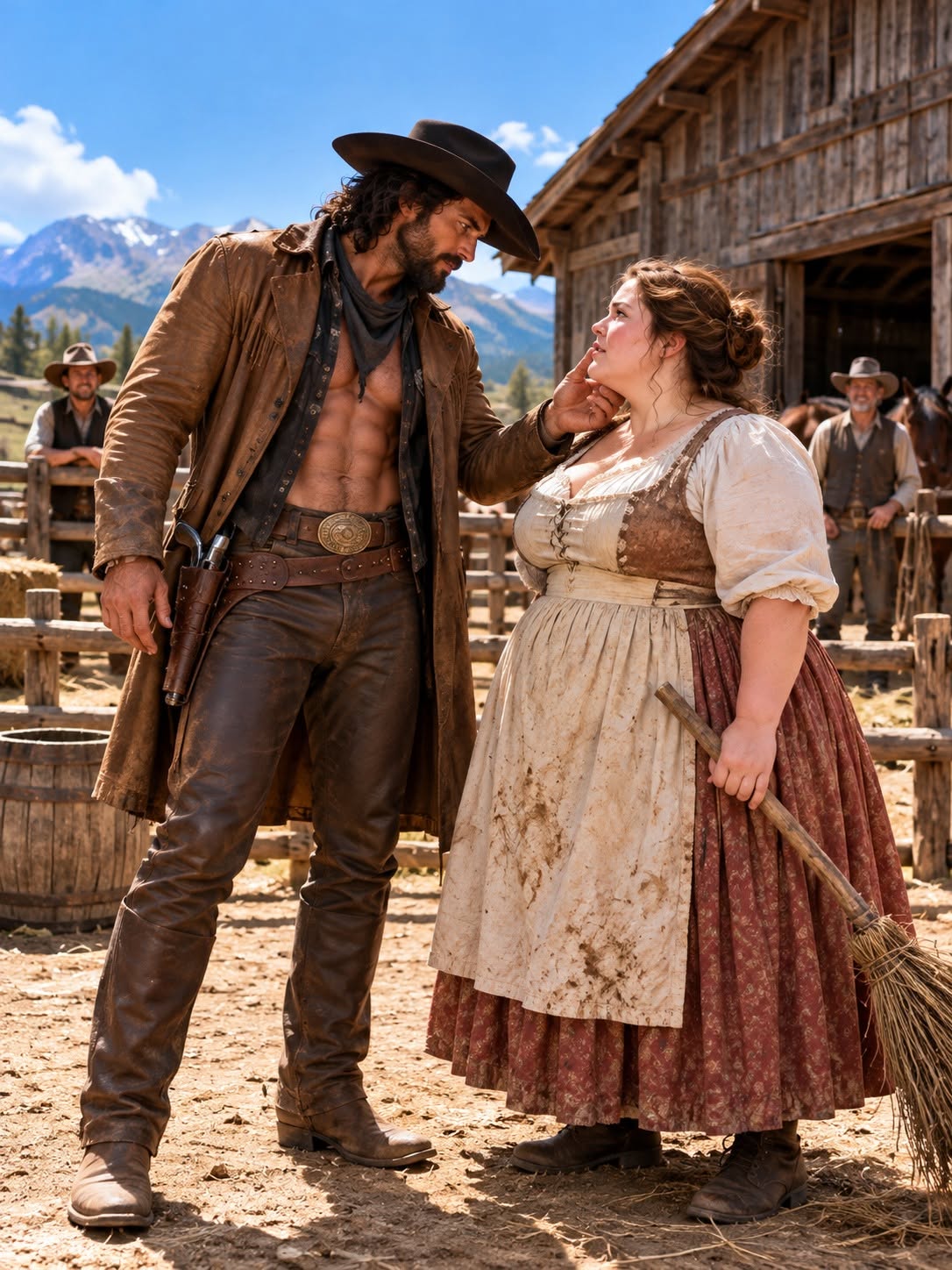
Eda stared at the mountain man.
For a long moment, the only sound between them was the restless stamping of horses in the nearby stalls.
Then she looked down at the leather pouch on the barrel.
“Did you pay my brother for me?”
Gunter Cole’s expression hardened.
“No.”
“Then what is that money?”
“Payment for the horses. Your brother decided what he thought your future was worth without asking you.”
Josiah let out an uncomfortable laugh.
“Now, Eta, don’t start making a scene. A man like Mr. Cole doesn’t come along twice. He’s offering you a roof, food, and a proper marriage.”
Eda turned toward him.
“You’ve already decided?”
Josiah’s smile faltered.
“Someone has to think practically.”
“Funny,” she murmured. “I thought I was the one who kept this place practical.”
The words struck harder than she intended.
For three years, she had risen before sunrise, cleaned stalls, mended harnesses, nursed sick foals, and kept the livery alive while Josiah entertained customers and collected praise.
Yet somehow, she was still the burden.
Gunter watched her carefully.
“I won’t drag you anywhere, woman. If you refuse, you refuse.”
Eda looked at him.
His beard concealed much of his face, but his eyes were steady. There was no pity in them.
That unsettled her more than cruelty ever had.
“Why me?” she asked.
“Because I watched you handle a horse that would have broken another person’s arm. Because you knew when to hold and when to release. Because you don’t mistake noise for strength.”
He paused.
“And because I need someone who understands that a living creature isn’t a thing to be conquered.”
Eda glanced toward the back corral.
The big roan gelding stood there, his scarred neck bowed, his black mane tossing in the wind.
“He’ll kill you if you get careless,” she said.
 “Perhaps.”
“He’s thrown five men.”
“Then I won’t be the sixth.”
For the first time that afternoon, the corner of Eda’s mouth twitched.
It wasn’t quite a smile.
But Gunter noticed.
“There’s something else,” she said.
“Name it.”
“I won’t be a servant in a house just because the servant happens to wear a wedding ring.”
Gunter nodded.
“Fair.”
“And I won’t be hidden when company comes.”
“Fair.”
“And if I come with you, I bring my own saddle, my tools, and my money.”
Josiah scoffed.
“Your money? What money?”
Eda reached into the pocket of her apron and drew out a little cloth purse.
Inside were silver coins, every one earned from breaking horses and treating injuries Josiah had charged customers to fix.
Gunter’s gaze moved to the purse.
“Your earnings,” he said.
“All of them.”
“Then they’re yours.”
Josiah’s face reddened.
He had not expected his sister to have a voice.
Much less a price she would not surrender.
Eda studied Gunter for another long moment.
“What happens when you discover I’m not the wife you imagined?”
The mountain man answered without hesitation.
“Then we’ll have to discover what kind of husband I am.”
Something in her chest shifted.
Not love.
Not yet.
Perhaps the smallest beginning of trust.
“Very well,” she whispered. “I’ll come.”
They were married the following morning in the little church at Oak Haven.
The congregation arrived expecting a spectacle.
Some came to laugh.
Others came to see whether the mountain man would change his mind when the bride stood beside him.
Eda wore a dark green dress she had altered herself. It fit her broad shoulders and generous figure without apology.
Her hair was pinned neatly beneath a simple hat.
She carried no flowers.
Gunter stood beside her in his cleanest coat, looking as though he’d rather face a charging bull than a church full of curious townsfolk.
When the minister asked whether he took Henrietta Price as his wife, Gunter answered firmly.
“I do.”
When it was Eda’s turn, she looked at the man who had purchased horses but refused to purchase her obedience.
“I do.”
A woman in the second pew whispered, “He’ll regret it before Christmas.”
Eda heard her.
So did Gunter.
Neither answered.
They left Oak Haven before noon with three mares, a packhorse, and the troublesome roan trailing behind them.
The road into the Bitterroot Mountains was narrow, winding, and merciless.
Snow still clung to the shaded slopes.
By sunset, Eda’s legs ached, her fingers were numb, and the wind had begun to howl through the pines.
Gunter glanced back at her.
“Cold?”
“Not enough to complain.”
“That’s not what I asked.”
She looked at him.
“Then yes.”
He stopped, dismounted, and handed her his thick wool coat.
She hesitated.
“You’ll freeze.”
“I’ve frozen before.”
“And survived?”
“Barely.”
She took the coat.
That evening, they reached his homestead.
It was a sturdy log house perched above a creek, with a barn, a fenced pasture, and a view of mountains that seemed to rise straight into the heavens.
Inside, the cabin smelled of cedar, ashes, and dried herbs.
There were two bedrooms.
Gunter pointed toward the smaller one.
“Yours.”
Eda set down her carpetbag.
“You’re giving me my own room?”
“I promised you a marriage, not a cage.”
She looked at him for a long time.
Then she noticed something peculiar.
A small wooden horse sat on the mantelpiece.
Its legs were uneven, its mane crudely carved.
But the craftsmanship was strangely familiar.
Eda stepped closer.
“Who made this?”
Gunter went still.
For the first time since she’d met him, the mountain man’s expression changed.
“Someone I knew.”
Before she could ask another question, a violent crash erupted from the barn.
The roan.
Gunter grabbed his rifle.
Eda caught his sleeve.
“Don’t shoot.”
“That horse has already broken half the corral.”
“And a bullet won’t mend it.”
They ran outside.
In the darkness, the roan was striking the fence, splintering boards beneath his hooves.
Gunter raised his lantern.
The horse screamed and reared.
Then Eda saw something.
A dark strap twisted beneath the saddle blanket, cutting into the gelding’s shoulder.
“Hold the lantern higher!” she shouted.
Gunter did.
Eda stepped toward the fence.
The roan’s eyes rolled white.
“Easy, boy.”
He struck the ground.
She saw blood.
And beneath the tangled strap, sewn into the lining of the old blanket, was a small brᴀss medallion.
Eda stopped breathing.
She knew that medallion.
She had seen one exactly like it hanging around the neck of a horse belonging to her father.
And suddenly, the mountain air seemed colder than the snow.
Because the horse Gunter had bought in Oak Haven was wearing a saddle blanket that should have been buried with her father.