PART 2: THE BRIDE WHO DISAPPEARED
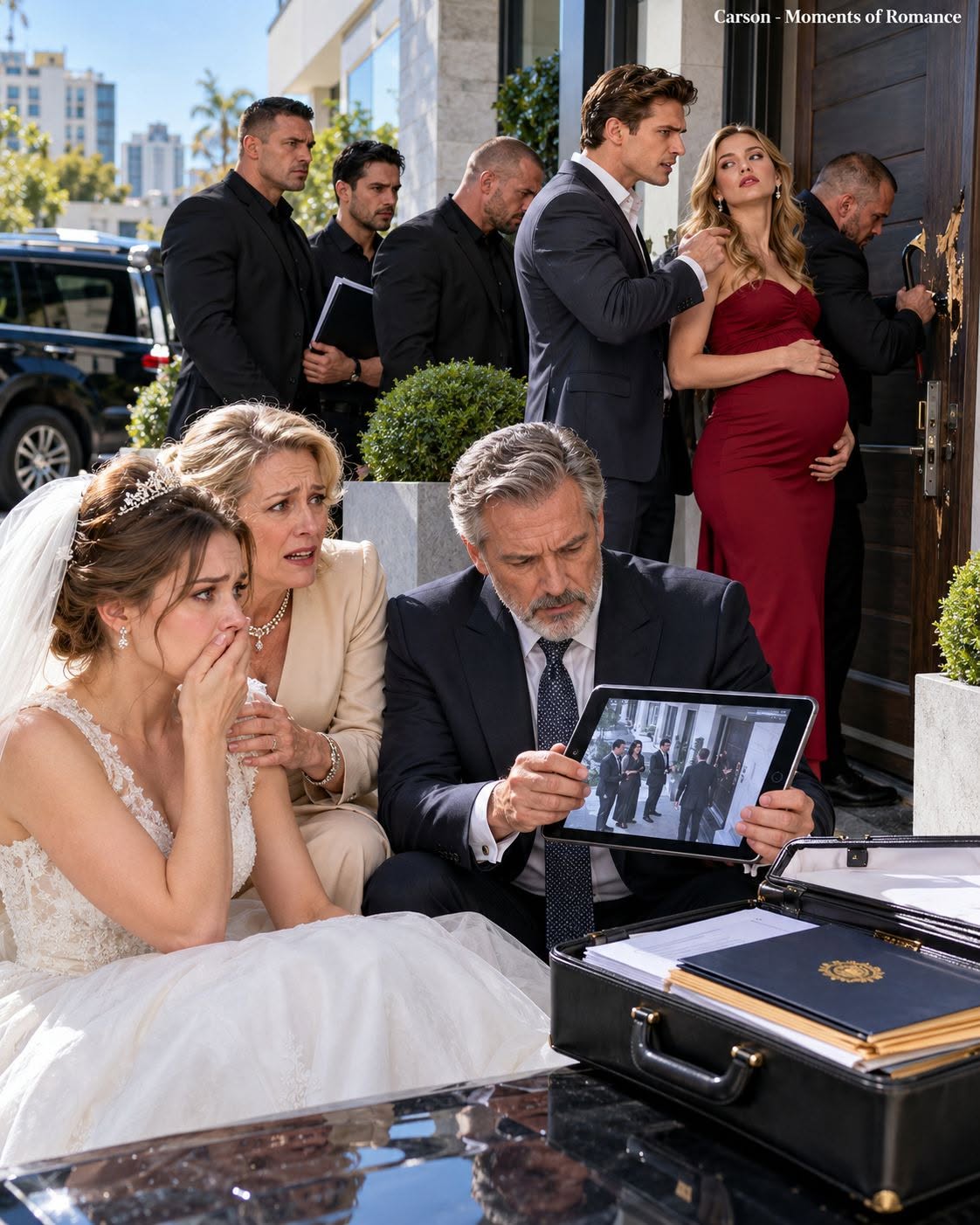
The wedding dress felt unbearably heavy. My hands were shaking, and the image of Christian standing beside his pregnant mistress kept replaying in my mind.
Three years.
Three years of believing his promises. Three years of working overtime while he built Nexus Tech. Three years of telling myself that the man who borrowed money for groceries today would someday build a future for us tomorrow.
And all that time, he had been planning to destroy me.
“Dad,” I whispered, “what does this mean?”
My father, Richard Prescott, closed the briefcase halfway.
“It means your mother and I should have told you the truth a long time ago.”
He looked at me with eyes that had suddenly become older.
“My name isn’t simply Richard Prescott, the retired businessman you think I am. I’m the founder and controlling shareholder of Prescott Meridian Group, a private investment company with interests in technology, real estate, and financial services.”
I stared at him.
I knew the name Prescott Meridian. Everyone in the technology industry knew it. Its investments had helped establish some of the most successful companies on the West Coast.
But I’d never connected it to my father.
“You own Prescott Meridian?”
“I built it.”
“Then why did we live in that tiny house? Why did you let me believe you were struggling to make ends meet?”
My mother reached for my hand.
“Because when you were younger, you told us you wanted someone to love you for yourself. Not for our money. Your father agreed that you deserved the chance to build your own life.”
My father sighed.
“We didn’t want to choose your partner for you. We wanted you to choose someone who respected you without knowing what your last name could give him.”
I looked back at the tablet.
“Christian knew.”
“Not everything,” my father replied. “But he knew your family had connections. That’s why he pursued you so aggressively after Nexus Tech began experiencing financial difficulties.”
A cold realization settled over me.
The mysterious investors who had rescued Christian’s company hadn’t appeared by accident.
“You funded Nexus Tech?”
“Through a subsidiary investment fund. We made the investment under an independent management structure. Christian was evaluated on his business plan, not on his relationship with you.”
“Why didn’t you tell me?”
“Because we wanted the investment to stand on its merits. We also wanted to see whether Christian would build a sustainable business.”
My father paused.
“He didn’t.”
I looked down at the papers.
“What happens now?”
His expression hardened.
“Now, we make certain he can never use your trust in him as a weapon again.”
He opened the briefcase and spread the documents across the seat.
The first was a copy of Nexus Tech’s investment agreement.
The second was a corporate ownership chart.
The third was a formal notice from Prescott Meridian’s legal department.
Christian had no idea that his company’s largest insтιтutional investor was controlled by the family he had dismissed as insignificant.
But my father wasn’t interested in simply embarrᴀssing him.
“We have security footage showing men attempting to force entry into your apartment,” he explained. “We have the audio of Christian discussing the fraudulent loan, and we have his statements about taking your medical records and arranging an unauthorized procedure.”
My stomach twisted.
“Can they really take my kidney?”
“No one has the right to take your organs without your informed consent. What they discussed is horrifying, but we’ll let the authorities establish precisely what they intended and who was involved.”
He squeezed my hand.
“You are not going anywhere near those men. We’ve contacted law enforcement, and our attorney is coordinating with the investigators.”
For the first time since the phone call, I could breathe.
Then my father said something that made my heart ache.
“Charlotte, I need you to understand that none of this is your fault.”
I lowered my head.
“I should have seen it.”
“No. You loved someone. He chose to exploit that love. Those are two very different things.”
I closed my eyes.
When I opened them again, I was no longer thinking about the wedding I had lost.
I was thinking about the woman I needed to become to survive what came next.
“Tell me what to do,” I said.
My father nodded.
“First, we get you somewhere safe. Second, we preserve the evidence. Third, we let the law handle Christian and the men he brought to your door.”
“And the wedding?”
My mother began to cry again.
I looked at the ivory fabric spread across my knees.
“Cancel it.”
My father nodded.
“Consider it done.”
I swallowed.
“No,” I corrected him. “I want to cancel it myself.”
For the first time that morning, I felt a small measure of control returning to my life.
“Let me send Christian one message.”
My father hesitated.
“Only if our attorney approves it and it doesn’t interfere with the investigation.”
He was right.
I wasn’t going to give Christian an opportunity to manipulate me again.
With my attorney’s guidance, I sent a brief message.
Christian, the wedding is canceled. Do not contact me or come near me. Any further communication must go through my attorney.
Then I blocked his number.
I didn’t tell him where I was.
I didn’t threaten him.
I didn’t reveal what my father had prepared.
I simply disappeared from his life.
And that was the first decision I had made in years that belonged entirely to me.
At 9:15 a.m., Christian stood in front of the shattered door of our apartment.
He had expected to find me frightened, confused, and ready to sign whatever papers he placed in front of me.
Instead, he found an empty apartment.
The bedroom closet had been cleared of my clothes. My jewelry box was gone. The wedding dress’s garment bag no longer hung behind the door.
He stormed into the kitchen.
“Where is she?”
Brooklyn followed him, one hand resting on her stomach.
“You said she would be here.”
“She was supposed to be here!”
One of the men holding the folder checked the apartment again.
“She left before we arrived.”
Christian grabbed his phone and called me.
The call went straight to voicemail.
He tried again.
Nothing.
“She’s playing games,” he muttered.
Brooklyn’s expression changed.
“What if she saw us?”
“She didn’t see anything.”
“What if someone told her?”
Christian turned toward her.
“Who would tell her? Her father? That useless man can barely afford his own house.”
The words had barely left his mouth when his phone rang.
It was Frank Dorsey, the man who had arranged the proposed loan.
Christian answered immediately.
“Where’s the signature?”
Frank’s voice was cold.
“You told me she would sign this morning.”
“She wasn’t there.”
“You said she had no one to protect her.”
“She doesn’t!”
“Then explain why a Prescott Meridian security team is standing outside the building and why two detectives have just asked me to accompany them for questioning.”
Christian went silent.
“Detectives?”
Frank swore under his breath.
“What exactly have you dragged me into, Reynolds?”
The call ended.
Christian stared at his phone.
For the first time, he wondered whether the woman he had treated as powerless might not be as powerless as he believed.
He was about to find out.
At 10:30 a.m., I sat in a private conference room at Prescott Meridian’s headquarters.
My wedding dress had been replaced with a simple navy suit my mother had purchased on the way.
Across the table sat my father’s general counsel, two investigators, and an independent forensic specialist.
The footage from my apartment was being preserved, along with the original recording files and access logs.
My attorney had also contacted the bank listed on the proposed eight-million-dollar loan documents.
The bank confirmed that no loan had been approved in my name.
However, a draft application had been submitted containing my personal information and a forged preliminary authorization.
The bank had flagged the application before disbursement.
That was the first piece of good news I’d heard all day.
The second was that the document naming me as guarantor had never received my signature.
“Can Christian still make me responsible for the debt?” I asked.
“No one can responsibly tell you that without examining every document,” my attorney replied. “But based on what we’ve seen, the application appears to contain serious irregularities. We will formally dispute any purported obligation and cooperate with the bank’s investigation.”
“And the men at my apartment?”
“The authorities will determine their roles. We have provided the footage and your statement.”
I nodded.
I wanted justice.
But I didn’t want revenge so badly that I became careless.
My father sat beside me, silent until the meeting ended.
Then he turned toward me.
“There’s something else you should know.”
I stiffened.
“What?”
“Christian’s company is preparing to close a major financing agreement next week. Our investment committee was scheduled to review the final terms.”
I stared at him.
“You’re going to pull the investment?”
“My personal feelings are irrelevant. The committee will review the company’s financial position, its disclosures, and any credible concerns about management conduct.”
“So he’ll lose everything?”
“Not necessarily. The company has employees who had nothing to do with what happened to you. We won’t punish them simply because their founder behaved disgracefully.”
I looked at him with new respect.
He could have used his wealth to destroy Christian in an afternoon.
Instead, he was insisting on a process that separated the innocent from the guilty.
“Thank you,” I whispered.
My father covered my hand with his.
“You don’t have to thank me for protecting you.”
Then he added, “But you do have to help us understand how much of Christian’s business you’ve been involved in.”
I frowned.
“What do you mean?”
He slid another folder toward me.
“Your consulting work.”
I opened it.
Inside were copies of financial analyses I had prepared for Christian over the previous three years. He had described them as routine administrative tasks. I had ᴀssumed they were simply part of helping a small company survive.
But the documents showed something else.
I had identified cash-flow problems, flagged questionable vendor invoices, and recommended changes to Nexus Tech’s financial controls.
Several of those recommendations had never been implemented.
Others had been incorporated into investor presentations without crediting my work.
I looked up.
“Why are these in your files?”
“Because our independent investment team retained copies of the financial materials provided during due diligence. Your analyses were among the most accurate documents they received.”
I felt a strange mixture of anger and disbelief.
Christian had spent years telling me I was lucky he allowed me to help with his business.
Yet some of the work that had kept his company alive had been mine.
My father smiled faintly.
“Charlotte, you are a remarkably capable financial analyst. You don’t need to prove that to me. But I think you’ve spent so long supporting Christian’s ambitions that you’ve forgotten your own.”
I looked down at the documents.
For three years, I had helped build a company whose founder was secretly planning to use me as collateral.
Now I had a choice.
I could walk away from the entire industry.
Or I could use what I had learned to build something that belonged to me.
For the first time, the second option felt possible.
At 1:40 p.m., my father’s ᴀssistant entered the conference room.
“Mr. Prescott, Christian Reynolds is on the phone. He says it’s an emergency.”
My father looked at me.
“Would you like me to take it?”
I considered the question.
“No. But you can tell him one thing.”
My father nodded to the ᴀssistant.
She placed the call on speaker.
Christian’s voice filled the room.
“Mr. Prescott, thank God. I need your help. There’s been a misunderstanding involving Charlotte. She’s disappeared, and I think someone is trying to sabotage my company.”
My father said nothing.
Christian continued.
“I know your family has certain connections. If you can help me locate her, I would be extremely grateful. We’re supposed to be married today.”
My father finally spoke.
“Mr. Reynolds, my daughter has canceled the wedding.”
There was a long silence.
“Your daughter?”
“Yes.”
Christian gave a nervous laugh.
“I don’t understand.”
“Charlotte Prescott is my daughter.”
Another silence.
Then Christian’s voice changed.
“Mr. Prescott, I can explain everything.”
“I’m sure you can explain many things. You’ll have the opportunity to do so through the appropriate channels.”
“Please. I love Charlotte.”
My father looked at me.
I shook my head.
He continued.
“You brought men to her apartment to force her to sign an eight-million-dollar loan guarantee. You discussed using her medical records to arrange a procedure she never consented to. We have provided the relevant evidence to investigators.”
Christian’s breathing became audible.
“That footage is being taken out of context!”
“Then you should cooperate with the investigation.”
“Mr. Prescott, you can’t let one misunderstanding destroy everything I’ve built!”
My father leaned forward.
“Your business is your responsibility, Mr. Reynolds. So is your conduct.”
Christian began speaking rapidly.
He blamed Brooklyn.
He blamed Frank.
He claimed the loan was merely a precaution and the medical discussion had been misunderstood.
He even said that he had planned to tell me everything after the wedding.
My father listened without interrupting.
Then he said the sentence Christian would remember for the rest of his life.
“You had three years to tell my daughter the truth. You chose to lie to her instead.”
The call ended.
I stared at the speaker.
For years, Christian had treated my father’s name as insignificant.
Now he finally understood why I had never needed to tell him who my family was.
But my father’s wealth wasn’t the thing that made me feel powerful.
It was the knowledge that Christian could no longer reach me simply because he wanted to.
For the first time, I was safe enough to decide what came next.
PART 3: THE WEDDING THAT NEVER HAPPENED — THE ENDING
The following week, Christian’s carefully constructed world began to unravel.
The proposed eight-million-dollar loan was suspended while the bank investigated the questionable application and the purported guarantee.
The men who had accompanied him to my apartment were questioned by law enforcement. Their involvement, and any charges that might follow, would depend on the evidence gathered by investigators.
Brooklyn’s situation became more complicated when she learned that Christian had not been honest with her either.
He had promised her that the loan would provide enough money to rescue Nexus Tech, pay off several creditors, and secure a comfortable future for their child.
But the financing had never been approved.
And the person he had intended to make responsible for it had vanished.
One afternoon, Brooklyn contacted my attorney.
She wanted to provide information about the conversations she had witnessed.
My attorney arranged for her to speak with investigators.
I did not meet with her.
I had no desire to become involved in a personal battle with a pregnant woman whose relationship with Christian was already collapsing.
Whatever she had done, the investigation needed facts, not my ᴀssumptions.
Meanwhile, Nexus Tech’s investors began a formal review of the company’s financial condition.
The independent committee discovered that Christian had overstated the certainty of several contracts and failed to disclose important risks ᴀssociated with the proposed financing.
The committee froze the pending investment until the review was complete.
Christian’s employees began asking questions.
The board demanded explanations.
And the man who had once bragged that he was about to become one of California’s most successful technology founders found himself spending his days answering lawyers instead of attending celebratory meetings.
But the consequences did not stop there.
The forensic review also identified evidence that some of the financial analyses I had prepared were presented to investors without proper attribution.
My attorney advised me to preserve my original files and let the independent reviewers determine how the documents had been used.
I did.
I wasn’t interested in making claims I couldn’t support.
I wanted the truth established accurately.
For once, I had no reason to rush.
Three months later, I received a letter from Christian.
It arrived at my attorney’s office in a plain white envelope.
Inside was a handwritten note.
Charlotte,
I know you probably hate me. I don’t blame you.
I told myself I was doing everything for our future. I convinced myself that once the company succeeded, I could make up for the lies and the risks I took.
I never expected you to discover what I was planning.
I still love you.
Please give me one chance to explain.
I read the letter twice.
Then I placed it on the table.
My attorney watched me carefully.
“Do you want to respond?”
I shook my head.
“No.”
“Are you sure?”
I thought about the rented wedding dress. The promises. The late nights. The moments I had defended Christian to my friends because I believed he was simply under pressure.
Then I remembered the security footage.
His expression had been so casual when he discussed my future as though it were an inconvenience.
He hadn’t been afraid that I would be hurt.
He had been afraid that I would refuse to sign.
“No,” I repeated. “I don’t owe him another conversation.”
My attorney nodded.
I asked her to preserve the letter with the other records.
Then I walked out of the office and went to lunch with my mother.
We talked about ordinary things.
A book she was reading.
A restaurant she wanted to try.
The weather.
For the first time in months, I didn’t spend the afternoon replaying Christian’s words in my head.
I was beginning to understand that healing didn’t always arrive with a dramatic revelation.
Sometimes, it arrived when you realized you had gone an entire hour without thinking about the person who hurt you.
Six months after the wedding that never happened, Prescott Meridian established a new financial analysis division focused on evaluating early-stage technology companies.
My father offered me a position.
I declined the first time.
Then I declined the second.
Finally, I agreed to meet with the independent hiring committee.
“I don’t want a job because I’m your daughter,” I told him.
“Good,” he replied. “I don’t want you to have one for that reason either.”
I went through the same interviews as the other candidates.
I presented a financial risk ᴀssessment, answered questions about investment controls, and explained how I would distinguish promising businesses from companies surviving on unrealistic projections.
The committee offered me the role.
I accepted.
My first project involved helping the firm develop stronger procedures for evaluating founders and protecting investors from misleading financial disclosures.
I also worked with the legal team to establish safeguards against conflicts of interest and unauthorized use of personal information.
The irony was impossible to ignore.
I had spent three years helping Christian build a business without understanding how little protection I had if he decided to exploit me.
Now I was helping create systems that would make it harder for someone else to suffer the same experience.
One evening, after a long meeting, my father stopped by my office.
“You look tired,” he said.
“I am.”
“Regretting the job?”
I smiled.
“Not yet.”
He sat across from me.
“Your mother tells me you’ve started painting again.”
I glanced toward the canvas leaning against the wall.
I hadn’t painted since before I met Christian.
At first, I had told myself I was too busy. Then Christian had called it a hobby. Eventually, I stopped mentioning it altogether.
Now I painted on weekends.
Not because I expected to sell anything.
Because it reminded me that I could create something without needing anyone’s approval.
“I forgot how much I enjoyed it,” I admitted.
My father looked at the unfinished canvas.
“Then don’t forget again.”
A year after the canceled wedding, I attended a charity gala with my parents.
The ballroom was filled with executives, artists, and philanthropists. A string quartet played beside the stage.
I wore a deep-blue dress that I had chosen myself.
No one had selected it to make me look wealthier.
No one had told me to choose something inexpensive.
And no one had asked me to prove that I deserved to be there.
As I stood near the windows, a familiar voice spoke behind me.
“Charlotte.”
I turned.
Christian stood several feet away.
He looked thinner. His expensive confidence had been replaced by an uncomfortable restraint.
For a moment, neither of us spoke.
Then he said, “You look beautiful.”
“Thank you.”
He glanced toward my father, who was speaking with another guest across the room.
“I heard you’ve been working at Prescott Meridian.”
“I have.”
“I suppose I should have known you were capable of something like that.”
I looked at him.
“You should have known I was capable of many things.”
He lowered his eyes.
“I deserved that.”
I didn’t respond.
He took a breath.
“Nexus Tech has a new interim leadership team. The board is still reviewing everything that happened. I may lose my position permanently.”
“I’m sorry the employees have had to go through so much uncertainty.”
He looked surprised.
“You’re not happy about what’s happening to me?”
“No.”
I met his gaze.
“I wanted the truth to come out. I wanted to be safe. I wanted the people responsible for what happened to me to be held accountable. But I never wished harm on the employees who depended on your company.”
He looked away.
“I used to think you were too soft to survive in business.”
“And now?”
“Now I think I didn’t know you at all.”
I let the silence settle between us.
Finally, he whispered, “I really thought we had a future.”
“So did I.”
His eyes filled with tears.
“Can you ever forgive me?”
I considered the question.
“Maybe one day I’ll stop feeling angry when I remember what happened. But forgiveness doesn’t mean I have to let you back into my life.”
He nodded slowly.
“I understand.”
“I hope you do.”
I turned toward the ballroom.
Christian remained where he was.
I didn’t look back.
Later that evening, my father found me standing outside on the terrace.
The air was cool, but not bitterly cold. The city glittered below us.
“Are you all right?” he asked.
I smiled.
“Yes.”
He leaned against the railing.
“I’ve been thinking about the day I picked you up.”
I looked at him.
“I remember every second.”
“I wanted to destroy Christian’s company the moment I saw that footage.”
“I know.”
“I thought that was what protecting you meant.”
He paused.
“But your mother reminded me that protecting you also meant letting you decide what kind of life you wanted afterward.”
I reached for his hand.
“Thank you for listening to her.”
He laughed softly.
“Your mother has always been better at telling me when I’m wrong.”
We stood together in silence.
Then I asked the question that had troubled me for months.
“Dad, why didn’t you tell me about Prescott Meridian when I was younger?”
He looked at the city.
“Because I wanted you to have a life that belonged to you. But I made the mistake of thinking that protecting your privacy meant keeping too many secrets.”
He turned toward me.
“I should have given you the truth and trusted you to decide what to do with it.”
I squeezed his hand.
“We can’t change the past.”
“No,” he said. “But we can do better from here.”
For the first time, I understood that even people who loved you could make mistakes by trying to control the outcome of your life.
The difference was whether they were willing to listen when you told them they were wrong.
On the second anniversary of my canceled wedding, I returned to the little apartment where everything had begun.
The shattered door had long since been replaced. The lease had ended, and another family lived there now.
I didn’t go inside.
I simply stood on the sidewalk for a moment, looking at the windows.
I remembered the woman I had been that morning.
She had worn a cheap wedding dress because she believed every dollar should go toward the future she and Christian were building.
She had believed that supporting someone meant trusting them even when their promises became harder to believe.
She had believed that if she loved him enough, they would eventually be happy.
I wished I could tell that woman something.
That her kindness had never been a weakness.
That trusting someone did not make her foolish.
And that she did not have to sacrifice her safety to prove she was worthy of love.
My phone vibrated.
It was a message from my mother.
Dinner is ready. Your father is asking whether you’re bringing that chocolate cake you promised.
I laughed.
Then I typed back:
On my way. And yes, I remembered the cake.
I walked toward my car.
I was no longer the woman who had almost signed away her future to save a man who never intended to protect her.
I was a daughter, a professional, an artist, and a woman who had learned to trust herself.
Christian had believed I was powerless because I didn’t flaunt my family’s wealth.
He had believed that my kindness meant I would never fight back.
He had believed that my love made me easy to control.
He had been wrong about all three.
But the most important thing I learned was not that my father was wealthy enough to protect me or that Christian had underestimated my family.
It was that my future had never belonged to Christian in the first place.
Not my money.
Not my body.
Not my career.
Not my name.
And certainly not my right to say no.
The wedding never happened.
The marriage never began.
And although the truth cost me the future I had imagined, it gave me the chance to build one that was truly mine.
As I drove away, the evening sun spread across the road ahead.
For the first time in a very long time, I wasn’t running away from something.
I was driving toward the life I had finally chosen for myself.
THE END.