PART 2 — THE BREAD THAT BROUGHT A TOWN TO ITS KNEES
PART 2 — THE BREAD THAT BROUGHT A TOWN TO ITS KNEES
By February 1937, the snow had buried the mountain trails, and hunger had begun to change Caldwell Hollow.
The general store had been closed for twelve days. The mill had stopped grinding grain. Families who once owned full pantries were now stretching their last handfuls of cornmeal into thin porridge.
And Cecil Drummond was running out of answers.
His three thousand acres meant nothing when the roads were buried, his livestock were starving, and the men he employed could no longer work. He had grain stored in his barns, but he refused to distribute it without payment.
“Charity makes people lazy,” he declared when a farmer begged for flour.
That evening, the farmer’s youngest daughter fainted from hunger.
Word reached Ada before sunrise.
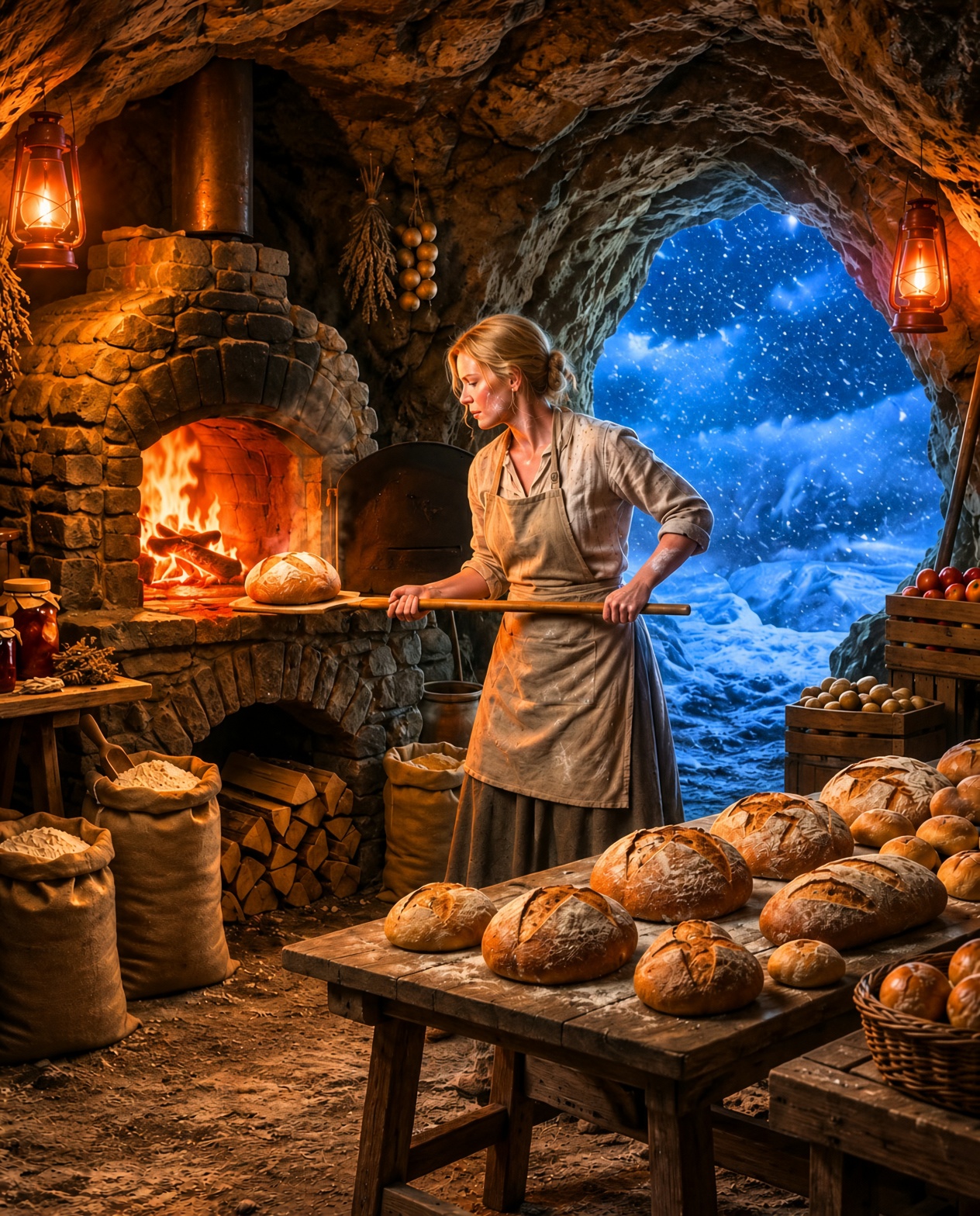
She stood inside the cave bakery, watching the flames glow beneath the great stone oven. Gus was kneading dough at the worktable, his sleeves rolled up and his white hair covered in flour.
“How much flour do we have?” Ada asked.
Gus glanced toward the storage shelves.
“Enough for perhaps three weeks if we ration carefully.”
“What if we don’t?”
He stopped kneading.
“Ada, there are nearly two hundred people down there.”
“I know.”
“And we can’t feed all of them forever.”
She looked at the rows of loaves cooling beside the oven.
“My mother used to say that bread is most important when someone has almost given up.”
Gus wiped his hands on his apron.
“Your mother sounds like a woman who understood the world better than most.”
Ada reached for her father’s old notebook. Its pages contained drawings of plants, notes about soil, and observations about fermentation. During the previous year, she had learned to stretch flour with ground acorns, dried sweet potatoes, and carefully prepared chestnuts.
The bread was darker and heavier than ordinary wheat bread, but it was filling.
She had also learned to make a sourdough culture that could survive for generations if properly cared for.
“We can teach them to make their own,” she said.
Gus studied her.
“Then we’d better start with the people who need it most.”
That afternoon, they sent a message down the mountain.
Anyone willing to walk to the old limestone cave could receive bread.
The first visitors were the Miller family, who arrived carrying an empty flour sack and two small children wrapped in blankets.
Mrs. Miller stared at the oven.
“You mean you’re giving this away?”
Ada placed a warm loaf in her hands.
“I’m giving you something to take home. Tomorrow, I’ll show you how to make another.”
The woman began to cry.
Her little boy tore off a piece of bread before it had completely cooled. He chewed slowly, then looked up at Ada.
“Miss Ada, it tastes like Christmas.”
For a moment, Ada could not speak.
She remembered being fifteen, standing in Cecil Drummond’s yard while he told her she was not worth the food she ate.
Now, the same town that had watched her walk into the freezing mountains was coming to her door.
But not everyone came with graтιтude.
Three days later, Cecil arrived.
He came in a polished black automobile, accompanied by two hired men. The vehicle could not reach the cave entrance, so they climbed the final stretch on foot, their expensive coats powdered with snow.
Cecil stepped inside without asking permission.
His eyes moved across the oven, the shelves, the sacks of grain, and the people gathered around the long wooden table.
“What is all this?” he demanded.
Ada stood beside Gus.
“A bakery.”
“Don’t be clever with me.”
“Then ask a clearer question.”
One of the hired men looked down, hiding a smile.
Cecil’s face darkened.
“You’re distributing food without a license. You’re bringing people onto private mountain land. You’re encouraging families to abandon their work.”
“This cave isn’t on your property,” Gus replied.
Cecil ignored him.
He pointed toward the bread.
“Where did you get the flour?”
“Some of it came from Gus. Some was traded. Some came from families who brought their own grain.”
“And the rest?”
“That’s none of your concern.”
Cecil stepped closer.
“I gave you a roof for two years, girl.”
“You gave me work and called it a debt.”
“I fed you.”
“You counted every bite.”
The cave became silent.
Cecil’s jaw тιԍнтened.
“You have no idea what you’re doing. These people need discipline, not handouts.”
Ada looked at the children sitting near the oven.
“They need food.”
Cecil turned toward the gathered families.
“Anyone who takes bread from this girl will lose their lease. Anyone who helps her will find themselves without work when spring comes.”
Nobody answered.
But this time, nobody lowered their eyes either.
Mrs. Miller stood up.
“My children ate because of Ada.”
A farmer near the entrance added, “Mine did, too.”
Then another voice spoke.
“And mine.”
Cecil looked around, realizing that the people he had controlled for years were standing together.
He backed toward the entrance.
“This isn’t finished.”
Ada watched him leave.
“No,” she said quietly. “It isn’t.”
That night, Gus found her sitting beside the cooling oven.
“You frightened him today.”
“I was frightened, too.”
“That’s usually how courage works.”
Ada smiled faintly.
But Gus noticed that she was staring at the notebook in her lap.
“What is it?”
She turned to a page her father had marked with a small drawing of the mountain.
There were notes about limestone, underground water, and a natural pᴀssage beneath the northern ridge.
At the bottom, Robert Holloway had written:
The old spring may be connected to the lower valley. If the surface water freezes, the mountain may still provide a reliable source.
Ada read the words twice.
“Gus, what if the town’s water supply is failing because everyone depends on the creek?”
He leaned closer.
“What are you thinking?”
She traced the drawing with her finger.
“I think there’s water inside this mountain.”
And if she was right, the cave bakery might be able to save the town in more ways than one.
But the following morning, someone left a message outside the cave.
It was written on a torn piece of paper and weighted with a stone.
STOP FEEDING THE TOWN. STOP ASKING ABOUT THE SPRING.
Gus read it once.
Then he looked toward the entrance.
“Cecil knows what your father was studying.”
Ada folded the note and placed it inside her father’s notebook.
For the first time in months, she wondered whether her parents’ deaths had left behind more than grief.
They might have left behind a secret.