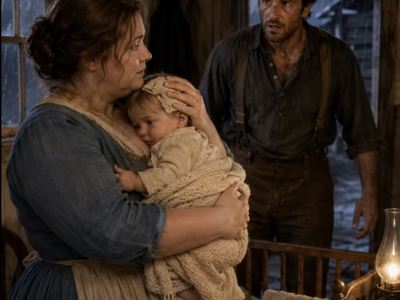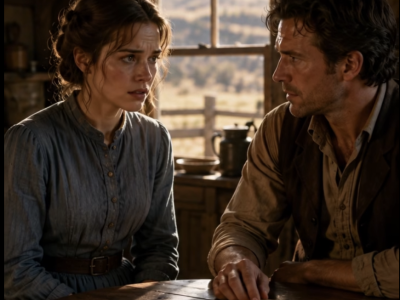
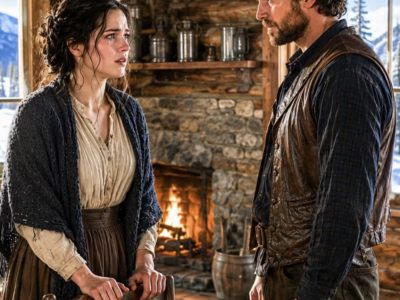
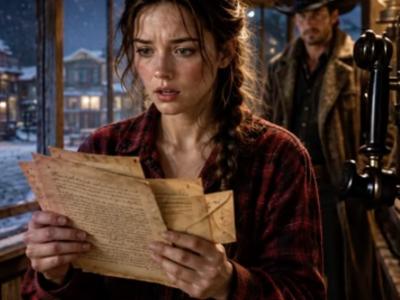
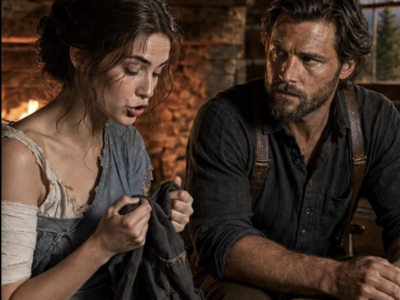
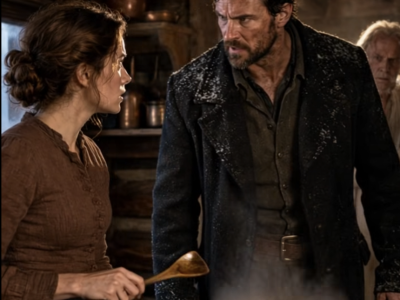
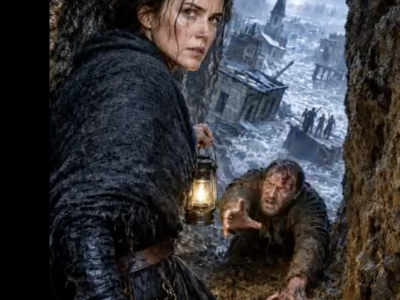
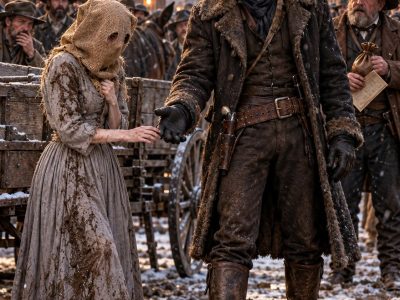
“A Banished Widow Crawled Into a Crack Barely Wider Than Her Body — What the Flood Uncovered Silenced the Entire Town The church bell was the first thing the flood ripped away. It spun into the black sky, still ringing wildly, as though the church itself were crying out one final warning. Then Redemption Gulch began breaking apart beneath the storm—roofs collapsing, walls splitting, entire buildings twisting into the raging current. Forty feet inside a narrow crack in the mountain, Clara Mercer stood with a lantern in one hand and her ᴅᴇᴀᴅ husband’s sH๏τgun in the other. Outside, the town that had banished her was screaming for help. Clara did not immediately move toward the entrance. Three months of exile had taught her that fear could make fools of decent people and monsters of cruel ones. She forced herself to breathe, resisting the old instinct to run toward suffering—even when the suffering belonged to people who had fired a warning sH๏τ behind her as she left town. Then, through the thunder and rushing water, someone shouted her name. “Clara!” Her body went rigid. No one in Redemption Gulch had spoken her name kindly since Thomas’s funeral. They said it like a disease, a curse, or a warning to children. “Clara Mercer! For God’s sake, help us!” She raised the lantern and entered the pᴀssage sideways. The fissure was barely wider than her shoulders, and sharp stone scraped against her sleeves as she squeezed forward. Lightning flashed through the opening, throwing hard white bars across her face. A man was crawling toward her on his stomach. Silas Finch. The saloon owner had once leaned over his porch railing and laughed as Clara pᴀssed below. “How’s that hole in the mountain?” he had called. “Found your ᴅᴇᴀᴅ husband hiding in there yet?” Now his hat was gone. Blood ran from a split above his eye, mixing with the mud covering his face. Every trace of pride had been washed away somewhere in the darkness below. “My wife,” he gasped. “My children. They’re trapped on the saloon roof. The whole thing is coming apart.” Lightning split the sky again. For one terrible second, Clara could see the entire basin. The mercantile lay crushed sideways across the flooded street. The church leaned at a sickening angle. Farther out, surrounded by black, violent water, the saloon roof shuddered beneath three small figures clinging desperately to the chimney. Silas grabbed the hem of Clara’s skirt. “Please,” he sobbed. “I know what I said. I know what we did to you. But they’re children, Clara.” She looked down at the man who had helped turn her grief into public entertainment. For several long seconds, she said nothing. Then she lowered the sH๏τgun. “Can you climb back down?” “I—I don’t know.” “That was not my question.” Silas swallowed hard. “Yes.” Clara immediately pulled the rope from her shoulder. “Then listen carefully. Tie this beneath your arms. Bring your wife first, then each child separately. If you panic, you drown them. If you argue with me, you drown them.” He nodded like a frightened boy. As Clara тιԍнтened the rope across his chest, Silas looked beyond her into the darkness. His eyes widened. Behind the woman the town had called mad was not a grave. It was not a desperate hiding place. There was a fire burning safely between stones. Shelves carved into the rock held sealed tins of food. Blankets were folded against the dry wall. A stone basin collected fresh water, one slow drop at a time. It was a shelter. The widow they had driven from Redemption Gulch had spent three months building the only place within fifty miles that the flood could not destroy. Silas stared at her, understanding arriving far too late. But the greatest secret was hidden beneath Clara’s coat. Inside the false bottom of Thomas’s canteen was a note written before his death—a note accusing his own father, Jedediah Mercer, of knowingly selling homes inside an ancient flood channel. Thomas had discovered the truth. And now, as the town disappeared beneath the water, the flood itself was tearing open the ground where Jedediah had buried the evidence. A violent crack thundered across the valley. Clara turned toward the entrance. Below them, the foundation of the mercantile split apart—and something large, iron-bound, and sealed rose from beneath the collapsing floor. Silas stared down at it in horror. Clara recognized it immediately. It was Thomas’s missing survey chest.
Read More
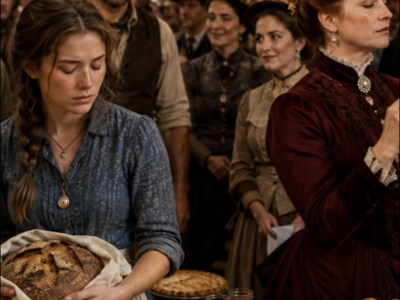
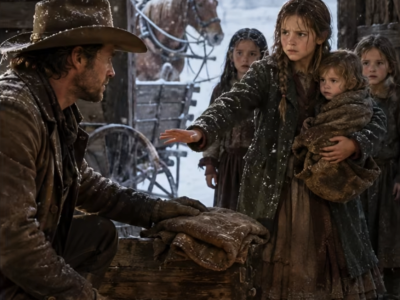
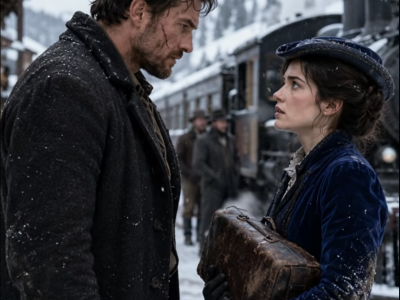
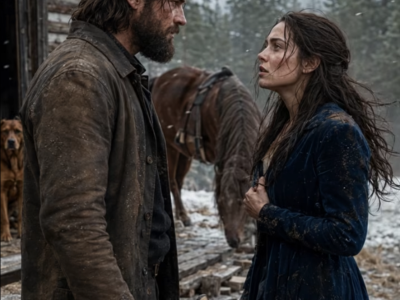
“The little girl held her sisters as if letting go would mean losing them forever. And before that frozen morning ended, a lonely cowboy would have to choose between the future he desperately needed—and four children no one else had come to save.** I wasn’t searching for a purpose when I crossed Harmon Flats that winter. I was only trying to survive. My old horse, Cutter, carried me through a blinding curtain of snow toward the next county, where a ranching job was waiting. It was the first honest opportunity I’d had in months, and if I arrived late, another man would take it. Then I saw the wagon. It sat crooked beside an abandoned grain shed, half buried beneath the snow. One wheel had shattered, and the exhausted mare still trapped in the traces looked too weak to take another step. I nearly rode past. Then I heard a faint sound from inside. A whimper. I climbed down and pulled back the stiff canvas. There were **four little girls huddled together in the darkness.** No food. No proper blankets. No adult in sight. The youngest girl lay motionless in her sisters’ arms. She had stopped shivering, and that frightened me more than the storm. Before I could move closer, the oldest child stepped between us. She couldn’t have been more than ten, but she stood like a guard protecting a fortress. Snow clung to her thin coat. Her face was pale with exhaustion, yet her eyes remained sharp and suspicious. “Your horse?” I asked gently. “Yes, sir.” “She can’t pull this wagon anymore.” “I know.” There were no tears in her voice. Only the quiet defeat of someone who had already cried too much. “Is anyone nearby?” Something flickered across her face. “No, sir.” I untied my only bedroll and offered it to her. She refused. “We’re not charity.” The words struck harder than any fist. “No,” I said. “You’re not.” I placed the blanket on the wagon rail and stepped away. Only after several silent moments did she take it and wrap it around her sisters. Using three of my last six matches, I built a fire inside the abandoned shed. The flames pushed back the cold, but the girl never stopped watching me. As though kindness always demanded payment. “I need your help,” I told her. “Your little sister must get warm.” After a long pause, she nodded. Her name was **Clara**. The youngest was **May**, barely three years old and drifting in and out of consciousness. I divided my last dried beef and two stale biscuits among them. Clara broke every piece into four equal portions. Each sister ate before she did. Every time. “You need food too,” I said. “I’m alright.” “Clara.” For the first time, she truly looked at me. Then she accepted the smallest bite. While the storm raged outside, Clara finally told me what had happened. Their father had left six weeks earlier to search for work. At first, letters came. Then a little money. Then nothing. Their mother had grown sick and died. Clara had buried her, loaded the wagon herself, and taken her sisters east with only one clue hidden inside her coat—a folded piece of paper bearing a single name: **Ruth Calloway.** Somewhere beyond Harmon Flats. That was all they had. One name. One direction. One dying horse. And winter closing in behind them. I thought about the ranching job waiting for me. Missing it could cost me everything. Then May whimpered. Clara тιԍнтened her arms around the little girl, holding her as though sheer determination could keep death away. In that moment, I knew I couldn’t leave them. By sunrise, Cutter was pulling the broken wagon east. Hours later, through the falling snow, smoke appeared above a lonely cabin. The front door flew open. An elderly woman rushed onto the porch, saw the children, and began to cry. She ran toward Clara with both arms outstretched. But Clara didn’t move. She only clung тιԍнтer to her sisters, caught between the instinct to protect them—and the terrifying possibility that, at last, someone had truly come to save them.
Read More