Akshat Khandelwal: The 3-Year-Old Indian Boy Living With Rare Klippel–Trénaunay Syndrome
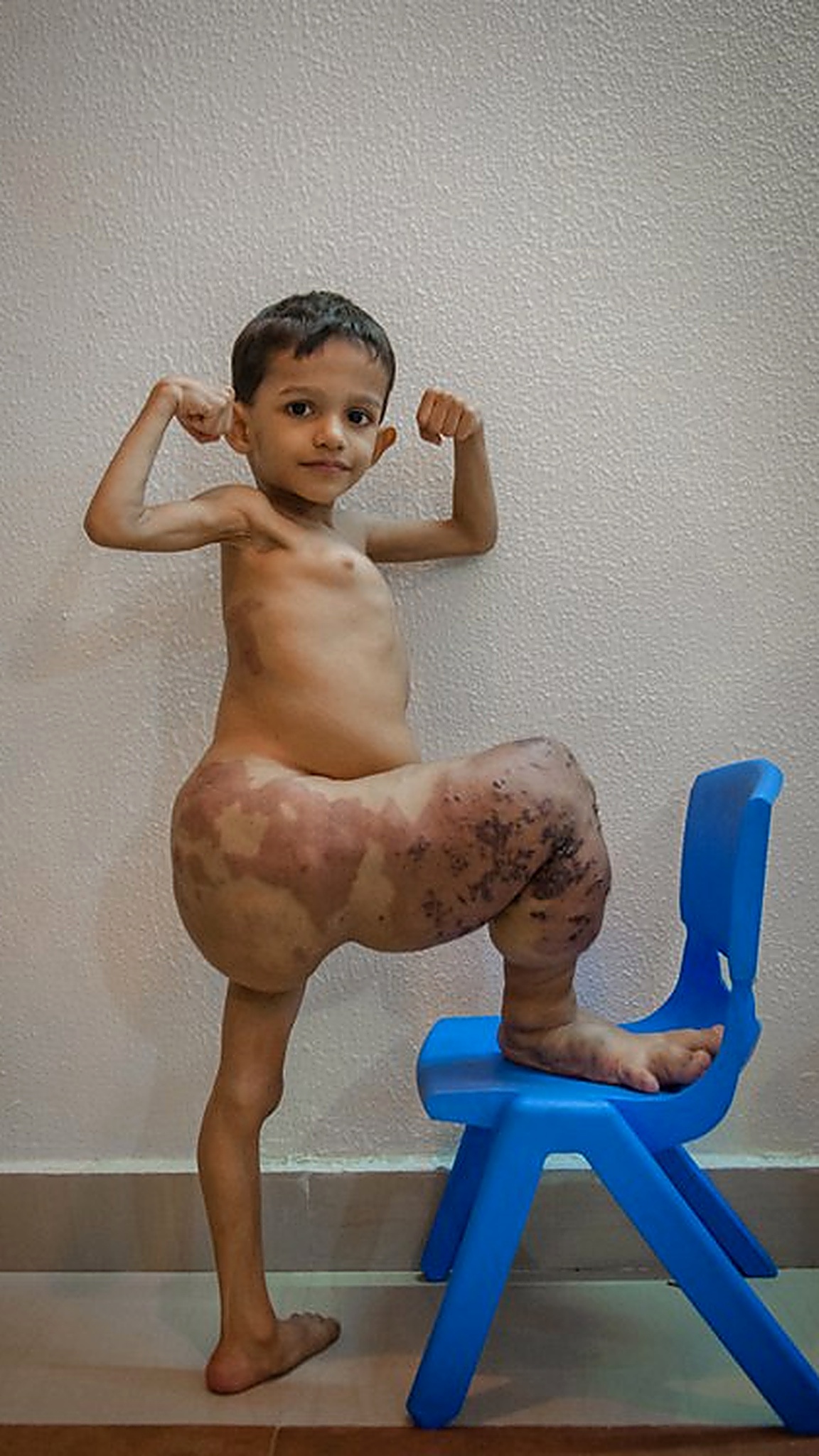
Akshat Khandelwal is a three-year-old boy from Delhi, India, whose childhood has been affected by a rare congenital disorder involving the development of blood vessels, soft tissues, and bones.
Unlike other children his age, Akshat has a visibly enlarged lower limb covered with extensive areas of unusual skin discoloration. Parts of his skin display reddish-purple and dark patches, while the affected leg appears significantly different in size and shape.
According to the information accompanying his story, Akshat has been diagnosed with Klippel–Trénaunay Syndrome (KTS), a rare congenital vascular disorder that can cause abnormal blood vessels and excessive growth of the affected limb.
Although the condition may initially appear to be a skin abnormality, its effects can extend much deeper, involving the veins, lymphatic system, muscles, and bones.
What Is Klippel–Trénaunay Syndrome?
Klippel–Trénaunay Syndrome is a rare condition that affects the development of blood vessels, lymphatic vessels, and surrounding tissues before birth.
It is generally recognized by three characteristic features: capillary malformations, venous malformations, and excessive growth of soft tissues and bones.
The condition most commonly affects one lower limb, although other parts of the body can also be involved.
The severity varies considerably. Some children have relatively small birthmarks and mild swelling, while others develop extensive vascular abnormalities and significant enlargement of an arm or leg.
KTS belongs to a group of conditions known as PIK3CA-related overgrowth spectrum (PROS).
The Three Main Characteristics of the Condition
1. Port-Wine Stains: Unusual Red and Purple Skin Patches
One of the earliest visible signs of KTS is a birthmark known as a port-wine stain.
These marks are caused by abnormalities in small blood vessels near the surface of the skin.
They can appear as flat patches ranging from pale pink to deep red, purple, or dark maroon.
Unlike ordinary bruises, these birthmarks are present from birth and may become more noticeable as the child grows.
In some patients, the affected skin can develop small vascular blisters that may bleed when injured.
2. Venous Malformations: Abnormally Developed Veins
Another major feature of KTS is the abnormal development of the venous system.
Veins are responsible for carrying blood back toward the heart. In affected children, some veins may be unusually enlarged, twisted, or improperly connected.
These abnormalities can interfere with normal blood circulation and cause blood to collect within the affected limb.
Over time, children may develop visible varicose veins, persistent swelling, discomfort, and an increased risk of blood clots.
3. Limb Overgrowth: Why Does One Leg Become Enlarged?
Perhaps the most noticeable feature of KTS is the excessive growth of one limb.
The affected leg may become thicker, longer, or significantly larger than the opposite leg.
This happens because the abnormal development of blood and lymphatic vessels is ᴀssociated with excessive growth of soft tissues and bones.
The difference may become increasingly noticeable as the child grows.
In more severe cases, unequal leg lengths can affect walking, balance, posture, and the development of the joints.
For a young child like Akshat, these physical changes may create additional challenges during important developmental stages.
What Causes Klippel–Trénaunay Syndrome?
KTS is generally ᴀssociated with genetic changes that occur during early embryonic development.
Many cases involve somatic mutations in the PIK3CA gene.
Unlike inherited genetic mutations that are present in every cell of the body, these changes usually occur after fertilization and affect only certain groups of cells.
This process is known as mosaicism.
The PIK3CA gene plays an important role in regulating cell growth, development, and survival.
When a mutation causes abnormal activation of this pathway, certain tissues may grow excessively and blood vessels may develop abnormally.
This helps explain why the condition can affect one limb much more severely than the rest of the body.
KTS is generally not inherited from parents in the usual way.
Possible Complications as the Child Grows
Although some children experience relatively mild symptoms, KTS can cause several complications that require long-term medical monitoring.
One important concern is abnormal blood clot formation.
Because blood may circulate poorly through malformed veins, clots can develop within the affected limb. In some cases, these clots can become dangerous if they travel to the lungs.
Other possible complications include:
- Chronic swelling caused by impaired lymphatic drainage.
- Pain and discomfort in the affected limb.
- Bleeding from abnormal superficial blood vessels.
- Skin infections and wounds.
- Differences in leg length and difficulties with walking.
- Gastrointestinal bleeding in patients with vascular malformations involving the digestive tract.
Not every child develops these complications. Regular examinations help doctors identify problems early and determine the most appropriate treatment.
How Is Klippel–Trénaunay Syndrome Diagnosed?
Doctors generally diagnose KTS by evaluating the characteristic physical features and examining the underlying vascular abnormalities.
A Doppler ultrasound can help ᴀssess blood flow and identify abnormal veins or blood clots.
Magnetic resonance imaging (MRI) and magnetic resonance venography (MRV) may be used to determine the extent of the vascular malformations and evaluate the affected muscles, bones, and soft tissues.
Doctors may also measure the length and circumference of both legs to monitor differences in growth.
A multidisciplinary team is often necessary because the condition can involve several body systems.
Treatment and Long-Term Care
There is currently no single treatment that permanently eliminates Klippel–Trénaunay Syndrome.
Instead, medical care focuses on managing symptoms, protecting the affected limb, improving mobility, and preventing complications.
Depending on the child’s condition, treatment may include:
Compression therapy: Specially fitted compression garments can help control swelling and improve symptoms ᴀssociated with venous and lymphatic abnormalities.
Laser treatment: Certain laser procedures can reduce the appearance of port-wine stains and other superficial vascular abnormalities.
Medication: Selected patients may benefit from medications that target abnormal growth pathways or help manage vascular complications.
Vascular procedures: Specialized interventions may be considered for problematic veins or vascular malformations.
Orthopedic care: Children with significant differences in limb length or abnormal bone growth may need orthopedic ᴀssessment, corrective footwear, or other interventions.
Treatment must be individualized because procedures that are suitable for one patient may not be appropriate for another.
A Young Boy Facing a Lifelong Medical Challenge
At only three years old, Akshat is still at the beginning of his childhood.
While other children his age are learning to run, jump, and explore the world, he may need additional medical attention to monitor the growth and development of his affected leg.
His condition is not simply a matter of unusual skin color or appearance. It involves a complex network of blood vessels, lymphatic structures, and tissues that may continue changing as he grows.
For his family, regular medical examinations and long-term care are important parts of ensuring his well-being.
Despite the challenges ᴀssociated with Klippel–Trénaunay Syndrome, many affected children can lead active and fulfilling lives with appropriate treatment and support.
Akshat deserves the same opportunities as every other child: to attend school, make friends, play freely, and grow up without being defined by his medical condition.
His story reminds us that rare congenital disorders can affect children in extraordinary ways, but every child deserves compᴀssion, dignity, and access to proper medical care.