BREAKING: 1.5-Million-Year-Old Hominin Face Reconstructed from Ethiopian Fossil!lh
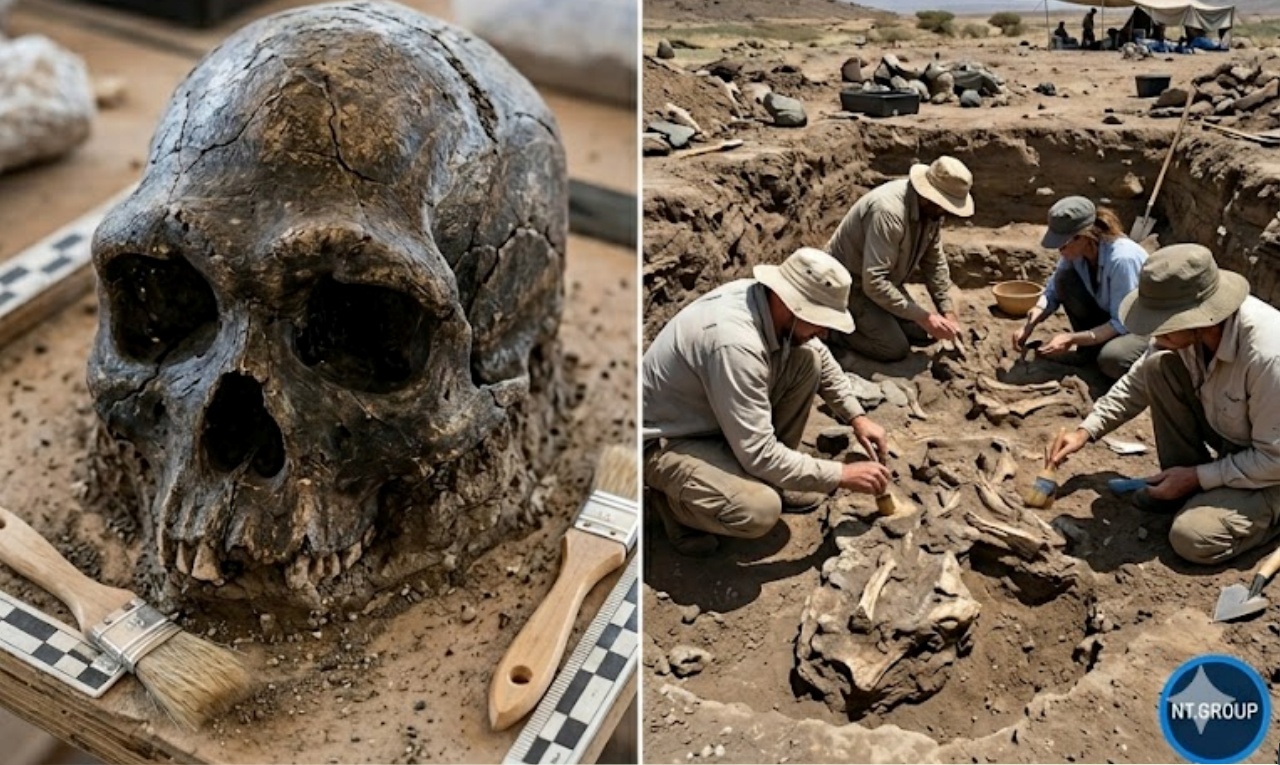
BREAKING: A 1.5‑million‑year‑old “face” from Ethiopia is changing what we thought Homo erectus looked like—right as it began spreading beyond Africa. Using high‑resolution CT scans and 3D ᴀssembly, researchers rebuilt the cranium known as DAN5/P1 from Gona (Afar Region, Ethiopia), dated to ~1.6–1.5 million years old, producing one of the most complete Early Pleistocene hominin skull reconstructions from the Horn of Africa.

The surprise is not that it’s old—it’s what it mixes. The reconstruction shows a small-brained adult (about 598 cm³) with a braincase that fits H. erectus, but a face and teeth that look more ancestral (“basal Homo”) than classic, roughly same‑age Kenyan H. erectus fossils. In the paper, the team points to features such as a less projecting nasal region and other “primitive” elements in the midface, a combination that makes evolution look less like a clean upgrade and more like a messy mosaic.
Why it matters: similar “mixed” anatomy is famous at Dmanisi (Georgia) and has fueled arguments that key H. erectus traits may have emerged outside Africa. DAN5/P1 shows that this transitional pattern also existed inside Africa, supporting a more complex story—possibly regional population structure (Horn of Africa vs. Lake Turkana) or even later population turnover at Gona. In short, the face doesn’t just get reconstructed; a tidy origin narrative does, too.