PART 3 — THE PRICE OF A H๏τ BREAKFAST
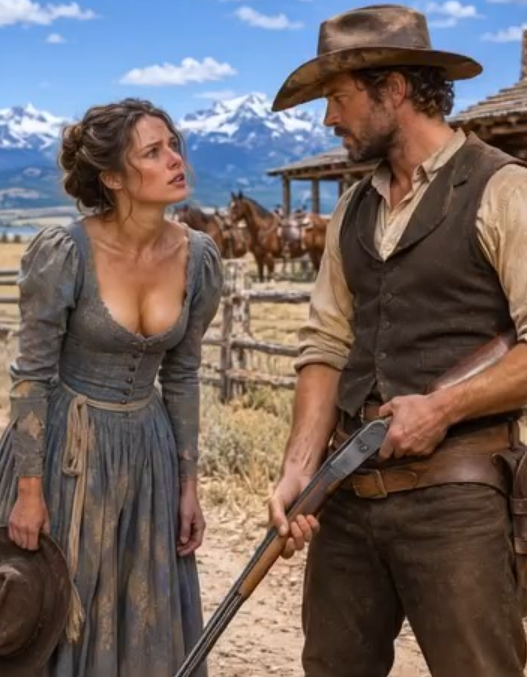
She Walked Onto a Lonely Cowboy’s Ranch With Just a Cast-Iron Skillet… Then She Asked to Rent His Worst Building
PART 3 — THE PRICE OF A H๏τ BREAKFAST
Hank did not sleep much that night.
He sat at his kitchen table with the forged boundary document spread before him.
The signature belonged to Samuel Pike, a county clerk who had died the previous summer. Hank remembered attending the funeral. He had even helped carry the coffin.
Someone had copied Pike’s signature and altered the ranch boundary.
And someone wanted Nell gone badly enough to risk forgery.
At sunrise, Hank rode into town.
He found the county recorder, a narrow-faced woman named Mrs. Ellery, sorting papers behind a crowded desk.
She examined the document.
Her expression changed.
“Where did you get this?”
“It was left at my ranch.”
She looked toward the office door before lowering her voice.
“This is not the first time I’ve seen something like it.”
Hank leaned forward.
“What do you mean?”
“Three other landholders have complained about boundary changes near Briggs’s station. Every one of them received an offer to sell shortly afterward.”
“Did they sell?”
“Two did. The third refused.”
“What happened?”
Mrs. Ellery hesitated.
“His barn burned down.”
Hank felt his jaw тιԍнтen.
“Has anyone investigated?”
“The sheriff says there isn’t enough evidence.”
Hank tapped the paper.
“Then perhaps it’s time someone found some.”
Mrs. Ellery studied him.
“Be careful, Mr. Mercer. Briggs has money, and money has a way of making people forget what they saw.”
Hank folded the document and put it away.
“I’ve spent eleven years minding my own business. Seems that hasn’t kept trouble off my land.”
Back at the ranch, Nell was serving breakfast to six men.
She had found an old wooden sign in the stable and painted the words:
NELL’S SKILLET — H๏τ FOOD, FAIR PRICES.
The sign hung beside the door.
A teamster was laughing at something she had said, and another man was asking whether she would make apple pie the next day.
Hank stood outside for a moment.
He had not heard that much laughter around his ranch in years.
When Nell saw him, she raised a hand.
“You’re just in time. I need another pair of hands.”
“I don’t work in kitchens.”
“Neither do I, officially. Yet here we are.”
She pointed toward a crate of potatoes.
“Peel those.”
Hank looked at the crate.
Then at her.
“You’re ordering me around?”
“I’m asking you to earn your breakfast.”
He sat down.
The men laughed.
And Hank, to his own surprise, began peeling potatoes.
Business grew over the next three days.
Travelers began planning their journeys around Nell’s breakfast. Some came from Briggs’s station, where the food was more expensive and the coffee had grown notoriously weak.
Nell never spoke badly of her compeтιтor.
She simply served generous portions and remembered people’s names.
She learned that one driver preferred his eggs nearly burned, that another could not eat pork, and that an elderly cattle buyer always wanted his coffee without sugar.
She made the bunkhouse feel less like an abandoned building and more like a place where a tired traveler could sit down without being hurried.
Hank repaired the porch, replaced the latch, and built a proper counter.
He told himself he was protecting his property.
But he found himself checking the road whenever Nell went outside.
He found himself listening for the bright sound of her spoon striking the skillet.
And when he came home from the far pasture, he began looking forward to seeing the lamp in her window.
One evening, he brought her a small wooden box.
“What’s this?” she asked.
“Found it in the barn.”
Inside were six clean plates, two good knives, and a set of tin cups.
Nell touched the rim of one plate.
“These are yours.”
“They’ve been sitting unused for years.”
“Still.”
“Use them.”
She looked up.
“Thank you, Hank.”
It was the first time she had called him by his given name.
He noticed.
So did she.
Neither mentioned it.
On the fifth morning, the trouble began.
A freight wagon pulled into the yard carrying a dozen crates.
The driver climbed down, looking furious.
“Miss Warren, I need to speak with you.”
Nell wiped her hands.
“What happened?”
“Briggs says I can’t stop here anymore. Says he’ll cancel my supply contract if I do.”
“You’re welcome to eat here regardless.”
“That’s not the problem. He owns the flour warehouse. He says he’ll refuse to sell me supplies if I keep bringing customers to your place.”
Nell looked at the wagon.
“What do you need?”
“Flour. Coffee. Salt. Beans. Everything.”
Hank stepped forward.
“I can supply the flour and beans from my stores.”
The driver shook his head.
“Briggs has already told the other merchants not to sell to you.”
Nell looked toward the road.
 For the first time, uncertainty crossed her face.
She had enough flour for two more days.
After that, she would have to close.
Hank saw the calculation in her eyes.
“Don’t worry about it,” he said.
“I can’t keep taking things from you.”
“You’re not taking them. I’ll sell them to you at cost.”
“And when Briggs threatens your cattle contracts?”
Hank looked at her.
“Then he’ll have to threaten me.”
Nell lowered her voice.
“I don’t want you losing your ranch because of me.”
Hank paused.
“Neither do I.”
She looked down.
For a moment, she seemed ready to apologize for arriving in the first place.
Then Hank added, “But I won’t let a man decide who gets to eat on my land.”
Nell’s eyes filled, though she quickly turned away.
“All right,” she whispered.
That afternoon, a boy rode up carrying a folded note.
He handed it to Hank and galloped away before anyone could question him.
The note contained only one sentence.
Tell your woman to close the kitchen before Sunday, or your cattle will be the next thing to disappear.
Hank read it.
Then he folded it carefully.
Nell came out of the bunkhouse.
“What is it?”
“Nothing you need to worry about.”
“That’s not an answer.”
He handed her the note.
She read it twice.
“Your cattle?”
“Probably a threat.”
“Probably?”
Hank looked toward the distant pasture.
“I’ve had trouble with rustlers before.”
Nell’s face тιԍнтened.
“Then we should tell the sheriff.”
“The sheriff plays cards with Briggs every Saturday.”
“Then we find someone who doesn’t.”
Hank looked at her.
She was frightened. He could see it in the way she held the paper.
But she wasn’t talking about leaving.
That surprised him.
“Why are you still here?” he asked.
Nell blinked.
“What?”
“You came here with four dollars and a skillet. Now a man with money and influence is threatening you. You could leave tonight and be halfway to another town by morning.”
She folded the note.
“I could.”
“Then why don’t you?”
She looked at the kitchen window, where the evening light glowed against the glᴀss.
“Because I have never had anything that was truly mine. Not a room, not a business, not even a future I chose for myself.”
She met his eyes.
“And every time someone tells me to leave, I remember how it felt to have no place to go.”
Hank was silent.
“I won’t run again,” she said.
Something in him shifted.
He had spent years believing that keeping people at a distance was the safest way to live.
But Nell had walked into his life carrying a skillet and had somehow made his ranch feel less empty.
He didn’t want her to leave.
Not because of the rent.
Not because he needed another cook.
Because he had begun to care whether she woke up smiling.
The next morning, Hank rode out to check the northern pasture.
He found the gate open.
The cattle were gone.
All forty-seven head.
There were tracks leading east toward the old river crossing.
He followed them for nearly an hour before discovering something caught on a fence post.
A strip of brown cloth.
The same material Walter Briggs had worn on his coat.
Hank tucked it into his pocket and rode back hard.
When he reached the ranch, Nell was standing outside the bunkhouse with a letter in her hand.
“Someone came while you were gone.”
“Who?”
“Briggs.”
Hank dismounted.
“What did he want?”
“He offered to buy the bunkhouse lease.”
“And?”
“I told him no.”
Hank looked at the letter.
She handed it to him.
It was a legal notice claiming that Nell had violated the terms of her rental agreement by operating an unauthorized commercial kitchen.
The notice gave her twenty-four hours to vacate the building.
Hank stared at the paper.
“He has no authority to do this.”
“He said he’d take it to court.”
“He won’t.”
Nell’s voice softened.
“Hank, I don’t want you fighting every battle for me.”
He looked at her.
“Then don’t ask me to stand aside while he steals what belongs to you.”
She swallowed.
“What if he wins?”
Hank took her hand.
“Then we’ll find somewhere else to cook.”
It was a simple promise.
But for a man who had spent eleven years refusing to let anyone depend on him, it meant more than he could say.
Nell looked down at their joined hands.
Then she looked up.
“Hank?”
“Yes?”
“I think I’m beginning to feel at home here.”
He held her gaze.
“Then let’s make sure nobody takes that away.”
That evening, the missing cattle were found.
They had been driven into a ravine near Briggs’s station and locked behind a hastily constructed fence.
Hank recognized the tracks.
He also found a leather account book lying beside the gate.
Inside were payments made to two hired riders, several supply merchants, and a county official.
The final page contained a list of landowners Briggs intended to force off their property.
Hank’s name was there.
So was Nell’s.
Beside her name, someone had written:
Remove the woman. Burn the building if necessary.
Hank rode back with the ledger.
But when he reached the bunkhouse, the door stood open.
The lamp had been knocked over.
The counter was broken.
And Nell’s cast-iron skillet lay in the dirt, its handle bent beneath a heavy boot.
He stepped inside.
“Nell?”
No answer.
He searched the kitchen, the storage room, and the yard.
Then he saw a small piece of paper pinned to the wooden counter with a knife.
It contained five words.
Come alone. Bring the ledger.
Below them was a location.
The old freight station.
Hank looked toward the darkening sky.
For the first time in eleven years, he was afraid of losing someone.
And this time, he wasn’t going to let the fear make him turn away.