PART 2: THE THREE DRESSES THAT CHANGED EVERYTHING
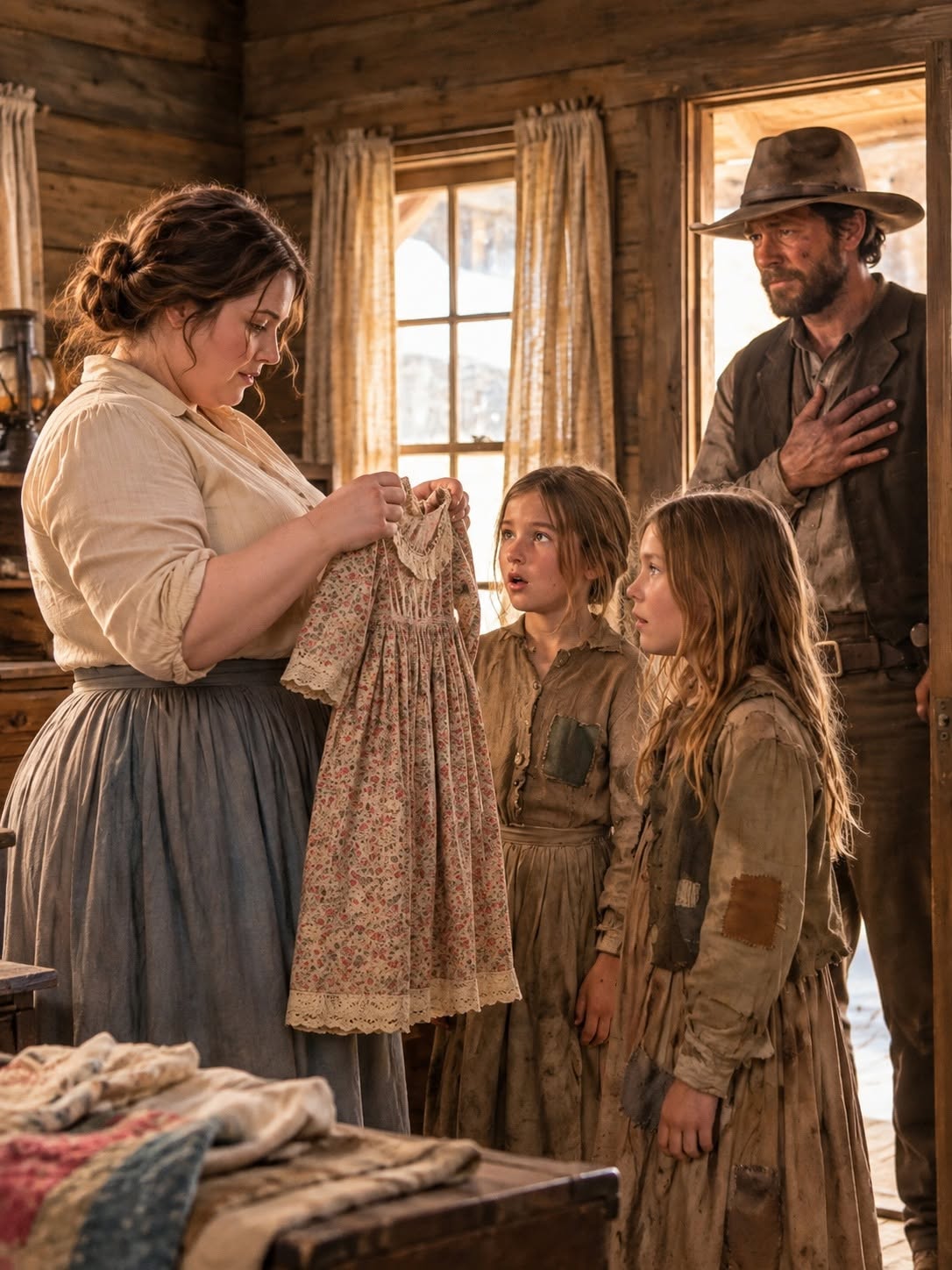
HIS DAUGHTERS WERE TOO EMBARRᴀssED TO WEAR THEIR TORN CLOTHES TO CHURCH—THEN THE HOUSEKEEPER TURNED OLD CURTAINS INTO BEAUTIFUL DRESSES
PART 2: THE THREE DRESSES THAT CHANGED EVERYTHING
By Monday morning, the green curtains were spread across the kitchen table.
Nell had worked until nearly midnight the night before, studying the pattern, measuring the girls, and calculating how much fabric she could save.
She had never made three dresses from a single pair of curtains before.
But she had done harder things with less.
Ruth stood beside the table, watching her carefully.
“Are you really going to cut them?”
Nell looked up.
“I wouldn’t have brought out the shears if I wasn’t.”
“What if you ruin them?”
“Then we’ll have three ruined dresses instead of two curtains nobody uses.”
Ruth almost smiled.
Almost.
Josie was less suspicious. She had spent the morning sorting ʙuттons from a little tin box Nell had given her.
Pearl sat beside the stove, turning her mother’s silver thimble around and around on its ribbon.
“Will mine have pockets?” she asked.
Nell looked at her.
“Every proper dress ought to have pockets.”
Pearl’s eyes widened.
“Even church dresses?”
“Especially church dresses. A girl needs somewhere to keep her important things.”
Pearl considered this seriously.
“My important thing is Mama’s thimble.”
“Then we’ll make sure your pockets are deep enough.”
For the next three days, the kitchen became a sewing room.
Nell worked by the window during daylight and by lamplight after supper. She used the cream lining for collars and cuffs, carefully preserved the embroidered leaves, and turned the strongest sections of the curtains into skirts.
Ruth helped cut thread.
Josie learned to sew ʙuттons.
Pearl was appointed official keeper of the pins, a responsibility she took very seriously.
Nate watched from the doorway more than once.
He had never realized how much work went into making something beautiful.
He had thought a dress was simply cloth sewn together.
Now he saw the careful measurements, the tiny sтιтches, the way Nell turned every leftover piece into something useful.
On Wednesday evening, he found Ruth standing in front of the mirror.
She was holding a scrap of green fabric against her shoulder.
“What do you think?” he asked.
She immediately lowered it.
“Nothing.”
Nate leaned against the doorframe.
“You can tell me.”
Ruth looked at the floor.
“I just wondered what Mama would have thought.”
The words caught him off guard.
Daniel’s wife, Mary, had been gone three years. Nate remembered her laughing at the kitchen table, her sleeves rolled up, flour on her cheek.
He remembered the way she used to dress the girls for church.
He also remembered promising Daniel, before the fever took him, that he would never let his daughters feel unwanted.
Yet somehow, without meaning to, he had allowed them to feel exactly that.
“Your mother would have liked the green,” he said.
Ruth looked up.
“How do you know?”
“Because she once told your father that green was the color of things that refused to die.”
Ruth’s eyes filled.
Nate cleared his throat.
“Don’t tell your sisters I said something sentimental.”
For the first time in weeks, Ruth laughed.
Thursday brought trouble.
A wagon stopped outside the house, and Hazel Dunn climbed down carrying a basket.
She was a kind woman, though she had a habit of speaking before considering whether her words might hurt.
“I heard the girls are getting new dresses,” she said cheerfully. “That’s wonderful. I wondered if you might need some of my daughters’ old ribbons.”
Nate came to the porch.
“That’s thoughtful, Hazel.”
But Ruth had heard.
She appeared in the doorway.
“We don’t need anybody’s old things.”
Hazel blinked.
“Oh, sweetheart, I only meant—”
“We have our own dresses now.”
Nell stepped forward before Ruth could say anything more.
“Thank you for thinking of them, Mrs. Dunn. We have the sewing well in hand.”
Hazel glanced toward the kitchen.
“Those curtains? You’re making dresses out of those?”
Nell nodded.
Hazel gave a little laugh.
“Well, I suppose anything is better than what they were wearing last Sunday.”
Ruth’s face turned red.
Nate stepped between them.
“That’s enough.”
Hazel looked surprised.
“I didn’t mean anything by it.”
“I know. But sometimes that doesn’t make a thing less hurtful.”
Hazel left with her basket.
Nate turned to Ruth.
“You don’t have to prove anything to anyone.”
Ruth crossed her arms.
“I know.”
But he could see that she didn’t.
By Friday, the dresses were almost finished.
Ruth’s was the most elaborate. Nell had used the broadest section of green fabric for its skirt, adding a cream collar and a row of tiny covered ʙuттons.
Josie’s dress had embroidered leaves running along the sleeves.
Pearl’s was shorter, with a soft cream sash and two deep pockets.
 Nell had saved the smallest piece of the original curtain pattern for the front of Pearl’s bodice.
When Pearl tried it on, she stood completely still.
“Is it mine?”
Nell knelt to straighten the hem.
“Every sтιтch.”
Pearl looked down at the dress.
Then she reached inside one pocket and carefully placed her mother’s thimble there.
“I can take Mama with me.”
Nell had to look away for a moment.
That night, Nate found her alone at the kitchen table.
A small piece of green fabric lay in her hands.
“You’ve done more for those girls in five days than I managed in five months,” he said.
Nell continued folding the cloth.
“They needed someone to listen.”
“I should have listened.”
“Yes,” she said quietly. “You should have.”
Nate nodded.
He appreciated that she didn’t soften the truth to make him feel better.
After a moment, he asked, “Why did you leave Ohio?”
Nell’s fingers stopped.
“My mother died. Then the woman I worked for decided she no longer needed a seamstress.”
“That’s all?”
“No.”
She folded the fabric again.
“My husband died two years ago. He left debts, and his family decided I was an inconvenience.”
Nate said nothing.
“I sold most of what I owned. The curtains were the one thing I couldn’t bring myself to part with.”
He looked at the green cloth.
“Then I hope you don’t regret using them.”
Nell finally met his eyes.
“I don’t.”
Saturday evening, the three girls stood in the kitchen wearing their finished dresses.
Ruth turned slowly in front of the mirror.
Josie held out her sleeves.
Pearl kept checking her pockets to make sure the thimble was still there.
Nate stood in the doorway.
For a moment, he saw Daniel’s girls as they had been before grief had made them cautious.
They looked like children again.
Not poor children.
Not children who needed to hide.
Just three little girls waiting for Sunday.
“Well?” Ruth asked.
Nate cleared his throat.
“Your father would be proud.”
Ruth’s lips trembled.
Then Josie began crying.
Pearl followed.
Soon all three were hugging their uncle, and Nate held them as though he could somehow make up for every Sunday he had failed to notice their sadness.
Nell quietly returned to the sewing table.
She didn’t want to interrupt.
But Ruth reached out and caught her hand.
“You’re coming with us tomorrow.”
Nell smiled.
“If Mr. Garrett permits it.”
Nate looked at her.
“Mrs. Marsh, I believe you’ve earned the front pew.”
Sunday morning arrived clear and cold.
The church bells rang across the valley.
Nate helped the girls into the wagon.
Nell sat beside Pearl, holding a small basket containing spare ʙuттons and thread.
As they approached the church, Ruth’s smile slowly disappeared.
Lucinda Whitcomb stood on the steps with two other girls.
She noticed the green dresses immediately.
“Well,” Lucinda said loudly. “Look at that. The feed-sack girls have found themselves curtains.”
Her friends giggled.
Ruth’s fingers тιԍнтened around the edge of her skirt.
Nate began to step forward.
But Nell gently touched his sleeve.
“Let Ruth decide what kind of girl she wants to be.”
Ruth took a breath.
Then she stepped down from the wagon.
“My dress is made from curtains,” she said calmly. “Your dress is made from expensive cloth. But neither one makes us better than the other.”
Lucinda opened her mouth.
Ruth continued.
“And at least nobody had to make my dress by hurting someone else’s feelings.”
The girls on the steps fell silent.
At that moment, the church doors opened.
Miss Tilden, the schoolteacher, came outside.
She looked at the three green dresses.
Then she looked at Nell.
“Mrs. Marsh,” she whispered, “where did you get that pattern?”
Nell seemed surprised.
“My mother designed it years ago.”
Miss Tilden stepped closer and examined the embroidered leaves.
Then her eyes filled.
“Those leaves…”
She touched the fabric gently.
“I know that work.”
And suddenly, the Sunday that was supposed to be about three new dresses became something much bigger.
Because Miss Tilden knew the woman who had originally made that curtain cloth.
And she knew why it had disappeared from Ohio twenty years earlier.