PART 3: THE TRUTH THAT BROUGHT HIM HOME
PART 3: THE TRUTH THAT BROUGHT HIM HOME
Gideon closed the door.
Sadie stood beside the counter, her hands trembling.
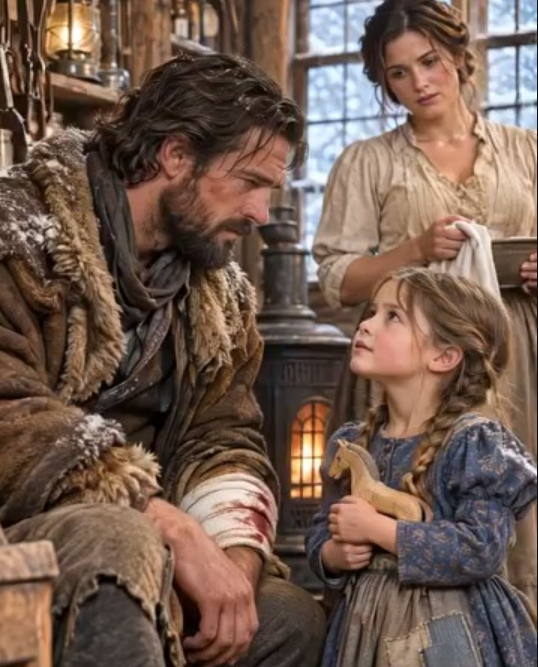
Lilly had returned to the little bed, but she was still awake. She held her wooden horse against her chest and watched the adults with frightened eyes.
“Sadie,” Gideon said quietly. “What did Pike mean?”
She stared at the floor.
For a long moment, she said nothing.
Then she pulled a small tin box from beneath the counter.
Inside were several folded papers, an old pH๏τograph, and a leather-bound notebook.
“My husband was a mine supervisor,” she began. “He worked at the Silver Crown Mine. Six months before the collapse, he discovered that the owners were sending men into unstable tunnels.”
Gideon listened without interrupting.
“Thomas complained to the foreman. He wrote reports. He asked them to stop production until the supports could be repaired.”
“And they refused?”
Sadie nodded.
“They told him the mine was safe. They said the workers were exaggerating. Then Thomas discovered that someone had altered the inspection records.”
She opened the notebook.
“These are copies of the original reports. Thomas brought them home the night before the collapse.”
Gideon picked up one page.
His eyes moved over the handwriting.
Then he froze.
The report was signed by Thomas Miller and witnessed by Caleb Rusk.
The same Caleb Rusk who had been listed on the debt document.
“Rusk worked for the mine owners,” Gideon said.
“Yes.”
“Did your husband know him?”
“They argued constantly. Thomas believed Rusk was being paid to falsify the inspections.”
Sadie wiped her eyes.
“The morning of the collapse, Thomas went into the mine to warn the men. The tunnel fell before anyone could get out.”
Gideon looked down at the papers.
“Why didn’t you take this to the sheriff?”
“I tried. Rusk told everyone Thomas had made mistakes. The mine company paid the families a small amount and insisted the matter was closed. I was left with Lilly, a store full of bills, and no money to fight them.”
Gideon looked toward the window.
He remembered the mine.
He remembered the men who had died.
He remembered Caleb Rusk.
Seven years earlier, Gideon had worked as a teamster hauling timber to the Silver Crown Mine. He had delivered beams to the site and complained that the supports were too thin.
The foreman had laughed.
Gideon had walked away.
A week later, the collapse occurred.
He had never forgiven himself for not doing more.
Now he understood why Sadie’s story felt so familiar.
“Rusk was there when the mine collapsed,” he said.
Sadie nodded.
“And he was the man who told me Thomas had died instantly.”
Gideon studied the documents.
“These records could prove the mine company knew the tunnel was unsafe.”
“They could also prove that Thomas was trying to save those men.”
“Why didn’t Pike destroy them?”
Sadie looked toward the door.
“Because he doesn’t know I still have them. He believes I gave the originals to someone in Denver.”
Gideon closed the notebook.
“Then we take them to the sheriff tomorrow.”
Sadie shook her head.
“Rusk owns half the town. The sheriff won’t help.”
“Then we’ll go to the federal mining inspector.”
She stared at him.
“You’d do that?”
Gideon looked toward Lilly.
“Your daughter deserves to grow up knowing her father was an honest man.”
Sadie covered her mouth.
For the first time in years, someone had spoken about Thomas as though he mattered.
The next morning, Gideon rode to the sheriff’s office with Sadie and the documents.
The sheriff was reluctant at first.
But when he saw the original inspection reports and the forged debt papers, his expression changed.
He sent a telegram to the territorial mining inspector in Cheyenne.
Then he asked Gideon to explain how he recognized Caleb Rusk’s handwriting.
Gideon told him everything.
Including the fact that he had delivered timber to the mine and had warned the foreman about the weak supports.
The sheriff leaned back.
“Why didn’t you report that before?”
Gideon stared at his hands.
“Because I was too busy burying my family.”
The sheriff’s expression softened.
“Grief doesn’t make you guilty, Cross.”
Gideon looked away.
He wasn’t sure he believed that.
Three days later, Caleb Rusk arrived in Oak Haven.
He came with two men and a signed order demanding the notebook.
Sadie refused.
Rusk laughed.
“Your husband is ᴅᴇᴀᴅ, woman. Stop pretending you can change what happened.”
Gideon stepped out from behind the mercantile counter.
“She isn’t pretending.”
Rusk turned.
“Cross. I heard you were sick.”
“Disappointed?”
Rusk looked at the bandage on Gideon’s arm.
“You should stay out of this.”
Gideon moved closer.
“I spent seven years staying out of everything.”
His voice was low.
“Not anymore.”
Rusk reached inside his coat.
 The sheriff stepped through the doorway with two deputies.
“Don’t.”
Rusk stopped.
The sheriff held up a telegram.
“The mining inspector is on his way. He wants to speak with you about falsified inspection reports, fraudulent debt claims, and the deaths at Silver Crown.”
Rusk’s face changed.
He looked at Sadie.
Then at Gideon.
“You think this changes anything?”
“No,” Sadie replied. “It changes what people will remember.”
Rusk was taken into custody pending investigation.
Within weeks, the mine owners were forced to produce their original records. The evidence confirmed that the tunnel had been declared unsafe before the collapse.
Thomas Miller had been right.
The families of the ᴅᴇᴀᴅ miners were awarded compensation, and the fraudulent debt against Sadie’s store was canceled.
For the first time since her husband’s death, Sadie could look toward the future without wondering whether someone would take her home.
But Gideon was struggling with a different kind of truth.
The day the inspector left town, he packed his supplies and prepared to return to his mountain cabin.
Sadie found him outside, тιԍнтening the straps on his horse.
“You’re leaving?”
“I’ve been away too long.”
She looked at his bandaged arm.
“Your wound isn’t healed.”
“It will be.”
She hesitated.
“Did Lilly do something wrong?”
Gideon looked up.
“What?”
“She keeps asking when you’ll come back. I told her you had a home in the mountains.”
He glanced toward the mercantile window.
Lilly was standing there, watching him.
She held the little wooden horse.
Gideon felt something twist inside his chest.
He had spent seven years avoiding children because their laughter reminded him of what he had lost.
Now he was afraid of leaving one behind.
He walked toward the window and crouched in front of Lilly.
“Why are you looking at me like that?”
“Because you’re going away.”
“I have a cabin to look after.”
Lilly nodded solemnly.
“Does your cabin have a stove?”
“Yes.”
“Does it have a bed?”
“Two.”
“Does it have a place for a little girl?”
Gideon couldn’t answer.
Lilly held out her wooden horse.
“You can borrow him until you come back.”
His throat тιԍнтened.
“Why would you give me your horse?”
“Because you look sad when you leave.”
He took the toy carefully.
Then, for the first time in seven years, Gideon Cross smiled without trying to hide it.
“I’ll come back,” he promised.
But he didn’t return the next day.
Or the day after.
He spent a week repairing the cabin, fixing the chimney, and clearing the snow from the path. Then he returned to Oak Haven with his wagon.
The wagon was full of lumber.
Sadie stared at it.
“What are you doing?”
“Building something.”
“What?”
Gideon pointed toward the empty lot beside the mercantile.
“A proper house. One with a kitchen, a bedroom for Lilly, and a porch facing the morning sun.”
Sadie looked at him.
“Why?”
He stepped closer.
“Because I have spent seven years living in a place where every room reminds me of the people I lost. I thought being alone was the only way to remember them.”
He paused.
“Then your daughter asked me whether I had a little boy once, and I realized something.”
“What?”
“I can remember my wife and son without spending the rest of my life refusing to be happy.”
Sadie’s eyes filled with tears.
“Gideon…”
“I don’t expect you to marry me because I bought lumber or because I helped with those papers. I don’t want you to owe me anything.”
He reached into his coat and produced a small wooden horse.
It was not Lilly’s toy.
It was an identical one, carefully carved from pine.
“I made this for her. And if you’ll let me, I’d like to make a life with both of you.”
Sadie looked at the horse.
Then at the man standing before her.
“You know I have a daughter.”
“I know.”
“You know she’ll always come first.”
“I wouldn’t want it any other way.”
“And I won’t be anyone’s replacement for the family you lost.”
Gideon shook his head.
“I wouldn’t ask you to be.”
Sadie reached for his hand.
“Then perhaps we can start with supper.”
His smile deepened.
“I’d like that.”
Months pᴀssed.
The house was finished before the first spring flowers appeared. Lilly chose the curtains, Trouble claimed the porch, and Gideon built a small shelf for the wooden horses.
Sadie kept her mercantile.
Gideon continued hauling freight, but he no longer rushed back to an empty cabin every evening.
One afternoon, while Lilly played in the yard, she asked him a question.
“Do you still miss Benjamin?”
Gideon knelt beside her.
“Every day.”
“Does that make you sad?”
“Sometimes.”
Lilly thought about it.
“Can you be happy and sad at the same time?”
Gideon smiled.
“Yes, sweetheart. You can.”
She nodded as though she had discovered something important.
Then she slipped her small hand into his.
“Good. Because Mama says we’re a family now.”
Gideon looked toward Sadie, who stood in the doorway.
He thought of his wife, his little boy, and the seven winters he had spent believing his heart was beyond repair.
Then he looked at the child beside him.
And he understood that love was not a door that closed forever when someone died.
Sometimes it was a light that stayed on, waiting for someone to find their way home.
That evening, Gideon sat beside the stove while Sadie served supper.
Lilly climbed into the chair beside him.
“Tell me about Benjamin,” she requested.
Gideon took a breath.
Then he began.
He told her about the little boy who loved horses, who laughed at falling snow, and who believed his father could mend anything.
He didn’t stop when his voice trembled.
He didn’t hide when his eyes filled.
And when Lilly reached across the table and took his hand, Gideon finally understood that remembering did not have to hurt forever.
Outside, snow began falling softly over Oak Haven.
Inside, a man who had forgotten how to smile sat at a crowded table, surrounded by warmth, laughter, and the promise of another morning.
For seven years, he had believed his story ended in 1876.
But sometimes, the heart does not need to forget its losses to find happiness again.
Sometimes, it only needs someone small enough to ask the right question.