PART 3: THE WIDOW’S SECRET — AND THE COWBOY WHO WAS WILLING TO DIE FOR HER
PART 3: THE WIDOW’S SECRET — AND THE COWBOY WHO WAS WILLING TO DIE FOR HER
The man on my floor died before sunrise.
I buried him beneath an oak tree behind the barn.
Not because he deserved a proper grave.
Because I didn’t want Annie waking up and seeing a ᴅᴇᴀᴅ body outside her window.
Ruth stood beside me while I covered the earth.
“I’m sorry,” she whispered.
I looked at her.
“For what?”
“For bringing this trouble into your home.”
I drove the shovel into the frozen ground.
“Ruth, if you apologize one more time for surviving, I’ll start believing you’ve forgotten how to do anything else.”
She lowered her eyes.
Then she reached for my hand.
It was the first time she had touched me without needing help.
I held her fingers for a moment before returning to the cabin.
There were more important things to do.
We left for town the following morning.
I took Ruth and the children in my wagon, keeping my rifle beside me.
The brᴀss key remained hidden inside Ruth’s dress.
Our destination was the old county bank.
I knew the manager, a nervous little man named Walter Finch, who had owed me money for three years.
When I entered, he nearly dropped his pen.
“Mr. Thornton.”
“Morning, Walter.”
He glanced at Ruth.
“Mrs. Bennett.”
She looked surprised.
“You know me?”
“Of course. Your husband was a good man.”
His expression changed when he noticed the key.
“Where did you get that?”
“From Samuel.”
Walter slowly closed the office door.
“Follow me.”
He led us downstairs to the vault.
There were dozens of numbered boxes.
Ruth found number seventeen.
Her hands trembled as she inserted the key.
Inside was a small packet of documents, a pH๏τograph, and a letter.
She opened the letter first.
It contained only a few lines.
My dearest Ruth,
If you are reading this, then I am gone. I am sorry I could not protect you. The land was never lost. The mortgage was forged, and Judge Harlan knows it.
The original deed is hidden where our children first learned to walk.
Trust no one wearing a badge.
Ruth covered her mouth.
I read the last line again.
Trust no one wearing a badge.
That explained the marshal.
I turned to the documents.
The first was the original land deed.
The second was a record of payments proving Samuel had settled every debt.
The third was a list of names.
Judge Harlan.
Deputy Marshal Collins.
Bank manager Walter Finch.
And several other men whose signatures appeared throughout the fraudulent transactions.
I looked at Walter.
He had gone white.
“You knew.”
The little man shook his head.
“I didn’t have a choice.”
“There’s always a choice.”
He swallowed.
“They threatened my family.”
Ruth stepped forward.
“Did you help them take my home?”
Walter began crying.
“I only changed the numbers. I never thought they’d kill Samuel.”
Ruth stared at him.
“Who did?”
Walter looked toward the stairs.
Then he whispered:
“Judge Harlan.”
We had barely left the bank when the first rider appeared.
Then another.
Then six more.
The street emptied as people recognized the men.
Judge Harlan rode at their center.
He was a handsome man in his fifties, with silver hair and a polished black coat.
He smiled when he saw Ruth.
“Mrs. Bennett. What a pleasant surprise.”
I stepped between them.
“Keep riding, Harlan.”
His smile faded.
“Thornton. This is county business.”
“Then conduct it somewhere else.”
He looked past me.
“Ruth, you have something that belongs to me.”
She held the packet against her chest.
“My husband’s land belongs to his children.”
Harlan laughed.
“Your husband was a fool.”
Ruth’s expression hardened.
“He was a better man than you’ll ever be.”
For a moment, Harlan looked genuinely surprised.
Then he lifted his hand.
Two men dismounted.
I reached for my rifle.
But before anyone could move, a familiar voice came from the bank entrance.
“That’s enough.”
Walter Finch stepped into the street.
Behind him stood three federal marshals.
One carried a warrant.
“Judge Harlan, you’re under arrest for fraud, conspiracy, and the murder of Samuel Bennett.”
Harlan’s face changed.
He looked toward Walter.
“You little coward.”
Walter raised his chin.
“No. I’m finally tired of being one.”
The judge reached for his pistol.
A federal marshal shouted.
A gunsH๏τ cracked.
Harlan’s horse reared, throwing him into the dirt.
Within seconds, the other men were disarmed.
Ruth stood motionless.
The man who had stolen her home was finally being taken away.
But she didn’t smile.
She simply closed her eyes.
And for the first time since Samuel died, she began to cry.
The trial lasted nearly two months.
Walter testified.
The bank records were examined.
The original deed was authenticated.
And Samuel Bennett was cleared of every accusation made against him.
Ruth received her farmhouse, her land, and the remaining livestock that had not been sold.
The county newspaper printed a long article about the widow who had defeated one of the most powerful men in Montana.
But the headline wasn’t what interested me.
It was the final sentence.
Mrs. Bennett has announced that she intends to rebuild her home and raise her children on the property her husband left them.
I read it twice.
Then I folded the newspaper.
I should have been happy for her.
Instead, something heavy settled inside my chest.
Because Ruth no longer needed my cabin.
And I had grown accustomed to waking up and hearing her voice in the kitchen.
I had grown accustomed to Annie following me into the barn.
I had grown accustomed to Thomas asking me to teach him how to ride.
I had grown accustomed to a family.
A family that wasn’t mine.
Three weeks later, Ruth came to my porch.
The snow had begun melting.
She wore a blue dress and carried a small basket.
Annie ran ahead.
“Mr. Caleb!”
I lifted her into my arms.
“Careful, little bird. You’ll knock an old man over.”
“You’re not old!”
“That’s the nicest thing anyone’s said to me this week.”
Thomas approached more slowly.
He had recovered completely.
“Can we see the horses?”
“After you help me repair the fence.”
He nodded eagerly.
Ruth stood on the porch, watching us.
When the children ran toward the barn, she stepped closer.
“I came to thank you.”
I nodded.
“You’ve already done that.”
“No. I don’t think I have.”
She placed the basket on the railing.
Inside was a loaf of bread and a small jar of blackberry preserves.
“I wanted you to have something from our new kitchen.”
I looked at her.
“Your new kitchen?”
 She smiled.
“We’re rebuilding the farmhouse. The children are excited.”
I forced a smile.
“Good.”
She hesitated.
“Caleb, I need to ask you something.”
“Go ahead.”
“Why did you help us?”
I looked toward the pasture.
“Because you needed help.”
“That isn’t the whole truth.”
I remained silent.
She stepped closer.
“Was it because you felt sorry for me?”
“No.”
“Because of what happened to your sister?”
I shook my head.
“Not entirely.”
She waited.
I finally looked at her.
“Because when you walked into my cabin, you looked at me like I was the last person in the world who might hurt you.”
Her eyes filled.
“And I didn’t want you to be wrong.”
Ruth lowered her head.
For a long moment, neither of us spoke.
Then she whispered:
“I’ve been thinking about something.”
I waited.
“When you told me to sleep in your bed, I thought you were asking something I couldn’t give.”
“I remember.”
“But you weren’t.”
“No.”
“You gave me a place where I could finally stop being afraid.”
I swallowed.
“I’m glad.”
She looked directly at me.
“And now I don’t know how to leave it.”
My heart began beating harder.
“Ruth…”
“I have my home back. My children are safe. I have enough money to rebuild everything.”
She took a trembling breath.
“So I need to know something.”
“What?”
“If I didn’t need your help anymore, would you still want me here?”
I stared at her.
The answer was so obvious that it hurt.
“Ruth, I wanted you here long before you had anywhere else to go.”
She began crying.
I stepped closer.
“I’m not asking you to forget Samuel. I’m not asking your children to call me anything. And I’m not asking you to give up your home.”
I took her hand.
“I’m asking whether there’s room in your life for a man who has spent eleven years believing he was better off alone.”
She looked down at our joined hands.
Then she smiled through her tears.
“I think there might be.”
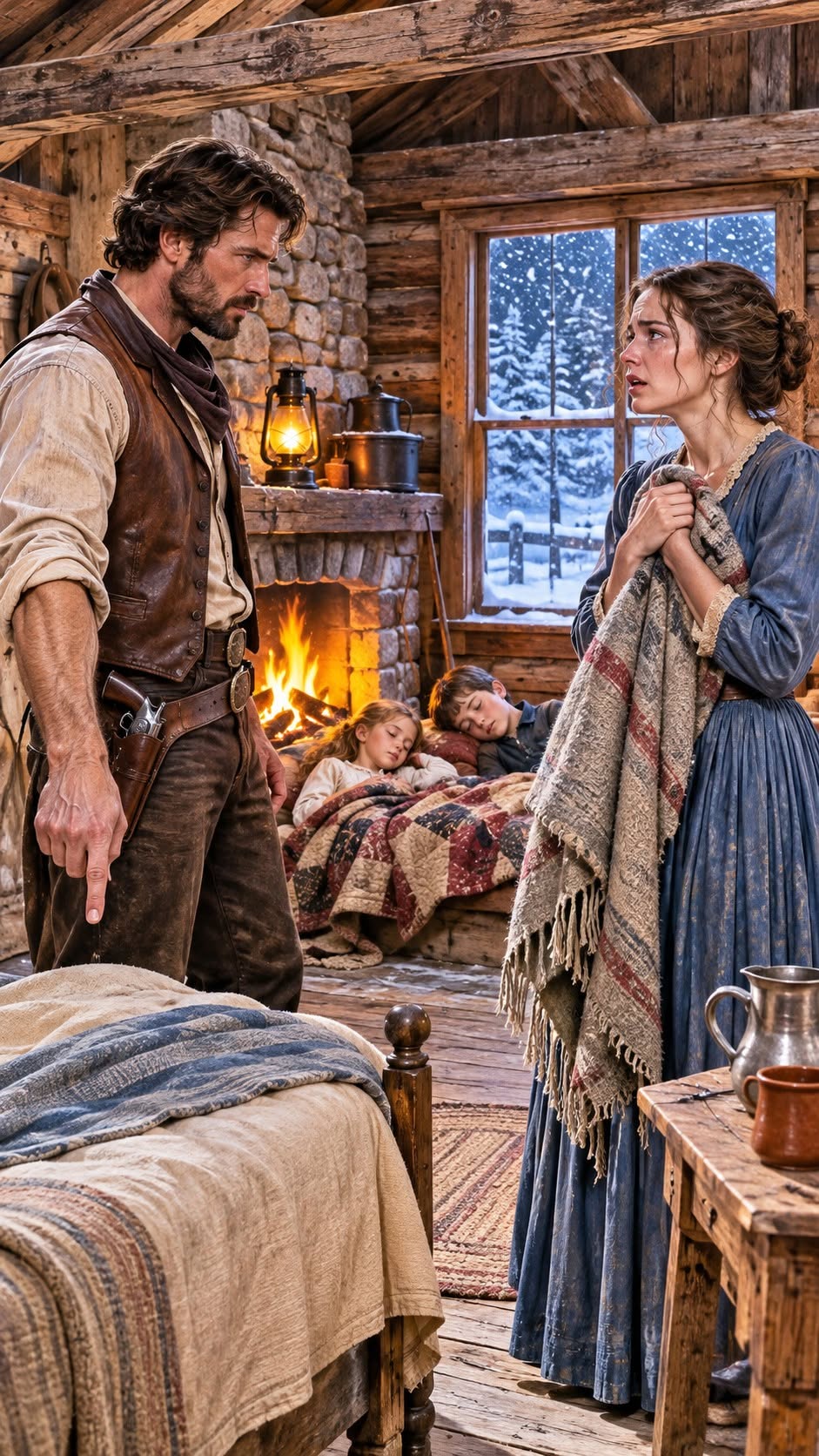
That evening, Annie fell asleep beside the fireplace.
Thomas was reading an old book near the window.
Ruth stood in the kitchen preparing supper.
I watched her for a long time.
Then I realized something.
The cabin had changed.
There were children’s drawings pinned beside the fireplace. A woman’s shawl hung near the door. Fresh flowers sat in a jar on the table.
And on the mantel was a pH๏τograph of Samuel Bennett.
I had not asked Ruth to remove it.
I never would.
When she joined me beside the fire, she noticed where I was looking.
“Would it bother you if I kept his pH๏τograph here?”
I looked at her.
“No.”
She touched the frame.
“He was a good husband.”
“I believe that.”
“And I loved him.”
“I know.”
She looked at me with uncertainty.
“Then how can you love me?”
I took a moment before answering.
“Because love isn’t a compeтιтion with the ᴅᴇᴀᴅ.”
Her eyes filled again.
“Samuel gave you two beautiful children. He deserves to be remembered for that.”
I gently touched her cheek.
“And if you ever decide you want another chapter, I’d be honored to be part of it.”
She leaned into my hand.
Then she kissed me.
It was not the desperate kiss of a frightened woman seeking protection.
It was a quiet, deliberate kiss from someone who had finally found the courage to choose happiness again.
And for the first time in eleven years, I understood what it meant to come home.
But the greatest surprise came the following spring.
I had been repairing the barn when Thomas ran toward me carrying a letter.
“Caleb! This came for Mama!”
I wiped my hands and opened it.
The envelope bore the seal of a lawyer in Helena.
Inside was a short message.
Mrs. Ruth Bennett,
Following the recent investigation into the Bennett land fraud, an additional property deed has been discovered in the estate of Judge Harlan.
The deed identifies a second parcel of land belonging to your late husband, Samuel Bennett.
I read the address.
Then I read it again.
The property was located less than a mile from my ranch.
It included a house.
A barn.
And forty acres of pasture.
But there was something stranger.
The deed had been signed twenty years earlier.
By Samuel Bennett.
And beneath his signature was another name.
Caleb Thornton.
I stared at it.
I had never seen the document before.
I had never owned that property.
And yet, my name was there.
I looked toward the house.
Ruth stood in the doorway, watching me.
“What’s wrong?”
I held up the paper.
“Ruth, I think there’s something your husband never told you.”
She approached slowly.
“What?”
I pointed to the second signature.
“He left something for me.”
Her eyes widened.
But before either of us could say another word, a rider appeared on the road.
An elderly man in a black coat.
He dismounted and removed his hat.
“Caleb Thornton?”
“Yes.”
The stranger looked at Ruth.
Then he said something that made her drop the letter.
“I’m Samuel Bennett’s older brother. And I’ve come to tell you what really happened the night he died.”
He reached inside his coat and produced a second document.
“This land wasn’t simply given to you, Mr. Thornton.”
His eyes moved toward Ruth.
“It was purchased with money Samuel had been saving for eleven years.”
He paused.
“And he didn’t save it for himself.”
Ruth’s lips parted.
“Then who was it for?”
The old man looked at her.
Then at the two children playing near the barn.
And quietly answered:
“For the man he believed would one day become their father.”
I looked at Ruth.
She looked at me.
Neither of us could speak.
Because somewhere in the past, long before a desperate widow had knocked on my door, Samuel Bennett had already decided that I was the man he wanted to protect his family.
And suddenly, the story of how Ruth had arrived at my cabin no longer seemed like an accident.
Someone had been leading her there all along.
THE END — OR PERHAPS THE BEGINNING OF A NEW LIFE.