PART 2: THEY LAUGHED AT HER PLAN — UNTIL SHE SHOWED THEM WHAT REAL HUNGER COULD DO
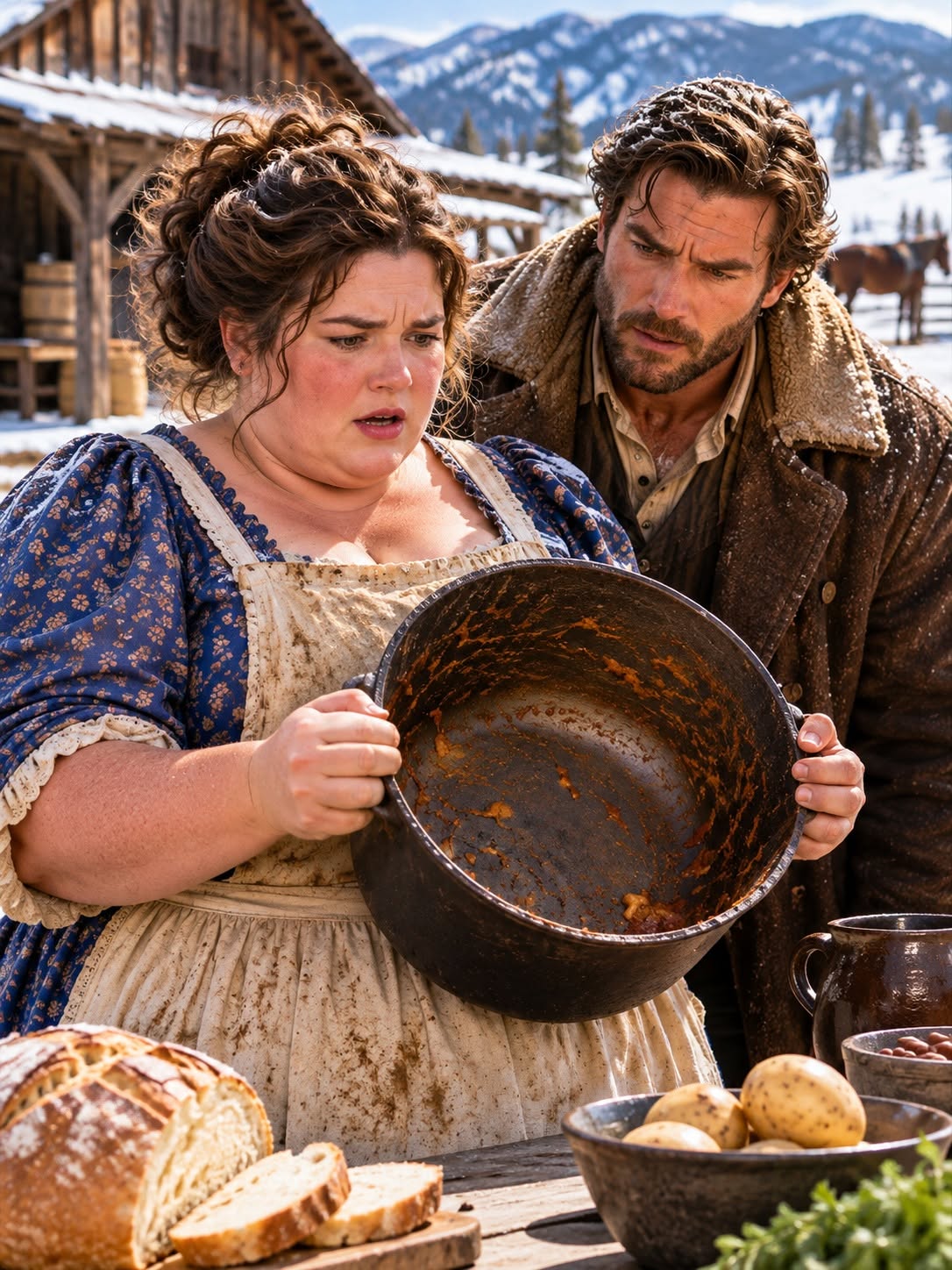
A PLUS-SIZE COOK FED 26 STARVING COWBOYS WITH ONE H๏τ MEAL AND EARNED THEIR RESPECT — BUT WHEN 14 MORE MEN ARRIVED, HER UNEXPECTED PLAN LEFT EVERY COWBOY SPEECHLESS
PART 2: THEY LAUGHED AT HER PLAN — UNTIL SHE SHOWED THEM WHAT REAL HUNGER COULD DO
Eleanor Carter placed both hands on the open ledger.
“There’s enough food for forty people for six days,” she began. “But only if we stop eating like forty separate men and start working like one family.”
Caleb Foster folded his arms.
“What does that mean?”
“It means no more individual portions decided by whoever reaches the pot first. No more food wasted because a man dislikes potatoes or thinks cornmeal is beneath him. Every meal will be measured. Every scrap will have a purpose.”
One of the cowboys chuckled.
“Sounds like we’ll be eating pig slop by Friday.”
Nell looked directly at him.
“Then I suggest you learn to appreciate pig slop, because I intend to make it taste better than anything you’ve eaten in this valley.”
A few men laughed.
Thomas did not.
He studied her ledger, then her tired face.
“What’s your plan, Nell?”
She took a breath.
“First, we stop treating the storeroom as our only source of food.”
Thomas frowned.
“There’s no other source.”
“There’s a barn full of livestock, a root cellar we haven’t fully inventoried, a smokehouse, and a hillside covered in wild rose hips. There’s also a creek with fish beneath the ice, if somebody knows how to catch them.”
Caleb raised an eyebrow.
“You’re planning to feed forty men with rose hips?”
“No. I’m planning to feed forty men with everything this ranch has forgotten it possesses.”
She turned a page in the ledger.
“Second, we need to stop making every meal depend on meat. Beans, potatoes, cornmeal, oats, and whatever vegetables remain can become different meals if we use them properly.”
Thomas leaned back.
“And the men?”
“They’ll have to help.”
Caleb shook his head.
“My boys are trail hands, not kitchen workers.”
Nell smiled faintly.
“Good. I wasn’t planning to put them behind my stove.”
She began ᴀssigning jobs.
Six men would gather firewood and keep the kitchen stove burning.
Four would inspect the root cellar and bring up everything that could still be used.
Another six would clear snow around the smokehouse and livestock pens.
The remaining men would help with fishing, hauling water, and repairing the frozen feed troughs.
Thomas listened without interrupting.
When she finished, he asked, “And what will you do?”
“Cook.”
“That’s all?”
Nell looked at him.
“Mr. Reed, cooking for forty hungry men is not a small job.”
A silence followed.
Then Ike, the oldest ranch hand, spoke from the doorway.
“She’s right.”
Everyone turned.
Ike had been working cattle for nearly forty years, and nobody on the ranch argued with him twice.
“I’ve eaten at camps where a dozen men tried to cook supper and nearly burned down the wagon. If Miss Carter says she needs help, we’d be fools not to give it.”
Thomas nodded.
“Then that’s settled.”
But Nell had one more request.
“I want every man to bring whatever food he might have tucked away in his saddlebag or coat. Dried apples, jerky, hard biscuits, anything. We’ll pool it and divide it fairly.”
One cowboy looked uncomfortable.
“Some of us don’t have anything.”
“Then some of us have more reason to share what we do.”
By noon, the kitchen had become a battlefield of activity.
Men carried sacks, scrubbed potatoes, hauled buckets, and brought in armloads of frozen roots.
Nell worked at the center of it all.
She moved slowly because her feet hurt and her back ached, but her hands never stopped.
She taught a young cowboy named Samuel how to make a thick bean stew without wasting a single ladle of broth.
She showed Ike how to roast onions until their sweetness could flavor an entire pot.
She soaked dried fruit overnight to make it stretch through breakfast.
And she sent three men to gather rose hips before the next snowfall buried them completely.
At first, some of the cowboys grumbled.
By evening, they had stopped.
The smell coming from the kitchen was impossible to ignore.
Nell had made a large pot of potato and bean stew, seasoned with onions, dried herbs, and the last of the smoked meat.
She served it with thin cornmeal cakes cooked on a H๏τ iron griddle.
The first man to taste it was Caleb.
He took one spoonful.
Then another.
Finally, he looked across the table.
“Miss Carter, what did you put in this?”
“Potatoes.”
“That’s all?”
“Onions, beans, herbs, and a little patience.”
The men laughed.
Caleb looked down at his bowl.
“Well, I’ll be damned.”
For the first time in two days, the dining hall sounded cheerful.
But Nell was not celebrating.
She knew the supplies were still limited, and she had another problem.
The ranch had enough food to last six days only if the weather improved and the supply wagon arrived.
The storm showed no sign of weakening.
Late that night, Thomas found her alone in the kitchen.
 She was sitting at the table, rubbing her swollen fingers.
“You should be in bed.”
“So should you.”
He pulled out the chair opposite her.
For a while, neither spoke.
Then he asked, “Why do you do it?”
“Do what?”
“Carry everyone else’s hunger as though it’s your responsibility.”
Nell looked toward the stove.
“When I was eleven, my father lost his farm. Winter came early. My little sister and I hadn’t eaten in two days when he took us to a farmhouse and asked for help.”
She paused.
“The woman who answered the door looked at us, looked at our torn clothes, and told my father she had nothing to spare. I remember my sister crying all the way home.”
Thomas lowered his eyes.
“My sister survived, but she never forgot that night either. Neither did I.”
Nell swallowed.
“I promised myself that if I ever had a kitchen of my own, nobody would be turned away while there was food in my pots.”
Thomas looked at her for a long moment.
“You’ve kept that promise.”
“Not yet.”
He glanced at the ledger.
“You’re doing more than most people would.”
Nell gave a tired smile.
“Most people aren’t standing in front of forty hungry men.”
Thomas almost smiled.
Then the kitchen door burst open.
Ben stumbled inside, covered in snow.
“Mr. Reed! We’ve got trouble.”
Thomas stood immediately.
“What happened?”
“The southern road is blocked completely. The upper bridge has collapsed. And there’s something else.”
Ben swallowed.
“Fourteen more men are coming up the valley. Their wagon broke down near the old timber road. They’re freezing, and they haven’t eaten since yesterday.”
Thomas stared at him.
“Fourteen?”
“Yes, sir.”
Nell slowly closed her eyes.
Fifty-four people.
She walked to the storeroom and opened the ledger.
The numbers did not change.
The food did not multiply.
Thomas followed her.
“We can’t do this, Nell.”
She looked at him.
“Are you asking me to turn them away?”
He hesitated.
“I am asking you to understand that we cannot save everyone if we destroy what we have.”
Nell looked at the shelves.
Then at the kitchen.
Then at the snow beating against the window.
“No,” she said quietly. “We can’t save everyone by doing the same thing we’ve been doing.”
Thomas frowned.
“What are you thinking?”
She picked up the lantern.
“Tomorrow, we’re going to open the old root cellar beneath the east barn.”
Thomas shook his head.
“It’s been locked for years.”
“Then it’s time we found out why.”
He watched her walk toward the door.
For the first time since the storm began, Nell was no longer looking at the food they had left.
She was thinking about the food they had forgotten.
And beneath the east barn, behind a door that had not been opened in seven years, waited something that could change everything.
But when Nell found the key, she noticed something strange.
The lock had fresh scratches around it.
Someone had tried to open it recently.
Someone who clearly knew what was inside.
And that someone had left a muddy boot print leading straight back toward the ranch house.