PART 3 — THE WOMAN WHO MADE HIM WANT A FUTURE
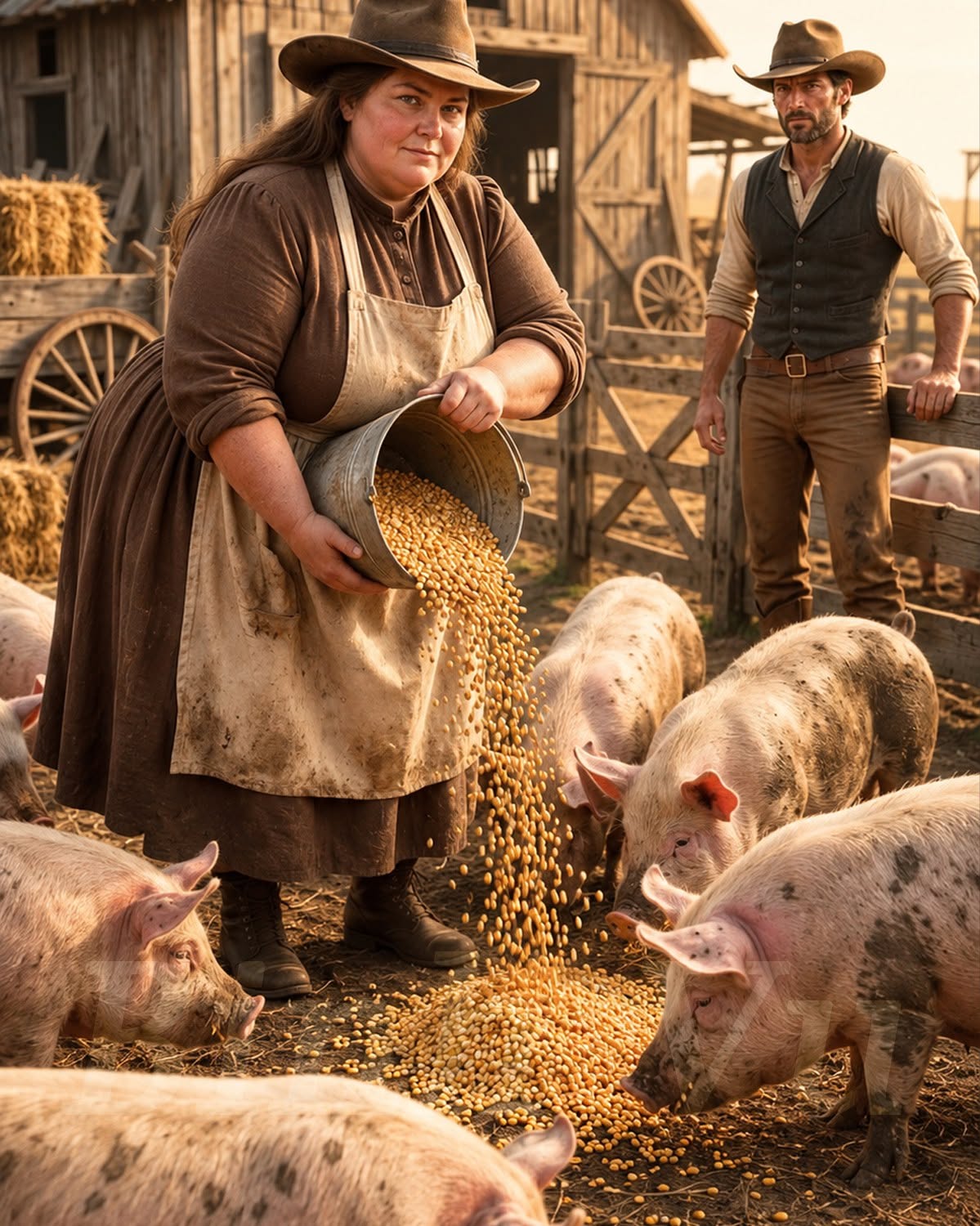
HE NEEDED A WIFE TO FEED THE PIGS—SHE MADE HIS FAILING FARM THE PRIDE OF THE COUNTY
PART 3 — THE WOMAN WHO MADE HIM WANT A FUTURE
The county hearing was held three days later.
Mabel stood before six men who had already decided what they thought of her.
A widow.
An outsider.
A woman who had arrived with four dollars and thirty cents.
Now they were calling her reckless.
One man read the accusation.
“Mrs. Ror intentionally opened the drainage gate.”
Mabel raised her chin.
“I did not.”
“Do you have proof?”
“Not yet.”
A murmur pᴀssed through the room.
Silas stood behind her.
He had barely spoken since they entered.
Then Harold Crane entered.
He smiled.
“May I?”
The judge nodded.
Crane placed a document on the table.
“The irrigation system belongs to Mr. Treadwell.”
“Which means Mrs. Ror had no legal authority to alter it.”
Mabel looked at him.
“That’s not true.”
Crane smiled.
“Isn’t it?”
She pointed to the document.
“That isn’t the original agreement.”
Crane’s smile faded.
Mabel stepped forward.
“The original drainage contract was signed by Silas’s father in 1871.”
She turned to the judge.
“It states the eastern channel must remain open.”
Crane interrupted.
“That document doesn’t exist.”
Mabel smiled.
“It does.”
Silas reached into his coat.
He handed the judge an old folded paper.
“The original.”
Crane’s face changed.
The judge read it.
Then looked up.
“Mr. Crane, where did you get your document?”
Crane said nothing.
The judge examined both.
“The signatures don’t match.”
Mabel looked at Crane.
“Because yours is forged.”
Silence.
Then the sheriff stepped forward.
“We found witnesses.”
Crane turned.
“What witnesses?”
The sheriff pointed toward the door.
Three farmers entered.
Then two workers.
Then an elderly man.
The man carried an old pair of boots.
“I found these near the drainage gate.”
Crane stared.
The iron heel was unmistakable.
The same heel pattern as his boots.
The judge turned to the sheriff.
“Arrest him.”
Crane stepped back.
“You can’t!”
The sheriff grabbed his arm.
“Can and will.”
As Crane was taken away, he looked at Mabel.
“This isn’t over.”
Silas stepped between them.
“It is.”
Crane was dragged out.
The room erupted in noise.
But Mabel barely heard it.
She looked at Silas.
“You knew.”
“About the boots?”
“No.”
She swallowed.
“About standing beside me.”
Silas smiled.
“I told you.”
 Outside the courthouse, the whole town was waiting.
Farmers.
Women.
Children.
Even the men who had once laughed at the Treadwell farm.
They had come because word had spread.
The woman who fixed the south field was fighting for it.
And they were ready to stand with her.
That afternoon, the county judge officially cleared Mabel.
More than that.
He awarded the Treadwell farm a grant for agricultural improvement.
The news spread across Missouri.
By harvest, the farm produced its largest crop in fifteen years.
The pigs won first prize at the county fair.
The milk cow won second.
And Mabel’s corn bread won first.
But the prize she cared about most was the blue ribbon hanging beside the kitchen door.
Silas walked in that evening.
He had changed clothes.
He was nervous.
Mabel noticed immediately.
“What’s wrong?”
“Nothing.”
“Silas.”
He took off his hat.
“I’ve been thinking.”
“That’s dangerous.”
He smiled.
“About you.”
Mabel stopped stirring the pot.
“That’s more dangerous.”
“I know.”
He stepped closer.
“When you arrived, I thought I needed a woman.”
Mabel looked at him.
“I was wrong.”
He continued.
“I needed someone who could see what I couldn’t.”
He reached into his pocket.
“I needed someone who would tell me when I was being foolish.”
Mabel laughed.
“That part I can do.”
“I know.”
He pulled out a small box.
Her smile faded.
“Mabel…”
He opened it.
Inside was a simple gold ring.
Not extravagant.
Not polished.
But beautiful.
“I don’t want you to stay because you owe me.”
“You don’t owe me.”
“I don’t want you to stay because the farm needs you.”
Mabel’s eyes filled.
“I want you to stay because I love you.”
She looked at the ring.
Then at him.
“And if I say no?”
Silas smiled sadly.
“Then I’ll fix the fence tomorrow anyway.”
She laughed through her tears.
“You’ll never learn.”
“Probably not.”
He took her hand.
“But I can learn what matters.”
Mabel looked around the kitchen.
The table.
The bread.
The old ledger.
The flowers she’d planted beside the window.
The farm outside.
The place she had arrived expecting to leave.
Then she looked at Silas.
“I have one condition.”
He raised an eyebrow.
“Another?”
“Yes.”
“What is it?”
“I don’t want to be your wife because you need someone to run the farm.”
Silas nodded.
“Then what?”
“I want to be your wife because you want a life with me.”
His eyes softened.
“That’s exactly what I want.”
Mabel took his hand.
“Then yes.”
He slipped the ring onto her finger.
And when he kissed her, it wasn’t the kiss of a lonely farmer marrying a practical woman.
It was the kiss of a man who had finally understood that the greatest harvest wasn’t corn.
It wasn’t money.
It wasn’t even a successful farm.
It was having someone beside you when the fields were flooded.
Someone who stayed when the roof leaked.
Someone who believed in the future when the ledger said there wasn’t one.
Someone who could look at broken things and say:
“We do the right things in the right order.”
Years later, people in Brier Hollow would still talk about the Treadwell farm.
They would talk about the south field.
The prize hogs.
The record corn harvest.
The agricultural workshops Mabel started for struggling families.
But whenever someone asked Silas what saved the farm, he never mentioned the drainage ditch.
He never mentioned the corn.
He never mentioned the money.
He always looked toward the kitchen window.
Where Mabel stood with flour on her hands.
And he’d say:
“I was looking for a wife to feed the pigs.”
Then he’d smile.
“And God sent me the woman who taught me how to build a home.”