PART 2 – THE LITTLE YELLOW CLOTHES REVEALED A SECRET HE HAD NEVER IMAGINED
PART 2 – THE LITTLE YELLOW CLOTHES REVEALED A SECRET HE HAD NEVER IMAGINED
The trunk opened with a long, reluctant creak.
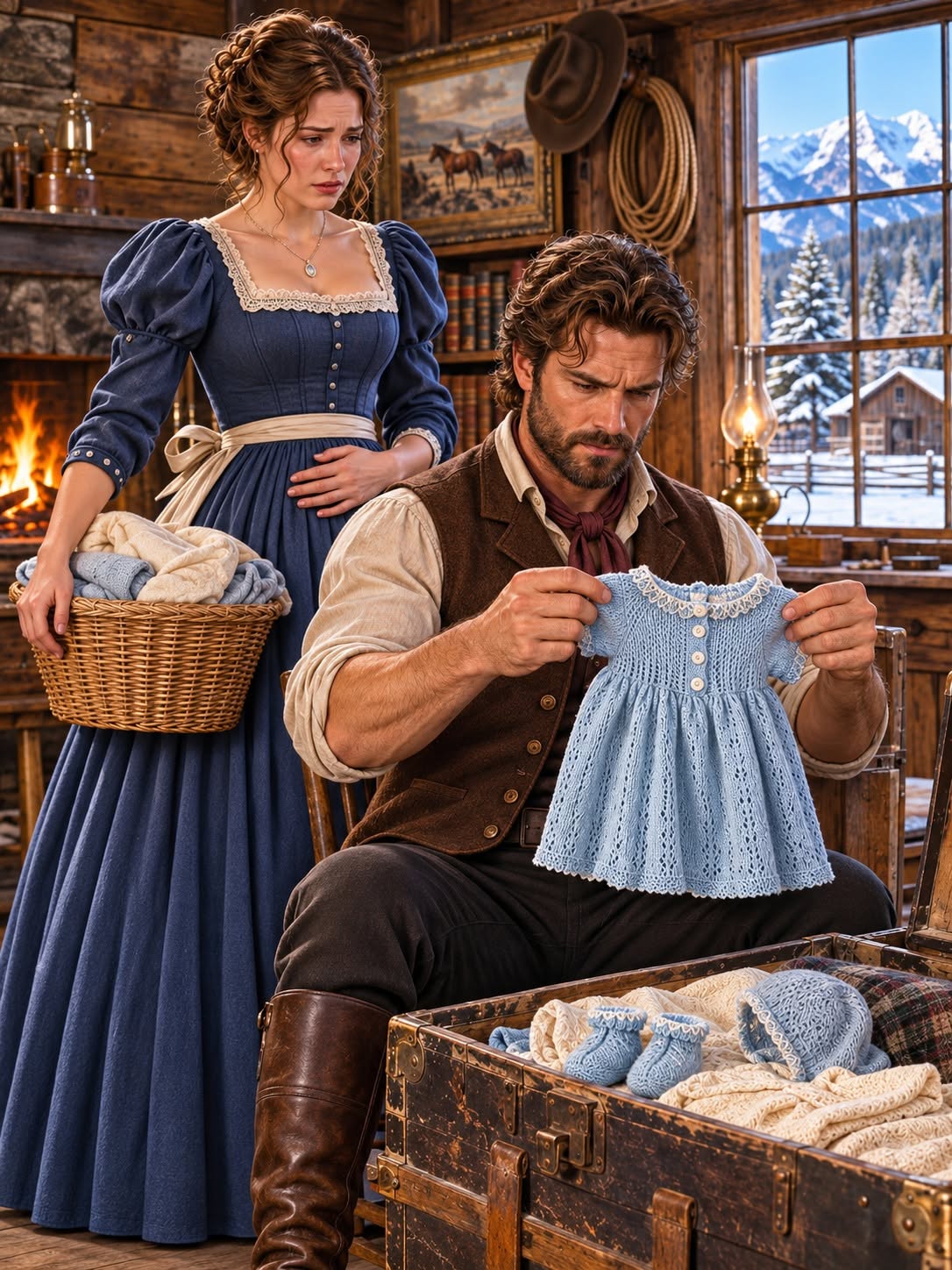
Jackson reached inside, expecting to find the railroad agreement buried beneath the old blankets. Instead, his fingers touched something soft. He pulled it out slowly, and a tiny yellow bonnet appeared in his large, weathered hands.
For several seconds, neither of us moved.
Then he lifted a little shirt, two knitted booties, and a yellow dress no bigger than his forearm.
“What is this?” he whispered.
I felt the room tilt beneath my feet.
“Mr. Thorne, please…”
He turned toward me, holding the little dress as though it were something precious and terribly fragile.
“Eliza, why are there baby clothes in my trunk?”
I tried to answer, but the words caught in my throat. My fingers тιԍнтened around the handle of my cleaning basket until they hurt.
“They’re mine,” I finally managed.
His gray eyes narrowed with confusion.
“Yours?”
“I made them.”
“For whom?”
I looked down at the floor.
“Please don’t make me say it.”
Jackson stared at me for a long moment. Then his gaze dropped to my waist, where the loose apron I’d worn for weeks could no longer completely conceal the small curve beneath it.
The little dress slipped slightly in his hands.
“Eliza…”
His voice had changed.
“Are you carrying a child?”
I nodded.
He took one step backward as though the answer had physically struck him. His face went pale, and he looked from the clothes to me again.
“How long have you known?”
“Several weeks.”
“And you said nothing?”
A bitter laugh escaped me before I could stop it.
“When was I supposed to tell you? Between breakfast and your letters from the bank? Or while you were pretending that July never happened?”
He flinched.
I had never spoken to him that way before. But the fear that had kept me silent for months was finally stronger than my desire to please him.
“I didn’t want your money, Mr. Thorne. I didn’t want your house or your cattle or your name. I was going to leave before anyone noticed. I’ve saved enough to get somewhere else, and I’ll find work. You won’t have to worry about me.”
Jackson placed the little clothes carefully on the desk.
“Leave?”
“Yes.”
“With my child?”
I looked up sharply.
“Your child?”
His jaw тιԍнтened.
“Is there any doubt about that?”
“No,” I whispered. “But I thought there might be in your mind.”
He looked genuinely wounded.
I continued before he could interrupt.
“I heard about the bank. I know the ranch is in trouble. I saw the figures on your desk. The last thing you need is a woman telling you she’s carrying your child when you haven’t even promised her a future.”
Jackson stared at me as though he had never considered that I might believe such a thing.
Then he lowered himself into the chair beside his desk.
“Eliza, look at me.”
I didn’t.
“Please.”
When I finally raised my eyes, his expression was unlike anything I’d seen before. There was no anger in it. Only exhaustion, regret, and something dangerously close to fear.
“Do you remember what I told you that night by the fireplace?”
“That the silence in this house was worse than winter.”
He nodded.
“I also remember what happened afterward. I remember waking the next morning and realizing I’d allowed myself to want something I had no idea how to protect.”
He rubbed his forehead.
“My father spent his life teaching me that a man’s worth was measured by what he owned. When he died, I inherited the ranch, the cattle, the house, and debts he never told me about. I’ve spent years trying to prove I could save everything he left behind.”
He glanced at the bank letter.
“I was so afraid of losing this place that I forgot there might be something worth keeping more than land.”
My eyes filled with tears.
“That doesn’t mean you want a family with me.”
“No,” he said quietly. “It doesn’t. And I won’t insult you by pretending one conversation can repair months of silence.”
For the first time, I saw him struggle to find the right words.
“But I want to know my child. And I want you to understand that you have never needed to earn the right to tell me about him or her.”
I pressed a hand against my stomach.
“You’re not angry?”
“Angry?”
His voice broke slightly.
“Eliza, I’ve spent four months wondering why you seemed to be disappearing in front of me. I thought you were unhappy here. I never imagined you were carrying this fear alone.”
He stood and approached me, but stopped before touching my arm.
“May I?”
I nodded.
His hand settled gently over mine.
For a moment, the entire room seemed to become quiet.
Then the baby moved.
Jackson froze.
“Was that…?”
I nodded through my tears.
 He looked down at my stomach with an expression I would remember for the rest of my life.
“Good heavens,” he whispered. “There’s really someone in there.”
I almost laughed.
“Yes, Mr. Thorne. That’s generally how babies work.”
A small, surprised smile appeared on his face.
It was the first time I’d seen him smile in months.
Then a knock sounded at the study door.
The ranch foreman, Caleb Miller, stepped inside holding a telegram.
“Sorry to interrupt, Jackson. But this came from Cheyenne. The bank’s representative is coming tomorrow morning.”
Jackson took the telegram and read it.
His expression hardened.
“What does it say?” I asked.
He folded the paper.
“They intend to take possession of the ranch unless I produce the original railroad agreement by noon tomorrow.”
I looked toward the open trunk.
“But you were looking for that agreement.”
“Yes.”
He returned to the trunk and searched beneath the blankets, moving old papers aside. Then he stopped.
The trunk was empty except for the baby clothes and a few letters.
“The agreement isn’t here.”
He searched again, more urgently this time.
“That’s impossible. My father told me he put it here.”
Caleb stepped closer.
“Jackson, there’s something else.”
“What?”
“The railroad men were here last week. They weren’t asking about cattle prices. They were asking how much of the northern pasture belonged to the ranch.”
Jackson slowly turned toward him.
“Who told them?”
Caleb hesitated.
“Mr. Brackett.”
The name changed everything.
Hollis Brackett was a wealthy land investor who had been trying to buy neighboring ranches for years. If the Thorne ranch fell into the bank’s hands, he would have the opportunity to purchase it cheaply.
Jackson looked at the empty trunk, then at the bank letter.
Suddenly, I remembered something.
“Mr. Thorne…”
He turned.
“There was an envelope beneath the lining. I noticed it when I cleaned the trunk last month. I thought it was an old letter, so I didn’t touch it.”
Jackson immediately knelt and examined the inside of the trunk. He pressed his fingers along the bottom until he found a loose wooden panel.
With a sharp pull, it came free.
Inside lay a sealed envelope bearing his father’s handwriting.
Jackson opened it.
The first page contained a legal agreement. The second contained a letter.
He read the agreement once, then again.
“What is it?” Caleb asked.
Jackson looked up, his face drained of color.
“My father didn’t mortgage the northern pasture.”
He turned the page.
“He transferred the mineral and railroad rights to a trust before he died. The bank cannot claim them.”
Then he reached the final paragraph.
His hand began to shake.
Because the agreement contained one more name.
Hollis Brackett.
And beneath that name was a handwritten statement from Jackson’s father, dated just three weeks before his death:
“If Brackett ever attempts to seize this land, remember that he knows exactly why I refused to sell.”
Jackson lowered the letter.
For the first time that morning, he looked more frightened than I had ever seen him.
“Eliza,” he said quietly, “I think my father was murdered for this land.”