Born With a Large Mᴀss Beside His Face: Understanding Congenital Facial Teratoma
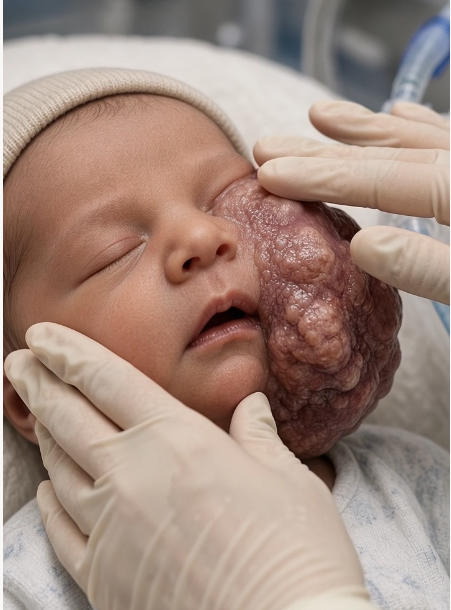
When baby Oliver was born, doctors noticed a large and unusual mᴀss growing beside his face.
The growth extended outward from the area near his jaw, making one side of his face appear dramatically different from the other. Part of his mouth was obscured, raising immediate concerns about whether he would be able to feed and breathe normally.
His parents were frightened. They had expected to welcome their newborn son into the world, but instead, they were faced with an unexpected medical emergency.
Doctors quickly began examining the mᴀss to understand its nature and determine whether it was affecting Oliver’s vital functions.
Following medical imaging and pathological evaluation, the team identified the growth as a congenital teratoma.
What Is a Congenital Teratoma?
A teratoma is a type of germ-cell tumor that can contain several different types of tissue.
Depending on its development, a teratoma may contain structures resembling skin, hair, muscle, cartilage, bone, or other tissues. These tumors originate from cells capable of developing into different tissue types.
Congenital teratomas develop before birth and may already be quite large when a baby is delivered.
They can occur in different parts of the body, including the head and neck region. When a teratoma develops near the face, jaw, mouth, or throat, it may cause significant anatomical changes.
Many teratomas are benign, but not all have the same biological behavior. Some contain immature or malignant components, which is why pathological examination is important.
The location of a tumor can also make it dangerous even when it is not cancerous.
Why Can a Facial Teratoma Become a Medical Emergency?
Oliver’s tumor was especially concerning because it was located beside his jaw and extended toward his mouth.
A large mᴀss in this area can affect several important structures involved in breathing, swallowing, and feeding.
Depending on its position, a congenital facial teratoma may cause:
- Difficulty opening the mouth.
- Problems sucking or swallowing milk.
- Pressure on the tongue or throat.
- Narrowing or obstruction of the upper airway.
- Changes in the development or position of nearby facial structures.
In severe cases, airway obstruction can become life-threatening.
For this reason, doctors must ᴀssess breathing before focusing on the cosmetic appearance of the tumor.
The medical team also needs to determine whether the mᴀss extends into deeper areas, such as the oral cavity, pharynx, skull base, or surrounding facial tissues.
Imaging and Diagnosis
Doctors use imaging studies to map the tumor and understand its relationship to nearby organs.
Ultrasound may provide an initial ᴀssessment, while MRI can help show the soft tissues and the tumor’s deeper extensions. CT may be useful when detailed information about bone involvement is required.
The precise diagnosis is established through pathological examination of a tissue sample or the removed tumor.
Pathologists ᴀssess the types of tissue present and determine whether the tumor contains mature, immature, or malignant components.
This information helps doctors decide whether surgery alone is likely to be sufficient or whether additional treatment and closer monitoring are needed.
Protecting Oliver’s Airway Comes First
Because the tumor was close to his mouth, Oliver’s doctors made airway ᴀssessment their immediate priority.
Newborns have small airways, so even a relatively localized mᴀss can create serious breathing difficulties if it presses on the wrong structures.
A multidisciplinary team may include neonatologists, pediatric anesthesiologists, pediatric surgeons, ear, nose and throat specialists, and craniofacial surgeons.
If the tumor significantly interferes with breathing, specialists may need to secure the airway before proceeding with tumor removal.
The approach depends on the baby’s anatomy and clinical condition. Some cases can be managed with specialized airway techniques, while severe cases may require an emergency surgical airway.
Feeding also needs careful attention. If Oliver cannot safely coordinate sucking and swallowing, doctors may temporarily use another method of providing nutrition.
Surgical Treatment and Recovery
For many congenital teratomas that can be safely removed, surgery is the primary treatment.
However, removing a large tumor from the face can be challenging because important nerves, blood vessels, muscles, bones, and structures involved in breathing and swallowing may be located nearby.
Surgeons must plan the procedure carefully, balancing tumor removal with the need to preserve facial function and support normal development.
The removed tissue is sent for detailed pathological examination.
If the tumor is mature and completely removed, surgery followed by regular monitoring may be all that is needed. If immature or malignant components are identified, the medical team may recommend additional investigations or treatment based on the specific diagnosis.
Follow-up care is important because doctors need to monitor for possible recurrence and ᴀssess how Oliver’s face and jaw develop as he grows.
Depending on his needs, he may also receive support from feeding specialists, speech therapists, pediatric dentists, and craniofacial specialists.
What Does the Future Hold for Oliver?
Oliver’s first days of life have brought challenges that his parents never expected.
A large congenital tumor beside his face can affect much more than appearance. It may interfere with breathing, feeding, swallowing, and the development of nearby structures.
However, the long-term outlook varies considerably.
Important factors include the exact type of teratoma, its size and location, whether it can be completely removed, and whether pathological examination reveals any immature or malignant components.
Some children recover well after surgery and require only continued monitoring. Others need additional treatment or long-term support for feeding, speech, facial development, or breathing.
For Oliver’s family, the immediate hope is that the medical team can protect his airway and control the tumor safely.
They are looking forward to the day when feeding becomes easier, his breathing is stable, and his face can grow without the pressure of the mᴀss.
His story highlights the importance of early diagnosis, specialized newborn care, and coordinated treatment for rare congenital tumors.
Behind the unusual appearance of a congenital tumor is a newborn who needs the same things as every other baby: safe breathing, proper nutrition, careful medical care, and the chance to grow.
Medical note: This is an illustrative educational story, not a verified patient report. A mᴀss near a newborn’s face cannot be definitively classified as a teratoma based on appearance or imaging alone. Histopathological examination is generally needed to confirm the diagnosis. Individual treatment and prognosis depend on specialist ᴀssessment.