The Little Boy Whose Legs Never Stopped Growing: Understanding Daniel’s Journey With Proteus Syndrome
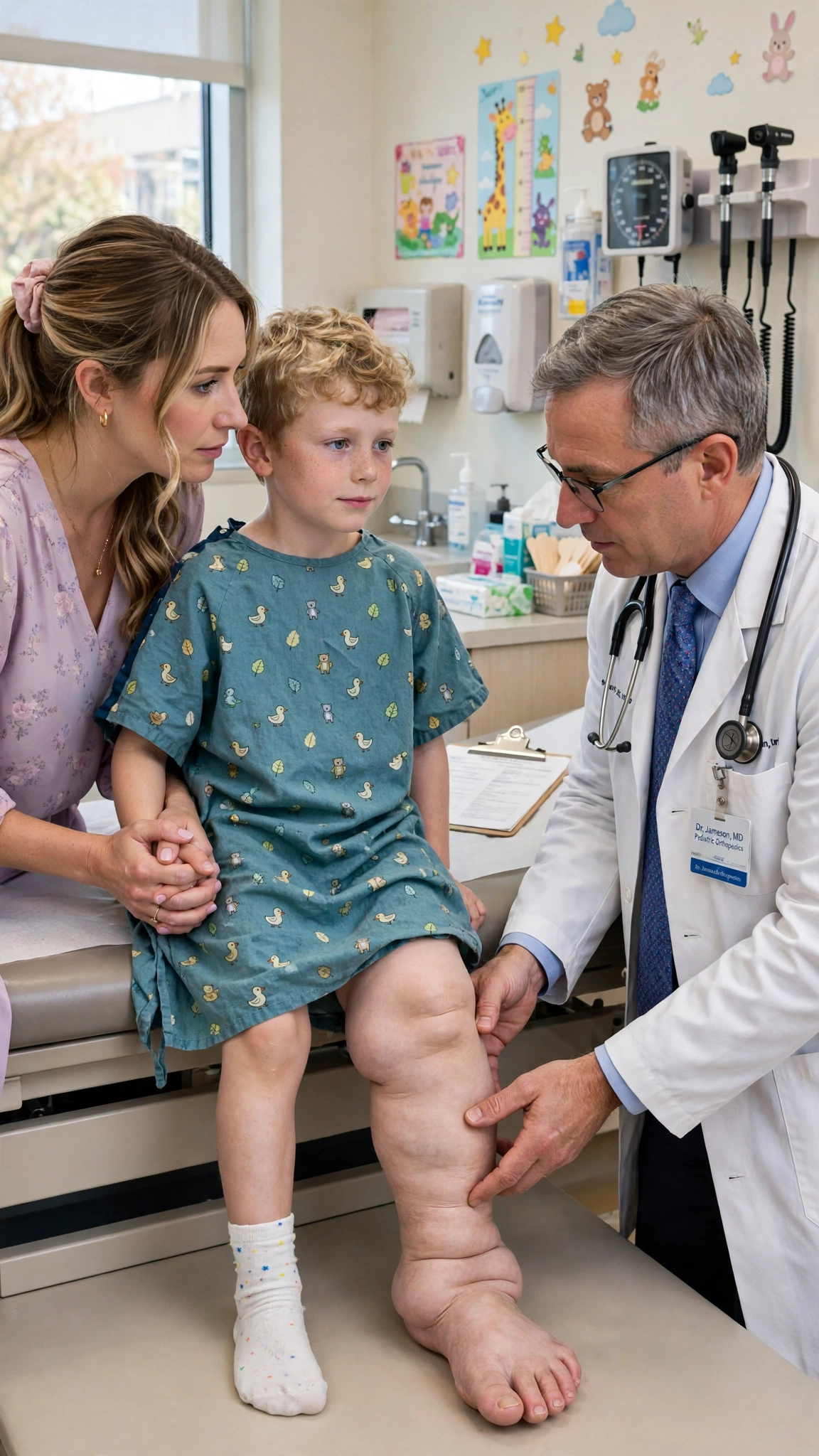
When little Daniel was born, his parents never imagined that his physical development would eventually become so different from that of other children.
During his first months of life, he appeared to be growing normally. However, as time pᴀssed, his family began noticing an unusual difference between his legs.
One leg seemed to be developing much faster than the other. Initially, the difference was subtle, but it gradually became more noticeable as Daniel grew older.
His affected leg increased significantly in size, and his foot became disproportionately large. The surrounding soft tissues also developed unevenly, creating a visible difference between the two sides of his body.
As the enlargement progressed, Daniel began experiencing difficulties with ordinary physical activities. Walking required more effort, and standing for extended periods sometimes caused discomfort.
Concerned about these changes, his parents sought medical advice and arranged further examinations with specialists.
Following several ᴀssessments, doctors diagnosed Daniel with Proteus syndrome, an extremely rare genetic condition characterized by progressive and disproportionate overgrowth of different tissues throughout the body.
Understanding Proteus Syndrome
Proteus syndrome is an exceptionally rare congenital overgrowth disorder that can cause certain parts of the body to develop disproportionately.
The condition is ᴀssociated with a somatic activating mutation in the AKT1 gene. This genetic change occurs during early development and affects only a portion of the body’s cells.
This phenomenon is known as genetic mosaicism.
Because the mutation is present in some cells but absent in others, the resulting growth abnormalities can affect specific areas of the body rather than the entire body uniformly.
Proteus syndrome can involve bones, fatty tissues, muscles, connective tissues, and skin.
The condition is generally not inherited from parents. Most cases result from a spontaneous genetic change during early embryonic development.
Its characteristic overgrowth is progressive, meaning that affected tissues may become increasingly enlarged as the child grows.
However, the pattern and severity of the condition vary considerably between individuals.
How the Condition Affects the Legs and Feet
One of the most recognizable characteristics of Proteus syndrome is asymmetric overgrowth, in which one part of the body becomes disproportionately larger than the corresponding area on the opposite side.
When the lower limbs are affected, several structures may be involved.
Bone overgrowth: Certain bones may become enlarged or develop abnormally, changing the length, shape, and proportions of the affected limb.
Soft-tissue overgrowth: Fatty tissue, muscles, and connective tissues may increase abnormally, contributing to the overall size and weight of the affected area.
Foot abnormalities: The foot may become disproportionately enlarged, and some individuals develop abnormal growth involving the toes and surrounding structures.
Skin changes: Some patients develop thickened skin, distinctive skin patterns, or other abnormalities involving connective tissue.
These changes may develop at different rates, making one limb increasingly different from the other.
For Daniel, the enlargement of his leg and foot gradually became an important factor affecting his mobility and everyday activities.
Why Walking Can Become Increasingly Difficult
When one leg becomes significantly larger or heavier than the other, normal movement and balance can become more challenging.
Children with lower-limb overgrowth may experience difficulties walking, running, jumping, and participating in physical activities.
Differences in limb length can also affect posture and the distribution of body weight across the hips, knees, ankles, and feet.
Depending on the structures involved, additional complications may include joint problems, abnormal foot positioning, discomfort, and reduced mobility.
For Daniel, activities that once seemed simple gradually required more concentration and physical effort.
He sometimes watched other children running freely and wished he could join them without worrying about the size and weight of his affected leg.
His parents understood that supporting his mobility would become an important part of his long-term care.
Medical Monitoring and Treatment Options
There is currently no cure for Proteus syndrome. Treatment focuses on managing abnormal growth, preventing complications, and improving the patient’s quality of life.
Because the condition can affect multiple tissues and organ systems, medical care often requires a multidisciplinary team.
Depending on the patient’s individual symptoms, specialists may include pediatricians, orthopedic surgeons, dermatologists, rehabilitation professionals, and other medical experts.
Orthopedic monitoring is particularly important when the legs and feet are affected. Doctors regularly evaluate bone development, limb alignment, joint function, and differences in limb length.
Physical therapy may help maintain flexibility, strengthen muscles, improve balance, and support safe movement.
Customized footwear and orthotic devices may also be recommended to improve comfort and mobility.
In selected cases, surgical procedures may be considered to address severe overgrowth, functional limitations, or orthopedic complications. These interventions require careful planning because the condition can continue progressing.
Comprehensive medical surveillance is also necessary because Proteus syndrome may involve blood vessels and other internal structures.
One important potential complication is an increased risk of deep vein thrombosis and pulmonary embolism in some individuals.
The appropriate treatment plan depends on the specific areas affected and the patient’s overall medical condition.
The Emotional Challenges of Growing Up With Proteus Syndrome
Living with a rare medical condition can affect more than a child’s physical development.
For Daniel, the difference in the size of his legs sometimes made it difficult to participate in activities that other children considered ordinary.
Running, jumping, and standing for extended periods could become exhausting.
He occasionally watched other children playing outside and wished he could move as freely as they did.
His parents understood that these experiences could sometimes make him feel different or discouraged.
They tried to create an environment where Daniel could explore his interests without feeling that his physical appearance defined his idenтιтy.
Rather than focusing exclusively on the activities he found difficult, they celebrated his achievements and encouraged him to participate in activities suited to his abilities.
Every additional step, every new skill, and every happy afternoon became a meaningful milestone for the family.
The Importance of Family Support
For parents of children with Proteus syndrome, daily life may involve frequent medical appointments, ongoing ᴀssessments, and difficult decisions about treatment.
They must learn to recognize changes in their child’s body while balancing medical responsibilities with ordinary family routines.
Daniel’s mother became one of his greatest sources of encouragement.
Whenever walking became difficult, she would gently hold his hand and encourage him to continue at his own pace.
His father also made sure that home remained a place where Daniel could relax, play, and enjoy being a child.
His favorite toys and cartoons brought moments of happiness that had nothing to do with medical examinations or treatment plans.
These ordinary experiences reminded the family that childhood should never be reduced to a medical diagnosis.
Looking Toward the Future
Proteus syndrome is a lifelong condition, and abnormal tissue growth may continue throughout childhood and adolescence.
The long-term outlook depends on which parts of the body are affected, the severity of the overgrowth, and whether additional complications develop.
Regular medical monitoring and appropriate interventions can help address emerging problems, support mobility, and improve quality of life.
For Daniel, the journey will require continued medical attention, patience, and family support.
There may be difficult days when physical limitations make him feel different from other children. There may also be new challenges as his body continues to develop.
However, his future should not be measured only by the progression of his condition.
He deserves opportunities to learn, play, develop friendships, and discover his own interests.
His enlarged leg may be one of the most noticeable aspects of his appearance, but it does not represent the entirety of his idenтιтy.
Daniel is not simply a child living with Proteus syndrome. He is a little boy with his own personality, hopes, and dreams, surrounded by a family determined to help him experience life as fully as possible.