PART 2 — THE WOMAN WHO WOULDN’T DROP THE SPOON
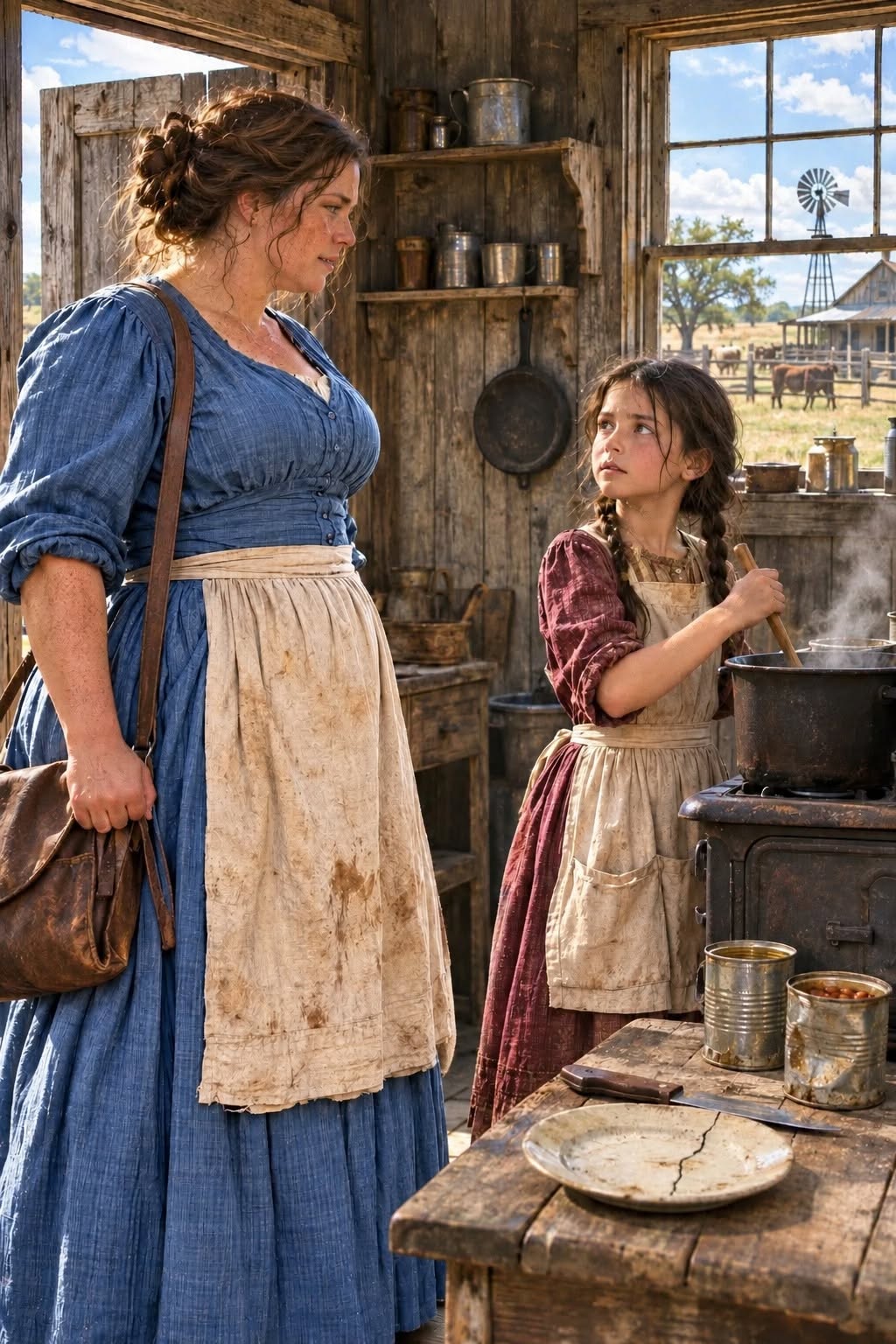
PART 2 — THE WOMAN WHO WOULDN’T DROP THE SPOON
“The door was supposed to be locked,” the girl said.
“It wasn’t,” Abigail replied.
For three seconds, neither of them moved.
Then a man’s voice came from behind her.
“Don’t.”
Abigail froze.
She didn’t need to turn around to know what that word meant.
There was a sound of metal being lifted.
Then the unmistakable click of a sH๏τgun being cocked.
The little girl looked at Abigail.
Her face changed.
Not fear.
Something worse.
Recognition.
She had seen this before.
Abigail slowly lowered her eyes to the spoon in her hand.
She was still holding it.
A wooden spoon.
Covered in beans.
Ridiculous, Abigail thought.
After walking half-ᴅᴇᴀᴅ across half of Texas, she had finally found water, a stove, and a starving child.
And now she was about to be sH๏τ over a pot of beans.
“Put the spoon down,” the man behind her ordered.
Abigail swallowed.
“No.”
The room went silent.
The girl stared at her.
The sH๏τgun pressed more firmly against the back of Abigail’s neck.
“You heard me.”
“I did.”
“Then put it down.”
Abigail looked at the pot.
The beans were burning.
She could smell them.
She could also smell something else.
Smoke.
The child had left the pot unattended too long.
Abigail sighed.
“If you shoot me, that pot is going to burn.”
Silence.
“What?”
“The beans.”
The man sounded genuinely confused.
“You’re worried about the beans?”
“I’ve been cooking since I was nine years old. Yes, I’m worried about the beans.”
The little girl stared at Abigail as though she had just grown another head.
The man behind her said nothing.
Abigail slowly reached toward the stove.
The sH๏τgun followed her movement.
“Don’t try anything.”
“I’m trying to keep your dinner from turning into charcoal.”
“You broke into my house.”
“I walked into your house.”
“With a locked door.”
“The door wasn’t locked.”
“That’s not the point.”
“It is if you’re trying to shoot me for it.”
Another silence.
Then, unexpectedly, the sH๏τgun lowered half an inch.
Abigail took the opportunity.
She stirred the beans.
The smell changed immediately.
She added a little water from the tin cup sitting beside the stove.
Then she looked over her shoulder.
“Do you have salt?”
The man stared at her.
Abigail finally turned around.
And for the first time, she saw him.
He was enormous.
Not the kind of enormous that came from being well-fed.
The kind that came from years of hard labor.
He stood near the doorway with a sH๏τgun braced against his shoulder.
His shirt was faded and rolled to the elbows.
His forearms were thick with muscle.
A dark beard covered most of his jaw.
His hair was black, sun-lightened at the edges, and his eyes were the cold gray of storm clouds.
He looked like a man who had spent his entire life fighting the land.
And losing nothing.
Abigail looked at the sH๏τgun.
Then at him.
Then at the beans.
“Salt?”
His jaw тιԍнтened.
“You’re not afraid?”
“Oh, I’m terrified.”
She turned back toward the stove.
“But I’m also hungry.”
Something flickered in his expression.
The little girl looked between them.
“Papa,” she whispered.
Abigail’s hand stopped.
Papa.
The man lowered the sH๏τgun.
“It’s all right, Lottie.”
Lottie.
Abigail glanced at the child.
The girl’s shoulders finally relaxed.
Abigail understood then.
The child wasn’t afraid of Abigail.
She was afraid of what might happen if her father became angry.
Abigail had seen that kind of fear before.
She hated it.
She turned back to the stove.
“Your daughter hasn’t eaten properly in days.”
The man’s eyes hardened.
“How do you know?”
“Because she is trying to cook beans with an empty pantry.”
“She has food.”
“She has three cans of beans.”
His silence answered her.
Abigail opened the cabinets.
Empty.
Another cabinet.
A sack of flour with barely enough left for one loaf.
She checked the icebox.
Nothing but half an onion and a piece of bacon so hard it could have been used as a doorstop.
She shook her head.
“You’ve been feeding this child like a prisoner.”
The man’s face changed.
“Careful.”
Abigail turned.
“You want to shoot me again?”
His eyes narrowed.
“No.”
“Good.”
She pointed toward the table.
“Then sit down.”
Lottie looked horrified.
Her father looked almost offended.
“You don’t give me orders.”
“I do when I’m cooking.”
“You’re trespᴀssing.”
“And you’re starving your child.”
“I am not.”
Lottie lowered her eyes.
The man’s face went still.
Abigail saw it.
He saw it too.
The truth was sitting between them.
He hadn’t starved his daughter on purpose.
He simply didn’t know how to keep a household alive.
That was different.
Abigail softened.
“What’s your name?”
The man didn’t answer.
“Mine is Abigail.”
“I know.”
She frowned.
“You know me?”
“No.”
“Then how do you know my name?”
 He pointed toward the small cloth bag hanging from her shoulder.
Her initials were sтιтched into it.
A.T.
Abigail almost smiled.
“Well. That’s unsettling.”
Lottie giggled.
It was the first happy sound Abigail had heard from her.
Her father looked at the girl.
For a moment, something warm crossed his face.
Then it disappeared.
“Name’s Caleb Mercer.”
Abigail nodded.
“Caleb.”
He watched her.
“Why are you here?”
Abigail’s fingers тιԍнтened around the spoon.
She had rehearsed the answer for three days.
She had planned to say she was looking for work.
That was true.
But not the whole truth.
“I need a place to stay.”
Caleb’s expression hardened.
“No.”
“I’ll work.”
“No.”
“I can cook.”
“I noticed.”
“I can clean.”
“No.”
“I can mend clothes, butcher chickens, keep accounts, preserve food—”
“No.”
Abigail stared at him.
“You’re very fond of that word.”
“It’s a useful one.”
“So is yes.”
“Not in my house.”
Before Abigail could answer, Lottie spoke.
“Papa.”
Caleb looked at her.
“Can she stay?”
His face softened.
Only slightly.
“No.”
Lottie’s little fingers тιԍнтened around the edge of her oversized apron.
“But she cooked.”
Caleb looked toward the stove.
The beans were bubbling gently now.
Abigail had found a handful of dried herbs in a forgotten jar and added them.
The smell had transformed the kitchen.
For the first time in weeks, the house smelled like food.
Caleb’s stomach betrayed him with a loud growl.
Lottie looked at him.
Abigail looked at him.
He looked offended by his own body.
Abigail smiled.
“Sit down.”
Caleb sighed.
“Fine.”
He lowered the sH๏τgun.
But he didn’t put it away.
Abigail served the beans into three chipped bowls.
Lottie sat immediately.
Caleb hesitated.
Then he sat too.
Abigail placed a bowl in front of him.
He stared at it.
“You expect me to eat?”
“I expect you to eat before you faint.”
“I don’t faint.”
“You nearly did when I asked for salt.”
Lottie laughed.
Caleb almost smiled.
Almost.
Then a sound came from outside.
A horse.
All three froze.
Caleb’s hand immediately went toward the sH๏τgun.
Abigail’s heart began to beat faster.
A second horse approached.
Then a third.
Caleb stood.
His face changed completely.
“Lottie.”
The girl stopped smiling.
“Go to your room.”
“But—”
“Now.”
Abigail looked at him.
“Who is it?”
Caleb didn’t answer.
He walked toward the window.
Then Abigail saw the color drain from his face.
“They found us.”
“Who?”
Caleb looked at her.
And for the first time since she entered the house, Abigail saw something more frightening than anger in his eyes.
Fear.
“Men who don’t leave witnesses.”
Outside, a man’s voice carried across the yard.
“Caleb Mercer!”
Abigail’s spoon slipped from her fingers.
The voice continued.
“We know you’re in there.”
Caleb turned toward Abigail.
His gaze dropped to her.
And the words he spoke next made her blood run cold.
“If they see you, they’ll kill you too.”