PART 3 — THE SECRET BENEATH HOLLOW FARM
PART 3 — THE SECRET BENEATH HOLLOW FARM
Hollis Brackett stopped three steps from the porch.
The rain had begun again.
Fine drops gathered on the brim of his hat.
Behind him, the two riders remained silent.
Marin stood in the doorway.
Elias Mercer was beside her.
Neither man looked frightened.
But Marin noticed the way Elias’s right hand had moved beneath his coat.
Not toward a weapon.
Toward the old documents.
That frightened her more.
Hollis removed his gloves.
“Miss Voss.”
“Mr. Brackett.”
“I hear you’ve decided to hold an exhibition.”
“I have.”
“A poor decision.”
“I’ve made worse.”
His eyes moved past her.
Toward the barn.
Forty-one Blackmir piglets were inside.
Hollis’s expression barely changed.
But Marin saw it.
Greed.
Not curiosity.
Not admiration.
Greed.
“You’ve been asking questions,” Hollis said.
“About my own property?”
“About things you don’t understand.”
Marin smiled faintly.
“That’s usually how people learn.”
Hollis stepped closer.
“Your uncle understood the importance of discretion.”
“My uncle also died with debts.”
A flicker crossed his face.
“He made mistakes.”
“Perhaps.”
Marin held up the old letter.
“But he made one thing very clear.”
Hollis’s gaze locked onto it.
“What did he say?”
Marin smiled.
“He told me never to sell to a man who calls my animals worthless.”
For the first time, Hollis lost his composure.
Only for a second.
But Elias saw it.
So did Marin.
Hollis’s voice became colder.
“Your uncle was stubborn.”
“He was.”
“And stubborn men often leave their families with nothing.”
Marin stepped forward.
“You seem unusually interested in what he left me.”
Silence.
Then Hollis laughed softly.
“You have no idea what you’ve inherited.”
Marin felt the words strike somewhere deep.
Because now she knew he wasn’t talking about the farm.
Hollis turned toward the barn.
“May I see the animals?”
“No.”
His eyebrows lifted.
“This is my property.”
“Yes.”
“And you refuse?”
“Yes.”
The smile disappeared.
“You’re making this difficult.”
“I’ve been told.”
Hollis put his gloves back on.
“Then perhaps you should understand the consequences.”
He walked away.
The riders followed.
Marin watched until they disappeared beyond the trees.
Then she turned to Elias.
“What was that symbol?”
He didn’t answer.
“Elias.”
He sighed.
“The Black Circle.”
“What is it?”
“A private livestock syndicate.”
Marin stared.
“A syndicate?”
“Not exactly a legal organization.”
“Then what?”
“Men who control breeding stock, slaughter contracts, feed supply, transportation routes.”
Marin’s stomach тιԍнтened.
“They control the county?”
“In some places.”
“Why would they care about six pigs?”
“Because six pigs can become six hundred.”
Elias pointed toward the barn.
“And six hundred can become a monopoly.”
Marin looked back at the Blackmirs.
The pieces began fitting together.
Hollis didn’t want to buy the farm.
He wanted to control the bloodline.
If he owned the only remaining breeding stock, he could decide who received them.
And who didn’t.
“But why would my uncle fight him?”
Elias’s expression changed.
“Because Peter discovered something.”
“What?”
“He discovered that the Blackmirs weren’t merely resistant to wet ground.”
Marin waited.
“They were resistant to something else.”
“What?”
Elias lowered his voice.
“Certain feed shortages.”
Marin frowned.
“That doesn’t make sense.”
“It will.”
He explained.
The original Blackmir line had been selected for generations in areas where corn crops failed regularly.
Their bodies converted low-quality forage unusually efficiently.
Not magically.
Not impossibly.
Just efficiently enough to matter.
In a drought, the difference could be enormous.
But there was more.
Peter had apparently been experimenting with different breeding combinations.
And his records showed something extraordinary.
Certain Blackmir offspring performed significantly better when raised on marginal forage.
If the results were confirmed, the breed could change the economics of livestock farming in drought-prone regions.
Marin sat down.
“So Hollis wants the bloodline.”
“Yes.”
“Why didn’t he just buy it from my uncle?”
“Peter refused.”
“And then?”
Elias didn’t answer.
Marin understood.
Her uncle hadn’t simply died leaving a bad farm.
He had died protecting something.
That night, Marin returned to the locked cabinet.
She searched every drawer.
Every ledger.
Every envelope.
Then she noticed something strange.
The floor beneath the cabinet sounded hollow.
She moved the cabinet aside.
A loose plank.
Her heart began pounding.
She pried it up.
Underneath was a narrow wooden box.
Inside were twenty-three notebooks.
All marked with dates.
Marin opened the first.
Breeding records.
The second.
Feed experiments.
The third.
County transactions.
Then she found a notebook marked:
BRACKETT — DO NOT TRUST.
She opened it.
Names.
Dates.
Payments.
Farm purchases.
And beside several names—
the word SOLD.
Not livestock.
Farmers.
Or rather, farmers who had been forced to sell their land.
Marin’s hands began shaking.
The pattern was obvious.
Hollis had acquired farms whenever drought or debt weakened their owners.
But one page stopped her.
At the bottom was her uncle’s name.
PETER VOSS — REFUSED.
Below it:
LAND STILL REQUIRED.
Marin stared at those words.
Then another line:
WAIT FOR HEIR.
She stopped breathing.
Her uncle had died eight months earlier.
And Marin had arrived only recently.
Someone had known she would inherit the farm.
Someone had been waiting for her.
A noise came from outside.
She closed the notebook.
Elias entered the room.
“We have a problem.”
“What?”
“The exhibition committee has canceled the event.”
Marin’s jaw тιԍнтened.
“Hollis.”
“Probably.”
She looked down at the notebook.
Then at the barn.
“No.”
Elias frowned.
“No?”
“They can cancel the exhibition.”
Marin closed the book.
“But they can’t cancel the truth.”
The next morning she made a decision.
She loaded six of the strongest Blackmir piglets into a wagon.
Not all forty-one.
Just six.
Then she drove toward the county courthouse.
Elias stared at her.
“What are you doing?”
“Showing them.”
“Showing who?”
“Everyone.”
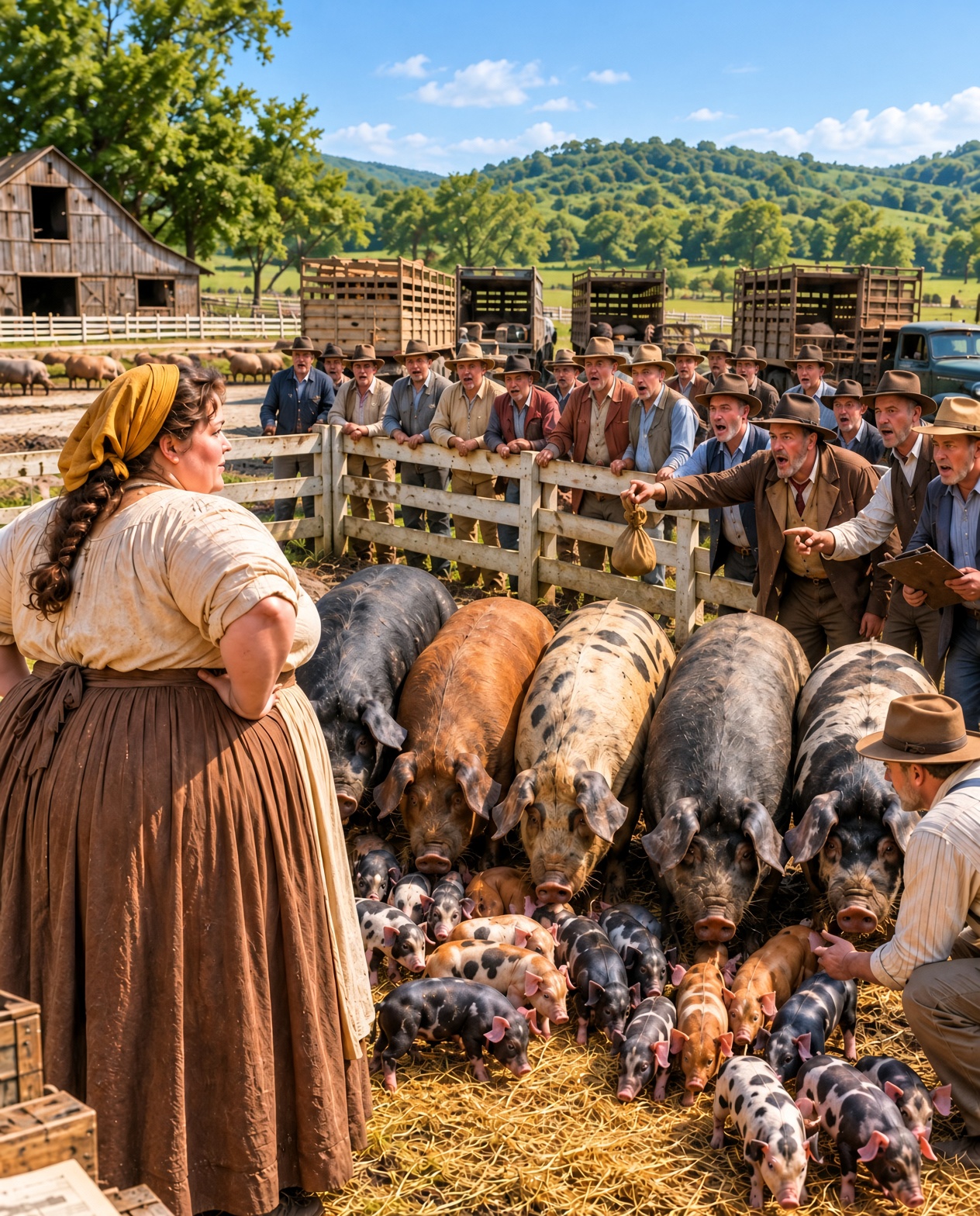
By noon, the courthouse square was crowded.
Farmers.
Merchants.
Feed sellers.
Children.
Even men who normally wouldn’t have crossed paths with Marin.
She stood beside the wagon.
Six Blackmir piglets rooted calmly through a patch of wet grᴀss.
People laughed.
Someone called them ugly.
Someone else called them swamp pigs.
Then Marin spoke.
She didn’t shout.
She didn’t need to.
She told them how little purchased feed the animals required.
She showed records.
Weight comparisons.
Growth charts.
Birth numbers.
She explained that forty-one piglets had survived on a farm everyone had called worthless.
The crowd grew quiet.
Then Tomas stepped forward.
He confirmed every figure.
A farmer asked what they would cost.
Marin gave a number.
Another farmer asked whether breeding stock was available.
Before she could answer—
Hollis Brackett appeared.
He walked through the crowd.
“You’re selling animals without proper certification.”
Marin looked at him.
“Then show me the law.”
Hollis stopped.
He hadn’t expected that.
A county clerk stepped forward.
“There is no such restriction.”
Hollis’s face hardened.
Then Elias spoke.
“Actually, Mr. Brackett, I believe the county should be more interested in another matter.”
He held up a copy of Peter’s records.
“The private Blackmir preservation herd.”
Hollis went completely still.
The crowd noticed.
Marin noticed.
And then an old farmer near the back spoke.
“I remember that herd.”
Everyone turned.
The old man removed his hat.
“Peter told me something twenty years ago.”
“What?”
“He said the Blackmirs weren’t meant to make him rich.”
He looked directly at Marin.
“He said they were meant to survive.”
A murmur moved through the crowd.
Hollis’s expression darkened.
Then a young boy pointed toward the road.
“Miss Voss!”
Everyone turned.
A second wagon was approaching.
Then a third.
Then a fourth.
Farmers.
Buyers.
Livestock men.
People who had heard about the Blackmirs.
Marin stared.
Elias smiled.
“You wanted an open day.”
He nodded toward the road.
“You just got one.”
But before Marin could respond, a rider came galloping from the opposite direction.
He nearly fell from his horse.
“Miss Voss!”
Marin ran toward him.
“What happened?”
The man struggled to breathe.
“Your barn.”
Her heart stopped.
“What about it?”
“Someone broke in last night.”
Marin looked toward Hollow Farm.
“Were the pigs hurt?”
“No.”
“Then what?”
The rider swallowed.
“They didn’t steal the pigs.”
Marin frowned.
“What did they steal?”
He handed her a small piece of paper.
Her uncle’s handwriting was on it.
But beneath it was another message.
Three words.
THE OTHER SIX.
Marin’s blood turned cold.
She looked at Elias.
He had gone pale.
“What does that mean?”
Elias stared toward the distant hills.
Then he whispered:
“Peter didn’t leave you six Blackmirs.”
Marin’s voice trembled.
“Then how many?”
Elias looked back at her.
“Twelve.”
And somewhere beyond Hollow Farm, hidden beneath forty years of mud and reeds—
six more Blackmirs were still alive.