PART 2: THE MOUNTAIN MAN WHO NEVER RAISED HIS HAND
PART 2: THE MOUNTAIN MAN WHO NEVER RAISED HIS HAND
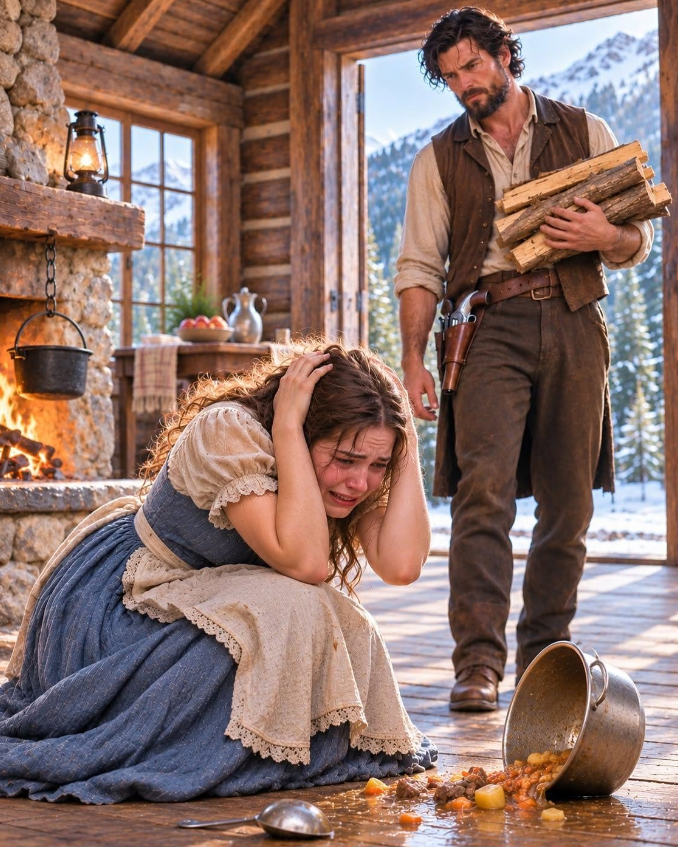
Cole stood motionless.
The firewood slipped from his arms and landed beside the hearth with a dull thud.
Abigail flinched.
“I’m sorry,” she whispered. “I’ll clean it up. Please don’t be angry.”
Cole looked at the broken bowl.
Then at the girl curled on the floor.
He had seen frightened animals before. Injured horses. Wolves caught in traps. Creatures so accustomed to pain that even an offered hand made them recoil.
But he had never seen a human being apologize for dropping a bowl.
“Abigail.”
She didn’t move.
“Look at me.”
Her shoulders тιԍнтened.
“I’m not going to hit you.”
She waited.
Cole crouched slowly, keeping a little distance between them.
“You hear me? Nobody in this cabin is going to hit you.”
Abigail cautiously lowered one arm.
Her eyes searched his face, looking for the anger that usually followed a promise like that.
Cole simply picked up the broken pieces.
“Accidents happen.”
“I can work harder,” she offered quickly.
“Didn’t ask you to.”
“I can cook. Wash clothes. Mend shirts. I can sleep outside if—”
“Enough.”
The word came out sharper than he intended.
Abigail immediately covered her head again.
Cole closed his eyes for a moment.
He had frightened her without even trying.
When he spoke again, his voice was quieter.
“Listen, girl. You’re not here to earn your supper. You’re not here to pay me back. You’re here because you needed somewhere safe to sleep.”
She stared at him.
“Why?”
Cole looked toward the window.
Outside, the mountains stood beneath a pale morning sky.
 “Because somebody should have helped you sooner.”
It was the only explanation he could give.
He fetched a broom and swept the broken bowl into the stove ash bucket. Then he placed a fresh one on the table.
“There’s oatmeal on the stove. Eat before it gets cold.”
Abigail remained on the floor until he stepped outside again.
Even then, she waited several minutes before moving.
She ate only half the bowl.
Not because she wasn’t hungry.
Because she had learned that finishing food sometimes meant there would be less for someone else, and being hungry was safer than being accused of taking too much.
Cole noticed.
He said nothing.
Instead, he placed another piece of bread beside her plate.
That afternoon, he showed her the cabin.
There was a small bedroom with a narrow bed, a chest of drawers, and a window overlooking the pine-covered ridge.
“You can use this room.”
Abigail looked inside.
“For how long?”
“As long as you need.”
“What if I make a mistake?”
Cole frowned.
“Then we’ll fix it.”
“What if I break something?”
“Then we’ll replace it.”
“What if you decide you don’t want me here?”
He was silent for a moment.
Then he answered honestly.
“I’ll tell you. I won’t surprise you with it.”
Abigail nodded as if she understood.
But she didn’t.
She had never lived in a place where tomorrow wasn’t something she had to fear.
Over the next few days, Cole discovered how little Abigail knew about ordinary kindness.
She asked permission before opening the pantry.
She folded her blanket every morning so тιԍнтly that the corners looked as if they had been measured with a ruler.
She stood whenever Cole entered a room.
And whenever he raised his voice to call across the cabin, she startled so badly that he began speaking more softly.
One evening, he found her sitting beside the hearth, sewing a tear in his old shirt.
“You don’t have to do that.”
“I wanted to.”
Cole studied the neat sтιтches.
“Where’d you learn?”
“My father.”
“Was he a tailor?”
“No. He was a carpenter. But he used to repair everything. He said a thing didn’t stop being useful just because it broke.”
Cole looked at the shirt.
“Sounds like a sensible man.”
Abigail’s fingers paused.
“He died when I was little.”
Cole nodded.
He knew better than to ask more.
But that night, after Abigail had gone to bed, he sat for a long time beside the fire.
He had spent years avoiding people.
His cabin was far from town, his neighbors few, and his conversations usually limited to traders who wanted furs or supplies.
He liked it that way.
People carried too many complications.
Yet the girl sleeping in the small bedroom had brought more silence into his cabin than he had ever known.
Not peaceful silence.
The kind that came from someone afraid to make a sound.
The following morning, Cole rode down to town for flour, coffee, and medicine.
At the general store, the shopkeeper looked up.
“Where’s your usual list?”
“Got it.”
The man leaned closer.
“Heard you’ve taken in Martha Bell’s daughter.”
Cole placed his coins on the counter.
“She’s staying with me.”
The shopkeeper lowered his voice.
“Careful with that woman. Martha’s got a nasty tongue. Says you paid her three gold coins for the girl.”
Cole’s expression hardened.
“That’s what happened.”
“People are talking.”
“People talk when they don’t have anything useful to do.”
The shopkeeper hesitated.
“She also says Abigail stole money from her before running away.”
Cole stopped.
“Did she?”
“I don’t know. That’s what Martha claims.”
“Then perhaps you should ask Martha where the money went.”
He collected his supplies and left.
But before he reached his horse, a woman hurried across the street.
It was Mrs. Harper, who ran the boarding house where Abigail had worked.
“Mr. Cole!”
He turned.
“Something wrong?”
Mrs. Harper glanced toward the store.
“I thought you ought to know. Martha has been telling everyone Abigail is a liar. She says the girl has a habit of making up stories.”
Cole said nothing.
Mrs. Harper lowered her voice.
“I employed Abigail for two years. That child worked harder than anyone in my kitchen. Never once did she complain. But she was always frightened when Martha came looking for her.”
“Why didn’t you help her?”
The older woman looked down.
“Because I thought it wasn’t my place.”
Cole studied her.
“That’s what everyone thought.”
He mounted his horse.
When he returned to the cabin, Abigail was outside gathering kindling.
She looked up as he approached.
“Did you find everything?”
“Most of it.”
He handed her a small paper parcel.
“Something for you.”
Abigail opened it carefully.
Inside was a pair of leather gloves.
She stared at them.
“They’re new.”
“Your hands are cracked.”
“I don’t need them.”
“Didn’t ask if you needed them.”
She looked at him, uncertain whether that was an order.
Then she slipped them on.
They were slightly too large.
But they were warm.
For the first time since arriving, a faint smile appeared on her face.
Cole pretended not to notice.
That evening, a storm began rolling over the ridge.
The wind rattled the shutters, and rain struck the roof in heavy bursts.
Cole was checking the back door when Abigail suddenly stopped moving.
A horse was approaching.
She recognized the sound before Cole did.
Her face went pale.
“It’s her.”
Cole turned.
“Who?”
“My mother.”
The horse stopped outside.
A fist struck the cabin door.
“Abigail Bell! Open this door!”
Abigail backed away.
Cole stepped between her and the entrance.
“Stay here.”
The door shook beneath another blow.
“Cole! I know she’s in there!”
He opened it just enough to see Martha standing on the porch, rain dripping from the brim of her bonnet.
Behind her stood a thin man holding a folded paper.
Martha’s eyes immediately moved past Cole.
“Get my daughter.”
“No.”
“She’s my responsibility.”
“Not anymore.”
Martha laughed bitterly.
“You paid me for her. Don’t pretend this is charity.”
Cole’s jaw тιԍнтened.
“I paid you because you wouldn’t let her leave without money changing hands.”
“You don’t know what that girl is like.”
“Maybe not. But I’m learning.”
Martha thrust the paper forward.
“I have legal authority. Abigail belongs with her family.”
Cole glanced at the document.
It was a county notice, but the seal looked unfamiliar.
“Who signed this?”
Martha hesitated.
“That’s none of your concern.”
“Then it doesn’t concern me.”
He began closing the door.
Martha’s voice suddenly changed.
“Ask her what happened to the silver watch!”
Cole stopped.
Behind him, Abigail had gone completely still.
Martha smiled when she saw his reaction.
“Ask your precious little guest what she stole from her own father.”
Cole looked back at Abigail.
The girl was trembling.
“It’s not what she says,” Abigail whispered.
Cole turned toward Martha.
“Leave.”
“You’ll regret this.”
“That’s my business.”
Martha stepped backward into the rain.
But before mounting her horse, she leaned close enough for Cole to hear.
“There’s a reason I kept that girl under my roof. Her father left something behind, and she knows where it is.”
Then she rode away.
Cole shut the door.
For a long moment, neither of them spoke.
Finally, he turned toward Abigail.
“What silver watch?”
She looked down at her hands.
“My father had one. He kept it in a little wooden box.”
“Did you take it?”
“No.”
Her voice was barely audible.
“Mother said I stole it. But I never touched it.”
Cole pulled a chair closer to the fire.
“Then tell me what happened.”
Abigail swallowed.
“My father gave me something before he died. He told me to keep it safe and not show anyone until I was old enough.”
“What was it?”
“A key.”
Cole looked up.
“What does it open?”
Abigail shook her head.
“I don’t know.”
She reached beneath the collar of her dress and pulled out a thin cord.
A small brᴀss key hung from it.
Cole recognized the workmanship immediately.
It was old, unusually shaped, and engraved with a symbol he had seen only once before.
On a locked iron chest in the abandoned mining office above town.
And suddenly Cole understood why Martha had been so determined to keep Abigail close.
The girl hadn’t simply been an unwanted daughter.
She was carrying something someone had spent years trying to find.