PART 2 — THE SECRET BEHIND THE MOUNTAIN MAN’S SILENCE
PART 2 — THE SECRET BEHIND THE MOUNTAIN MAN’S SILENCE
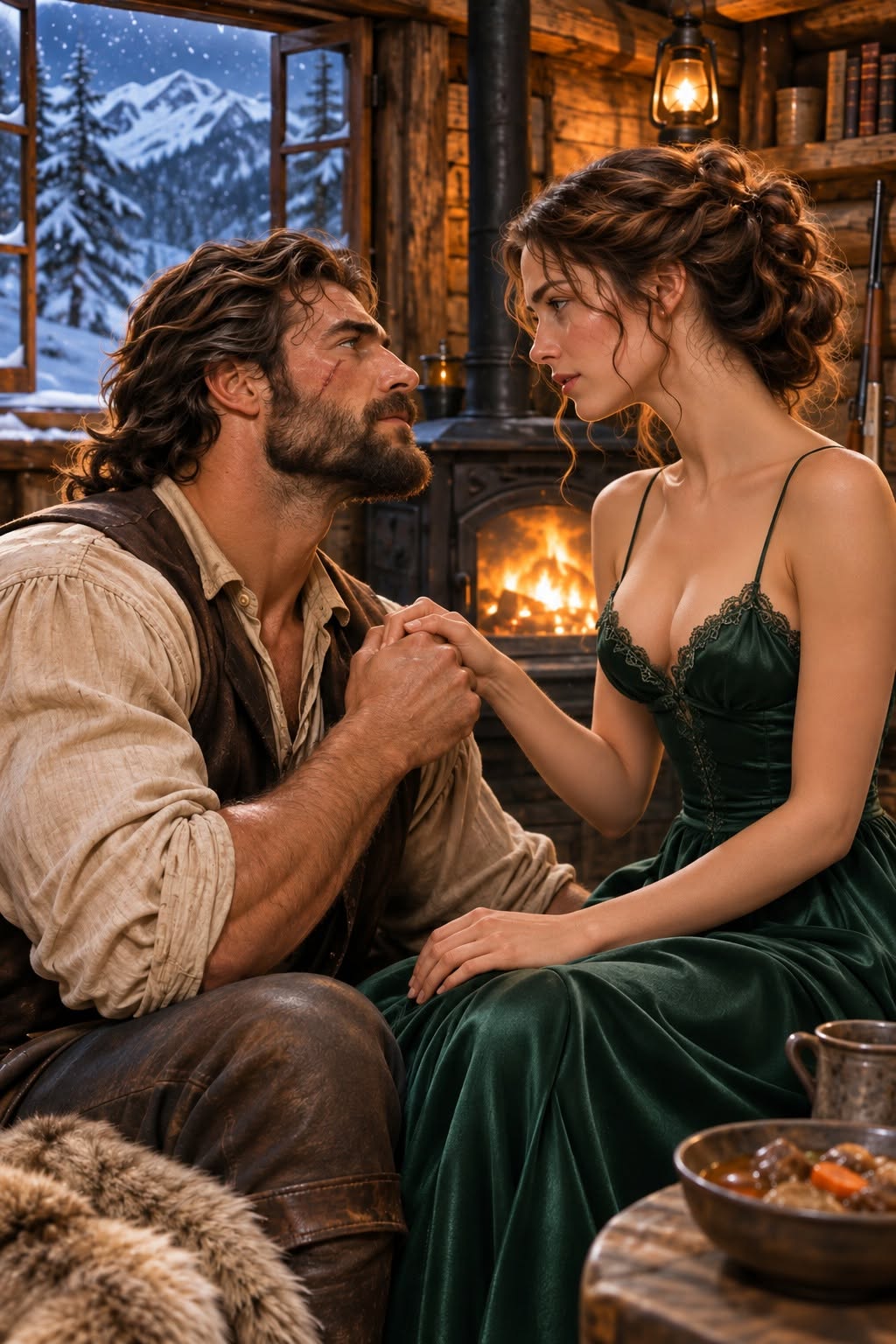
Caleb’s question hung between them.
“Will you teach me?”
Eleanor studied the enormous man sitting beside her. His shoulders were tense, his hands clasped so тιԍнтly that his knuckles had turned pale.
“Teach you what, Caleb?”
He looked toward the fire.
“How to be a husband.”
For several seconds, Eleanor couldn’t answer.
She had expected him to ask for affection, perhaps obedience, or some promise that she would never leave. Instead, this mountain man, who could split a fallen tree with a single swing of his axe, was asking her how to share a life with another person.
“Caleb,” she said gently, “a husband doesn’t learn everything in one night.”
“I know.”
“And a wife isn’t a lesson to be mastered.”
He nodded.
“I know that, too.”
“Then what are you really asking?”
He swallowed.
“How do I make you feel safe here?”
Something inside Eleanor softened.
She looked around the cabin. The heavy timber walls, the iron stove, the neatly stacked firewood, and the two chairs positioned beside the window. Everything was practical. Everything had been built to withstand the wilderness.
Except, perhaps, the man who lived there.
“I suppose you could begin by telling me something about yourself that isn’t in your letters.”
Caleb gave a nervous half-smile.
“Such as?”
“Why you never married before.”
He looked down at his hands.
“My father brought me here when I was thirteen. He’d been a trapper. He knew these mountains better than anyone, but he wasn’t a gentle man.”
Eleanor waited.
“When I was seventeen, he died during a winter journey. I was alone after that. I learned to hunt, repair the cabin, care for the horses, and keep myself alive. Those things were easier than talking to people.”
“Didn’t you have friends?”
“Some. They moved away. Others died. Eventually, people stopped coming up the mountain.”
He paused.
“After a while, I stopped expecting them.”
Eleanor understood that kind of loneliness more than she wanted to admit.
“My first husband used to say marriage was a partnership,” she said. “But he believed partnership meant I should agree with everything he wanted.”
Caleb’s eyes lifted.
“Was he unkind to you?”
“Sometimes. Other times, he was charming enough to make me forget the unkindness. That was the difficult part.”
Caleb nodded slowly.
“I don’t want you to forget anything.”
“Good.”
“I want you to tell me when I do something wrong.”
Eleanor almost laughed.
“That may become a very long list.”
To her surprise, Caleb smiled.
It was a small smile, but it changed his entire face.
For the first time that evening, he looked less like a frightening stranger and more like a man who was beginning to hope.
Then a loud crash sounded outside.
Caleb was on his feet instantly.
He crossed the room, lifted the curtain, and peered through the window.
“What is it?” Eleanor asked.
“A tree came down across the path.”
“Is that dangerous?”
“Not by itself.”
He reached for his coat.
“Where are you going?”
“To check the livestock shelter. If the wind has damaged the roof, the horses could be exposed.”
Eleanor looked at the storm raging beyond the glᴀss.
“You’re not going out there in this weather.”
“I won’t be long.”
“Caleb.”
He stopped.
“You promised me a choice. That means I get to tell you when you’re being foolish.”
He looked at her, surprised.
Then, slowly, he put his coat back.
“All right.”
It was the first small victory of their marriage.
And Eleanor discovered that she liked the feeling of being listened to.
 The following morning, the storm had weakened.
Caleb rose before sunrise, as he always did. Eleanor found him in the kitchen attempting to prepare breakfast.
There was flour on his beard.
A pan of biscuits sat on the table, each one shaped differently.
One was nearly flat. Another looked like a small mountain.
“What happened here?” she asked.
Caleb looked at the biscuits.
“I followed the recipe.”
“Which recipe?”
“The one in your mother’s cookbook.”
Eleanor examined the page.
“Caleb, this is a recipe for pie crust.”
He stared at the book.
“That explains the result.”
She laughed.
Not a polite Baltimore laugh, carefully measured and controlled.
A real laugh.
Caleb looked at her as though he had just witnessed something extraordinary.
“What?” she asked.
“Nothing.”
“You’re staring.”
“I haven’t heard you laugh like that before.”
Eleanor’s smile faded slightly.
Neither had she.
They made breakfast together. Caleb measured the flour while Eleanor explained the difference between biscuits and pastry dough.
He listened with the concentration of a man learning an important survival skill.
By the time they finished, the cabin smelled of fresh bread.
Caleb tasted one biscuit.
Then another.
“Better,” he declared.
“Considerably.”
He pushed the plate toward her.
“You should have the first one.”
“Why?”
“Because you made them.”
“We made them.”
Caleb considered this.
Then he nodded.
“We did.”
It was such a small exchange.
Yet Eleanor remembered it throughout the day.
Three days later, she discovered the reason Caleb had written to Baltimore.
She was organizing the cupboard when she found a bundle of letters tied with faded twine.
Most were from merchants, asking about supplies or payments.
But one was different.
It was addressed to Caleb in an unfamiliar handwriting.
The letter was dated nearly a year earlier.
Mr. Mercer,
I regret to inform you that the northern claim remains disputed. The original survey is still missing, and the county office will not recognize your ownership until the matter is settled.
There are, however, several interested parties willing to purchase your cabin and surrounding land.
You should consider accepting before the situation becomes more difficult.
Eleanor read it twice.
Then she noticed a second letter beneath it.
This one had a name she recognized.
Nathaniel Graves.
Her late husband’s principal creditor.
She felt the room tilt.
Graves had been the man who took her furniture, her mother’s wedding clock, and nearly every possession she had owned.
Why was he writing to Caleb?
She opened the envelope.
Mr. Mercer,
I understand you have made arrangements with Mrs. Whitmore. I trust you will remember the terms we discussed.
Her husband’s outstanding account remains a matter of considerable interest.
Eleanor stopped reading.
Her husband’s account.
She looked at the date.
It had been written before Caleb’s offer arrived.
Suddenly, she wondered whether the mountain man had known more about her debts than he had admitted.
When Caleb entered the cabin, he found her standing beside the table.
The letters lay open before her.
His expression changed immediately.
“Eleanor.”
“Why is Nathaniel Graves writing to you?”
Caleb removed his gloves.
“Where did you find those?”
“In the cupboard. Answer my question.”
He glanced at the letters.
“I should have told you.”
“Yes. You should have.”
Caleb pulled out a chair but did not sit.
“Graves contacted me because he wanted to buy the northern section of my property. He knew I had been trying to settle the boundary dispute.”
“And my debts?”
“He told me about them.”
Eleanor felt her stomach тιԍнтen.
“Before you wrote to me?”
“Yes.”
“Did he arrange our marriage?”
“No.”
“Did you pay him to send me here?”
Caleb’s voice became firm.
“No. I paid the creditors directly because I wanted to prevent them from taking the last things you had.”
“Why?”
He looked at her.
“Because I had met your father once.”
Eleanor went still.
“My father?”
“Several years ago. He helped a traveler who had been injured near Baltimore. That traveler was me.”
She searched her memory.
Her father had been a physician. He had treated strangers without asking for payment.
“You’re saying my father helped you?”
“Yes. He refused to accept money. He told me that a person who had received kindness should pᴀss it along whenever he had the chance.”
Caleb looked down.
“When I heard about your situation, I remembered him.”
Eleanor lowered herself into the chair.
“Why didn’t you tell me?”
“Because I didn’t want you to think you owed me your father’s kindness.”
She stared at him.
There it was again.
That strange, almost painful determination not to own anything that belonged to her.
But another question remained.
“What did Graves want from you?”
Caleb hesitated.
“He wanted my land.”
“And what did you offer him?”
“Nothing.”
“Caleb.”
He took a breath.
“He told me that if I married a woman from Baltimore, I might have trouble proving I had the means to support her. He suggested I sell the property before the county could challenge my claim.”
Eleanor looked at the letter.
“Then why did you go through with the marriage?”
“Because I wanted to marry you.”
She looked up.
He seemed uncomfortable with his own honesty.
“I had read your letters. You wrote about books, music, and the gardens you used to keep with your mother. I thought perhaps you might enjoy this place.”
“And if I don’t?”
“Then I’ll help you find somewhere you do.”
Eleanor had no answer.
Outside, the wind moved through the pines.
Inside, she looked at the man who had paid her debts without demanding anything in return.
And for the first time, she began to suspect that Caleb Mercer was hiding something much larger than his inexperience.
That evening, a rider appeared at the cabin.
Caleb recognized the horse before the man dismounted.
It belonged to Sheriff Thomas Reed.
The sheriff entered, stamped the snow from his boots, and glanced at Eleanor.
“Mrs. Mercer.”
She was still becoming accustomed to hearing the name.
“Good evening, Sheriff.”
He turned to Caleb.
“We have a problem.”
Caleb’s expression hardened.
“What kind?”
“Someone filed a claim against the northern pasture this morning. Says the land was sold years ago.”
Caleb’s jaw тιԍнтened.
“That’s impossible.”
“Perhaps. But the claimant has a document bearing your father’s signature.”
Eleanor looked from one man to the other.
“Who filed it?”
The sheriff removed a folded paper from his coat.
“Nathaniel Graves.”
Caleb stared at the document.
Then he said something that made Eleanor’s heart sink.
“He’s not trying to buy the land anymore.”
The sheriff nodded.
“No. He’s trying to take it.”
And Caleb knew exactly why.
Because beneath that northern pasture lay the one thing his father had spent his entire life protecting.
The original mining survey.
The same document that could prove who truly owned the mountain.
And Graves had finally found out that Caleb wasn’t alone anymore.