PART 3 — WHEN THE TOWN CAME BEGGING, THE GIRL MADE ONE DEMAND
PART 3 — WHEN THE TOWN CAME BEGGING, THE GIRL MADE ONE DEMAND
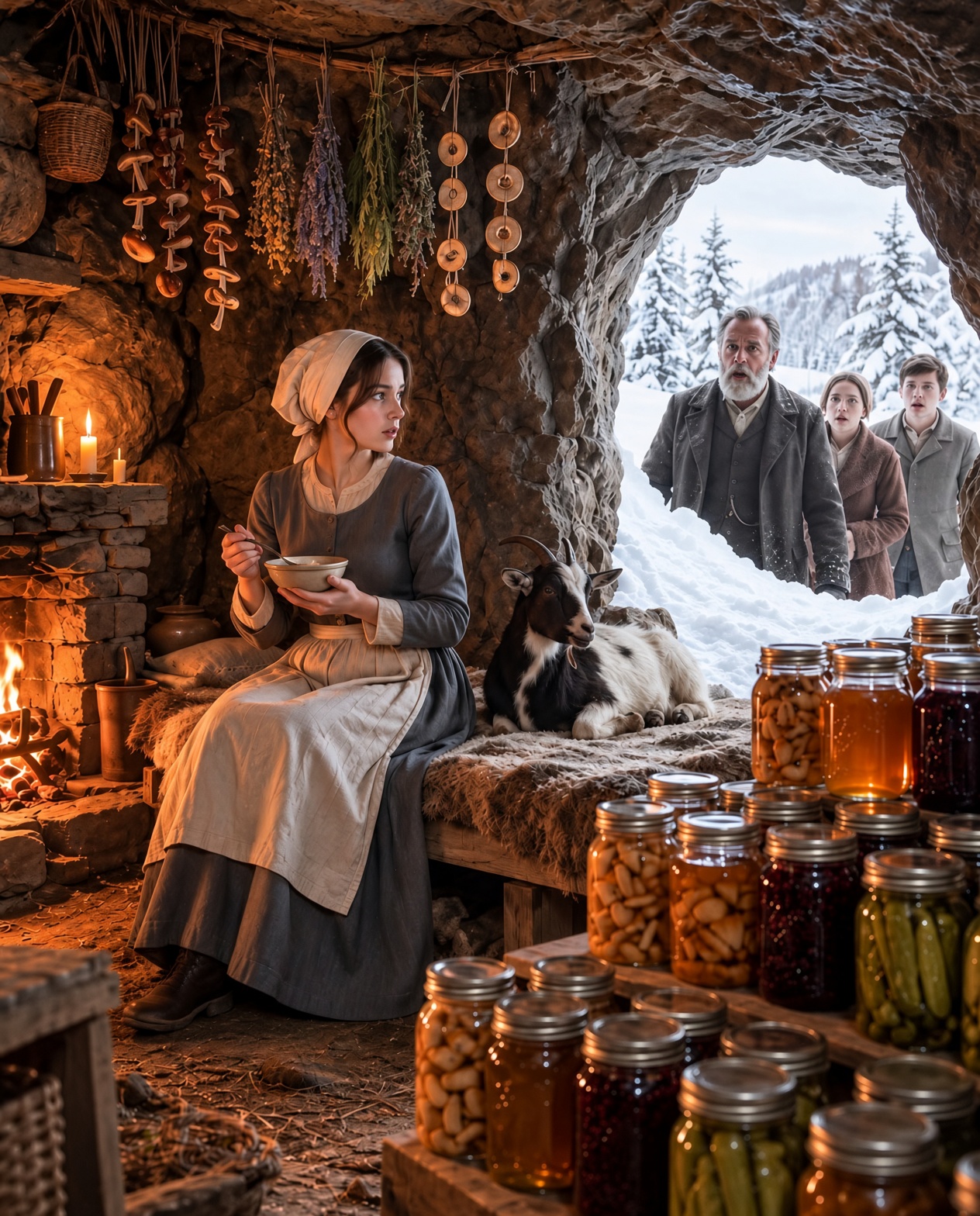
By the sixth day, the cave had become the only warm place many people in the valley could reach.
There were twenty-three people inside.
Marin knew every name.
She knew which children preferred their bread toasted, which elderly neighbors needed extra blankets, and which families had arrived without enough warm clothing.
She also knew the food would not last indefinitely.
That morning, she stood beside the storage shelves and counted the remaining supplies.
Two sacks of flour.
One small barrel of potatoes.
A basket of dried beans.
Several jars of preserves.
A little salt.
Not enough for twenty-three people through another week.
Thomas noticed her expression.
“How bad?”
“Bad enough that we need more food.”
“Where can we get it?”
Marin looked at Clara.
“The store.”
Clara shook her head.
“My father will never open the cellar.”
“Then we’ll ask the sheriff to come with us.”
“He’ll tell him the cellar is empty.”
“Not if we have the inventory.”
Clara held up the folded paper.
“My father keeps the cellar key in his desk.”
Thomas frowned.
“We shouldn’t send you back alone.”
“I won’t be alone,” Clara replied. “I’ll go with the sheriff.”
Marin nodded.
“Good. And don’t argue with your father. Let the sheriff handle it.”
By midday, Clara and Sheriff Dawson had left the cave.
The others waited anxiously.
The wind howled against the mountain, and snow continued to fall.
Marin tried to keep the children occupied by teaching them to knead bread.
Elsie pressed her small hands into the dough.
“Miss Marin, when the storm ends, will you come back to town?”
Marin smiled.
“I haven’t decided.”
“Why not?”
She looked at the little girl.
“Because sometimes a person has to decide where she belongs.”
Elsie considered that.
“You belong here.”
Marin glanced around the cave.
The words touched something deep inside her.
For months, she had believed she had been thrown away.
But here, among people who needed her and whom she had learned to trust, she was beginning to understand that being abandoned by one person did not mean she had no place in the world.
Two hours later, the sheriff returned.
He came through the entrance with Clara, carrying a notebook and a key.
“The cellar wasn’t empty,” he announced.
Thomas gave a short laugh.
“How much?”
“Enough to feed several families for weeks.”
Clara’s face was pale.
“My father said he was saving it for a better price.”
Sheriff Dawson removed his gloves.
“I’ve ordered the supplies released for emergency distribution. The county will investigate the false inventory and the price increases.”
Marin nodded.
“Will the families get their food?”
“They will.”
Clara looked toward the floor.
“My father is furious.”
Marin placed a hand on her shoulder.
“You did the right thing.”
But the sheriff was not finished.
“There is something else. The road into town is completely blocked. A group of families are trapped near the church, and one of the roofs has partially collapsed.”
Marin looked toward the entrance.
“How many?”
“Eleven, possibly more.”
Thomas immediately stood.
“We need to get them here.”
Sheriff Dawson shook his head.
“The trail is dangerous. We can’t take everyone up the mountain in this weather.”
Marin looked at the cave.
Then at the food.
Then at the children.
“We don’t need to bring everyone here.”
The sheriff frowned.
“What do you mean?”
“We have supplies. The town has supplies hidden in the store. And there are people here who know how to organize food distribution.”
She turned toward Thomas.
“Can you help establish a second shelter once the weather allows it?”
“Absolutely.”
“Abigail, can you organize meals?”
The old woman nodded.
“Give me a pot and I’ll feed an army.”
Marin looked at the sheriff.
“Then we make a plan. Nobody gets left behind.”
For the next several hours, the cave became a center of activity.
They divided food into family portions, prepared supplies for the moment travel became possible, and listed the names of people still missing.
Nobody asked whether Marin was too young to lead.
Nobody laughed at her mountain shelter.
They simply listened.
On the seventh day, a strange silence settled over the mountain.
The wind had weakened.
Snow still covered everything, but the sky had begun to brighten.
Thomas stepped outside and returned a few minutes later.
“The worst may be over.”
A cheer rose from the children.
But Marin was looking toward the valley.
A column of smoke was rising from the direction of town.
“Is that the church?” she asked.
Thomas narrowed his eyes.
“I think so.”
Sheriff Dawson reached for his coat.
“We need to check.”
Before he could leave, someone shouted from outside.
“Help! Please!”
A young boy appeared at the entrance.
His face was red from the cold, and he was carrying a small bundle.
“It’s my grandmother,” he gasped. “She can’t walk. She’s at the schoolhouse.”
Marin grabbed her father’s shawl.
“How far?”
“Not far. But the road is covered.”
Thomas looked at the sheriff.
“We’ll go together.”
Marin stepped forward.
“I’m coming.”
“No,” Thomas said. “You need to stay with the others.”
“I know the mountain trails better than anyone here.”
He looked at her.
She was right.
The sheriff finally nodded.
“Stay behind us. We move carefully and we turn back if the conditions worsen.”
They set out with blankets, food, and lanterns.
The journey was slow.
Snow had buried the fences, and several familiar paths had disappeared. But Marin remembered the shape of the land and guided them around the steepest slopes.
When they reached the schoolhouse, they found six people waiting inside.
An elderly woman sat beside the stove, wrapped in two coats.
Her grandson rushed to her.
“Grandma!”
Marin handed the sheriff a bundle of food.
“We need to get them somewhere warm.”
The woman looked at Marin.
“Are you the girl with the cave?”
Marin nodded.
“I am.”
The old woman took her hand.
“I heard you were helping people.”
Marin smiled.
“Come on. We have bread waiting.”
As they prepared to leave, the schoolmaster approached her.
“Miss Pasco, there’s something you should know.”
“What is it?”
He pointed toward the valley.
“Silas Rener has been telling people you stole supplies from his property.”
Marin went still.
“What?”
“He claims the food in your cave belongs to him.”
The sheriff frowned.
“Does he have proof?”
“No,” the schoolmaster replied. “But he’s gathered several men and plans to come up the mountain.”
Marin looked at the people waiting behind her.
Her mother.
The children.
The families who had trusted her.
She had spent months building a shelter, and now Silas wanted to take it away.
“Let him come,” she said.
The sheriff studied her.
“Are you sure?”
Marin looked toward the mountain.
“I’ve spent long enough running from that man.”
On the eighth morning, the storm finally stopped.
The valley was buried beneath enormous drifts, but sunlight broke through the clouds.
Marin stood at the cave entrance, watching the snow sparkle.
Then she heard footsteps.
Not one person.
Many.
A long line of townspeople was making its way up the mountain.
Some carried empty baskets. Others carried children. A few were supported by neighbors as they struggled through the snow.
At the front walked Silas Rener.
Behind him were the storekeeper, several farmers, and a group of men from town.
Silas stopped when he saw Marin.
“There you are.”
Marin did not move.
“What do you want?”
He pointed toward the cave.
“You’ve been taking food from people who need it.”
The crowd murmured.
Marin looked at the people behind him.
She recognized several families who had been turned away from the store. She saw children who had once laughed when Silas called her useless.
Now they were carrying empty baskets.
“Is that what you told them?” she asked.
Silas ignored her.
“Open the cave. We need your supplies.”
Marin folded her arms.
“You said I wasn’t worth feeding.”
A few people lowered their eyes.
“You’re making this personal,” Silas snapped.
“You made it personal when you crossed my name off that list.”
Ruth stepped forward.
“Silas, please.”
He turned toward her.
“Stay out of this.”
Marin looked at her mother.
Then she looked at the crowd.
“I will share what I have,” she said. “But not because Silas ordered me to.”
The townspeople fell silent.
“I’ll share because nobody should have to watch their children go hungry while someone else hides food behind a wall.”
The storekeeper shifted uneasily.
The sheriff stepped forward.
“We have already recovered the supplies from your cellar. They’ll be distributed according to need.”
Silas looked furious.
“This girl has no authority!”
Sheriff Dawson opened his notebook.
“Neither do you, Mr. Rener.”
A murmur pᴀssed through the crowd.
Then Thomas Bell stepped forward.
“Marin saved my daughter.”
Abigail Moore raised her voice.
“She fed my grandchildren.”
The schoolmaster added, “She warned this town about the storm when nobody else would listen.”
One by one, people began speaking.
And for the first time, Silas found himself standing before a crowd he could no longer control.
But Marin wasn’t finished.
She walked to the storage shelves and brought out a small wooden box.
Inside were several folded papers.
Her father’s old notebook.
A map of the mountain.
And a letter addressed to her.
She had found it beneath the false bottom of the miner’s candleholder the night before.
She had not yet opened it.
Now, with the entire town watching, she unfolded the paper.
The handwriting was unmistakable.
Her father’s.
My dear Marin,
If you have reached the cave, then you have discovered the place I wanted you to find.
There is something I never told you about the winter I worked in the mountains.
The cave belongs to an old mining claim, and the records were never transferred when the mine closed.
The claim includes the spring, the surrounding woodland, and the stone shelter.
I left the original papers with someone I trusted.
His name is written beneath this letter.
Marin turned the page.
There was a name.
Silas Rener.
The crowd went completely silent.
Marin looked up at her stepfather.
“You knew about this place.”
Silas’s face had lost its color.
He took one step forward.
“Give me that letter.”
Marin held it тιԍнтly.
“You didn’t throw me out because there wasn’t enough food, did you?”
Silas said nothing.
“You threw me out because you knew my father had left me something.”
The sheriff moved between them.
“Mr. Rener, I think we’d better have a conversation.”
But Silas was staring at the letter.
And then, from the back of the crowd, Ruth spoke.
“There’s something else you need to know, Marin.”
Everyone turned.
Her mother was crying.
“Your father didn’t die believing you would be alone. He told me about the cave before he pᴀssed away. He told me to protect you and the children.”
Marin felt her throat тιԍнтen.
“Then why didn’t you tell me?”
Ruth lowered her head.
“Because Silas threatened to take everything away from us. I was afraid.”
Marin looked at her mother for a long moment.
She wanted to be angry.
She was angry.
But she also saw the fear in Ruth’s face and understood that the truth was more complicated than she had imagined.
Then Ruth reached into her coat and removed a second envelope.
“I kept this hidden,” she whispered. “Your father said you should only read it when the whole town knew about the cave.”
Marin took it.
On the front were six words:
THE CAVE WAS NEVER THE TREASURE.
She opened the envelope.
And what she read made her look back toward the mountain.
Because her father’s final message revealed that the cave had once been used as a refuge for an entire mining community—and somewhere beyond its hidden chamber was something he had spent years trying to protect.
Something that could change the future of every family in the valley.
TO BE CONTINUED…