PART 2 — EIGHT DAYS OF SNOW, AND THE GIRL THEY HAD ABANDONED
PART 2 — EIGHT DAYS OF SNOW, AND THE GIRL THEY HAD ABANDONED
Marin grabbed her father’s old miner’s candleholder and moved toward the entrance.
The scraping came again.
Then a voice called through the snow.
“Please! Is anybody in there?”
Marin froze.
She pushed aside the blankets covering the narrow opening and peered through the gap.
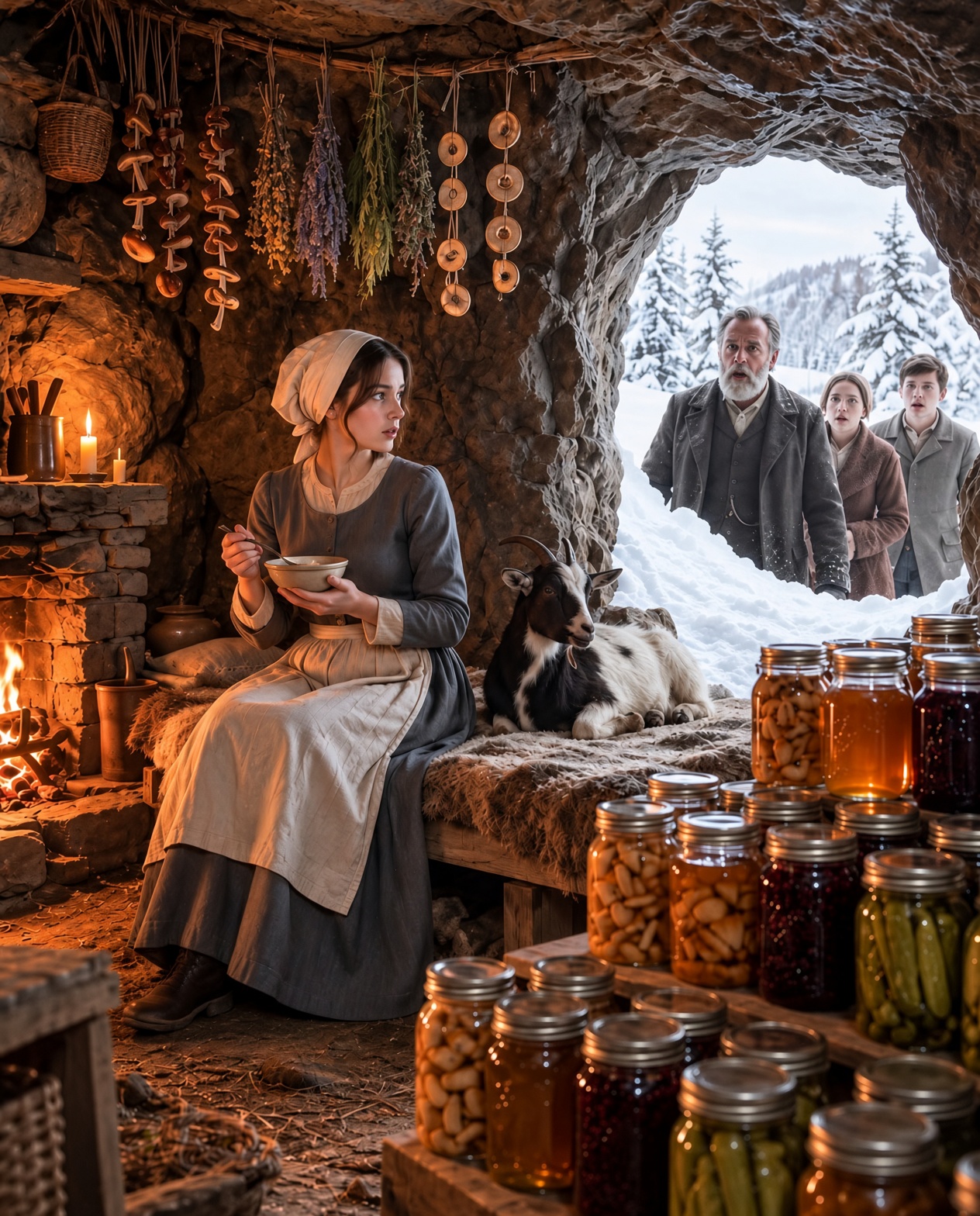
A man stood outside, nearly buried beneath the drifting snow. His coat was torn, his beard covered in ice, and one arm was wrapped around a little girl.
Marin recognized him immediately.
It was Thomas Bell, the blacksmith who had laughed at her in the town square.
“Marin?” he called. “Thank heaven!”
The little girl was his eight-year-old daughter, Elsie. Her face was pale, and she was too exhausted to speak.
Marin opened the entrance enough for them to crawl inside.
“Bring her closer to the fire,” she said.
Thomas lowered his daughter onto a blanket.
“She hasn’t eaten since yesterday morning. Our cabin roof is buried, and the chimney won’t draw.”
Marin hurried to the storage shelves.
She brought warm broth, dried apples, and a small loaf of bread.
Thomas stared at the food.
“You have all this?”
“I’ve been preparing for winter.”
“But how?”
“By listening when the mountains warned me.”
He lowered his eyes.
“I shouldn’t have laughed.”
“No,” Marin replied. “You shouldn’t have.”
She did not say it to punish him. She simply refused to pretend his words had never hurt.
Elsie slowly drank the broth.
After a while, the little girl looked around the cave.
“Is this your house?”
Marin glanced at the stone walls.
“It is now.”
Elsie smiled faintly.
“It’s prettier than ours.”
For the first time that morning, Marin smiled, too.
But the mountain was far from finished with them.
By the second day, the storm had become a wall of white.
Snow covered the trails, the fences, and the roofs of houses throughout the valley. The creek disappeared beneath thick ice. Nobody could reach the main road.
Marin had prepared for a long winter, but she had never expected to shelter an entire family.
Thomas insisted on helping.
He cleared the entrance when the wind allowed it, repaired a loose section of the storage shelf, and helped Marin keep track of the food.
By afternoon, another visitor arrived.
It was Mrs. Abigail Moore, the widow who ran the town’s laundry.
She had two grandchildren with her.
“Silas said you were living like a wild animal,” she explained, removing her wet scarf. “But I heard Thomas found you here.”
Marin handed her a blanket.
“There’s room near the back wall.”
Abigail looked at the shelves.
“Child, you’ve got enough food here to feed a village.”
“Not forever.”
“Perhaps not. But it’s more than most of us have.”
Marin served everyone a bowl of vegetable stew.
The old woman tasted it and closed her eyes.
“My husband used to make soup like this.”
“Did he teach you?”
“No. He taught me how to complain about his cooking.”
Everyone laughed.
For a brief moment, the cave felt less like a shelter and more like a home.
Then a distant rumble shook dust from the ceiling.
Thomas looked upward.
“Was that thunder?”
Marin shook her head.
“Snow shifting.”
She remembered the marks on the cave wall. Hundreds of small scratches, some grouped in rows. The previous inhabitants had apparently recorded something about the mountain.
She took her father’s candleholder and examined the markings again.
Beside the date 1853, someone had carved a crude drawing of the cave entrance.
Below it were three words:
NEVER BLOCK THE VENT.
Marin looked toward the narrow crack in the ceiling.
Her father had taught her that a fire needed fresh air. She had noticed the natural opening when she first entered the cave and had kept it clear.
Now she understood why the warning had been carved into the wall.
This shelter had saved people before.
And it had nearly failed them once.
She checked the ventilation opening, making sure it remained unobstructed.
“What’s wrong?” Abigail asked.
“Nothing,” Marin answered. “I just want to make certain this place can keep everyone safe.”
On the third day, the cave entrance became difficult to reach.
Thomas and Marin worked together to clear the drift, but the wind kept pushing fresh snow into the opening.
Inside, the children began to grow restless.
Elsie sat beside Marin, watching her mend a torn blanket.
“Were you always alone?” she asked.
Marin’s needle stopped.
“No.”
“Where’s your family?”
Marin looked toward the fire.
“My father died when I was younger. My mother is still in town.”
“Why doesn’t she come here?”
Marin took a breath.
“Sometimes grown-ups make choices that hurt people.”
Elsie considered this.
“My father says people can make mistakes and still be good.”
Marin looked at Thomas.
He was pretending not to listen.
“Your father sounds wise,” she said.
“He isn’t,” Elsie replied. “He burns breakfast.”
Thomas laughed.
And for a little while, the cave was filled with the sound of children laughing instead of wind.
By the fourth day, the food situation had become serious.
Marin counted the remaining supplies twice.
There was enough flour for several more loaves, but fewer potatoes than she had planned. The dried beans would last longer if she served smaller portions.
She gathered the adults around the worktable.
“We need to ration carefully.”
Thomas nodded.
“I can help with that.”
Abigail raised a hand.
“I know how to make soup stretch. My grandmother taught me.”
An older farmer named Mr. Harlan offered to repair the broken storage crate.
Nobody argued.
For the first time, Marin was not the only person carrying the responsibility.
They divided the work. Thomas maintained the entrance. Abigail helped prepare meals. The older children organized the supplies, while the younger ones gathered blankets and kept the sleeping area tidy.
Marin made a list on a piece of scrap paper.
At the top she wrote:
EVERYONE EATS. EVERYONE HELPS.
She pinned it to the wall.
That evening, a new sound came from outside.
Three sharp knocks.
Then a familiar voice.
“Marin! Open this door!”
Her stomach тιԍнтened.
Silas Rener.
Thomas stood.
“Do you want me to answer?”
“No.”
Silas shouted again.
“I know you’re in there! You have food, and the town needs it!”
Marin approached the entrance.
“You told me there wasn’t enough food for everyone.”
“Don’t start with me!”
“You crossed my name off your winter list.”
“That was different!”
“How?”
There was silence.
Then Silas spoke more quietly.
“Your mother is here. She’s cold. She needs shelter.”
Marin’s heart lurched.
“Is she alone?”
“No. I’m with her.”
Marin looked at Thomas.
He shook his head slightly, warning her not to rush.
But Marin moved toward the entrance.
“Let my mother in.”
Silas appeared first, followed by Ruth.
Her mother’s cheeks were red from the cold. She looked exhausted and frightened.
When Ruth saw Marin, her eyes filled with tears.
“Oh, sweetheart.”
Marin wanted to run into her arms.
She wanted to ask why her mother had let her leave.
Instead, she stepped aside.
“Come inside, Mama.”
Ruth embraced her.
“I should have stopped him,” she whispered. “I should have stood up for you.”
Marin closed her eyes.
“You should have.”
Ruth began to cry.
Silas remained near the entrance, looking at the food shelves.
He seemed less interested in the family reunion than in the sacks of flour stacked against the wall.
“I knew you’d been hiding supplies,” he said.
Marin turned.
“They’re not yours.”
“I’m her stepfather.”
“That doesn’t make them yours.”
Silas pointed toward the people sitting around the fire.
“You can’t feed all these people. Give me the supplies, and I’ll arrange things properly.”
Thomas stepped between them.
“You’ve done enough arranging.”
Silas glared at him.
“This is a family matter.”
“No,” Thomas replied. “It’s a matter of people trying to survive.”
Silas looked around the cave.
He saw the children, the blankets, the food, and the people who had once obeyed him without question.
Then he saw the small wooden box beside Marin’s bed.
It contained her father’s old papers.
His expression changed.
“What is that?”
Marin moved in front of it.
“Nothing that concerns you.”
Silas stared at her.
For the first time, she realized he wasn’t merely angry that she had survived.
He was afraid of something she might discover.
And she intended to find out what it was.
On the fifth day, the storm grew worse.
The town’s remaining food supplies were running low. Families who had refused Marin’s warnings now began making their way toward the mountain whenever the weather briefly eased.
Some arrived with children.
Others came with elderly relatives.
A few brought whatever they could carry: blankets, jars of preserves, sacks of oats, and bundles of firewood.
Marin welcomed them all.
But when the cave filled nearly to capacity, she knew they needed another shelter.
She remembered the smaller chamber beyond the main room.
It was dry, but its floor was uneven and covered with loose stones. With Thomas’s help, she cleared the space and arranged blankets along the walls.
Abigail organized the children.
Mr. Harlan repaired the wooden supports.
And Marin baked the last of the flour into small loaves.
As she worked, she heard a familiar voice near the entrance.
“Marin?”
She turned.
A young woman stood there holding a lantern.
It was Clara, the daughter of the general-store owner.
Marin recognized the fear in her eyes.
“My father sent me,” Clara said.
“Is he all right?”
Clara hesitated.
“He’s not sick. But he has a problem.”
“What kind of problem?”
She reached into her coat and pulled out a folded paper.
“My father has been hiding food in the cellar of the store. He told everyone there was almost nothing left, but he has enough provisions to last for months.”
Thomas looked at Marin.
“The false wall,” he murmured.
Marin remembered what she had seen before leaving town.
The general-store owner had lied to desperate families while secretly protecting his own supplies.
Clara continued.
“He says he won’t give anything away. He says people should have saved their money.”
Marin took the paper.
It was an inventory list.
And beside several items were the names of families who had been turned away.
Marin’s face hardened.
“Why are you bringing this to me?”
Clara looked down.
“Because my little brother is hungry. Father won’t let him eat from the stored food unless I promise not to tell anyone.”
Nobody spoke.
Marin placed a loaf of bread into Clara’s hands.
“Your brother can eat here.”
Clara’s eyes filled.
“Thank you.”
“But we need to show the sheriff that those supplies exist.”
Clara nodded.
“I know where the cellar key is.”
Marin looked at the paper again.
The blizzard had exposed more than the weakness of the town’s preparations.
It had exposed the people who had been willing to let their neighbors suffer while protecting their own fortunes.
And when the storm finally ended, there would be questions that nobody could avoid.