PART 2 — SIXTEEN COWBOYS, ONE KITCHEN, AND A WOMAN WHO REFUSED TO BE DEFEATED
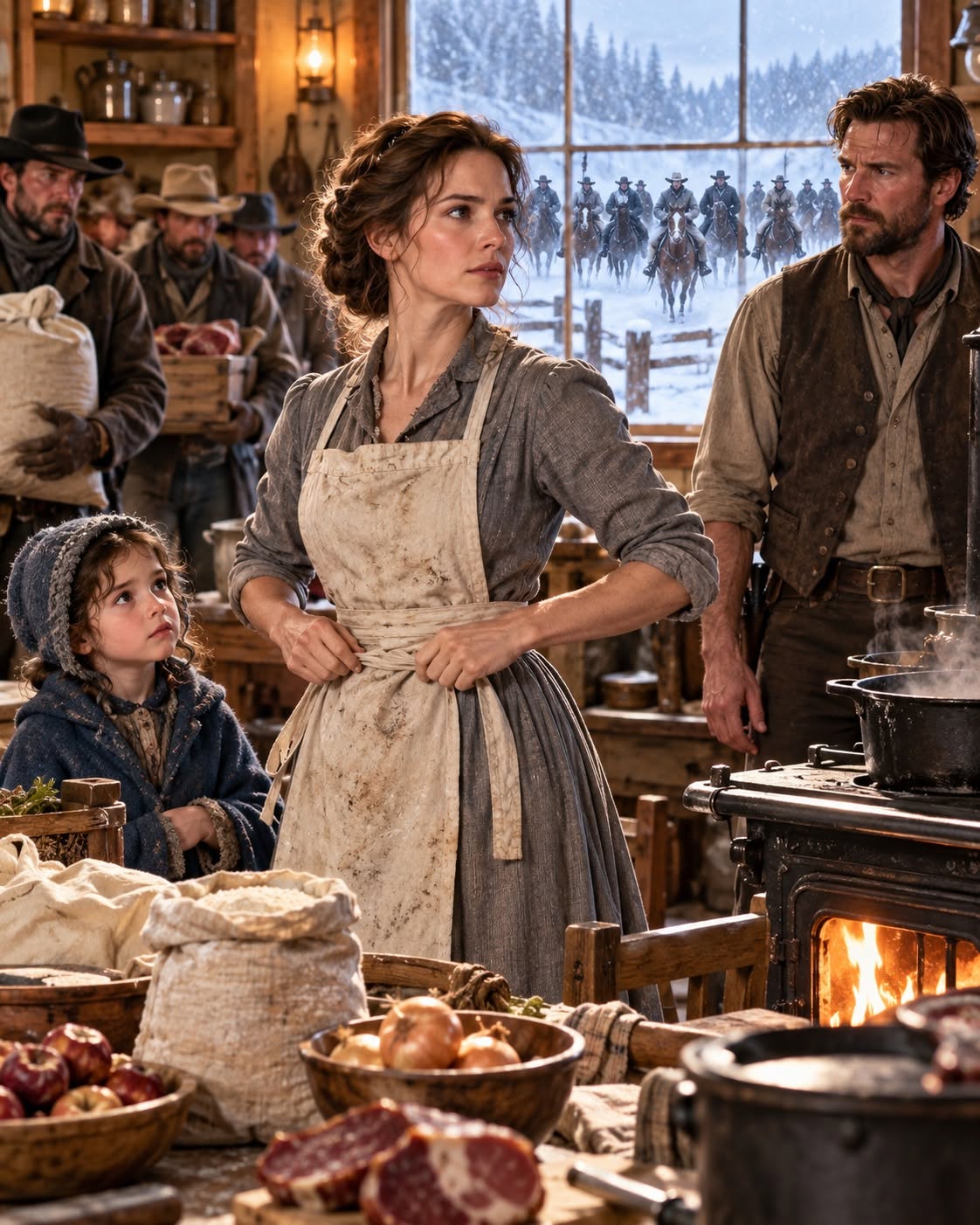
PART 2 — SIXTEEN COWBOYS, ONE KITCHEN, AND A WOMAN WHO REFUSED TO BE DEFEATED
The first horse appeared through the snow just before noon.
Then came another.
And another.
Within minutes, sixteen exhausted cowboys were riding toward the Broken Spur Ranch, their horses stumbling through the drifts. Their coats were stiff with ice, their hats were white with snow, and several men could barely keep their hands around the reins.
Silas Redfern stood on the porch, counting them.
Sixteen.
Exactly as the rider had warned.
Behind him, Deke Rollins stepped outside and stared at the approaching crew.
“Well, that’s a fine mess,” he muttered. “We haven’t enough food to feed them, and half the men are too tired to lift a spoon.”
Silas glanced toward the kitchen window.
Eliza Marlowe was already moving.
She had pulled every sack of flour from the pantry, set two pots over the stove, and ordered three ranch hands to carry water. The remaining onions were being chopped. Salt pork was sizzling in a skillet, and a large kettle of beans was beginning to bubble.
Maisie sat on a wooden stool near the warmest corner, carefully sorting the clean spoons from the dirty ones.
“Mother says every spoon has a place,” the little girl explained when a cowboy glanced at her.
The man smiled faintly.
“Then I reckon we’d better put every spoon in the right place.”
Eliza heard the horses stop.
“Silas!”
He appeared in the doorway.
“Yes?”
“I need the mudroom cleared. Every wet coat goes there, not beside the stove. Bring the spare blankets from the upstairs cupboard. And tell the men to leave their boots on the mat.”
Silas blinked.
“You’re giving orders on my ranch?”
Eliza looked at him over her shoulder.
“Would you rather have sixteen men tracking snow through your kitchen while the food burns?”
For a moment, Silas said nothing.
Then he turned.
“Deke! You heard her!”
Deke stared at his employer.
“You’re taking orders from the new cook?”
“I’m taking orders from the only person who appears to know what she’s doing.”
That ended the discussion.
The cowboys entered the house in a disorderly line.
The first man, a tall rider named Hank Mercer, nearly collapsed against the doorframe.
“Lord Almighty,” he whispered. “I thought we’d never see a roof again.”
“Sit down before you fall down,” Eliza instructed.
He looked at her.
“Ma’am?”
“There’s a bench by the wall. Sit. Take off your gloves, and don’t put your wet coat near the fire. You’ll get warm more safely if we get you dry first.”
Hank obeyed.
One by one, the others followed.
Eliza worked without panic.
She directed the younger ranch hands to collect the wet clothing, arranged blankets for the most exhausted riders, and made sure each man received a cup of warm broth before anything heavier.
She noticed one cowboy holding his left hand close to his chest.
“Let me see that.”
“It’s nothing, ma’am.”
“Then it won’t hurt to look.”
The man’s fingers were swollen and stiff from the cold. Eliza asked him to sit closer to the stove, gave him a dry cloth, and instructed him not to rub his hands roughly.
Then she returned to the kitchen.
By half past twelve, the table was covered.
There were biscuits, beans, fried potatoes, slices of salt pork, and a large pot of vegetable stew. Eliza had stretched the ingredients by adding onions, carrots, and the last of the dried peas.
It wasn’t a feast.
But it was H๏τ.
And there was enough for everyone.
The cowboys stared at the food as if they had entered another world.
Hank took the first bite of biscuit.
He closed his eyes.
“Ma’am, I believe that’s the finest thing I’ve tasted in my entire life.”
A few men laughed.
Someone asked for another serving.
Then another.
Within minutes, the room filled with conversation.
 Men who had spent the morning fearing they might not reach shelter were now arguing cheerfully over who had eaten the last biscuit.
Silas stood near the doorway.
He had expected Eliza to struggle.
He had expected complaints, confusion, perhaps even tears.
Instead, she had turned a nearly empty pantry into a meal for sixteen men and restored order to a house that had been falling apart for months.
And she had done it without once asking him for praise.
Deke approached him.
“She’s good with a kitchen.”
Silas watched Eliza place another bowl before an exhausted cowboy.
“She’s good with people,” he replied.
Deke frowned.
“Still doesn’t mean she belongs here.”
Silas looked at him sharply.
“What’s that supposed to mean?”
Deke shrugged.
“She’s got a child. She’s a widow. We hired her to cook, not bring a family into the middle of a working ranch.”
Silas’s jaw тιԍнтened.
Before he could answer, a small voice interrupted them.
“Mr. Rollins?”
Maisie stood beside the table holding a clean napkin.
Deke looked down.
“What is it, little one?”
“Mother says you haven’t eaten.”
Deke glanced at the kitchen.
“Your mother said that?”
Maisie nodded.
“She said people who work outside need warm food too, even if they forget to ask.”
For a moment, the foreman had no answer.
Then he accepted the napkin and took the bowl Maisie offered.
“Well, thank you.”
The girl smiled and returned to her mother.
Silas watched her go.
His late wife, Catherine, had always believed children understood more than adults gave them credit for. She had often said that a household could not be measured by the number of rooms it contained, but by whether people felt safe inside it.
He had not thought of those words in years.
The afternoon pᴀssed in a blur of activity.
Eliza found clean shirts for the cowboys, arranged a rotation for the laundry, and asked two men to help repair a loose shutter. She even discovered that the pantry contained enough oats to prepare a warm breakfast the following morning.
When Silas asked how she had managed to keep everything organized, she gave him a simple answer.
“I learned to make a little last.”
He looked at her.
“Where?”
Eliza lowered her eyes briefly.
“After my husband died, Maisie and I lived in a rented room outside Cheyenne. Some weeks, I had more work than food. Other weeks, I had food but no work. You learn quickly when a child depends on you.”
Silas felt something тιԍнтen in his chest.
He had known she was a widow.
He had not known what widowhood had cost her.
“Why didn’t you tell me?”
“Would it have changed your decision?”
He hesitated.
Eliza returned to wiping the counter.
“That’s what I thought.”
Silas looked away.
At supper, the cowboys gathered around the table again.
Hank raised his cup.
“To the woman who fed sixteen hungry fools when we arrived looking like frozen fence posts!”
Laughter filled the room.
“To Mrs. Marlowe!”
The men repeated it.
Eliza blushed slightly but continued serving.
Then Hank turned toward Silas.
“Boss, you ought to keep her.”
The room became quiet.
Silas looked at Eliza.
She did not turn around.
Deke put down his fork.
“She’s only been here a few days. We don’t know anything about her.”
Hank shrugged.
“We know she fed us when we were half-frozen. That’s more than enough for today.”
A few cowboys nodded.
Silas felt every pair of eyes in the room.
He thought of the stagecoach returning Monday morning.
He thought of the promise he had made to Eliza.
She had until then to decide whether she and Maisie should leave.
But now he understood something.
He had been measuring her by what she could do for his household.
He had never considered what his household might become because of her.
After supper, he found her folding the clean towels.
“Mrs. Marlowe.”
She looked up.
“Yes, Mr. Redfern?”
“I want to discuss Monday.”
Her expression became guarded.
“Of course.”
“I don’t want you to leave.”
Eliza placed the towel on the shelf.
“Why?”
Silas opened his mouth, but the answer did not come easily.
“Because this ranch needs you.”
She looked at him for a long moment.
“Does it need me, or does it need someone to keep working?”
He frowned.
“There’s a difference?”
“An important one.”
She picked up another towel.
“I came here because I wanted a stable home for my daughter. I can work hard. I can cook, mend, keep accounts, and care for a house. But I will not spend the rest of my life being useful to people who have already decided I am temporary.”
Silas felt the truth of her words.
“I haven’t decided that.”
“You told me I had until Monday.”
He had no answer.
Eliza continued folding.
“Maisie deserves to know whether she is welcome somewhere. I won’t let her become attached to a place where she might be sent away without warning.”
From the hallway came a small voice.
“Mother?”
Maisie stood holding her little blue cloak.
“Are we going away on Monday?”
Eliza turned immediately.
“Come here, sweetheart.”
The girl approached.
Eliza knelt and ʙuттoned her cloak.
“We haven’t decided yet.”
Maisie looked past her toward Silas.
“Did I do something wrong?”
Silas felt the question like a blow.
“No,” he said quickly. “You did nothing wrong.”
“Then why do we have to leave?”
He stared at the child.
Because he had never considered that his careless decision might sound like a judgment on her.
He lowered himself to one knee.
“You don’t have to leave because of anything you did, Maisie.”
She studied his face.
“Promise?”
Silas looked at Eliza.
He knew a promise made too quickly could become another disappointment.
So he answered carefully.
“I promise I’ll speak with your mother before making any decision.”
Maisie seemed satisfied.
She slipped her hand into Eliza’s.
“All right.”
When they left the hallway, Silas remained there for a long time.
Then he heard Deke speaking quietly near the back door.
“That woman has turned the whole place upside down.”
Silas looked toward the foreman.
“Perhaps it needed turning upside down.”
Deke’s expression darkened.
“You’d better be careful, boss. Some people come to a ranch with more than a suitcase and a child.”
Silas narrowed his eyes.
“What are you suggesting?”
Deke shrugged.
“Nothing. Just saying you don’t know who you’re letting into your house.”
Silas watched him walk away.
For the first time, he wondered whether Deke’s objections had anything to do with Eliza’s cooking.
And that night, as the ranch finally settled into uneasy quiet, a folded piece of paper appeared beneath the kitchen door.
It contained only one sentence.
Ask Eliza Marlowe what happened in Cheyenne before you give her a permanent place at Broken Spur.
Silas read it twice.
Then he looked toward the room where Eliza and Maisie were sleeping.
Who had written it?
And what was someone trying so desperately to hide?