PART 2 — THE WIDOW WHO REFUSED TO BE SAVED
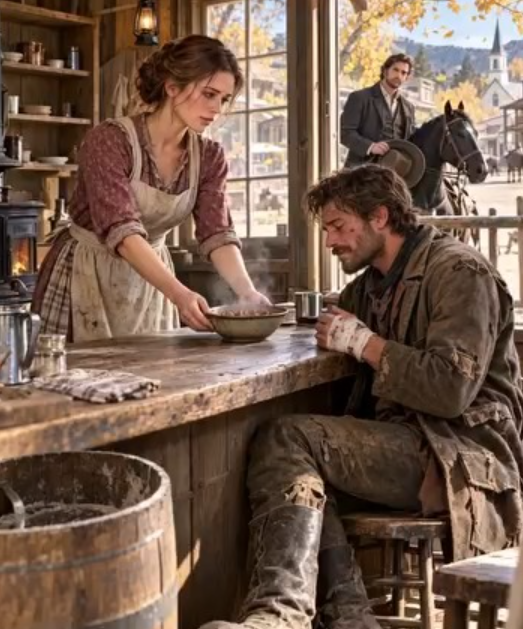
PART 2 — THE WIDOW WHO REFUSED TO BE SAVED
“You need a cook?”
Norah Vale repeated the words as though she were testing them for hidden meaning.
Thomas Ward nodded.
“Sixteen men. Four or five days on the trail. I need someone who can prepare meals, keep provisions organized, and make certain nobody goes hungry.”
“And you thought of me?”
“I watched you feed a stranger when you had nothing left for yourself.”
Norah turned back to the dishes.
“That tells you I can cook?”
“It tells me something more important.”
She stopped washing.
“What?”
“That I can trust you with hungry men.”
For the first time, something resembling amusement crossed her face.
“You might regret saying that when sixteen cowboys start complaining about biscuits.”
“I’ve heard worse complaints.”
“Then you haven’t heard sixteen cowboys complain about biscuits.”
Thomas laughed softly.
But Norah wasn’t finished.
“I want the terms clear, Mr. Ward. I won’t accept charity disguised as employment. I won’t have anyone whispering that you hired me because you’re sorry for me. And I expect to be paid the same as any other cook.”
“Agreed.”
“Half before we leave. The remainder when we return.”
“Agreed.”
“And I won’t be expected to mend every man’s clothes, wash every shirt, or listen to drunken nonsense simply because I’m a widow.”
Thomas removed his gloves.
“Mrs. Vale, I believe you’ve just negotiated a better contract than the one my foreman has.”
That brought the smallest smile to her lips.
“Perhaps your foreman needs lessons.”
Thomas’s expression changed.
He had come expecting to hire a cook.
Instead, he found himself thinking about the man who had stolen Jonah Reed’s wages.
“I suspect he does.”
The following morning, Norah arrived at Dry Table Ranch carrying a small leather case and a folded list of supplies.
She had borrowed a wagon from the church caretaker because her own horse had been sold three weeks earlier to pay the last installment on her husband’s burial expenses.
Thomas met her outside the kitchen.
“Good morning.”
“Morning, Mr. Ward.”
“Thomas will do.”
“Then Norah will do.”
He smiled.
Inside the kitchen, she found enough flour for perhaps two weeks, a sack of beans, dried apples, coffee, salt pork, and several jars of preserved vegetables.
She inspected everything before saying a word.
“Who keeps your provisions?”
“Lyall Voss.”
Norah looked at the flour sack.
Then at the beans.
Then at the coffee tin.
“Does he?”
Thomas frowned.
“Is something wrong?”
“Your flour is damp. Your beans have been stored near something that smells like kerosene, and this coffee is nearly a month past its freshness.”
“Can it be used?”
“Certainly. If your cowboys enjoy drinking boiled disappointment.”
Thomas laughed.
He hadn’t expected that.
By noon, Norah had reorganized the kitchen, made a list of missing supplies, and discovered that the ranch’s accounts were even more disordered than its pantry.
There were purchases recorded twice.
Several deliveries had no receipts.
And one entry caught her attention.
Six sacks of winter oats — $42.
She checked the storage shed.
There were only two sacks.
Norah wrote the discrepancy in the margin.
She didn’t know it yet, but she had just found the first loose thread in a much larger deception.
That afternoon, Jonah Reed arrived at the ranch.
Thomas was waiting in the office with the payroll ledger.
Lyall Voss stood beside the desk, his expression irritated.
“I don’t see why we’re wasting time on this,” the foreman said. “The man damaged company property.”
“Then show me the damage report.”
Lyall opened his mouth.
Thomas continued.
“Show me the repair invoice. Show me the signed deduction. Show me the record of his eleven days of work after the accident.”
The room became quiet.
Lyall shuffled through several papers.
“I don’t have those documents here.”
“Then where are they?”
“Probably with the old accounts.”
Thomas looked at him.
“You manage the accounts, Lyall.”
Jonah stood near the door, his injured hand resting against his coat.
“I told you he wouldn’t pay,” he muttered.
Thomas opened the ledger.
“Jonah, you are owed fourteen dollars. Here’s your full payment, including the wages for those eleven days.”
He counted the money onto the desk.
Jonah stared at it.
Then he picked it up carefully, as though he expected someone to snatch it away.
“Thank you, sir.”
“You shouldn’t have needed to ask twice.”
 Lyall shifted his weight.
“Thomas, you’re making a mistake. Men like him will take advantage if you let them.”
Thomas closed the ledger.
“Men like him?”
“You know what I mean.”
“No, Lyall. I don’t think I do.”
For a moment, neither man spoke.
Then Lyall turned and walked out.
Thomas watched him disappear through the office door.
He had known the foreman for six years.
Now he wasn’t sure he knew him at all.
The cattle drive began three days later.
Norah rode in the supply wagon, carrying flour, dried meat, coffee, and enough provisions to feed sixteen men.
The cowboys were skeptical.
They had heard that the new cook was a widow from town who had nearly given away her last meal.
Some expected weak coffee and watery stew.
Others expected a woman who would complain about the dust.
They were wrong about both.
On the first evening, Norah prepared thick beef stew, fresh biscuits, and fried apples.
The men gathered around the fire.
Nobody spoke for the first several minutes.
Finally, an old cowboy named Silas Boone leaned back and declared, “If this is what happens when a woman has nothing left to eat, I hope she never gets rich.”
The camp erupted in laughter.
Norah shook her head.
“Eat your stew, Mr. Boone.”
“Yes, ma’am.”
Thomas watched from across the fire.
He noticed how the men listened when she spoke.
He noticed how she remembered who preferred coffee without sugar, who had a bad knee, and who always saved the last biscuit for the youngest rider.
But most of all, he noticed that she never placed herself above the men or beneath them.
She simply treated everyone as though they mattered.
That night, Thomas found her sitting beside the supply wagon, writing in a small notebook.
“What are you recording?”
“Provisions used. Meals prepared. What we’ll need tomorrow.”
“You’ve been working since sunrise.”
“So have you.”
“I’m the owner.”
Norah looked up.
“And I’m the cook. We both have responsibilities.”
He sat on the opposite side of the wagon.
For a while, they listened to the cattle shifting in the darkness.
Then Thomas spoke.
“My mother used to say that a man’s character was easiest to recognize by how he treated someone who couldn’t do anything for him.”
Norah closed her notebook.
“Your mother sounds like she knew people.”
“She did.”
“Was she a good woman?”
Thomas looked toward the fire.
“The best I ever knew.”
“Then you were fortunate.”
“I was. Until I wasn’t.”
He didn’t explain.
Norah didn’t ask.
A few moments later, she said quietly, “My husband used to pray for a child. Every Sunday. He believed God would answer if we kept asking.”
Thomas turned toward her.
“Did He?”
“No.”
Her voice remained steady, but something in it had changed.
“After Samuel died, I stopped praying for a long time. I couldn’t understand why some people received everything while others were left with empty houses.”
Thomas lowered his eyes.
“Perhaps that’s why I haven’t understood my own prayers lately.”
Norah studied him.
“What have you been praying for?”
He hesitated.
“A wife.”
She looked away.
“And have you found one?”
“No.”
He paused.
“But I met a woman who reminded me what kind of man I ought to be before asking God to send one.”
Norah said nothing.
Neither did Thomas.
And for the first time, the silence between them felt comfortable.
But the following morning, that peace would be tested.
At dawn, Jonah discovered that one of the supply crates had been opened.
A small envelope lay beneath the flour sack.
Thomas recognized the handwriting immediately.
It belonged to Lyall Voss.
Inside was a single sheet of paper.
Stop digging into the accounts. The next mistake will cost more than fourteen dollars.
Thomas read it twice.
Then he looked toward Norah.
She was standing beside the wagon, holding the inventory notebook.
“Mr. Ward,” she said quietly, “I think someone has been stealing from your ranch for a long time.”
Thomas folded the letter.
“Why do you say that?”
Norah opened her notebook to the page she had marked three days earlier.
“Because the missing oats aren’t the only thing that doesn’t add up.”
She pointed to a series of purchases.
“Someone has been charging you for supplies that never arrived.”
Thomas stared at the figures.
Then he looked at the woman who had nearly starved herself to feed a stranger.
He had hired a cook.
But he might have brought an honest witness into a house built on lies.
And somewhere behind them, a rider was already heading toward Red Hollow with news that Norah Vale had begun asking the wrong questions.