PART 2 — THE STOCKINGS THAT BETRAYED HER
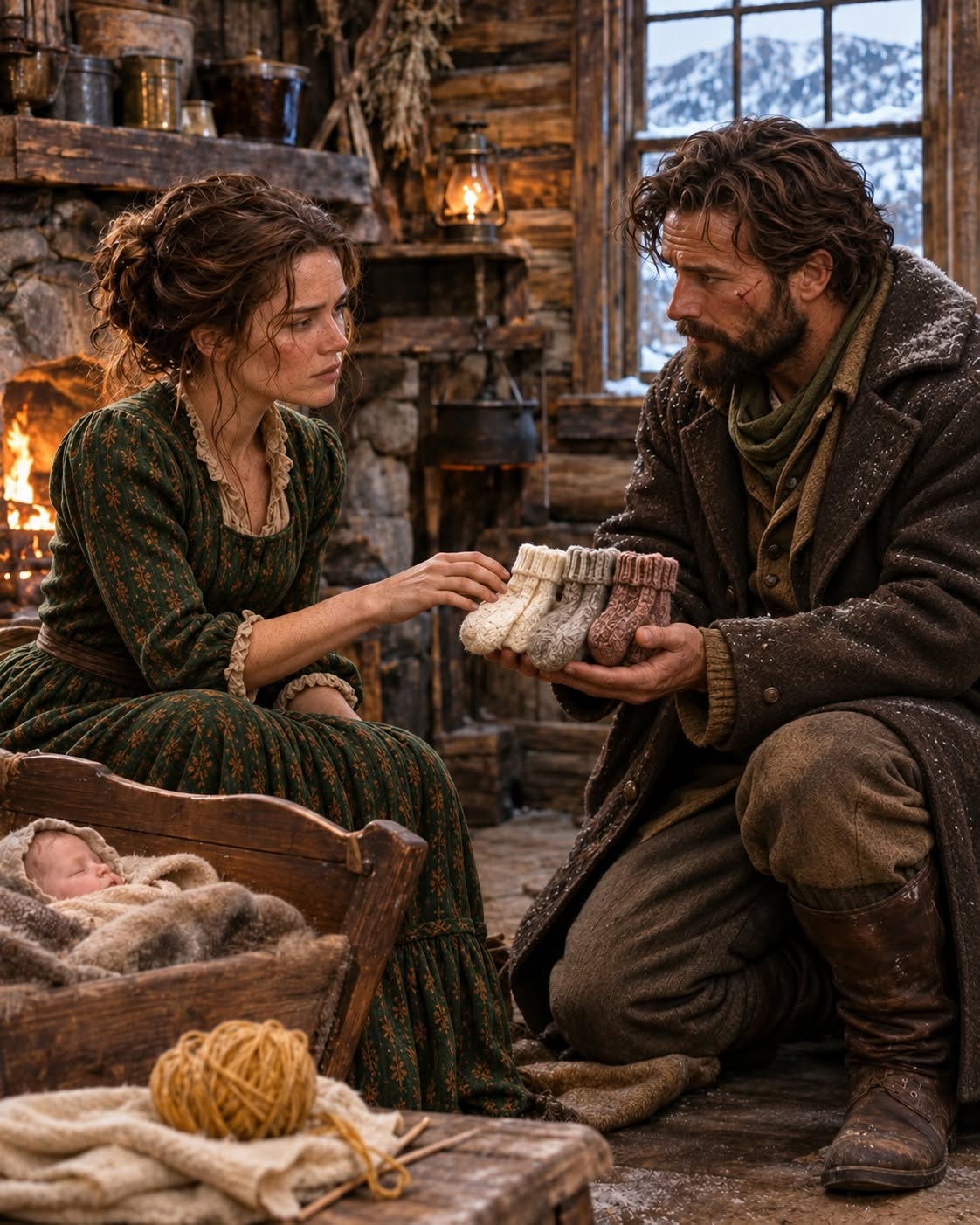
PART 2 — THE STOCKINGS THAT BETRAYED HER
“Before you close that,” Maeve said, “tell me whether Reginald Blythe saw what you bought.”
Caleb’s hand remained on the door.
For several seconds, the only sound was the wind pressing against the cabin walls.
“No,” he finally answered. “Not that I know of.”
“Then why did you look at the window?”
“Because I saw a rider on the lower trail when I came back.”
Maeve felt the warmth leave her face.
“Who?”
“I couldn’t make out his features. He turned toward the eastern ridge before I reached the clearing.”
“Was he carrying a black horse?”
Caleb looked at her sharply.
“You know him?”
“I know the horse.”
She turned toward the cradle. Her daughter stirred, making a small sound beneath the fur blanket. Maeve bent to tuck the covering around her, buying herself a moment to think.
The rider had not been a stranger.
Three weeks earlier, Reginald Blythe had arrived at her husband’s modest homestead with a polished walking stick and a document bearing a sum of money Maeve had never heard of. He claimed her late husband, Samuel, had borrowed against the property. When she asked to see the original agreement, he showed her a signature that looked almost like Samuel’s.
Almost.
Samuel had been a careful man. He never signed anything without reading it twice.
And he had never borrowed money from Reginald Blythe.
When Maeve refused to surrender the homestead, Blythe had smiled.
He explained that debts did not disappear because a man died. Then he looked at Thomas and asked whether she had considered how difficult it would be to raise two children without a roof.
The next morning, two men came to the house.
Maeve had left before they reached the door.
“Caleb,” she whispered, “I think he followed me.”
Caleb moved away from the door.
“Tell me exactly what happened.”
She hesitated.
He did not press her. Instead, he pulled a chair closer to the fire and waited.
That small kindness nearly undid her.
“Samuel died on October seventeenth,” she began. “Fever. He was ill for six days. I buried him on the hill behind our house.”
Caleb listened without interruption.
“Two days later, Blythe arrived with papers claiming Samuel owed him nine hundred dollars. I told him I had never seen the agreement. He said the property would be taken whether I believed it or not.”
“And the children?”
“He said the debt could be settled another way.”
Caleb’s expression changed.
“What did he mean?”
Maeve looked toward Thomas.
“He said a woman alone could not possibly provide for two children. He suggested that someone with money might take the baby while I found work for myself.”
The fire snapped.
Caleb slowly set down the cup he had been holding.
“He offered to take your daughter?”
“He called it an arrangement.”
“He had no right.”
“He said he had witnesses. He said the sheriff would support him.”
Caleb stood and walked to the window. He looked across the snow-covered clearing, his shoulders rigid.
“Blythe has been buying up claims along this side of the mountains,” he said. “A man who wants land doesn’t always begin by asking for it.”
Maeve swallowed.
“Then you understand why I cannot stay here.”
He turned.
“You can stay tonight.”
“And tomorrow?”
“Tomorrow we find out whether that rider was following you.”
She shook her head. “You don’t understand. If Blythe discovers where I am, he will come here. He will bring men. He will tell everyone I stole his money or ran away with his children.”
“Then we’ll have to make sure the truth gets there first.”
Maeve looked at him in disbelief.
“You would risk your home for a woman you found in a cave?”
Caleb glanced toward the three pairs of tiny stockings.
“I bought those because a baby needed warm feet. I didn’t know they would start a war.”
For the first time since entering his cabin, Maeve almost smiled.
But the moment did not last.
A sharp knock sounded against the door.
Thomas jumped.
Caleb raised one hand, signaling Maeve to remain where she was. He moved to the door and listened.
“Wolf!” a man’s voice called from outside. “Open up. It’s Jonah.”
Caleb lifted the bar.
Jonah Reed stepped inside, brushing snow from his hat. He was a broad-shouldered ranch hand with a weathered face and a thick gray mustache. His expression was unusually serious.
“Found something near the lower trail,” he said.
He held out a small object.
A brᴀss ʙuттon.
Maeve recognized it immediately.
It had come from the coat worn by one of Blythe’s hired men. She had seen the same ʙuттons when they came to her homestead.
Jonah noticed her reaction.
“You know it?”
Maeve nodded.
“It’s from the man who came to our house.”
Caleb took the ʙuттon and turned it over.
“Where did you find it?”
“Beside the old split-rail fence. Fresh horse tracks, too. Someone rode up, dismounted, and walked toward the cabin.”
“How close?”
Jonah looked toward the door.
“Close enough to see the smoke from your chimney.”
Maeve’s hand went instinctively to her daughter’s cradle.
“Then he knows.”
Caleb placed the ʙuттon on the table.
“Not necessarily.”
 Jonah gave him a doubtful look. “You bought enough supplies in Miller’s Landing to feed a family for a month. Constance Garrick was at the store. By the time I reached town, she had already told half the settlement that Caleb Wolf was keeping a woman and two children in his cabin.”
Maeve closed her eyes.
There it was.
The stockings had not merely been a kindness. They had become a trail of breadcrumbs leading straight to her door.
“Who else heard?” Caleb asked.
“Everybody who was sitting near the stove.”
Jonah removed his gloves.
“And Blythe’s clerk was among them.”
Caleb’s jaw тιԍнтened.
“Then we don’t wait for him to come here.”
Maeve looked at him.
“What do you intend to do?”
“Go to Miller’s Landing.”
“No.”
Her answer came so quickly that both men turned.
Maeve stood beside the table, her fingers gripping its edge.
“If you go there and ask questions, Blythe will know I am here. If you threaten him, he will claim you kidnapped me. If you tell the sheriff, he may already be on Blythe’s side.”
Jonah frowned.
“You have reason to believe that?”
“I have reason to believe Blythe has paid someone to make his papers look official.”
Caleb studied her.
“Did Samuel leave you anything?”
Maeve hesitated.
Then she reached beneath the collar of her dress and pulled out the little silver locket.
“My husband gave me this the night before he died. He told me never to let Blythe see it.”
She opened it.
Inside was no portrait, only a folded scrap of paper so small that it had been hidden behind the metal lining.
Caleb leaned closer.
Maeve carefully unfolded it.
The writing was faint, but the words were unmistakable.
If anything happens to me, find the original survey at the abandoned mill. The account book is hidden where the old waterwheel cannot turn.
Jonah stared at the message.
“Samuel knew something.”
“He knew Blythe was lying,” Maeve replied. “But he never had time to explain.”
Caleb read the note again.
“The abandoned mill is two miles north of here.”
“Can we reach it?” Maeve asked.
“Not in this weather,” Jonah said. “The northern trail is already filling with snow. Another storm and the pᴀss will close.”
Caleb folded the paper and returned it to her.
“Then we leave before daylight.”
Maeve shook her head.
“I cannot take the children into another storm.”
“You won’t have to,” Jonah said. “I’ll stay here with them.”
Caleb looked at him.
Jonah shrugged. “Someone has to keep the fire going. Besides, I know this cabin better than you do, and I don’t trust strangers wandering around the clearing.”
Maeve studied the two men.
For the first time, she began to understand that Caleb had not simply offered her shelter. He had given her something she had almost forgotten existed.
A choice.
Still, there was one question she could not ignore.
“Why are you helping me?” she asked.
Caleb looked away.
For a moment, she thought he would refuse to answer.
Then he said, “Because I once watched a man lose everything while people stood around saying it wasn’t their business.”
His voice was quiet.
“I’ve regretted that for years.”
Before Maeve could ask more, a sound came from outside.
Not a knock.
A horse.
All three turned toward the window.
A rider emerged from the trees, moving slowly through the falling snow. His horse was black.
Maeve’s heart began to pound.
The man stopped beside the fence and dismounted. He was tall, wearing a dark coat and a wide-brimmed hat.
He did not approach the door.
Instead, he placed something on the fence post.
Then he climbed back into the saddle and disappeared into the trees.
Caleb reached for his coat.
“Jonah, stay with them.”
He stepped outside, keeping his eyes on the surrounding woods. When he returned, he carried a folded envelope.
Maeve recognized the handwriting before he opened it.
Reginald Blythe.
Caleb handed it to her.
The message inside contained only three sentences.
Mrs. Morrow, I know where you are.
You have until the first snowfall closes the pᴀss to return what belongs to me.
If you refuse, I shall collect the debt from the children.
Maeve read it twice.
Her hands trembled, but she did not cry.
Caleb took the letter and placed it on the table.
“He won’t touch them.”
“You cannot promise that,” she whispered.
“No,” he admitted. “But I can promise he won’t find you without having to answer for what he’s done.”
Jonah moved toward the window.
“Caleb…”
Something in his voice made them all turn.
Far beyond the clearing, three dark figures had appeared along the ridge.
They were too distant to recognize, but their horses were moving toward the cabin.
Caleb looked at Maeve.
“Take the children into the back room. Bring the locket and nothing else.”
Maeve gathered her daughter, then reached for Thomas’s hand.
But before she could move, Jonah spoke again.
“Wait.”
He had picked up the envelope. There was something written on its back, almost invisible beneath the fold.
He held it toward the light.
It was a name.
Not Maeve’s.
Not Caleb’s.
Samuel Morrow.
And beneath it, in a different hand, were five words that made Jonah’s face turn pale.
The debt was paid in 1868.
Maeve stared at the writing.
Her husband had supposedly borrowed the money in 1869.
If the debt had already been paid a year earlier, then Reginald Blythe had not come to collect what he was owed.
He had come to take something he had no right to claim.
Caleb looked from the message to Maeve.
“Your husband didn’t owe him anything.”
Maeve shook her head, unable to speak.
Then Jonah turned the envelope over once more.
A second line had been written beneath the first.
Ask Caleb Wolf what happened at the mill.
The room went silent.
Maeve slowly lifted her eyes toward the mountain hermit.
Caleb did not look surprised.
He looked as though he had been waiting for this moment for years.
And outside, the three riders had reached the lower fence.
END OF PART 2