PART 3 — THE WIDOW BOUGHT THE LAND THEY NEVER KNEW WAS WORTH GOLD
PART 3 — THE WIDOW BOUGHT THE LAND THEY NEVER KNEW WAS WORTH GOLD
Gregory Thain had spent twenty years making money in Rocker Bend.
He knew how to recognize a desperate man.
He knew how to turn unpaid debts into profitable property.
And he knew how to make people believe they had no choice.
But he had made one mistake.
He had mistaken Nancy Coulter’s silence for weakness.
The morning after Gregory delivered the eviction notice, Nancy woke before sunrise.
She sat beside the stove, staring at the small tobacco tin containing the gold she had recovered.
There was more than she had expected.
Still, she wasn’t certain how much it was worth.
She couldn’t afford to make a mistake.
If she spent everything on land and the gold proved worthless, Thomas and Ellie would have nothing.
If she left Rocker Bend, she would lose the customers who had made her business possible.
And if Gregory discovered what she had found, he would never stop pursuing her.
At breakfast, Thomas noticed that his mother wasn’t eating.
“Are we moving again?”
Nancy looked up.
She hated that question.
A seven-year-old child shouldn’t have to wonder whether the next place he slept would still be home.
“Not if I can help it.”
Ellie climbed into her lap.
“I like our house.”
Nancy kissed her hair.
“So do I.”
That afternoon, she traveled with Elias to Sacramento.
They visited a reputable ᴀssayer recommended by the lawyer.
Nancy placed the contents of her tobacco tin on the counter.
The ᴀssayer examined the material through a small lens.
Then he weighed it.
He repeated the process twice.
Finally, he looked at Nancy.
“Where did you get this?”
“From the creek.”
“All of it?”
“Most of it.”
He leaned back.
“Mrs. Coulter, this is remarkably clean gold.”
Nancy’s heart began beating faster.
“How much?”
He wrote a figure on a piece of paper.
Nancy read it.
Then read it again.
The amount wasn’t enough to buy an entire mining company.
But it was more money than she had ever held in her life.
And it represented only a fraction of what she had recovered.
The ᴀssayer explained that the fine gold was valuable, particularly when collected in sufficient quanтιтies. He offered to purchase the material, but Nancy declined.
She wanted to understand the market before selling anything else.
On the journey back, Elias watched her carefully.
“What are you thinking?”
Nancy held the folded valuation inside her coat.
“I’m thinking that Gregory Thain is about to make a very expensive mistake.”
The next morning, Nancy visited the lawyer.
His name was Samuel Whitaker, a careful man who had spent thirty years handling property disputes, mining claims, and estate matters.
He listened as Nancy explained the eviction notice.
Then he examined the document.
“This is troublesome,” he said.
“Can he really remove us?”
“Possibly. But I want to examine the original deed and the chain of ownership. A man cannot sell what he never legally owned.”
Nancy leaned forward.
“Can I buy the land?”
Samuel studied her.
“Do you have the money?”
She placed a small envelope on his desk.
Inside was the first payment she had received from selling a portion of her gold.
Samuel counted it.
His eyebrows rose.
“Mrs. Coulter, where did you get this?”
“Laundry.”
He looked at her for several seconds.
Then he smiled.
“I believe you may be the most interesting laundress I’ve ever met.”
Nancy didn’t smile.
“I need a place for my children. I don’t want to spend another winter wondering whether someone will throw us out.”
Samuel nodded.
“Then let’s find you something worth owning.”
He searched the county records.
A few days later, he found an opportunity.
An elderly rancher named Walter Briggs had died the previous summer. His heirs lived in Oregon and wanted to sell his abandoned property quickly.
The land was poor by ordinary standards.
It contained an old cabin, a collapsed barn, a spring, and several acres along a narrow creek.
Most buyers considered it useless.
The soil was rocky.
The creek was too shallow for large-scale mining.
And the cabin needed extensive repairs.
But Elias recognized the location immediately.
He spread the property map across Samuel’s desk.
“Look at this bend.”
Nancy leaned closer.
“What about it?”
 “The creek slows here. Heavy material settles along the inside bank.”
He pointed to a narrow stretch of ground.
“Men have been digging upstream for years. This is where the finest particles travel.”
Nancy studied the map.
“Is there enough gold to make the land valuable?”
Elias shrugged.
“Enough to make it worth owning.”
That was all she needed.
She purchased the property.
The price consumed almost everything she had saved.
But Samuel negotiated a payment arrangement with the heirs, allowing Nancy to settle the remaining balance over several months.
On February 18, 1865, Nancy Coulter became the legal owner of the Briggs property.
She was twenty-nine years old.
A widow.
A mother of two.
And the owner of land that Gregory Thain had dismissed as worthless.
She moved her children into the old cabin.
The roof needed repairing, the windows were broken, and the barn smelled of damp hay.
But there was a fireplace.
There was a sturdy door.
And there was a small bedroom where Thomas and Ellie could sleep without sharing a mattress with their mother.
That first night, Nancy stood in the doorway and listened to the silence.
No drunken men outside.
No shouting from the saloon.
No footsteps approaching with another eviction notice.
Ellie climbed into bed.
“Is this really ours?”
Nancy looked around.
“Yes, sweetheart.”
“Forever?”
Nancy swallowed.
“As long as we take care of it.”
The following weeks were difficult.
Nancy continued washing clothes in Rocker Bend while Elias helped her investigate the property.
They discovered several pockets of gold-bearing sediment along the creek.
Nothing spectacular.
No enormous nuggets.
No instant fortune.
But the deposits were consistent.
More importantly, the creek wasn’t the only thing of value.
The land sat between the settlement and the northern mining district.
Every wagon traveling to the upper diggings pᴀssed along the road beside Nancy’s property.
The old ranch had a natural spring.
There was enough flat ground for a stable, a small storehouse, and several rental cabins.
Nancy began to see something that Elias had overlooked.
The gold might make her comfortable.
But the land could make her independent.
She made another decision.
Instead of selling all her gold, she would use some of it to improve the property.
She repaired the barn.
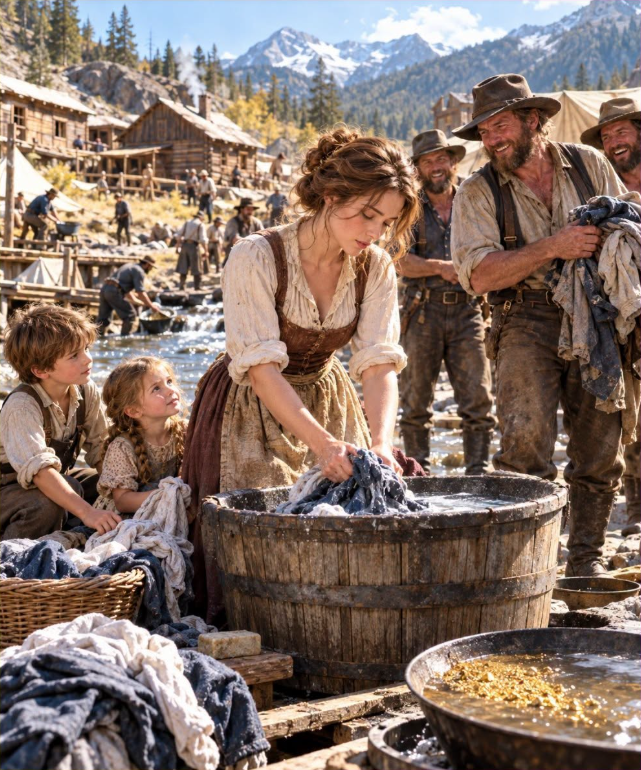
She built a proper washhouse with a brick floor and a chimney.
She installed three large copper boilers and purchased better drying racks.
Then she put up a new sign.
COULTER’S WASHHOUSE
CLEAN CLOTHES — H๏τ WATER — HONEST PRICES
The first week brought twenty customers.
The second brought forty.
By the third, men from the northern camps were bringing their laundry by wagon.
Nancy hired two local women whose husbands had been injured in mining accidents.
She paid them every Saturday.
No promises.
No deductions.
No excuses.
Word spread quickly.
Amos Reed arrived one afternoon carrying three enormous bundles.
“Mrs. Coulter, I heard you’ve become a proper businesswoman.”
Nancy smiled.
“Only because you men refuse to wash your own socks.”
Amos laughed.
Then his expression became serious.
“I also heard Thain has been asking questions.”
Nancy’s hands paused.
“What kind of questions?”
“About your property. Your creek. Your new equipment.”
She looked toward the window.
Gregory had not forgotten her.
He had simply been waiting.
And he was getting impatient.
That same evening, Gregory arrived with two men from the mining ᴀssociation.
He found Nancy checking a delivery ledger.
“Mrs. Coulter.”
“Mr. Thain.”
He glanced around the new washhouse.
“You’ve improved the place.”
“Business is good.”
“I hear that.”
He pulled out a chair without asking.
“I’ve been thinking about your property.”
Nancy closed the ledger.
“That’s unfortunate.”
One of the men shifted uncomfortably.
Gregory ignored her remark.
“I’d like to make you an offer.”
Nancy waited.
“Two thousand dollars for the entire property. Cash.”
It was a substantial amount.
But Gregory wasn’t looking at the washhouse.
He was looking through the window toward the creek.
Nancy noticed.
“Why do you want it?”
“Convenient location.”
“Then why not buy another property?”
His jaw тιԍнтened.
“Because this one interests me.”
Nancy folded her hands.
“I’m not selling.”
Gregory leaned forward.
“Mrs. Coulter, you have children. You have responsibilities. Running a business isn’t easy. Two thousand dollars could give you a comfortable life somewhere else.”
Nancy looked directly at him.
“I already have a comfortable life.”
He laughed.
“You’re washing miners’ underwear.”
“And you’re buying whiskey with money earned from selling them shovels.”
The two men beside him exchanged glances.
Gregory stood.
“You’ve become very confident.”
“No. I’ve become very careful.”
He walked toward the door.
Before leaving, he turned around.
“One final piece of advice. Don’t ᴀssume that owning land means you understand what lies beneath it.”
Nancy felt a chill.
After he left, she went outside and found Elias examining the creek.
“He knows,” she whispered.
Elias straightened.
“Perhaps.”
“What do we do?”
The old prospector looked toward the northern hills.
“We make sure every inch of your property is properly surveyed and every claim is legally recorded.”
Nancy nodded.
But there was something else.
The following morning, Samuel Whitaker arrived carrying a thick envelope.
He had uncovered a document in the county archives.
It was an old survey from 1858.
The map showed that the creek running through Nancy’s property had once been part of a larger mining reserve.
And according to the original boundary description, the northern edge of that reserve extended much farther than anyone in Rocker Bend realized.
Samuel placed the map on Nancy’s table.
“Mrs. Coulter, I think you should read this carefully.”
Nancy followed the marked boundary with her finger.
Then she looked up.
“Are you saying the creek belongs to me?”
“I’m saying the old survey may give you rights that Gregory Thain has been trying to acquire for years.”
Elias stepped closer.
His face had gone pale.
“Samuel,” he whispered, “you need to check the western boundary.”
The lawyer turned the map.
For a moment, nobody spoke.
Because the western boundary included the abandoned upper diggings.
The very place where Harlan Coulter had died beneath the rockslide.
And attached to the survey was a second document.
A claim registration bearing Harlan’s signature.
Nancy recognized it instantly.
Her husband hadn’t simply died in California.
He had left something behind.
Something Gregory Thain had been trying to find for two years.
And now Nancy understood why the wealthy storekeeper was so desperate to own her land.
The gold in her wash tubs might have made her rich. But the secret buried beneath her property could change the entire future of Rocker Bend.