PART 3 — THE DEBT THAT SHOULD NEVER HAVE EXISTED
PART 3 — THE DEBT THAT SHOULD NEVER HAVE EXISTED
Daniel stared at the signature.
For several seconds, nobody spoke.
Then he looked up.
“My father died six years ago.”
“I’m aware,” Harlan replied.
“Then explain why this document carries his signature from six months after his death.”
The visitor’s smile barely changed.
“An unfortunate clerical discrepancy, perhaps. The important matter is that the debt remains outstanding.”
Daniel placed the paper on the table.
“Get out.”
“Mr. Cole, I would advise you to consider the consequences before—”
“I said get out.”
Harlan slowly gathered his papers.
“You have thirty days. After that, the company will begin proceedings to recover what it is owed.”
He paused at the doorway and glanced toward Clara.
“And congratulations on your marriage, by the way. I imagine a wife will make the coming difficulties easier to bear.”
Clara felt Daniel stiffen.
“We aren’t married,” she said.
Harlan’s eyebrows rose.
“Not yet?”
Daniel opened the door wider.
“Good night, Harlan.”
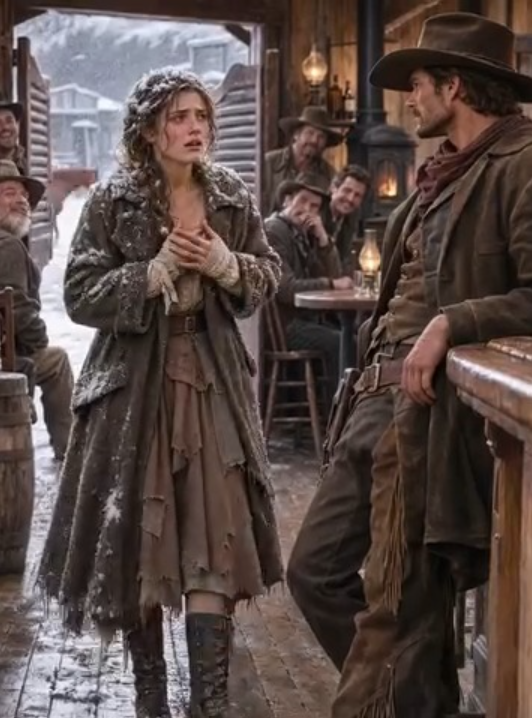
The man stepped into the snow.
But before he disappeared, he turned.
“One final thought, Mr. Cole. Your father was a proud man. It would be a shame if his reputation were damaged because his son couldn’t settle his obligations.”
The door slammed.
Daniel remained where he was, his hand gripping the frame.
Mrs. Bell approached the table.
“What did he want?”
“Money.”
“How much?”
Daniel didn’t answer immediately.
Clara looked at the document.
“May I?”
He hesitated, then handed it to her.
She read the first page carefully.
The document claimed that Daniel’s father had borrowed eight thousand dollars from the Colorado Agricultural and Land Company. Interest had accumulated, bringing the total to nearly fourteen thousand.
It also claimed the ranch had been offered as security.
Clara read it twice.
Then she turned to the last page.
“Daniel, may I ask something?”
“Go ahead.”
“Did your father ever borrow money from this company?”
“No.”
“Are you certain?”
“I handled his accounts during his final years. There was no such loan.”
Clara examined the signature again.
“I don’t know your father’s handwriting, but I know something about documents.”
Daniel looked at her.
“My father taught me bookkeeping. He used to say that a person could hide a lie in a sentence, but numbers usually betrayed it.”
She pointed to the date.
“This paper says the loan was issued on May eighteenth. But the interest calculation begins in March.”
Daniel leaned closer.
She traced the figures with one finger.
“And the amount written here doesn’t match the amount used in the calculation.”
 Mrs. Bell frowned.
“Are you saying the man lied?”
“I’m saying this document deserves to be examined by someone who understands accounts.”
Daniel took the paper back.
“That’s enough for tonight.”
Clara lowered her eyes.
“I didn’t mean to interfere.”
“You didn’t.”
He folded the document and placed it inside his coat.
“I just don’t want you dragged into something that isn’t your concern.”
Clara looked at him.
“Perhaps it became my concern when a stranger came into this house and threatened the man who gave me shelter.”
Daniel had no answer.
The next morning, Clara discovered that the ranch was far from the orderly place she had imagined.
The kitchen pantry was nearly empty. Several shirts needed mending. The accounts were stacked in an untidy pile on the desk, and a broken latch on the pantry door had apparently been broken for months.
Mrs. Bell had been managing everything alone since the previous cook left.
“You don’t have to do all this,” the older woman told Clara when she found her sorting the pantry.
“I know.”
“Then why are you doing it?”
Clara smiled faintly.
“Because I can.”
By noon, she had prepared a proper meal, mended two shirts, and organized the kitchen supplies.
Daniel returned from the barn to find her sitting at the dining table with his account books spread around her.
He stopped in the doorway.
“What are you doing?”
“Trying to understand your father’s records.”
“I thought we agreed you wouldn’t get involved.”
“We didn’t agree to that.”
Daniel sighed.
“Clara—”
“I’m not doing this because I expect anything in return. I’m doing it because the figures in that document don’t make sense, and I suspect your father would have wanted someone to notice.”
That last sentence silenced him.
He pulled out a chair.
“What have you found?”
Clara turned the ledger toward him.
“Your father recorded every major expense and payment. Look here. Six years ago, he paid the final installment on a loan from the Fairview Bank.”
“I remember.”
“And here is the bank’s receipt.”
She placed a small paper beside the ledger.
“The account was closed. No balance remained.”
Daniel stared at the receipt.
“Where did you find that?”
“In the back of the blue account book.”
He rubbed his forehead.
“I searched these books after he died. I never saw it.”
“It was tucked between two pages.”
Clara continued.
“There’s something else. Your father’s signature appears on this receipt, but compare it with the one on Harlan’s document.”
Daniel placed both papers side by side.
At first glance, the signatures looked similar.
Then he noticed the differences.
The letter C in his father’s name always had a small upward hook. The signature on Harlan’s document did not.
And the final stroke of the surname was too short.
“Someone copied it,” Daniel whispered.
Clara nodded.
“Possibly.”
Daniel stood and walked to the window.
For years, he had believed his father’s financial affairs were settled. He had never imagined that someone might be using the old man’s name to claim the ranch.
“Why would anyone do this?” he asked.
Clara looked at the papers.
“Perhaps because they believe you won’t question them.”
Daniel turned.
“What makes you say that?”
“Because the man came here expecting you to be frightened. He spoke as though the land already belonged to his employer.”
Daniel looked out toward the snowy pasture.
There was something he had not told Clara.
Three months earlier, he had received an offer for the ranch from the same company. He had refused because his father had spent thirty years building it.
Two weeks later, a section of fencing had been cut, allowing several cattle to wander onto the neighboring property.
Then his barn had been broken into.
He had ᴀssumed it was ordinary trouble.
Now the pieces were beginning to fit together.
“Clara,” he said quietly, “I think someone wants me off this land.”
Before she could answer, a horse came galloping up the driveway.
A young ranch hand jumped down before the animal had fully stopped.
“Daniel!”
It was Thomas, the hired hand who worked the western pasture.
“What happened?”
“Someone’s been in the north barn.”
Daniel grabbed his coat.
“What did they take?”
Thomas swallowed.
“Nothing, sir. That’s the strange part.”
“Then what?”
“They left something.”
He reached into his coat and pulled out a small envelope.
Daniel opened it.
Inside was a single sheet of paper.
The message was brief.
SELL THE RANCH BEFORE THE END OF THE MONTH.
Beneath it was a second sentence.
OR YOUR NEW BRIDE WILL BE THE FIRST TO PAY FOR YOUR STUBBORNNESS.
Daniel’s expression changed.
He folded the paper slowly.
Clara stood behind him.
“Let me see.”
“No.”
“Daniel.”
“I said no.”
She stepped closer.
“Don’t protect me by keeping me ignorant.”
He turned toward her, anger and fear battling across his face.
“You don’t understand what these people might do.”
“Then explain it to me.”
For a long moment, he said nothing.
Then he looked at the woman who had arrived at his door with seventy-three cents and no place to go.
“I can handle a threat against myself,” he said. “But I won’t risk someone else’s life because I offered them shelter.”
Clara’s voice softened.
“You offered me a choice, Daniel. Remember?”
He nodded.
“Then let me make one now.”
She held his gaze.
“I am not leaving because a stranger tells me to.”
Daniel looked away.
He had spent years convincing himself that depending on nobody was the safest way to live.
Now a woman he had known for barely two days was standing beside him, refusing to let him face trouble alone.
And for the first time in years, the ranch did not feel quite so empty.
That evening, Daniel found Clara in the kitchen, carefully sтιтching a tear in one of his old shirts.
“Mrs. Bell says you haven’t stopped working since breakfast.”
“Mrs. Bell talks too much.”
“She does.”
Clara smiled.
Daniel leaned against the doorframe.
“I owe you an apology.”
“For what?”
“For making decisions about what you can handle without asking you.”
She threaded the needle.
“Apology accepted.”
He watched her work for a moment.
“Why are you so determined to stay?”
Clara’s hands paused.
“Because I have spent months being treated as though my only value is what someone might get from me. My relatives wanted money. My landlord wanted rent. Men in towns wanted me to disappear when I asked for work.”
She looked up.
“You were the first person who offered me a choice without making me feel small.”
Daniel’s expression softened.
“I didn’t do anything extraordinary.”
“You’d be surprised how rare ordinary kindness can be.”
He looked down at the shirt in her hands.
“It’s one of my father’s.”
“I noticed.”
“He wore it the week before he died.”
Clara carefully folded the repaired fabric.
“Then I’ll take extra care with it.”
Daniel was quiet.
Finally, he said, “There’s something I should tell you.”
She waited.
“The offer I made in the saloon wasn’t entirely a joke. I do want a wife. Not someone to cook and clean while I work. Someone to share this place with.”
Clara lowered the shirt.
“And you think that could be me?”
“I’d like the chance to find out.”
She studied him.
“I can’t promise to love you.”
“I know.”
“I can’t promise I’ll never leave.”
“I know that too.”
“And if we ever marry, I want my own place in this household. I won’t be treated like a servant who happens to wear a wedding ring.”
Daniel nodded.
“You’d have that.”
Clara looked toward the dark window.
“Then perhaps we should start by getting through the winter.”
For the first time that evening, Daniel smiled.
“That’s a beginning.”
But neither of them noticed the shadow moving past the kitchen window.
Someone had been listening.
And outside, beneath the snow-covered porch, a gloved hand slipped a second envelope through the gap beneath the door.
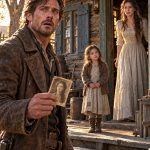
Inside was a pH๏τograph of Daniel’s father standing beside a man Clara recognized.
It was Everett Harlan.
On the back, someone had written:
YOUR FATHER DIDN’T DIE OWING THIS MONEY. HE DIED BECAUSE HE REFUSED TO SIGN THE LAND AWAY.
And beneath that sentence was a name.
A name that made Daniel’s blood run cold when Clara showed him the pH๏τograph.
His own uncle.
The man who had supposedly left Colorado twenty years earlier—and who Daniel had believed was ᴅᴇᴀᴅ.