PART 3 — THE DEED THAT COULD DESTROY THEM BOTH
PART 3 — THE DEED THAT COULD DESTROY THEM BOTH
Samuel had spent ten years building his ranch.
He had bought the first forty acres with the money left after his wife’s death, then worked through summers and brutal winters to purchase another hundred.
Every fence post had been placed by his own hands.
Every barn had been raised with his own labor.
And now Eleanor was telling him that the land might never have belonged to him.
He looked at her.
“How long have you known?”
“Only since I read my mother’s letter.”
“Does your father know you have the deed?”
“I don’t think so. Mother told me she had hidden it somewhere safe. I never knew where.”
Samuel glanced toward the window.
The three riders were approaching the porch.
“Then we’d better find out what they want before they decide to take it.”
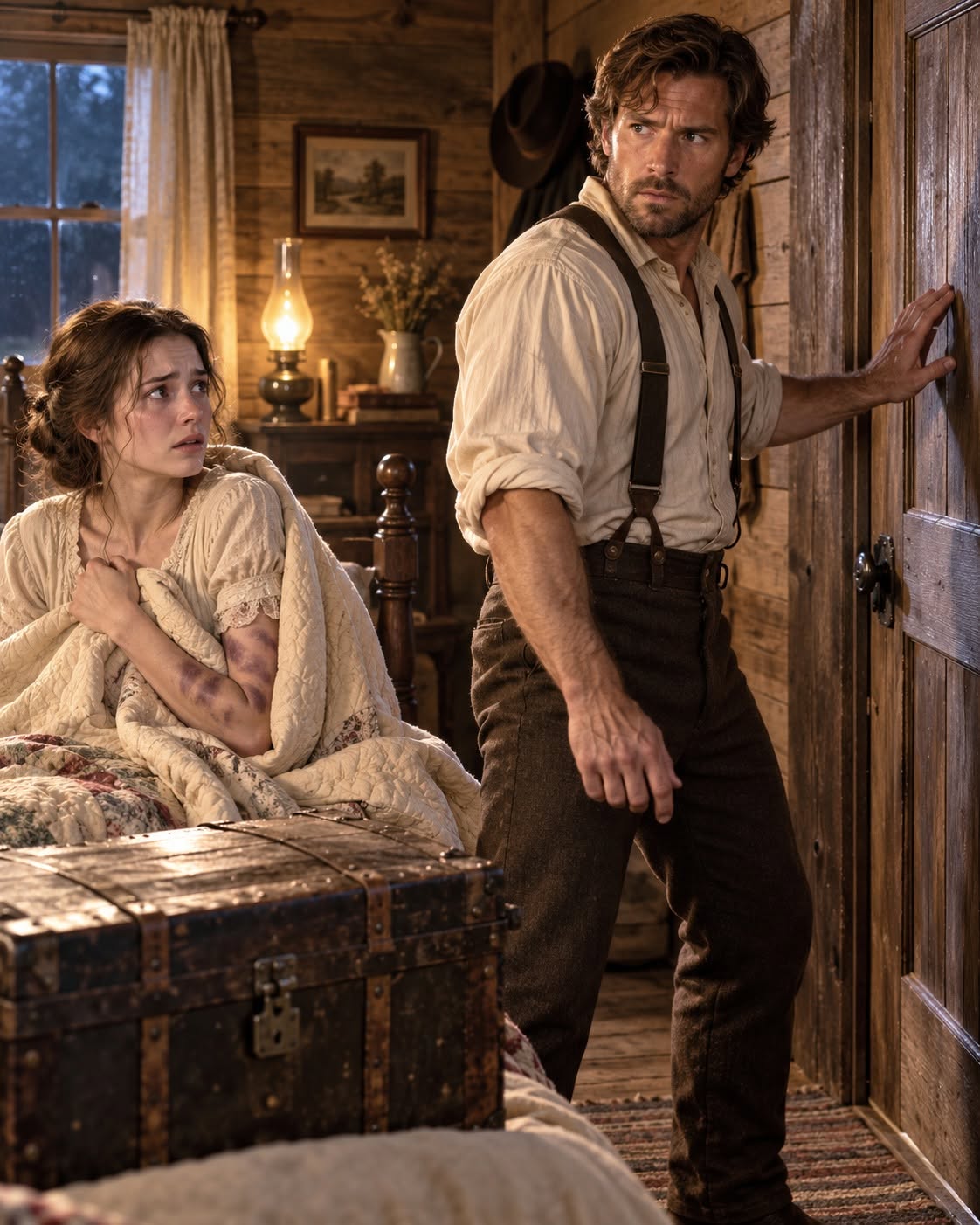
He placed the notebook and pH๏τograph inside the trunk, then carried the trunk into the bedroom.
“There’s a small storage room behind the kitchen. You can wait there if you feel safer.”
Eleanor shook her head.
“I’m tired of hiding.”
Samuel studied her for a moment.
“All right. But you stay beside me.”
He opened the front door.
Thomas Whitaker stood on the porch with two other men.
This time, his pleasant expression had vanished.
“Mr. Bennett. I believe we have unfinished business.”
Samuel leaned against the doorframe.
“You said you were returning with the authorities.”
Thomas glanced at his companions.
“Plans changed.”
One of the men stepped forward and displayed a folded document.
“We have a court order requiring the immediate return of Eleanor Holloway to her legal guardian.”
Samuel examined the paper.
It carried an official-looking seal, but something about the wording seemed strange.
“Which judge issued this?”
Thomas hesitated.
“That’s not your concern.”
“It becomes my concern when you come onto my property demanding my wife.”
Thomas’s eyes narrowed.
“Your wife?”
He laughed bitterly.
“That marriage won’t protect you.”
Eleanor stepped forward.
“Stop lying, Thomas.”
The men turned toward her.
Her voice trembled, but she continued.
“My mother knew what you did. She kept the records. I have them.”
For the first time, Thomas looked genuinely alarmed.
Then his expression hardened.
“You’re a foolish girl. You have no idea what you’re holding.”
“I know you stole money from the company.”
Thomas stepped closer.
“Your father trusted me.”
“My father helped you.”
“Your father is a dying old man who barely remembers his own name.”
Eleanor went pale.
Samuel noticed.
“What’s he talking about?”
Thomas smiled.
“Perhaps your new bride hasn’t mentioned that her father suffered a serious illness last winter. He’s no longer capable of managing his affairs.”
Eleanor looked at him in disbelief.
“That’s impossible.”
“Is it?”
Thomas pulled another paper from his coat.
“This is a declaration appointing me as the administrator of James Holloway’s estate. It gives me authority over his property, his business, and his daughter’s inheritance.”
Samuel examined the signature.
It looked remarkably similar to the one in the notebook.
But Eleanor shook her head.
“My father couldn’t have signed that.”
“Why not?”
“Because he can’t write anymore. His right hand has been paralyzed since February.”
Thomas’s smile vanished.
A heavy silence settled over the porch.
Samuel handed the document back.
“Then I suggest you explain that to the sheriff.”
Thomas stared at him.
For several seconds, he seemed to consider his next words.
Then he leaned closer.
“You have no idea what you’ve involved yourself in, Bennett. You married a woman who is worth more trouble than she’s worth.”
Samuel’s expression became cold.
“Careful.”
Thomas straightened his coat.
“This isn’t finished.”
He turned toward his horse.
But before leaving, he looked at Eleanor.
“Your father wants to see you.”
Eleanor didn’t answer.
“He’s waiting in St. Louis. And he’s not doing well.”
The three men rode away.
Samuel watched until they disappeared beyond the cottonwoods.
Then he turned toward Eleanor.
“Do you believe him?”
She lowered her head.
“I don’t know.”
“Do you want to see your father?”
Her answer came slowly.
“Yes.”
Samuel nodded.
“Then we’ll find out the truth.”
That evening, Eleanor sat beside the kitchen window while Samuel prepared supper.
She had hardly touched her food.
“Samuel?”
“Yes?”
“Why did you answer my advertisement?”
He stopped cutting the bread.
It was an unexpected question.
“I was lonely.”
“That’s all?”
He considered the answer.
“I suppose I wanted someone to talk to at the end of the day. Someone to share the little things with.”
Eleanor looked at her hands.
“I wasn’t looking for a husband when I answered your letter.”
Samuel placed the knife down.
“Then why did you?”
“Because I needed to leave.”
He nodded.
“I suspected as much.”
She looked toward him.
“Does that make you regret marrying me?”
“No.”
“Even knowing my troubles might destroy everything you’ve worked for?”
Samuel pulled out the chair opposite her.
“Eleanor, I didn’t marry a deed or a bank account. I married a woman who deserves to sleep without being frightened of the next morning.”
 Her eyes filled.
He continued.
“But I need you to understand something. You don’t have to remain here because you think you owe me for protecting you.”
Eleanor looked at him for a long time.
Then she whispered:
“Nobody has ever given me a choice before.”
Samuel reached for his coffee.
“Then perhaps it’s time you started making them.”
For the first time that evening, Eleanor smiled.
It was small.
Uncertain.
But it was real.
The following morning, Samuel rode into Abilene to speak with the county clerk.
He wanted to verify the land records before Thomas could make another move.
Eleanor remained at the ranch with the housekeeper, Mrs. Cooper, an elderly widow who had worked for Samuel since the previous spring.
Before Samuel left, he gave Eleanor a small brᴀss key.
“What’s this?”
“The lock on the office cabinet. There’s a telephone in town, but no reason to use it unless you need help. If anyone comes, you don’t have to open the door.”
She nodded.
“Be careful.”
Samuel smiled faintly.
“I intend to be.”
He was gone for nearly five hours.
When he returned, Eleanor immediately noticed his expression.
“What happened?”
Samuel removed his hat.
“The county records show that your mother owned this property before she died.”
Eleanor stood.
“Then Thomas was telling the truth?”
“Not entirely.”
He placed a document on the table.
“Your mother’s land was transferred to your father under a temporary guardianship agreement. That agreement expired when you turned twenty-one.”
Eleanor stared at him.
“So the land should have been mine?”
“According to the original record, yes.”
Samuel tapped the document.
“But there’s another problem. Someone filed a transfer of ownership three months ago. The signature is supposedly yours.”
Eleanor shook her head.
“I never signed anything.”
“I know.”
Samuel placed a second paper beside the first.
“That’s why I spoke with the clerk. He remembers the filing. He said the document was delivered by a man who claimed to be your legal representative.”
“Thomas?”
Samuel nodded.
Then he reached into his coat and removed a small folded note.
“This was attached to the filing.”
Eleanor opened it.
There were only two sentences.
The girl must be found before the original deed reaches the bank.
If she has already married, separate her from the husband immediately.
Eleanor read the words twice.
“Why would they want to separate us?”
Samuel didn’t answer immediately.
Instead, he looked toward the trunk.
“Because your marriage may have changed something they didn’t expect.”
He opened the leather notebook again and searched through the final pages.
There, beneath several financial records, was a clause written in her mother’s handwriting.
Should my daughter marry of her own free will after reaching the age of twenty-one, all property held in trust shall pᴀss directly into her name. No guardian, administrator, or former trustee shall retain authority over it.
Samuel read it aloud.
Eleanor covered her mouth.
Her mother had arranged everything.
The inheritance wasn’t simply waiting for her.
It was protected by her marriage.
Thomas had spent years controlling Eleanor because he needed her signature. But now that she had married Samuel freely, his authority over the estate might have ended permanently.
And that explained his desperation.
Yet the biggest surprise was still waiting.
Samuel turned to the final page.
A name appeared beneath the clause.
Daniel Mercer.
Beside it was a short message:
He knows where the second deed is hidden. Trust him before you trust anyone carrying your father’s seal.
Eleanor stared at the name.
“Daniel Mercer…”
Samuel nodded.
“He disappeared last winter. I heard he was working as a clerk for a land company in St. Louis.”
“Why would my mother trust him?”
Before Samuel could answer, Mrs. Cooper rushed into the room.
“Mr. Bennett!”
Her face was pale.
Samuel stood immediately.
“What is it?”
“A gentleman just arrived. He says he has traveled from St. Louis to speak with Mrs. Bennett.”
Eleanor’s heart began pounding.
“Who?”
Mrs. Cooper swallowed.
“He says his name is Daniel Mercer.”
Samuel and Eleanor exchanged a look.
“Where is he now?” Samuel asked.
“On the porch.”
Samuel walked to the window.
A thin, silver-haired man stood beside a dark horse, holding a leather briefcase.
He looked exhausted.
His coat was dusty, his boots were worn, and one hand trembled as he adjusted his spectacles.
But what caught Samuel’s attention was the small pH๏τograph tucked into the man’s hatband.
It was a pH๏τograph of Eleanor’s mother.
Samuel opened the door.
“Mr. Mercer?”
The stranger nodded.
“Samuel Bennett?”
“Yes.”
Daniel looked past him.
His eyes found Eleanor.
For a long moment, he said nothing.
Then he removed his hat.
“Miss Holloway, I’ve been trying to find you for nearly a year.”
Eleanor stepped forward.
“Why?”
Daniel placed his briefcase on the porch.
“Because your mother didn’t leave you just one inheritance.”
He opened the case and removed a thick envelope.
“She left you the proof that Thomas Whitaker murdered her reputation, stole her property, and arranged for your father to be declared incompetent.”
Eleanor felt her legs weaken.
But Daniel wasn’t finished.
He pulled out one final document.
“This is the original deed. And there’s something else you need to know.”
He looked directly at Samuel.
“Your ranch isn’t the only property Thomas has been trying to steal.”
Samuel frowned.
“What do you mean?”
Daniel unfolded a map.
It showed dozens of properties surrounding Abilene, including Samuel’s ranch.
Every parcel had been marked in red.
At the center was a large piece of land beside the railway.
And beneath it, written in Samuel’s father’s handwriting, were four words:
THE BENNETT FAMILY LAND.
Samuel stared at the map.
His father had died fifteen years earlier.
He had never mentioned owning property in Kansas.
Daniel slowly closed the briefcase.
“Mr. Bennett, your marriage to Eleanor has uncovered something much bigger than an inheritance.”
He lowered his voice.
“Thomas Whitaker has been stealing land from families across this territory for more than twenty years.”
Then he looked at Eleanor.
“And your mother was the only person who ever managed to prove it.”
A distant horse whinnied.
Daniel turned sharply toward the road.
His face changed.
“Someone followed me.”
Samuel moved to the window.
Two riders were approaching from the eastern trail.
But Eleanor recognized the horse in front.
She had seen it in her father’s stable as a child.
It belonged to James Holloway.
Her father was coming.
And when the riders finally reached the porch, the man who dismounted wasn’t the weak, helpless old man Thomas had described.
James Holloway stood straight, his eyes clear and his expression furious.
He looked at Eleanor.
Then at Samuel.
Finally, he spoke five words that shattered everything she thought she knew.
“You married the wrong Bennett, daughter.”
Samuel slowly turned toward his new wife.
Because suddenly, it seemed that her mother hadn’t chosen his advertisement by accident.
And the real reason Eleanor had been sent to Kansas was about to come to light.
To be continued in Part 4.