PART 3 — THE MAN WHO WANTED THE LITTLE GIRL’S LAND
PART 3 — THE MAN WHO WANTED THE LITTLE GIRL’S LAND
The rider stopped outside Eleanor Briggs’s farmhouse just as the last sunlight disappeared behind the Nebraska hills.
His silver-gray stallion stamped impatiently against the dirt.
The man sitting in the saddle wore a dark coat, polished boots, and a broad black hat. A silver watch chain crossed his vest, and his expression suggested that the entire county ought to be grateful he had bothered to visit.
Harlan Voss.
Caleb recognized him immediately.
He stepped onto the porch and closed the door behind him.
“Evening, Voss.”
Harlan removed his hat.
“Mercer. I heard you were back in the neighborhood.”
“Funny. I heard you were supposed to be in Lincoln.”
“I had business closer to home.”
His eyes moved past Caleb toward the kitchen window.
“Is the little Lund girl inside?”
Caleb didn’t move.
“Why are you asking?”
“Because Thomas Lund was a debtor of mine. His affairs need settling.”
“Thomas never mentioned owing you anything.”
Harlan gave a thin smile.
“Then perhaps Thomas wasn’t as honest with you as you believed.”
Caleb stepped down from the porch.
“Careful.”
The word was quiet, but it carried enough warning to make Harlan’s smile disappear.
“I didn’t come here to argue,” Harlan said. “I came to make arrangements for the child.”
“What arrangements?”
“Her father is ᴅᴇᴀᴅ. She’s a minor. She needs a proper home. I have already spoken with a family in town willing to take her.”
Caleb stared at him.
“You found a family to take a child before her father’s body was even buried?”
“Some people are capable of acting quickly.”
“Some people are capable of showing up when a little girl is in trouble. You weren’t one of them.”
Harlan’s face darkened.
“Don’t confuse your temporary kindness with legal authority, Mercer. You have no relation to that child.”
“Neither do you.”
“That remains to be seen.”
Harlan reached inside his coat and produced a folded document.
“Thomas signed an agreement last spring. If he failed to repay his outstanding obligation, the western pasture would transfer to me. His daughter cannot inherit property burdened by debt.”
Caleb took one step closer.
“Let me see it.”
Harlan held the paper just out of reach.
“You wouldn’t understand the terms.”
“I understand enough to know Thomas paid his debts.”
“Then you should have encouraged him to keep better records.”
Caleb’s eyes narrowed.
“What does that mean?”
“It means the original agreement is missing. And without it, there’s very little anyone can prove.”
For several seconds, neither man spoke.
Then Harlan folded the document and returned it to his pocket.
“I’ll be back tomorrow. I expect the child to be ready.”
“She isn’t going anywhere with you.”
Harlan mounted his horse.
“We’ll see about that.”
He turned toward the road, but before riding away, he looked over his shoulder.
“One more thing, Caleb. Thomas was a stubborn man. He made the mistake of believing a piece of land was worth more than his own peace.”
Caleb watched him disappear into the darkness.
Then he returned inside.
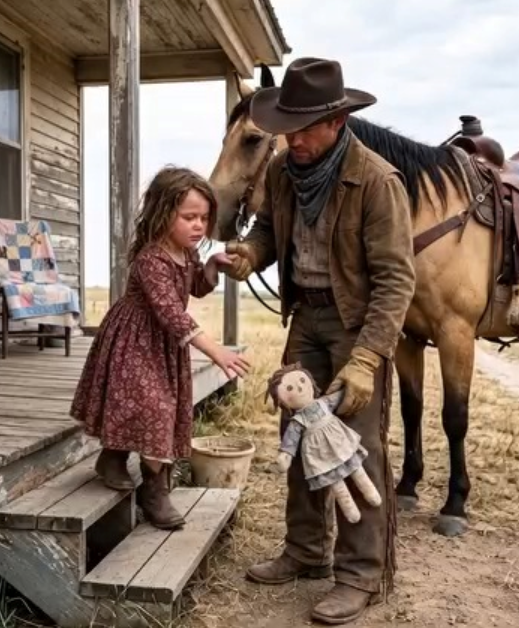
Eleanor was standing in the kitchen doorway. Phoebe sat at the table, holding Miss Prine.
“Was that the bad man?” she whispered.
Caleb nodded.
“Yes.”
“Is he taking our house?”
Caleb pulled out the chair beside her.
“No, Phoebe. Not tonight.”
 “But Papa said the western pasture belonged to us.”
“Your papa was right.”
She studied his face.
“Can you make the bad man go away?”
Caleb didn’t promise something he couldn’t guarantee.
But he did make another promise.
“I can find out what he wants. And I can make sure he doesn’t get to decide your future without anyone standing up for you.”
Phoebe considered that answer.
Then she placed Miss Prine on the table.
“Papa said you would know what to do.”
Caleb looked down at the doll.
For the first time that evening, he felt the weight of the promise Thomas had left behind.
The next morning, Caleb rode into Deshler.
He went straight to the sheriff’s office, where Sheriff Walter Briggs was reviewing the documents from Thomas Lund’s property.
Walter was Eleanor’s younger brother, a broad-shouldered man with a patient temperament and a reputation for refusing to be intimidated.
He listened as Caleb described Harlan’s visit.
When Caleb finished, Walter leaned back.
“Voss has been asking about that property for months.”
“Why?”
“There’s water beneath the western pasture. A natural underground spring. Thomas discovered it while repairing his well.”
Caleb frowned.
“That’s not unusual.”
“No. But the spring feeds a small creek that crosses several neighboring farms. Voss has been buying the surrounding parcels. If he gets Lund’s forty acres, he’ll control the last stretch of land between his holdings and the creek.”
Caleb understood.
The forty acres weren’t valuable because of the grᴀss.
They were valuable because of the water.
“Has Thomas ever signed anything giving Voss the land?”
“Not that I’ve found.”
“Then where did Voss get that agreement?”
Walter tapped the desk.
“That’s what I’d like to know.”
He opened a drawer and removed a thin folder.
“Thomas came to see me in July. He said Voss had offered him money for the western pasture. Thomas refused. Two weeks later, Voss produced a document claiming Thomas had already agreed to sell.”
“Did Thomas bring proof?”
“Yes. He said he had a deed and a payment record that would settle the matter. He promised to bring them back the following week.”
Caleb’s stomach тιԍнтened.
“Did he return?”
“No.”
The sheriff looked toward the window.
“Now he’s ᴅᴇᴀᴅ, and Voss is trying to take the child.”
Caleb placed Thomas’s note on the desk.
Walter read it carefully.
“Where did you get this?”
“Phoebe kept it in her doll. Thomas told her to give it to me if something happened.”
Walter looked up.
“Then Thomas believed you could help him.”
Caleb stared at the paper.
“I should have come sooner.”
“Perhaps. But guilt won’t help that little girl now.”
The sheriff stood.
“We need the original deed, the payment records, and someone who can establish whether Thomas signed Voss’s agreement.”
“Where would Thomas keep them?”
Caleb thought for a moment.
Then he remembered something.
During the cattle drive, Thomas had shown him a small wooden box beneath the floorboards of his bedroom. He had laughed when Caleb asked why he kept it there.
“Because a thief looks in cupboards,” Thomas had said. “A sensible man looks where nobody wants to crawl.”
Caleb grabbed his hat.
“The farmhouse.”
By noon, Caleb and Sheriff Briggs were back at the Lund homestead.
The house looked smaller in daylight.
The curtains hung motionless. The chickens scratched near the well, and a child’s wooden wagon sat beside the porch.
Phoebe wasn’t with them. Eleanor had insisted she remain at her house until the situation was settled.
Caleb entered the bedroom.
The bed had been stripped, and the room had been cleaned by the undertaker. Yet the untouched glᴀss of water remained on the chair.
Caleb picked it up and carried it to the kitchen.
Then he noticed something.
A narrow gap between two floorboards near the pantry.
He knelt and pressed his fingers against the wood.
One board shifted.
Beneath it was a small iron ring.
Walter helped him lift the loose panel.
A wooden box lay underneath.
Caleb pulled it out and wiped away the dust.
Inside were several folded receipts, a county survey, and a sealed envelope bearing Thomas’s handwriting.
The sheriff examined the documents.
“These are the original payments.”
Caleb counted them carefully.
Every payment Thomas claimed to have made was recorded.
The final receipt was there too.
Dated August 14.
Stamped and signed by the bank.
Thomas Lund had paid his mortgage in full.
Harlan Voss had no legitimate claim to the property.
But the envelope contained something even more important.
Caleb opened it.
Inside was a letter addressed to him.
Caleb,
If you’re reading this, I hope it means you found Phoebe before the wrong people did.
I know I asked you to come back and help me. I know you were busy, and I don’t blame you for having a life of your own.
But Voss has become dangerous in ways I cannot explain in a letter.
He doesn’t simply want my land. He wants the spring beneath it. He has offered money, threatened legal action, and now claims I signed an agreement I never signed.
I have proof that he altered the county records. I have also discovered that someone inside the courthouse is helping him.
There is one more thing.
If anything happens to me, don’t let anyone convince Phoebe that she has no family. Her mother left something behind that I never had the courage to show her.
Look inside Miss Prine.
Caleb stopped reading.
He read the final sentence again.
Look inside Miss Prine.
Walter glanced at him.
“What is it?”
Caleb handed him the letter.
For a moment, the sheriff said nothing.
Then he looked toward the empty bedroom.
“Thomas knew someone might come after the child.”
“And he hid the proof with her.”
Caleb folded the letter.
“No. He hid something else with her. Something her mother left behind.”
That evening, Caleb returned to Eleanor’s farmhouse.
Phoebe was sitting on the floor beside the fireplace, arranging wooden blocks into a little house.
When she saw him, she jumped up.
“Did you find Papa’s things?”
Caleb knelt.
“Yes. We found some papers that prove your papa owned his land.”
Phoebe’s face brightened.
“So the bad man can’t take it?”
“Not if we can help it.”
She looked down at Miss Prine.
“Papa said you might want to see her.”
Caleb gently held out his hands.
“May I?”
Phoebe hesitated, then gave him the doll.
Miss Prine was old and worn. One ʙuттon eye had been replaced with a small black bead, and the sтιтching along her back looked different from the rest.
Caleb turned her over.
There was a tiny seam beneath the doll’s faded blue dress.
He carefully examined it.
Eleanor brought a pair of small sewing scissors.
With Phoebe watching closely, Caleb opened the seam.
A folded piece of cloth slipped out.
Inside it was a small silver locket.
Phoebe gasped.
“That’s Mama’s!”
Caleb opened the locket.
Inside was a tiny pH๏τograph of a young woman holding a newborn baby.
On the back, someone had written:
For Phoebe, when she is old enough to know the truth.
But there was another paper tucked behind the pH๏τograph.
A name.
An address in Omaha.
And a sentence that made Caleb look at the sheriff, who had just entered the room.
“If Thomas is gone, take Phoebe to her grandmother. Do not let Harlan Voss find her first.”
Phoebe looked between the adults.
“Who’s my grandmother?”
Caleb stared at the address.
He had expected to find evidence of a land fraud.
He had not expected to discover that Phoebe had family she had never known.
And if Thomas had hidden her grandmother’s name inside a doll, then perhaps the little girl had been kept away from someone for a reason.
Outside, a wagon rolled to a stop.
A woman stepped down.
She was dressed in black, carrying a small leather traveling case. Her eyes moved from the sheriff to Caleb, then settled on Phoebe.
The moment she saw the child, her face changed.
“Phoebe?”
The little girl stepped behind Caleb.
The woman began to cry.
“I’ve been looking for you for five years.”
Caleb stood slowly.
“Who are you?”
The woman opened her traveling case and removed a pH๏τograph.
It showed the same young woman pictured inside the locket.
“My name is Margaret Lund,” she said. “I am Phoebe’s maternal grandmother.”
Then she looked directly at Caleb.
“And I believe Harlan Voss has been lying about why Phoebe’s mother died.”
TO BE CONTINUED — PART 4: THE GRANDMOTHER WHO KNEW THE SECRET