PART 3 — THE DOCUMENT THAT COULD DESTROY THEIR MARRIAGE
PART 3 — THE DOCUMENT THAT COULD DESTROY THEIR MARRIAGE
For several seconds, I could hear nothing but the rain.
The paper lay between us, its edges curling from the damp air. I recognized the legal language, the county seal, and the description of Willow Creek Valley.
But I did not recognize the signature.
Someone had written my name in a careful imitation of my handwriting.
Someone had also made a terrible mistake.
“Deputy Price,” I said quietly, “when was this filed?”
“Yesterday morning.”
“And when does it claim I signed it?”
“August twenty-first.”
I looked at Wyatt.
“My father died on August nineteenth.”
The deputy nodded.
“That’s correct.”
“I was in Willow Creek Valley that entire week. I did not travel to town, and I certainly did not sign away my inheritance.”
Wyatt reached for the document.
“Who submitted it?”
“A man named Silas Crowe.”
The name changed the atmosphere in the room.
Hollis, who had been standing near the door, muttered something under his breath.
Wyatt’s expression hardened.
“Crowe has no business with my wife’s property.”
“Apparently, he believes otherwise,” the deputy replied. “He claims he purchased the water rights through an authorized representative.”
“Who?”
The deputy looked at the document.
“Samuel Bell.”
I frowned.
“I don’t know anyone by that name.”
Wyatt leaned forward.
“Samuel Bell is Crowe’s land agent.”
The deputy nodded.
“Mr. Crowe says he had Mrs. Mercer’s consent. He also says the water rights were part of a larger agreement involving this ranch.”
I felt a coldness spread through me.
“That’s why he came.”
Wyatt looked at me.
“Who?”
“Silas Crowe. He didn’t come after the valley because he wanted the land. He wanted the water.”
I walked to the pantry and returned with the old account book I had found behind a stack of spoiled grain.
For three days, I had been studying the ranch’s records while cooking and cleaning. Wyatt had never asked what I was doing with the books, and I had not thought it necessary to explain.
Now I opened the ledger to a page marked with a strip of blue cloth.
“Your cattle have been drinking from Willow Creek for years,” I said. “But the amount recorded here doesn’t match the number of animals on the ranch.”
Wyatt frowned.
“That’s because the western herd was moved to the lower pasture.”
“No. Look at the dates.”
 I placed my finger on the first entry.
“Three weeks ago, someone recorded a payment for water access. Then another payment two days later. And another the following week.”
Wyatt studied the page.
“I never authorized these.”
“Exactly.”
The deputy stepped closer.
“Those payments were made to whom?”
I turned another page.
“Silas Crowe’s company.”
Wyatt’s face darkened.
“He has been charging me for water that belongs to my wife?”
“Not just that,” I replied. “Look at the quanтιтies.”
The figures were wrong.
Someone had been recording more cattle than the ranch actually owned, then using those inflated numbers to justify larger payments.
But there was something else.
At the bottom of the page, a small mark appeared beside several entries.
A crooked little star.
I had seen it before.
On the forged document.
“Deputy, may I see the paper again?”
He handed it to me.
I placed the ledger beside the document.
“There. The same mark.”
Wyatt leaned closer.
“What does it mean?”
“I don’t know yet. But whoever wrote these accounts used the same symbol on the supposed transfer of my water rights.”
The deputy took a closer look.
“That’s not a county marking.”
“No,” I said. “It’s a private mark.”
I turned the ledger toward Wyatt.
“Someone has been using your ranch records to create false debts. And someone has been using my name to transfer land that was never theirs to sell.”
Wyatt stared at the pages.
For the first time, I saw something beyond anger in his expression.
Fear.
Not for himself.
For what the discovery meant.
“If Crowe has been collecting money from us for water,” he said, “he has also been building a claim against the valley.”
“Which means he could try to take it through the courts,” I answered.
The deputy closed his document case.
“I’ll need to take these papers to the county office. But I must warn you, Crowe has already requested an emergency hearing.”
“When?” Wyatt asked.
“Monday morning.”
It was Saturday night.
We had less than two days.
After the deputy left, Wyatt remained at the kitchen table, studying the ledger.
“You found all this while I was out with the herd?”
“I found it while I was making supper.”
He looked at me.
“You were cooking and examining ranch accounts?”
“And cleaning the pantry.”
A faint, embarrᴀssed expression crossed his face.
“I suppose you were right about the kitchen.”
“I’m not interested in being right about the kitchen, Wyatt. I’m interested in keeping my father’s land.”
He nodded slowly.
“Then we’ll keep it.”
I wanted to believe him.
But the next morning brought a surprise neither of us expected.
A black carriage stopped outside the ranch house.
A woman stepped down, wearing a dark traveling dress and a hat decorated with a silver pin.
I recognized her immediately.
Mrs. Beatrice Langley.
She had been my father’s closest neighbor for twenty years and one of the few people who had visited him during his final illness.
She entered the house without waiting to be invited.
“Mrs. Mercer,” she said, “I wish I had come sooner.”
I offered her a chair.
“Is something wrong?”
She looked at Wyatt, then at the door.
“I need to speak about your father.”
My heart тιԍнтened.
“What about him?”
Beatrice removed a folded letter from her handbag.
“Three days before he died, your father came to my house. He was frightened.”
“Father was never frightened.”
“He was afraid of Silas Crowe.”
I felt my throat тιԍнтen.
She placed the letter in front of me.
“Your father told me Crowe had offered him a large sum of money for the valley. When he refused, Crowe threatened to make sure you would never inherit it.”
I opened the letter.
The handwriting was unmistakable.
My father’s.
My dearest daughter,
If anything happens to me, do not trust any document that claims to transfer Willow Creek. I have made arrangements to protect the land, but the original papers must remain hidden until you are ready to claim them.
The water is more valuable than anyone in town understands.
Remember what I told you about the old mill.
I read the final sentence twice.
The old mill.
It had been abandoned for nearly twenty years, standing beside the upper creek with its roof half-collapsed and its wooden wheel broken.
I looked at Beatrice.
“Did Father tell you what was hidden there?”
She shook her head.
“He only said the truth was somewhere Crowe would never think to look.”
Wyatt rose from his chair.
“Then we’ll go there.”
“Not yet,” Beatrice said.
She reached into her handbag again.
This time, she produced a small envelope sealed with red wax.
“Your father asked me to give you this only if someone tried to take the valley.”
My fingers trembled as I opened it.
Inside was a single brᴀss key and a short note.
The old mill holds the first answer. But the second is buried where the water changes direction.
I looked up.
“What does that mean?”
Beatrice’s face had gone pale.
“I believe your father was talking about the underground channel.”
Wyatt moved closer.
“What underground channel?”
“Before the valley became valuable, your wife’s grandfather built a hidden water channel to protect the spring during drought. It was never included on the county maps.”
I stared at the key.
“If Crowe finds it, he could control the entire water supply.”
Beatrice nodded.
“And there is something else.”
She hesitated before continuing.
“Silas Crowe has already sent men to the old mill. They arrived yesterday afternoon.”
Wyatt reached for his coat.
“Then we’re going now.”
I stood.
“No.”
He turned.
“No?”
“We’re not riding into the storm with no plan, no supplies, and no idea how many men Crowe has sent.”
“We don’t have time to wait.”
“We don’t have time to make a foolish mistake, either.”
I walked to the pantry and began gathering supplies.
Bread. Cheese. Dried meat. Water. Lantern oil. Rope. A blanket. The medicine chest.
Wyatt watched me.
“You’re coming?”
“It’s my father’s land.”
“You could be in danger.”
“So could you.”
He looked as though he wanted to argue.
Then he noticed the wagon already waiting outside.
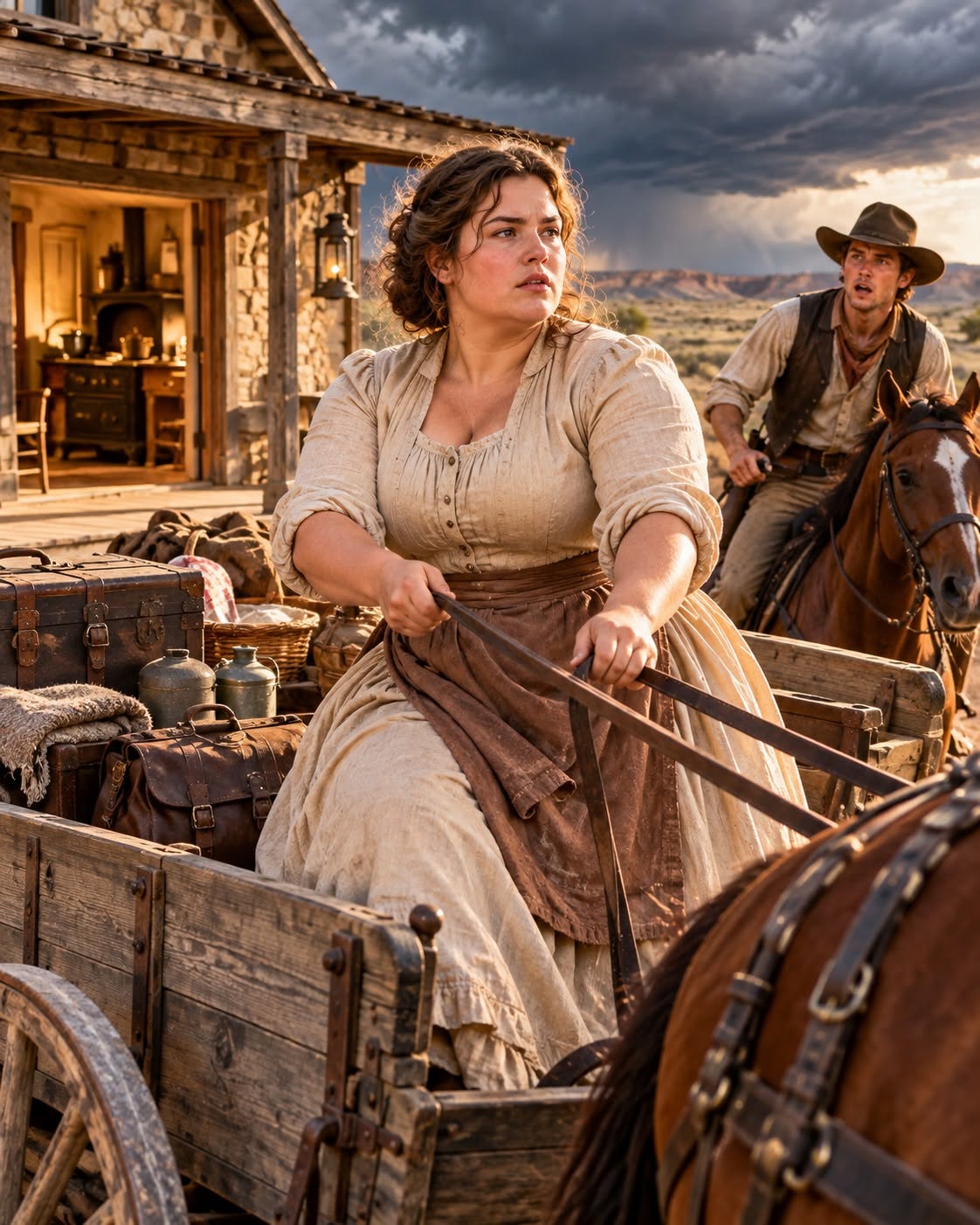
The same wagon I had driven through the ravine.
He nodded.
“All right, Mrs. Mercer. You lead.”
We reached the old mill shortly before noon.
The place looked exactly as I remembered it. The broken wheel stood beside the creek, and wild grᴀss had grown through the old wooden floor.
But fresh tracks marked the mud.
Several horses.
A wagon.
And boot prints leading inside.
Wyatt signaled for Hollis to stay near the horses while we approached.
The door hung open.
Inside, a lantern burned on the floor.
Someone had been there recently.
I used the brᴀss key on a narrow iron box hidden beneath the mill’s old workbench.
The lock turned.
Inside lay a folded map, a bundle of letters, and a small leather book.
I opened the book first.
It contained the original water records from my grandfather’s time.
But the map was what made Wyatt stop breathing.
It showed Willow Creek Valley in extraordinary detail, including the underground channel and every point where water entered the property.
A red line marked a second spring beneath the northern ridge.
“There’s another source?” Wyatt whispered.
I nodded.
“And it runs beneath the land Crowe has been trying to purchase.”
Then I noticed the final page.
It was a list of names.
Several belonged to county officials.
One belonged to the local sheriff.
And the last name made my blood turn cold.
Wyatt Mercer.
Beneath it was a handwritten note:
The rancher knows more than he admits. If he refuses to cooperate, remove him from the agreement.
I slowly turned toward my husband.
“Wyatt?”
He had gone completely still.
His eyes were fixed on the page.
“Tell me,” I whispered, “why your name is written here.”
He did not answer immediately.
Instead, he reached into his coat and pulled out a folded letter.
It was old, stained, and sealed with a mark I recognized.
The crooked star.
“I was going to tell you,” he said.
My heart began to pound.
“Tell me what?”
Wyatt looked at the letter, then at me.
“Your father didn’t choose me by accident.”
I stepped back.
“What are you saying?”
He lowered his voice.
“Before he died, he came to me. He told me Crowe was planning to steal the valley. He asked me to marry you because he believed I was the only man in the county Crowe couldn’t easily control.”
I stared at him.
“You knew?”
“I knew he was afraid. I knew the valley was in danger. But I didn’t know about the forged papers or the hidden spring.”
“Then why didn’t you tell me?”
Wyatt’s expression changed.
“Because I made a promise to your father.”
“What promise?”
He held out the old letter.
“To protect you until you discovered the truth yourself.”
I looked at him, unable to speak.
Then a sound came from outside.
A horse whinnied.
Hollis shouted.
Wyatt moved toward the door.
But before he could reach it, a voice rang out from the other side.
“Step away from the papers, Mercer!”
Silas Crowe stood in the doorway with four armed men behind him.
His smile was thin and cold.
“Thank you for finding what I spent ten years searching for.”
He looked directly at me.
“Now, Mrs. Mercer, I’m afraid you’ll have to make a choice.”
He raised a folded document.
“Your husband can keep his ranch, or you can keep your valley.”
Then he smiled.
“But you cannot have both.”
And behind him, one of his men dragged Hollis into the mill.
Hollis’s hands were tied.
His face was bruised.
And he was holding something I had never seen before.
My father’s wedding ring.
End of Part 3.