PART 2 — THE MOUNTAIN TRAPPER’S UNEXPECTED BID
PART 2 — THE MOUNTAIN TRAPPER’S UNEXPECTED BID
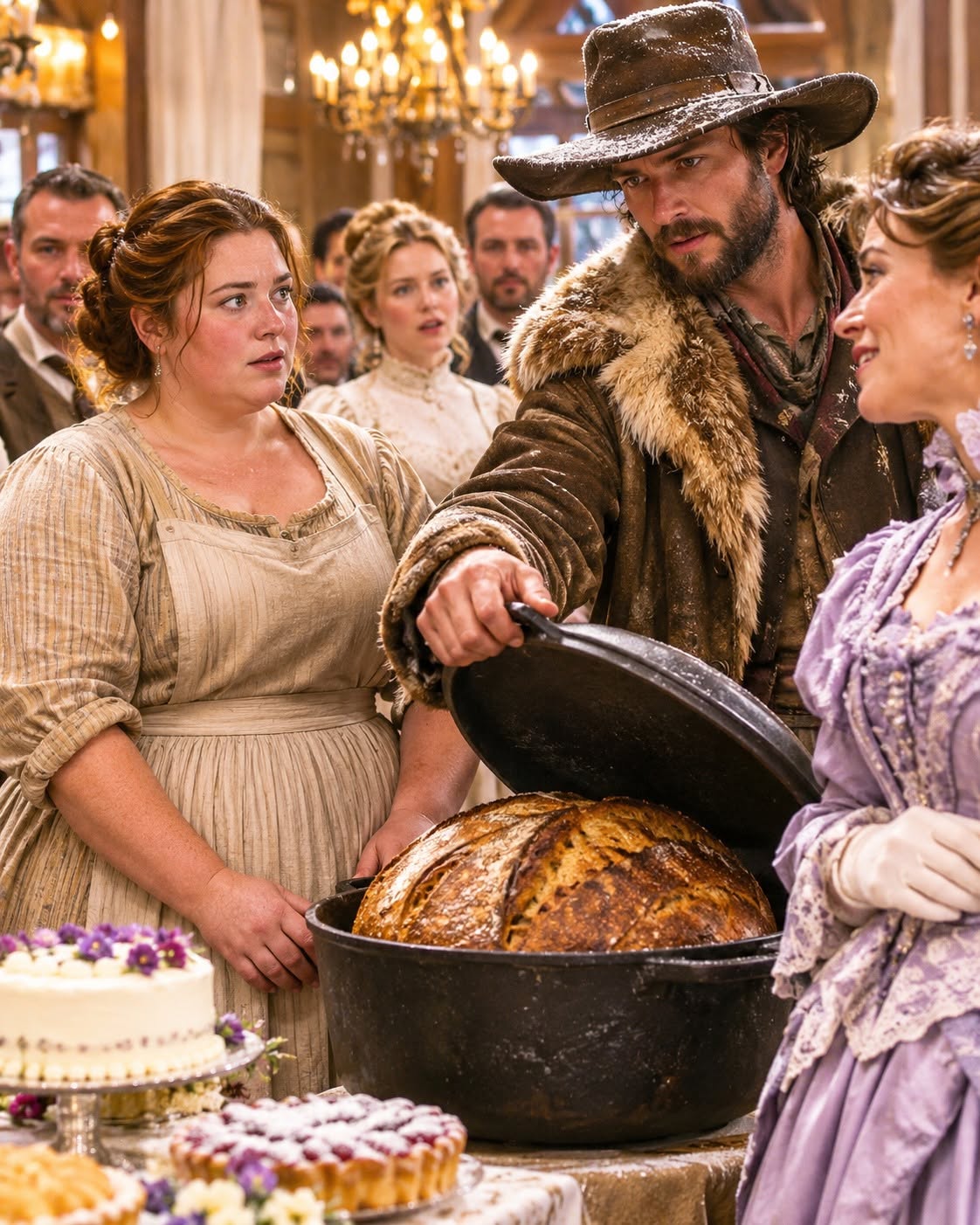
Harlan Jessup lifted the loaf with both hands.
It was heavier than it looked.
He turned it slowly, examining the dark crust, the deep scoring, and the golden flour dusted across its surface.
Then he pressed one broad thumb against the bottom.
A hollow sound answered him.
His eyebrows rose.
“Who made this?”
Harriet swallowed.
“I did, sir.”
“How long did you let it rise?”
“Almost eighteen hours. The weather was cold, so I had to keep it near the kitchen stove.”
“And the flour?”
“Half wheat, half rye. I ground the toasted oats myself.”
Harlan looked at her again.
“You know what you’re doing.”
Harriet wasn’t sure how to respond.
Nobody in Bitter Creek had ever asked her about the bread itself.
Pearl leaned toward Josephine and whispered loudly enough for half the room to hear.
“Perhaps Mr. Jessup has never seen a proper cake before.”
A few people chuckled.
Harlan ignored them.
He placed the loaf back inside the Dutch oven and looked toward Mayor Higgins.
“How much are you asking?”
The mayor blinked.
“Well, Mr. Jessup, we’re accepting bids. The proceeds go toward repairing the church roof.”
Harlan reached into his coat and removed a small leather purse.
“Five dollars.”
The room went silent.
Five dollars.
That was more than the angel food cake had brought.
Pearl’s smile disappeared.
“Five dollars for that?”
Harlan turned his head.
“Would you prefer I offer six?”
Nobody laughed.
He placed five silver dollars on the table.
“Sold?”
The mayor looked at Harriet.
“Miss Whitcomb?”
 Harriet could barely speak.
“Yes, sir.”
Harlan nodded once.
“Good.”
He picked up the heavy pot.
But instead of walking toward the refreshments, he turned to Harriet.
“Can you make another one?”
She stared at him.
“Another loaf?”
“Exactly like this.”
“How many?”
“Four.”
Harriet’s heart began beating faster.
“Four?”
“Four loaves every week. Perhaps more if the first batch turns out as well as I expect.”
Pearl stepped forward.
“Mr. Jessup, surely you aren’t serious. That’s ordinary boardinghouse bread.”
Harlan studied her.
“Then why did you spend the entire evening talking about it?”
Pearl’s mouth fell open.
Harriet lowered her eyes to hide her astonishment.
Harlan continued.
“I spend most of my winters in the mountains. A man working a trapline needs food that lasts. Your fancy cakes might look pretty on a table, but they won’t keep a man warm through a fourteen-hour day.”
He looked at Harriet.
“This bread will.”
For the first time in years, Harriet felt someone had seen the value of something she had made.
Not her appearance.
Not her father’s old boardinghouse.
Her work.
“I could make four,” she whispered.
“Good. I’ll pay you one dollar per loaf.”
Josephine nearly dropped her teacup.
“One dollar?”
Harlan nodded.
“More if the quality holds.”
Harriet looked at the five dollars on the table.
It was enough to buy flour, firewood, and several weeks of groceries.
But the most astonishing part was that Harlan had not finished speaking.
“I also need a cook.”
Harriet blinked.
“A cook?”
“My cabin sits near the northern ridge. I’m planning to bring two men up there before the snow closes the pᴀss. We’ll be repairing the old supply shed and preparing provisions for winter.”
He paused.
“I need someone who understands bread, preserves, dried meat, and keeping a kitchen running.”
Harriet’s face grew warm.
“I’ve never worked in a mountain camp.”
“You’ve run a boardinghouse kitchen alone. That’s more experience than most men I’ve hired.”
The room was completely silent.
Then Josephine found her voice.
“But Mr. Jessup, surely you don’t intend to take a young woman into those mountains?”
Harlan looked at her.
“Why not?”
“It’s dangerous. And she isn’t exactly suited to mountain work.”
Harriet felt the familiar sting.
She had heard those words all her life.
Too heavy.
Too slow.
Too ordinary.
But Harlan’s expression didn’t change.
“Can she cook?”
“Yes,” Josephine replied reluctantly.
“Can she make bread?”
“You can see that she can.”
“Then I reckon she’s suited enough.”
He turned back to Harriet.
“I’ll be leaving in three days. You can decide before then.”
He placed a small card beside the silver dollars.
An address.
A time.
And a simple promise.
Seven dollars for the first week’s work, plus supplies.
Harriet stared at the card.
Seven dollars.
Her father’s boardinghouse had been losing money for months. The roof leaked, the flour merchant had stopped extending credit, and the bank had sent a notice about the overdue mortgage.
She desperately needed the work.
But the thought of leaving Bitter Creek with a man whose name frightened half the town made her hesitate.
“Why me?” she finally asked.
Harlan was quiet for a moment.
“Because when I lifted that lid, I smelled the kind of bread my mother used to make.”
His voice softened.
“She died when I was sixteen. During the winters, she’d bake two loaves every Sunday. One for the table and one for whoever came through the door hungry.”
He looked down at the pot.
“I haven’t smelled bread like that in twenty years.”
Harriet’s throat тιԍнтened.
Before she could answer, a sharp voice interrupted them.
“Harriet!”
It was Mr. Barlow, the flour merchant.
He approached with a folded paper in his hand.
“I’m glad I found you. Your father’s account is overdue. Unless I receive payment by Monday, I’m taking the remaining equipment as collateral.”
Harriet went pale.
“Mr. Barlow, I only need another week.”
“You’ve had six.”
Harlan turned toward the merchant.
“How much?”
“That’s between Miss Whitcomb and me.”
“How much?”
Barlow named the amount.
Harlan counted several bills from his purse and placed them on the table.
“Consider it paid.”
Harriet stared at him.
“Mr. Jessup, I cannot let you—”
“It’s an advance against the work.”
“But—”
“You’ll earn it.”
He picked up the Dutch oven.
Then he looked at Harriet with an expression she would remember for years.
“Three days, Miss Whitcomb. Don’t let these people convince you that your hands aren’t worth something.”
And with that, he walked out into the November snow.
Harriet remained beside her table, holding the five dollars.
Behind her, Pearl whispered:
“She’s going to regret this.”
But Harriet wasn’t listening.
She was looking at the card.
For the first time since her father’s death, she had a reason to imagine a future beyond the boardinghouse kitchen.
She didn’t know that Harlan Jessup had a secret of his own.
And that the moment she stepped onto his mountain property, she would discover why he had been living alone for nearly fifteen years.