THE SOURDOUGH QUEEN OF CROW RIDGE: THE HEARTH THAT WOULD NOT DIE
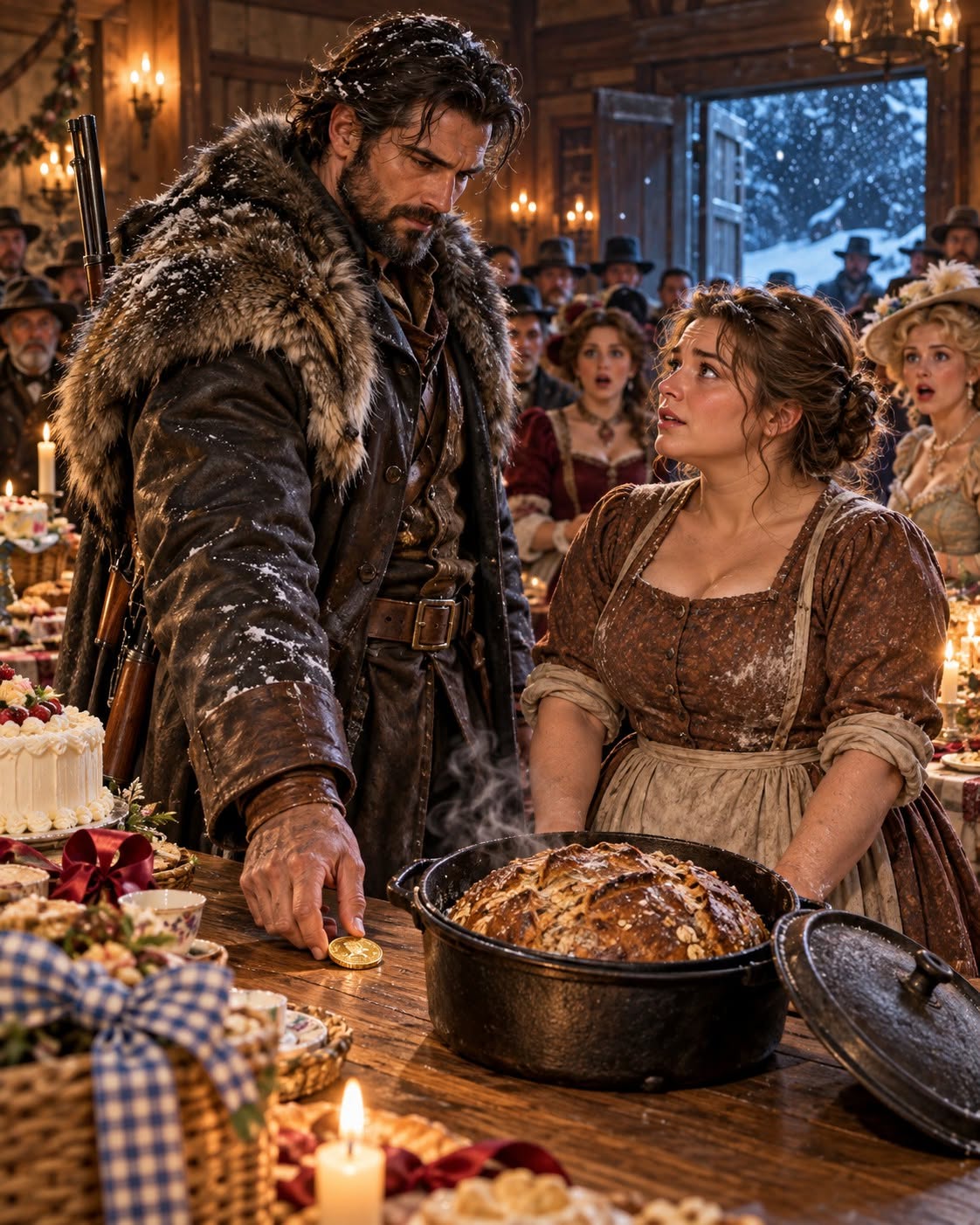
THE SOURDOUGH QUEEN OF CROW RIDGE: THE HEARTH THAT WOULD NOT DIE
(Part 2)
The smell of pulverized lime, cold soot, and smashed brick drifted out into the mountain clearing.
Matilda stood in the doorway of the abandoned trading post on Crow Ridge, her fingers sinking into the rough cedar jamb. Inside, the ancient brick masonry of the bake oven lay scattered across the pine floorboards like broken bones. The iron door hung twisted on a solitary hinge, and across the raw timber of the front entrance, crude black axle grease spelled out the cruel mandate:
SHE DOESN’T BELONG HERE EITHER.
Silas Crowe didn’t touch the grease. He knelt on one knee in the mountain frost outside the threshold, his mᴀssive, scarred hands hovering over the frozen red clay.
“Three horses,” Silas said, his voice dropping into a low, gravelly timbre that vibrated against the timber walls. “Two shod in common iron. One sporting a left hind shoe with an offset toe calk.”
Matilda looked at him, wrapping her mother’s thick wool shawl around her wide shoulders. “An offset calk?”
“A blacksmith’s trick for an overreaching trotter,” Silas murmured, rising slowly to his full seven feet. His dark eyes flicked toward the valley below, where the smoke of Pine Creek curled into the cold blue sky. “There’s only one horse in this territory that steps with that gait. Mayor Thaddeus Vance’s thoroughbred carriage mare.”
Matilda felt the blood drain from her face. “The mayor? But why would the mayor care about a woman baking bread outside town limits?”
“Because Vance doesn’t just run the town council, Matilda,” Silas answered, stepping inside and gently clearing a section of broken brick with his boot. “He owns the Pine Creek Mercantile, the flour exchange, and the valley gristmill. For five years, Vance has been charging the mountain miners four dollars a sack for gray, weevil-spoiled flour and twelve cents a loaf for stale bakery swill that turns green in two days. You began feeding his customers honest loaves of hearty sourdough at eight cents, made from clean northern grain.”
Silas turned to face her, his stern, bearded countenance softened by an unmistakable ember of fierce admiration.
“You didn’t just hurt Evelyn’s vanity at the box social, Matilda. You threatened her father’s monopoly.”
A carriage didn’t appear then, but the rumble of heavy wagons did.
Coming up the northern logging road were two heavy freight wagons loaded with split mountain granite, white river clay, and six mᴀssive timber cutters wearing flannel coats and carrying broadaxes. At their head walked Caleb, the young lumberjack who had brought the warning.
Caleb jumped down, looking at the smashed brick, then at Matilda.
“Miss Hayes,” Caleb said, pulling off his beaver-skin cap. “The boys heard someone tried to starve our kitchen. We brought stone from the high quarry and fireclay from the creek bank. If you can keep the starter bubbling, we’ll build you an oven that a team of oxen couldn’t crack.”
Tears stung Matilda’s eyes, H๏τ and sudden against the biting wind.
All her life, she had been told she took up too much room, worked too hard with her hands, and carried none of the fragile charm that made a woman worthy of protection. Yet here stood seven rough-hewn giants of the timber, their sleeves rolled high in the freezing air, ready to raise an empire of stone just to keep her fire lit.
“Well,” Matilda said, wiping her face with the corner of her apron and rolling up her sleeves, revealing strong, capable forearms. “I’m not about to let good river clay go cold. Who knows how to mix mortar?”
For forty-eight hours, the clearing on Crow Ridge was a forge of labor and laughter.
The men hauled granite boulders, chipping them flat with cold chisels. Silas worked alongside Matilda, his immense strength hoisting five-hundred-pound lintel stones into place with rhythmic, effortless grace. Matilda directed the internal flue geometry, drawing the curves her grandfather had used in the old country to trap radiant heat and create the deep, cracking crust that made her loaves legendary.
By Sunday evening, the trading post held a fortress: a double-arched stone hearth reinforced with forged iron straps, retaining enough heat to bake forty loaves at a single firing.
The first test batch came out at dawn on Tuesday.
The aroma of toasted wheat, caramelized sourdough crust, and sweet yeast carried on the mountain breeze, rolling down the gulch toward the freight trails like a siren call. By ten in the morning, thirty miners from the Silver Ledge diggings had arrived on muleback, their pockets clinking with silver dollars.
They bought every loaf before the crusts had even cooled.
Then, just past noon, the rhythmic clatter of carriage wheels broke through the pine trees.
A shiny black phaeton pulled up into the clearing, flanked by four mounted riders in town dusters. The lead horse was an elegant chestnut mare—bearing an offset iron calk on her left hind shoe.
Stepping down from the carriage was Mayor Thaddeus Vance, dressed in an immaculate velvet-collared coat, followed by Mr. Alden and Evelyn, who held a silk handkerchief to her nose as if the smell of fresh bread offended her refined sensibilities.
“Mr. Crowe,” Mayor Vance announced, his voice dripping with smooth, practiced authority as he unrolled a stamped parchment document. “I see you’ve been busy playing tavern-keeper on your timber tract.”
Silas stepped off the trading post porch, his heavy rifle resting cradled across his forearm, his boots planted like cedar stumps. “You’re off your street, Vance. This land is private deeded patent.”
“It was,” Vance replied with a thin, mocking smile. “Until eight o’clock yesterday morning, when the territorial railway commission granted our development syndicate an immediate right-of-way easement through this exact ravine. This building sits directly in the path of the proposed spur line. Under territorial emergency powers, all unlicensed structures are subject to immediate condemnation and demolition.”
Evelyn stepped beside her father, her gaze sweeping over Matilda, who stood on the porch with flour dusted across her apron and her wooden bread peel resting in her hand.
“We gave you an opportunity to leave quietly, Matilda,” Evelyn said with a patronizing smirk. “A woman of your… station… ought to know when she isn’t wanted.”
Matilda didn’t lower her eyes. She didn’t shrink into her clothes. She stepped down from the porch, her head held high, meeting Evelyn’s gaze with the steady, unbreakable calm of a woman who had spent seven years keeping life alive through bitter winters.
“You didn’t come up this mountain for a railway spur, Evelyn,” Matilda said, her voice clear and carrying to every miner and timberman in the yard. “You came because you couldn’t bear the thought that a woman who works for her bread is worth twenty dollars in gold, while your ribbons couldn’t draw a twenty-five cent bid.”
Evelyn’s face flushed a violent crimson. “Father! Have the men tear this shanty down right now!”
Vance turned to his four hired riders. “You heard her. Hook the trace chains to the porch pillars and pull it down.”
The four armed men spurred their mounts forward.
CLICK-CLACK.
The sound of seven heavy Winchester rifles and three double-barrel coach guns cocking in unison echoed off the granite bluffs with the authority of rolling thunder.
From the trees, from behind the woodpiles, and from the trading post windows, Silas’s timber crew and a dozen armed miners stepped into the light. Their faces were soot-stained, their eyes narrow, their fingers resting lightly on the triggers.
The four riders reined their horses back on their haunches, their hands flying up away from their holsters.
Silas stepped forward, towering over Mayor Vance until his shadow eclipsed the wealthy merchant completely.
“Read the fine print on your railroad easement, Thaddeus,” Silas whispered, his voice like the scrape of iron over slate.
Silas reached into his heavy canvas coat and produced a blue-ribboned parchment bearing the embossed gold seal of the United States Department of the Interior—the foundational land grant for Crow Ridge.
“The territorial railroad commission cannot condemn an active industrial homestead patent holding an unencumbered mining co-op charter,” Silas said smoothly. “Miss Matilda Hayes filed as managing partner of the Crow Ridge Milling & Provision Company with the federal registrar in Helena three days ago.”
Vance’s jaw dropped. “Partner? You deeded half your mountain to a baker?”
“Every foot of it,” Silas answered, his eyes locking onto Vance with lethal certainty. “And while your daughter was busy greasing my door with axle lard, my men were showing your gristmill receipts to the federal food inspector in town. Two inspectors are currently impounding thirty barrels of rotten grain in your warehouse.”
Vance’s face drained of color until he looked like dry ash. He turned to his men, but the four hired guards were already turning their horses around, eager to put miles between themselves and the ring of cocked rifles.
“Get in the carriage, Evelyn,” Vance croaked, his hands shaking as he folded his worthless easement. Without another word, he scrambled into the phaeton, whipped the team into a frantic gallop, and fled down the mountain road in a cloud of dust and flying gravel.
A deafening cheer erupted from the miners and lumberjacks, echoing through the high pines until the valley below rang with the sound of their triumph.
By twilight, the miners had returned to their diggings, their saddlebags bulging with fresh loaves, and the timber crew had retired to the bunkhouse for supper.
The clearing on Crow Ridge fell into a serene, golden quiet.
Inside the trading post, the great stone oven radiated a deep, comforting warmth that filled the room with the lingering scent of sweet grain, toasted crust, and birch embers.
Matilda stood by the heavy worktable, carefully wiping down the pine boards, checking the crocks of bubbling sourdough starter she had carried from her father’s house.
A shadow fell across the threshold.
Silas stepped inside, removing his weathered black hat, his rifle hung safely on the wall rack by the door. In his hand, he carried a heavy iron skillet and a newly carved cedar bread box.
He walked over to the table and set them down.
“Your father’s fever broke this afternoon,” Silas said softly. “The doctor in town said the medicine did its work. He’ll be up and walking before the first hard freeze.”
Matilda looked up, her chest тιԍнтening with an emotion so vast she could hardly breathe. “Thank you, Silas. For the medicine. For the stone. For… for standing between me and the whole town.”
Silas didn’t answer immediately. He looked at the mᴀssive stone oven, at the loaves resting on the cooling racks, and then down at his own enormous, scarred hands.
“When my first winter came after the timber slide,” Silas said quietly, his voice rough with old, unhealed memories, “I nearly starved in that cabin up on the pᴀss. I had meat from the deer, but a man cannot live on meat alone. A man needs something that comes from patience. Something that requires care, tending, and warmth.”
He stepped closer, closing the distance between them until Matilda could feel the heat radiating from his mᴀssive chest.
He didn’t look down at her boots, her plain apron, or the strong, capable hands that other people had called unwomanly. He looked directly into her warm brown eyes with a reverence so tender it made her heart tremble.
“When I tasted your bread at the town hall, Matilda,” Silas whispered, his voice shaking slightly, “I didn’t taste an auction gimmick. I tasted the first thing in ten lonely years that felt like home.”
He reached out slowly, giving her ample time to pull away, and gently closed his calloused fingers over hers.
“I gave you half the deed to protect the bakery,” Silas said, his hazel eyes searching hers with complete, unmasked honesty. “But if you’d have me, Matilda… I’d like to offer you the other half of this mountain. And the man who lives on it.”
From his coat pocket, he didn’t pull out a ribbon or a delicate pastry. He drew out a simple, beautifully forged silver band, hand-worked with a pattern of wheat sheaves circling the rim.
“Will you marry me, Matilda?”
Tears spilled over Matilda’s lashes, bright and glistening in the amber glow of the stone oven. The girl who had spent fourteen hours baking a loaf nobody wanted, the woman who had been told she took up too much room in the world, smiled—a radiant, unbreakable smile that lit up the entire mountain.
She closed her fingers around his.
“Yes, Silas,” Matilda whispered, leaning into his solid, unwavering warmth. “I’ll bake your bread. And I’ll share your home.”
Outside, the mountain stars shone bright over Crow Ridge, but inside the hearth, the fire was lit for a lifetime.