PART 2 — THE STRANGER IN THE WOLF-HIDE COAT
PART 2 — THE STRANGER IN THE WOLF-HIDE COAT
The chair stood empty behind Abel Ward.
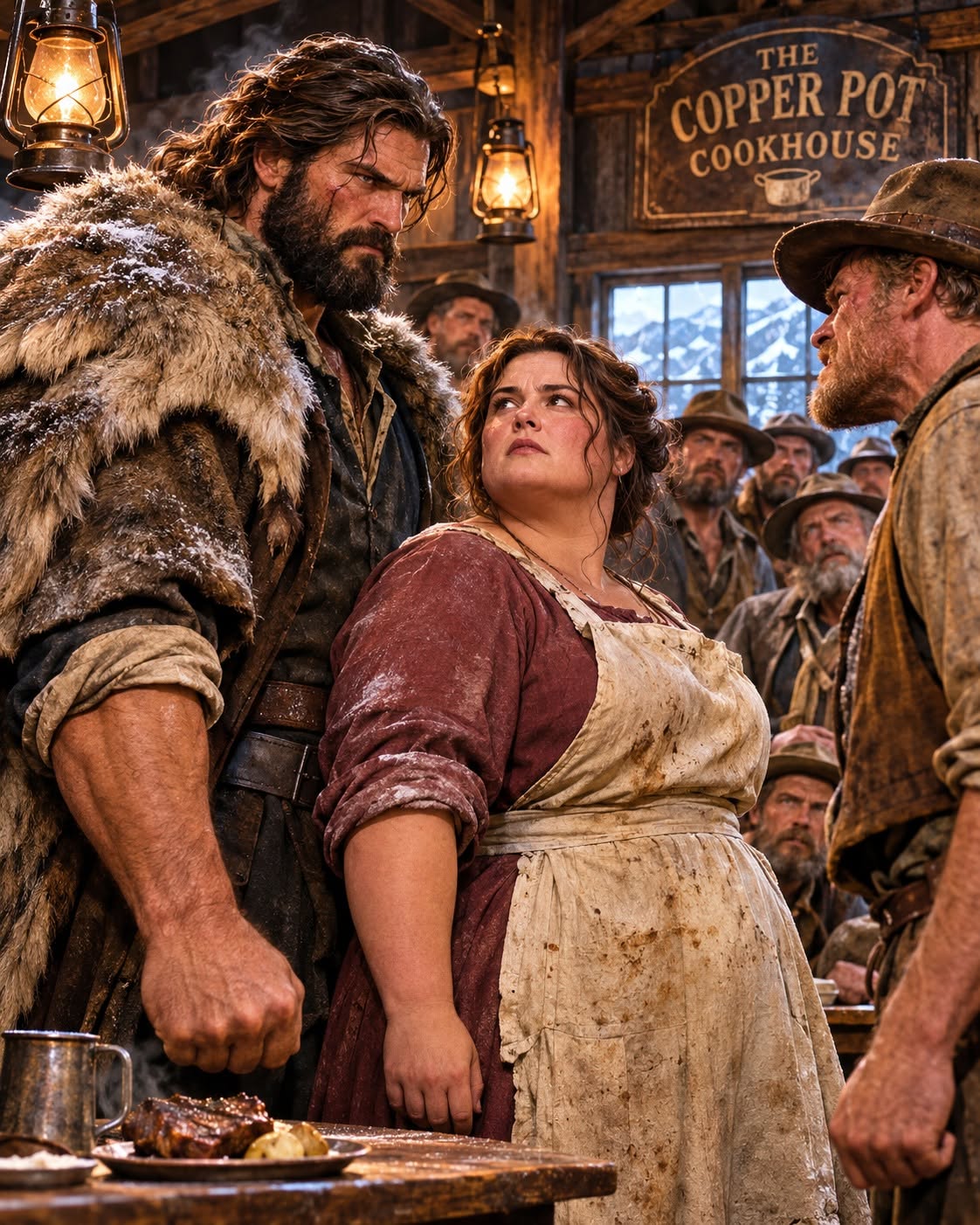
He rose slowly, unfolding his enormous frame until his head nearly reached the low ceiling beams. The wolf-hide coat slipped from one shoulder, revealing a broad chest beneath a worn flannel shirt.
Deke Harlan turned around.
“What are you staring at?”
Abel didn’t answer immediately.
He looked at Deke’s raised hand, then at me.
“Put it down,” he said.
His voice wasn’t loud.
It didn’t need to be.
Deke laughed nervously.
“This is between me and the cookhouse woman.”
Abel took one step forward.
“Then settle your bill and leave her alone.”
A few miners shifted in their seats. Nobody laughed this time.
Deke glanced around, hoping his friends would support him.
“Did you hear that? The mountain giant thinks he owns this place.”
Abel stopped beside my table.
“No,” he replied. “She owns it.”
Those four words struck me harder than Deke’s insults ever had.
For years, men had treated the Copper Pot as though it belonged to whoever shouted the loudest. Abel was the first person in a long time to remind them that I was the one who worked for it, paid for it, and kept its doors open.
Deke’s face reddened.
“Move aside.”
Abel didn’t move.
Deke shoved his shoulder.
It was like pushing against a stone wall.
Abel barely shifted.
 “I’m giving you one chance,” he said quietly. “Step away from her.”
Deke’s friends suddenly became fascinated with their drinks.
Then something unexpected happened.
An older miner named Walter Briggs stood from his chair.
“Deke, that’s enough.”
Deke spun around.
“Sit down, Walter.”
“No.”
Walter looked at me.
“I’ve eaten here every Thursday for eleven years. She’s never once refused to feed me when I was short on money. You owe her half a month’s wages, and you know it.”
Another miner stood.
Then another.
One of them placed several coins on the counter.
“For my unpaid coffee.”
A second followed.
Soon, a small collection of coins sat beside the register.
I stared at them, unable to speak.
Deke looked around the room and realized his audience was disappearing.
“You’ll regret this,” he muttered.
He pointed at Abel.
“And you, mountain man, won’t be in Red Dog forever.”
Abel’s expression remained unchanged.
“Neither will you.”
Deke stormed out with his friends.
The door slammed behind them.
For several seconds, nobody moved.
Then Walter cleared his throat.
“Loretta, that beef is getting cold.”
A few nervous laughs filled the room.
I wiped my hands on my apron.
“Then you’d better eat it before I charge you for reheating.”
The laughter this time felt different.
It wasn’t directed at me.
It was with me.
After closing, I found Abel sitting beside the stove.
He had finished his meal and was examining the elk meat he had brought.
“You didn’t have to do that,” I told him.
He looked up.
“Do what?”
“Stand up to Deke.”
Abel considered the question.
“Someone should have done it years ago.”
I looked down at my swollen knee.
“People around here don’t usually interfere.”
“That’s why men like him keep doing what they do.”
I poured him another cup of coffee.
“You can sleep in the storeroom tonight. There’s a clean blanket and a small cot.”
He nodded.
“Thank you.”
I hesitated.
“Why did you come to Red Dog, Mr. Ward?”
“Abel.”
“Why did you come, Abel?”
He looked toward the window.
“Looking for work.”
“What kind?”
“Carpentry. Fencing. Repairs. Whatever needs doing.”
I glanced at the elk meat.
“You certainly brought enough supper to pay for a few nights.”
“I brought enough to pay for what I needed.”
He spoke plainly, without trying to impress me.
That made me trust him a little more.
The following morning, I discovered that Abel had already repaired the loose back step.
He had also fixed the kitchen door, which had been sticking for months.
When I asked why, he shrugged.
“You nearly tripped over it last night.”
I stared at the repaired hinge.
“You noticed that?”
“I notice things.”
For the first time in a long while, I found myself smiling before breakfast.
But the peaceful morning didn’t last.
Around ten o’clock, Sheriff McBride arrived.
He was a narrow-faced man with a carefully trimmed mustache and a habit of looking at people as though they were already guilty.
He entered the Copper Pot and glanced at Abel.
“Ward. I heard you caused trouble last night.”
Abel continued repairing a wooden stool.
“Didn’t know defending a woman was against the law.”
The sheriff ignored him.
“Deke Harlan has filed a complaint. Says you threatened him and ᴀssaulted him.”
I nearly dropped the coffee pot.
“That’s a lie!”
McBride looked at me.
“Then perhaps you can explain why half the town says you were involved in a disturbance.”
“Because Deke tried to strike me.”
The sheriff sighed.
“Women and their stories.”
Abel slowly put down his tools.
“Careful, Sheriff.”
McBride’s hand moved toward his belt.
“Are you threatening an officer?”
“No. I’m reminding you that witnesses saw what happened.”
The sheriff looked around the empty cookhouse.
“Witnesses can forget things.”
Then he turned toward me.
“I’m also here about your property taxes, Mrs. Hayes. You’ve missed two payments. The county has begun proceedings to seize this building.”
My stomach тιԍнтened.
I knew about the taxes.
I’d been trying to gather the money, but the slow season and unpaid accounts had made it impossible.
“Give me until spring,” I pleaded. “I’ll pay every cent.”
McBride shook his head.
“That’s not my decision.”
He placed a folded notice on the counter.
“You have ten days.”
Then he left.
I stared at the paper.
The Copper Pot wasn’t just a business.
It was the last thing my late husband and I had built together.
Abel picked up the notice and read it.
“Who owns the mortgage?”
“The bank in Silver Creek.”
“Who holds the tax claim?”
“The county.”
He studied the document.
“Something doesn’t look right.”
“What do you mean?”
He pointed to a handwritten notation at the bottom.
“Why is Deke Harlan’s name on a county property notice?”
My blood turned cold.
I looked closer.
There it was.
Deke’s signature.
And beside it, a line that read:
Interested purchaser.
Abel folded the paper.
“Loretta, I don’t think this is just about your unpaid bill.”
I swallowed.
“Then what is it about?”
He looked toward the front window, where two riders had stopped across the street.
“Someone wants this building badly enough to make sure you lose it.”
That evening, Abel asked permission to examine the old property records I kept beneath the counter.
I brought him a wooden box containing receipts, mortgage papers, and the original deed.
He studied the documents for nearly an hour.
Finally, he found something.
“Your husband bought this property outright before you married?”
“Yes.”
“Did he leave it to you?”
“He did. I have the papers.”
Abel examined the deed again.
“Then why does the county notice claim you have a mortgage balance?”
I leaned over his shoulder.
A strange entry appeared in the records.
A loan had supposedly been taken against the Copper Pot six months earlier.
But the signature wasn’t mine.
It wasn’t my husband’s either.
Someone had forged it.
Abel’s jaw тιԍнтened.
“Deke isn’t acting alone.”
Before I could answer, a small stone crashed through the front window.
A piece of paper was tied around it.
I picked it up.
Five words had been written in black ink.
LEAVE RED DOG BY SUNDAY.
Abel looked at the broken glᴀss.
Then he looked at me.
“Now we know.”
I folded the note and placed it beside the forged document.
“No,” I said quietly. “Now they know I’m not leaving.”
Abel studied me for a moment.
Then he nodded.
“Good.”
But as he returned to the storeroom, I noticed something strange.
He had turned pale.
He was staring at the forged signature.
And when I asked what was wrong, he answered with a sentence that changed everything.
“I’ve seen that handwriting before.”
“Whose?”
Abel looked toward the dark window.
“The man who sent me here.”