PART 2 — THE MAN WHO WOULD NOT LOOK AWAY
PART 2 — THE MAN WHO WOULD NOT LOOK AWAY
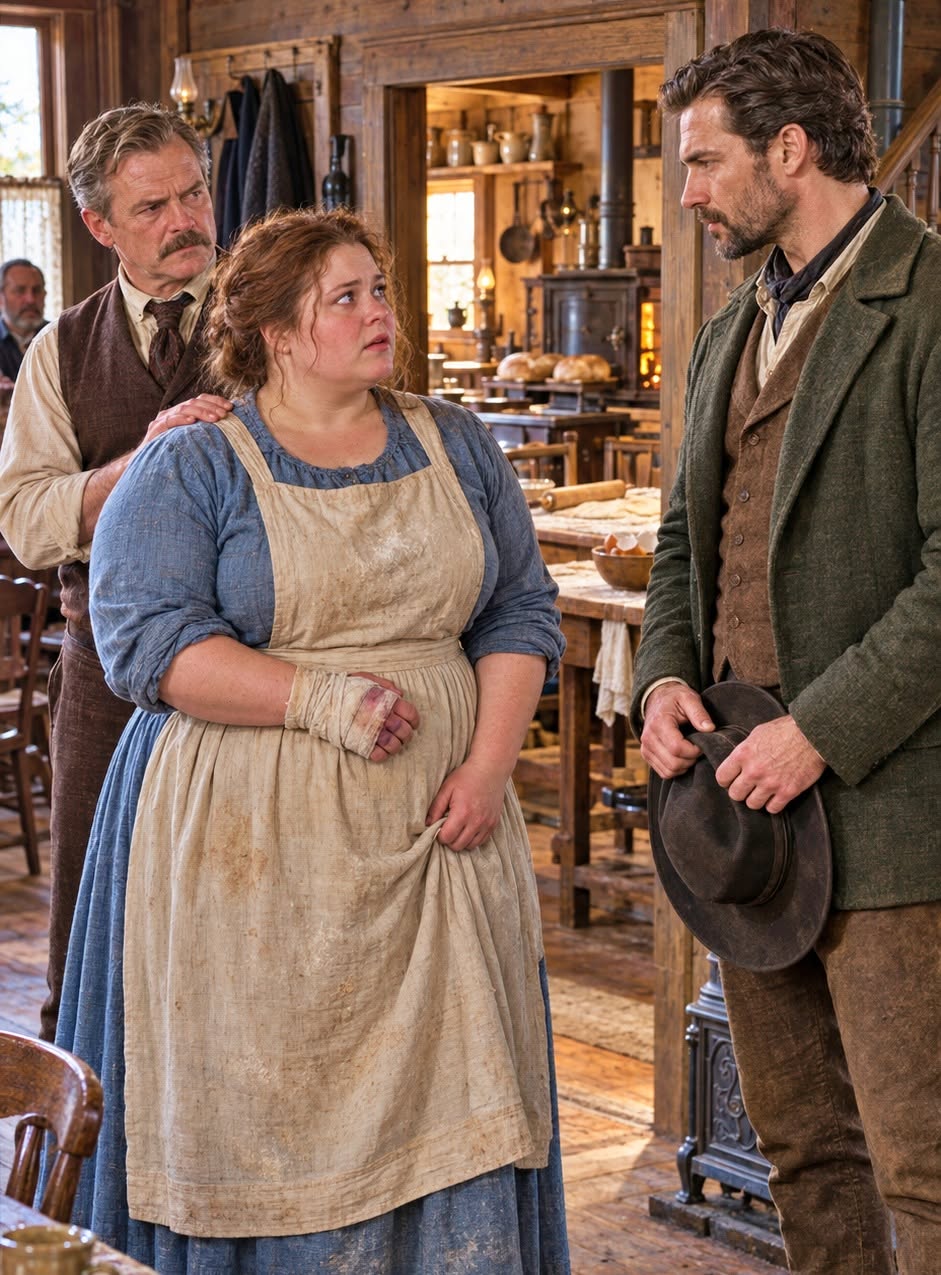
Laurel glanced at the strip of flour sack around her hand.
“Bad enough that I can’t close it properly,” she said. “Not bad enough to stop me working.”
Gareth Sinclair’s expression remained steady, but something in his eyes hardened.
“That wasn’t what I asked.”
She had expected pity. She had expected outrage, perhaps, or a lecture about why she should have left the boarding house long ago.
Instead, he waited.
Laurel drew a breath. “Raymond shut the cellar door on my hand. I’d corrected his accounts in front of a boarder. He didn’t like being made to look foolish.”
“How long ago?”
“Eight days.”
“And you’ve been cooking since?”
“People need to eat.”
Gareth looked toward the kitchen. The scent of warm pastry drifted through the doorway.
“Do you want to leave this house?”
The question struck harder than any accusation.
Laurel had imagined leaving in the quiet hours of night. She had pictured walking until the road disappeared beneath her feet. But every imagined escape ended with Raymond finding her, or with no money, no work, and nowhere to go.
“I don’t know,” she admitted.
“That’s an honest answer.”
He set his hat on a nearby table. “I’m offering you a position at Copper Ridge. Cook and keeper of the kitchen. Your wages will be your own. Your room will be your own. Nobody will touch you or your belongings without permission.”
Raymond’s voice sounded from the hallway. “That’s generous of you, Sinclair. But Laurel’s already employed.”
Gareth did not turn.
“I’m speaking with Laurel.”
Raymond stepped into the room, his smile thin and brittle. “She’s my stepdaughter. She owes me.”
Laurel felt the old stillness begin to settle over her.
 Gareth noticed.
“Miss Eaves,” he said, “do you owe this man anything?”
Raymond’s smile vanished. “Don’t be ridiculous. I raised her.”
“You housed me,” Laurel said softly.
The words surprised her. They surprised Raymond, too.
“You fed me,” she continued, her voice trembling but clear. “You gave me a roof. I worked for it. I kept your books. I cooked for your boarders. I cleaned your rooms. I have not been idle a single day.”
Raymond took a step toward her.
Gareth moved—not aggressively, not with a raised fist. He simply placed himself between them.
“Don’t,” he said.
One quiet word.
Raymond stopped.
“You think you can walk into my house and take what belongs to me?” Raymond hissed.
Gareth’s gaze did not waver. “Laurel doesn’t belong to you.”
The room fell silent.
For a moment, Laurel could hear nothing but the ticking of the mantel clock. Then Raymond laughed, a sharp and unpleasant sound.
“You’ll regret this,” he said to her. “You’ll come crawling back.”
Laurel looked at the floor. The fear was still there. It had not vanished simply because someone had spoken on her behalf.
But for the first time, she was not standing alone inside it.
“I’ll come for my mother’s recipe book,” she said.
Raymond’s face changed.
It was only a flicker—but Gareth saw it.
“What recipe book?” Gareth asked.
“My mother’s,” Laurel replied. “She kept it in the kitchen drawer. It has her handwriting, her notes, all the things she taught me.”
Raymond folded his arms. “That book belongs to this house.”
“No,” Laurel said. “It belonged to my mother.”
Gareth turned slightly toward Raymond. “Then you’ll return it.”
“You have no authority here.”
“Not yet,” Gareth said.
There was something in that answer that made Raymond’s confidence falter.
Gareth picked up his hat. “Miss Eaves, I’ll be staying at the H๏τel in town tonight. If you decide to come to Copper Ridge, the stage leaves at nine tomorrow morning. I’ll meet you there.”
He did not tell her she had to go.
He did not ask her to trust him.
He left the choice in her hands.
And that, more than anything, frightened Laurel.
Because she had spent years learning how to survive without choices.
That evening, Laurel prepared supper with her left hand.
The boarders noticed the difference. Mr. Holloway, the schoolteacher, watched her struggle to lift a pot and rose to help.
“Please,” Laurel said, “I can manage.”
He stopped at once.
“Of course,” he replied. “Just tell me if you need anything.”
It was such a small kindness that her eyes stung.
After supper, Raymond summoned her to his office.
The recipe book lay on his desk.
Laurel’s heart lurched.
“Take it,” he said. “And stop making trouble.”
She reached for it.
Raymond pulled it away.
“You think Sinclair’s going to save you? Men like him don’t hire women out of charity. He’s got a reason.”
Laurel swallowed. “He offered me a job.”
“He offered you a story.” Raymond leaned back. “You’ll be back in a week. And when you are, you’ll remember who gave you a roof.”
He tossed the book toward her.
Laurel caught it against her chest with her left arm.
She did not answer. She walked upstairs, packed her few belongings, and wrapped the recipe book in her mother’s old shawl.
Then she sat beside the window and watched the road.
At dawn, she was still afraid.
But she went.
The stagecoach ride to Copper Ridge took nearly four hours. The land opened into wide grᴀsslands, dark pines, and hills that seemed to roll into the horizon.
Gareth rode beside the coach for the final mile.
When Laurel stepped down at the ranch, she found a sprawling house, a long barn, and a group of cowboys gathered near the corral.
They looked at her.
Some were curious. One was openly doubtful.
Gareth introduced her without ceremony.
“This is Miss Laurel Eaves. She’ll be running the kitchen.”
A broad-shouldered cowboy named Harlan tipped his hat. “We’ve been living on beans and hard biscuits since Mrs. Finch left.”
“Then you’ll be pleased to know I can make bread,” Laurel said.
A few men laughed—not cruelly, but with the sort of surprise that made her uncertain.
Gareth turned to her. “Your room is upstairs. The kitchen is yours. The pantry key is here.”
He placed a small brᴀss key in her uninjured hand.
Laurel stared at it.
No one had ever given her a key and meant it as a gift.
“Thank you,” she whispered.
Gareth nodded. “You don’t have to thank me for what you’ve earned.”
That afternoon, Laurel made her first loaf at Copper Ridge.
She worked slowly, careful with her injured hand. When the dough had risen, she shaped it with the practiced patience her mother had taught her.
The smell of fresh bread filled the kitchen.
One by one, the cowboys drifted toward the doorway.
Harlan sniffed the air. “That’s the smell of a proper supper.”
Laurel smiled despite herself.
Then the kitchen door swung open.
A stranger stood there, dust-covered and breathing hard.
He looked straight at Laurel.
“Miss Eaves?” he asked.
“Yes?”
He held out a folded letter.
“Your stepfather sent this after you. Says you’ll want to read it before you start working here.”
Laurel’s smile disappeared.
The letter bore Raymond’s familiar handwriting.
And beneath it, in a different hand, was a name she had not seen in years:
Colette Eaves.
Her mother’s name.