PART 4 — THE DAY THE WAGONS BEGAN LINING UP OUTSIDE HER GATE
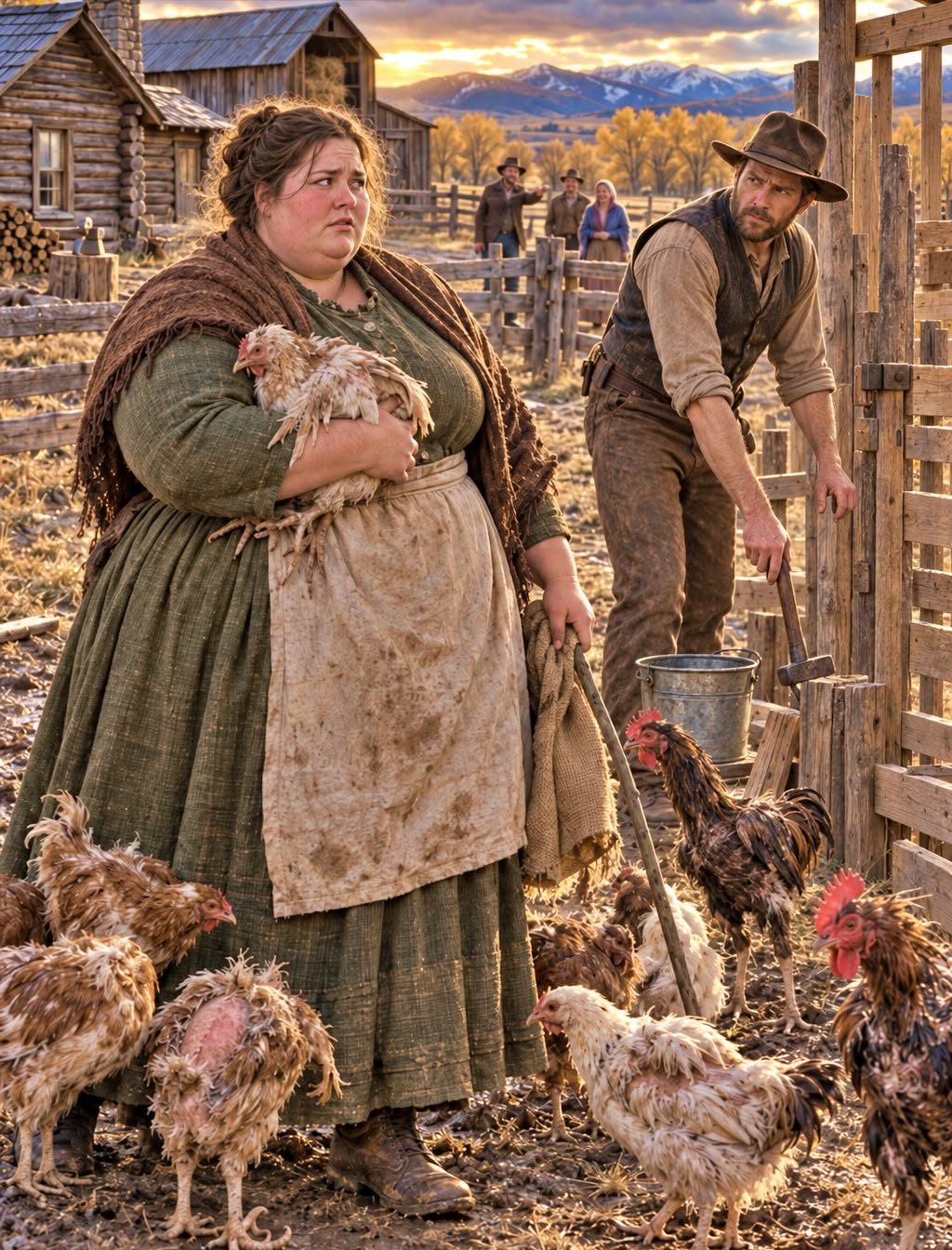
PART 4 — THE DAY THE WAGONS BEGAN LINING UP OUTSIDE HER GATE
The agricultural exhibition was scheduled for the second Saturday in May.
Abigail had never attended one.
She had never imagined that eleven unwanted chickens would eventually earn her an invitation to stand among Wyoming’s most respected farmers.
But she wasn’t going to let Silas Whitcomb frighten her away.
For three weeks, she prepared.
She selected six healthy birds from the original flock and several of their offspring. She cleaned their feathers, checked their feet and made sure they were accustomed to traveling in wooden crates.
Thomas built a special transport wagon.
Abigail packed her notebooks, egg samples and feeding records.
And then, two nights before the exhibition, disaster struck.
She woke to the sound of chickens screaming.
Thomas was already outside.
“Abigail! Get dressed!”
She hurried into her coat and ran toward the barn.
The door stood open.
Several nesting boxes had been overturned.
Feed was scattered across the floor.
And the breeding records she had kept in a wooden cabinet were missing.
For a moment, Abigail couldn’t move.
Those notebooks represented months of careful work.
Every observation.
Every measurement.
Every record of which birds had recovered and which offspring had inherited their strongest qualities.
Thomas examined the broken latch.
“Someone came inside.”
Abigail looked toward the back of the barn.
There were footprints in the mud.
Two different sets.
One belonged to a man wearing large boots.
The other appeared to come from someone with a narrow heel.
Thomas followed the tracks toward the fence.
Then he stopped.
A piece of blue cloth was caught on a splintered board.
He recognized it immediately.
“Whitcomb.”
Abigail took the cloth.
She didn’t cry.
She didn’t shout.
Instead, she walked back into the barn and began gathering the scattered papers that remained.
Thomas watched her.
“Abigail, we should report this.”
 “We will.”
“But first?”
“First, we’re going to see what they missed.”
She went to the kitchen and returned carrying a small tin box.
Inside were copies of her most important records.
Thomas stared.
“You made duplicates?”
“Of course.”
“When?”
“After Whitcomb’s second visit.”
For the first time that morning, Thomas smiled.
“Remind me never to underestimate you.”
Abigail looked toward the damaged barn.
“That’s exactly what everyone else has been doing.”
They reported the break-in to the local authorities.
But the investigation moved slowly.
Whitcomb denied everything.
He claimed he had been in Cheyenne on the night of the incident.
There was no immediate proof connecting him to the theft.
Abigail knew she needed more than accusations.
She needed the exhibition.
On Saturday morning, the Turners loaded their birds and headed into town.
Milhaven had never seen Abigail so determined.
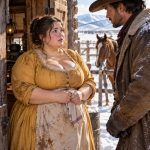
Her broad shoulders were wrapped in a clean brown coat, and her hair was pinned neatly beneath a hat.
She carried her notebook against her chest.
Several people watched her wagon pᴀss.
Some smiled.
Others whispered.
Delbert Marsh stood outside the general store.
“Going to show those circus chickens to the judges?”
Abigail stopped her wagon.
“That’s the plan.”
Delbert shook his head.
“Well, good luck.”
There was no laughter in his voice this time.
The exhibition grounds were crowded.
Farmers had brought horses, cattle, sheep and poultry from settlements across the territory.
Abigail found her ᴀssigned space and carefully arranged the cages.
At first, nobody paid much attention.
Her birds were ordinary-looking.
No spectacular plumage.
No unusual size.
No expensive imported breeds.
But when the judges began examining the poultry, something unexpected happened.
One of them stopped beside Abigail’s table.
“These birds came from a damaged flock?”
“Yes, sir.”
“How many did you originally purchase?”
“Eleven.”
“For how much?”
“Twelve cents.”
The judge raised his eyebrows.
“That’s an interesting beginning.”
He examined the birds more closely.
Then he opened her notebook.
For nearly twenty minutes, he studied her records.
He called another judge.
Then a third.
They began discussing the feeding history, the recovery of the original hens and the performance of their offspring.
Abigail stood quietly.
Finally, the oldest judge looked up.
“Mrs. Turner, who taught you to keep these records?”
“I learned poultry management while working in Missouri. My husband helped me build the facilities, but the records are mine.”
He nodded.
“You’ve done something many experienced farmers fail to do.”
“What’s that?”
“You’ve distinguished between a bird that is genuinely unproductive and one that has simply been poorly managed.”
He closed the notebook.
“That is worth studying.”
The judges moved to the next exhibit.
Abigail didn’t know what to expect.
Then, shortly before noon, the announcement came.
Her flock had received special recognition for its documented recovery and breeding potential.
She had not won the grand prize.
But the judges wanted her to present her methods at the next agricultural gathering.
And they had something else to tell her.
A poultry merchant from Cheyenne had requested permission to purchase breeding stock.
Not just eggs.
Not just ordinary chickens.
He wanted to establish a larger breeding program using Abigail’s selected birds.
Thomas stared at her.
“Do you understand what this means?”
Abigail nodded slowly.
“It means we might be able to build something.”
That evening, they returned home with a certificate, several orders and more money than they had earned during the previous month.
But the real surprise was waiting at their gate.
Three wagons stood outside.
A woman from a neighboring settlement wanted twenty eggs.
A farmer wanted ten chicks.
And a boardinghouse owner wanted a regular weekly supply.
Abigail stepped down from the wagon.
“Can I help you?”
The boardinghouse owner smiled.
“Mrs. Turner, I’ve heard about your eggs. I’d like to place an order.”
Thomas looked toward the road.
Another wagon was approaching.
Then another.
Within two weeks, the little homestead became a regular destination.
People arrived from settlements miles away.
Some wanted eggs.
Others wanted young birds.
Several farmers wanted to learn how Abigail had managed to restore the original flock.
She began selling healthy breeding stock, sharing her husbandry records with interested buyers and taking orders for future hatchings.
Her operation grew carefully.
She refused to sell more birds than she could responsibly raise.
She also insisted that buyers understand the importance of proper shelter, clean water and suitable feed.
The same people who had laughed at her twelve-cent purchase were now waiting outside her gate.
And Abigail never forgot how that felt.
One afternoon, Delbert Marsh arrived carrying his hat.
“Mrs. Turner.”
She looked up from her ledger.
“Delbert.”
“I’ve got a proposition.”
“What kind?”
He shifted his weight.
“I’d like to buy fifty chicks. And I’d like to know if you’d consider letting me raise some of your breeding stock.”
Abigail studied him.
“Why?”
“Because you’re doing something right.”
She closed the ledger.
“I’ll sell you chicks, provided you agree to the same care requirements as everyone else.”
“Fair enough.”
He hesitated.
“Abigail, I also wanted to say something.”
She waited.
“I was wrong about you.”
He looked uncomfortable admitting it.
“I thought you were wasting your money. I thought those birds were worthless.”
Abigail glanced toward the barn.
“They were worth more than twelve cents.”
Delbert nodded.
“I see that now.”
But just as he was preparing to leave, a second horseman rode into the yard.
It was the local deputy.
He carried an official-looking envelope.
“Mrs. Turner?”
“Yes?”
“I’ve been asked to deliver this notice.”
She opened it.
Her face changed.
The county agricultural office had received a formal complaint questioning the ownership of the original eleven chickens.
According to the complaint, the birds had supposedly belonged to another breeder and had been removed without proper authorization.
If the claim was upheld, Abigail could lose her breeding stock and be forced to surrender the profits from its sale.
Thomas stepped forward.
“That’s nonsense. We bought those birds from Harkin.”
The deputy nodded.
“Then you’ll need to prove it.”
Abigail looked at the notice again.
At the bottom was a familiar signature.
Silas Whitcomb.
But there was something even more disturbing.
Attached to the complaint was a sworn statement from the original seller.
Old Harkin.
The very man who had accepted her twelve cents and laughed as she walked away with eleven unwanted chickens.
Abigail slowly folded the paper.
Thomas looked at her.
“Do you think Harkin has changed his story?”
She nodded.
“Someone has convinced him to.”
Then she looked toward the barn, where the descendants of those eleven chickens were scratching peacefully in the straw.
For months, she had believed the hardest part of her journey would be proving that the birds had value.
Now she faced a much bigger battle.
Someone wanted to take everything she had built.
And this time, they weren’t coming to her gate with an offer.
They were coming with the law.
But Abigail had kept one thing that nobody knew about.
A tiny receipt.
Written in Harkin’s own handwriting.
And on its reverse was a sentence that could destroy Silas Whitcomb’s entire case.
TO BE CONTINUED IN PART 5…