PART 2 — THE MOTHER WHO REFUSED TO OWE HIM ANYTHING
PART 2 — THE MOTHER WHO REFUSED TO OWE HIM ANYTHING
Elias Hart looked at Clara Whitcomb for a long moment.
“Doctor if one of the children gets sick?” she repeated.
“I’ll pay the doctor.”
“And if Luke gets hurt working for you?”
“I’ll cover the expense.”
“What if you decide you no longer need us?”
“I’ll give you notice and pay every dollar we’ve earned.”
Clara studied him.
“And if you decide you want something else in return?”
The question landed between them like a stone.
Elias slowly removed his hat.
“Mrs. Whitcomb, I am offering you employment, not purchasing your family.”
Clara’s expression didn’t change.
“Men have used different words for the same thing before.”
Luke looked down at his boots.
Owen suddenly became very interested in a loose piece of fence wire.
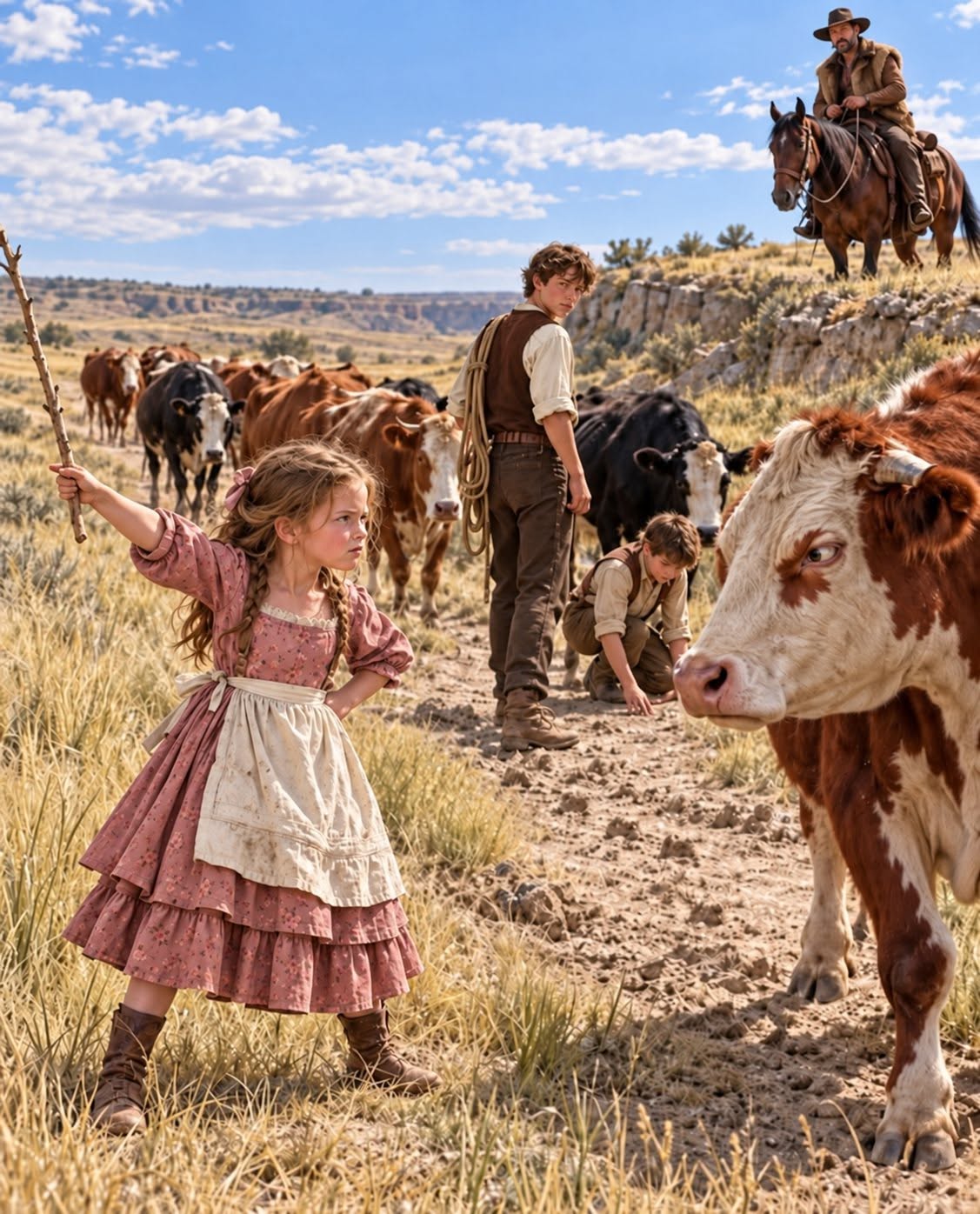
Sadie stopped swinging her willow branch.
Elias understood then that this wasn’t simply a woman being difficult.
She had learned to question every kindness because somewhere along the way, kindness had come with a price.
“I won’t ask you to trust me today,” he finally said. “Come inspect the cottage. Ask whatever you need. If you don’t like what you see, you walk away. No hard feelings.”
Clara said nothing.
Then Sadie tugged her mother’s apron.
“Can we at least see if the cottage has a stove?”
Clara looked down.
“Sadie.”
“What? I’m only asking about the stove.”
Elias almost laughed.
“It’s got a stove.”
“Does it work?”
“Better than some of my ranch hands.”
Sadie considered this.
“Then I think we should look.”
The north cottage stood beneath three old cottonwood trees.
It wasn’t grand.
The white paint had peeled from the window frames, and one shutter hung slightly crooked. But the roof was solid, the chimney clean, and the front steps had recently been repaired.
 Inside were two downstairs rooms, a small kitchen, and a loft with enough space for three narrow beds.
A cast-iron stove stood against the far wall.
There was a table, four chairs, a cupboard, and a stack of freshly cut firewood beside the back door.
Clara walked through every room.
She checked the windows.
Opened the cupboards.
Tested the water pump.
Then she climbed the stairs to inspect the loft.
Elias waited outside with the children.
Luke stood beside the doorway.
“Sir?”
“Yes?”
“Would you really pay me every Saturday?”
“Every Saturday.”
“Even if the cattle don’t need much work?”
“You’ll have other jobs.”
Luke nodded.
“I’m good with fences.”
“I noticed.”
“And I can ride.”
“I noticed that too.”
The boy hesitated.
“Would I be allowed to go to school sometimes?”
Elias looked at him.
“How old are you?”
“Fifteen.”
“You ought to be in school.”
Luke glanced toward the cottage.
“Somebody has to help Mama.”
Elias didn’t answer immediately.
Then he said, “We’ll arrange the work around school whenever we can.”
Luke looked genuinely surprised.
Inside, Clara had found something unexpected.
A small shelf beside the kitchen window held several books.
An old geography book.
A worn dictionary.
A collection of children’s stories.
She touched the spines.
“Who lived here before?”
“My sister,” Elias answered from the doorway. “She moved east after she married.”
Clara looked at the books again.
“Why did you leave them?”
“Never thought much about it.”
She nodded slowly.
Then she turned toward him.
“It’s a good cottage.”
Elias waited.
“But I want the agreement written down.”
“Of course.”
“And I want Luke’s wages paid directly to him, not deducted for anything we use.”
“Agreed.”
“And nobody comes into our home without knocking.”
“Agreed.”
Clara looked almost uncomfortable with how easily he accepted.
“One more thing.”
“Go ahead.”
“My children aren’t to be treated like they owe you their lives.”
Elias put his hat back on.
“Mrs. Whitcomb, I have seven hundred cattle, three broken wagons, and a barn roof that leaks whenever the wind blows east. I need workers. I don’t need anyone worshipping me.”
For the first time, Clara smiled.
It was brief.
But Elias noticed.
They moved into the cottage two days later.
Luke started work the following morning.
Owen was given a notebook and pencil because Elias discovered the boy could recognize cattle tracks, weather changes, and bird movements with astonishing accuracy.
Sadie became fascinated by the ranch’s chickens.
Within a week, she had named all seventeen hens.
Within two weeks, she had also named the rooster.
Elias regretted allowing this.
The rooster was now called General Sherman, and Sadie insisted he had a military personality.
Clara found work in the ranch kitchen.
She could stretch flour, preserve vegetables, and prepare meals that made even the oldest ranch hands ask for seconds.
She also repaired torn shirts and organized the pantry.
Elias paid her separately for every task.
He never once suggested that her work was part of some unspoken obligation.
Slowly, the cottage began to feel lived in.
A small curtain appeared in the kitchen window.
Flowers grew in a wooden box beneath the porch.
The children laughed more often.
And Elias found himself riding past the north cottage more frequently than necessary.
He told himself he was checking the fencing.
Nobody believed him.
Not even his oldest ranch hand, Walter Briggs.
One evening, Walter caught him staring toward the cottage.
“You planning to inspect that fence again, boss?”
Elias looked away.
“It’s a troublesome fence.”
“Been troublesome for three weeks.”
“Could use replacing.”
Walter nodded solemnly.
“Certainly. Might take another month if you keep staring at it instead of fixing it.”
Elias gave him a warning look.
Walter grinned and walked away.
But the first real trouble arrived on a Thursday.
Elias returned from town carrying a sack of flour and a newspaper.
He found Clara standing outside the cottage with an unfamiliar man.
The stranger wore a dark waistcoat and carried a leather briefcase.
His horse was tied to the fence.
Clara’s face was pale.
Luke stood behind her, fists clenched.
Owen held Sadie’s hand.
Elias dismounted.
“Everything all right?”
The stranger turned.
“Mr. Hart, I presume.”
“That’s right.”
“My name is Charles Whitcomb. I’m Clara’s brother-in-law.”
Clara closed her eyes briefly.
Elias understood immediately.
This was family trouble.
And family trouble rarely came alone.
Charles adjusted his waistcoat.
“I’ve come to take my late brother’s children back to Missouri.”
Luke stepped forward.
“We’re not going.”
Charles ignored him.
“Children don’t make legal decisions.”
Elias glanced at Clara.
“Is that what you want?”
“No.”
Her answer came without hesitation.
Charles laughed.
“You don’t have the means to raise them, Clara. You’ve barely managed to keep them fed.”
Clara’s face тιԍнтened.
“I have managed.”
“By moving into a stranger’s cottage?”
Elias stepped forward.
“Careful.”
Charles looked him over.
“I’m not discussing this with you.”
“You’re standing on my property, speaking to a woman under my roof. That makes it my concern.”
Charles opened his briefcase.
“I have papers from the county court. The children are to be placed under my guardianship.”
Clara reached for the document.
Her hands trembled as she read it.
Then she looked up.
“This isn’t a court order.”
Charles’s expression changed.
“What?”
“It says you’ve filed a peтιтion. It doesn’t say the judge has approved it.”
Elias took the paper.
He read it carefully.
Clara was right.
Charles had made the document look far more authoritative than it actually was.
“Your peтιтion will be reviewed,” Elias said. “Until then, the children stay with their mother.”
Charles’s face reddened.
“You think your money makes you untouchable?”
“No. I think your paperwork makes you impatient.”
The stranger snatched the document back.
“This isn’t over.”
He mounted his horse.
Before riding away, he turned toward Clara.
“You should have accepted my offer when you had the chance.”
Clara went completely still.
“What offer?” Elias asked.
But Charles was already riding away.
That night, Elias found Clara sitting alone on the cottage porch.
The children had gone to bed.
A lamp burned beside her.
“May I sit?”
She nodded.
Elias took the chair beside her.
For several minutes, neither spoke.
Then he asked quietly:
“What offer was he talking about?”
Clara stared at the dark pasture.
“Charles wanted me to sign the children over to him after my husband died.”
“Why?”
“He said he could provide a proper home. Better education. Better opportunities.”
“And you refused.”
“I refused because he didn’t want to raise them.”
Elias waited.
“He wanted the land.”
Elias turned toward her.
“What land?”
Clara swallowed.
“My husband inherited a small piece of property from his father. It isn’t worth much to most people, but there’s a spring running through it.”
Elias frowned.
“A spring?”
She nodded.
“Charles believes there’s more water beneath that land than anyone realizes. He’s been trying to obtain it for years.”
Elias looked toward the western hills.
The drought had made every reliable water source valuable.
“Why didn’t your husband sell?”
“Because he knew what Charles intended to do.”
Clara reached into the pocket of her apron.
She pulled out a small folded letter.
“My husband wrote this shortly before he died.”
Elias accepted it.
The handwriting was uneven, but the message was clear.
If Charles ever comes asking for the children, don’t let him take them. The land belongs to them. The deed is hidden where he will never think to look.
Elias read the final sentence twice.
Then he looked at Clara.
“Do you know where your husband hid it?”
She shook her head.
“No.”
A gust of wind moved through the cottonwoods.
From inside the cottage, Sadie called sleepily.
“Mama?”
Clara immediately stood.
“I’m here, sweetheart.”
But before she could reach the door, Elias noticed something on the porch floor.
A small piece of paper had slipped from the letter.
He picked it up.
There were three words written on it.
ASK THE BOY.
Elias looked toward the bedroom window.
Owen.
The quiet child who watched the ground.
The child who noticed everything.
And suddenly, Elias wondered whether the boy had already discovered something the adults had missed.
END OF PART 2.